Integrating Suppliers: Moving Impact from Lean Programs to the Next Level
June 14, 2013 Leave a comment
Integrating Suppliers: Moving Impact from Lean Programs to the Next Level
by Thomas Frost, Holger Gottstein, Christian Greiser, and Robert Tevelson
JUNE 04, 2013
Overview
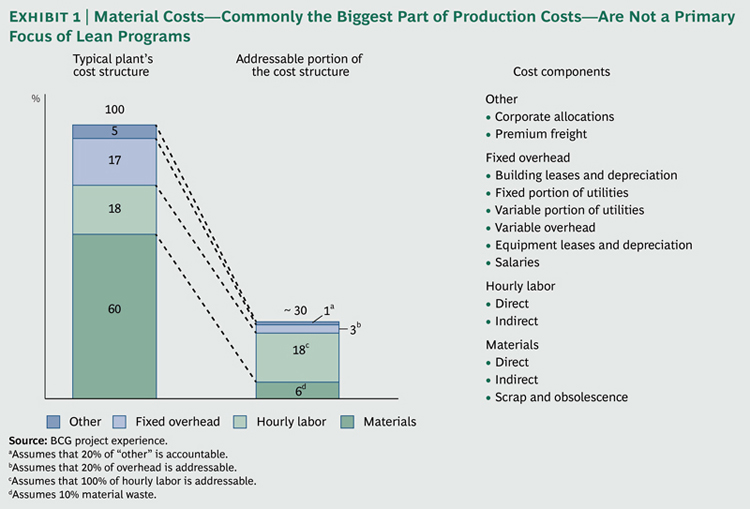

Many manufacturers that have applied lean concepts to their operations find that although they do achieve significant savings, their production costs remain high. This is, in most cases, attributable to material costs, which, depending on industry can range from 60 to 80 percent of total production costs. (See Exhibit 1.)
The challenge for these manufacturers is to discover how to extend lean concepts and practices beyond the walls of their own factories. The most effective way is to forge links with key suppliers on the basis of lean principles. In addition to yielding cost savings, this kind of collaboration can form the foundation of a profitable strategic partnership. More than simply an approach to eliminating waste in procurement, creating such relationships means leveraging existing lean techniques to the fullest and using them to transform a manufacturer’s entire supply chain.The overriding goal is to create a spirit of partnership by identifying the potential for mutual improvement on a fair and collaborative basis. Although many manufacturers approach their suppliers seeking ways to reduce material costs, typical efforts produce only short-term savings. Few form the basis for sustained, close collaboration. Building trust comes first. If this is done effectively, savings and other benefits will follow. Because those benefits extend beyond immediate savings, it can be advantageous to form a lean-based partnership even with suppliers in low-cost countries.
The best results have been achieved using a three-step integration process, which begins with optimizing the way information and materials flow between supplier and manufacturer. It extends to the way the supplier produces and can lead to collaborative product design and redesign. Ultimately, the process involves the full integration of a key supplier into a lean culture of continuous improvement. The main focus should be on enhancing supplier innovation and responsiveness—along with cost reduction over entire product life cycles—rather than on quick savings. Supplier integration has been achieved successfully by major consumer-product manufacturers, especially in the automobile industry. Toyota is one of the notable examples. (See Getting to Win-Win: How Toyota Creates and Sustains Best-Practice Supplier Relationships,(https://www.bcgperspectives.com/content/articles/automotive_metals_mining_getting_to_win_win_how_toyota_creates_and_sustains_best_practice_supplier_relationships/)BCG Focus, September 2007.) Before beginning the process, a manufacturer should analyze its own level of lean development and ambitions for the future. (See “The Three Leagues of Lean.”)
The Three Leagues of Lean
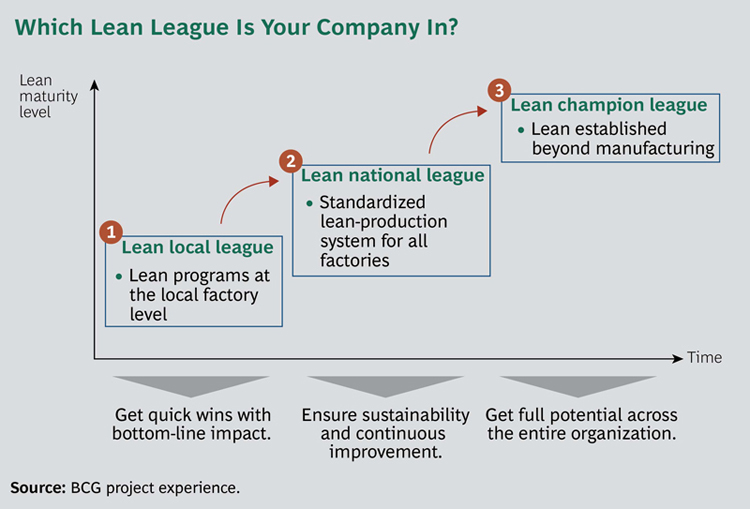
As in football, companies at different stages of lean development play in different leagues. Companies need to be honest with themselves about their current league status and which league they want to be in. (See the exhibit below.)
Lean Local League. This is the initial level of lean development. Companies in the local league have established lean programs in some but not all of their factories. Losses are identified in four areas (equipment, labor, quality, and materials), and lean tools (flow and availability, quality, organization, and cultural-transformation tools) are used to eliminate those losses. Local-league companies use lean techniques to get quick wins with bottom-line impact.
Lean National League. Companies in this league—one step up—have a standardized lean-production system for all factories; and common tools, principles, processes, and metrics are applied consistently across the manufacturing organization. National-league companies’ dynamic approach to governance systematically renews itself on a regular basis so that continuous improvement is woven into the fabric of the lean program.
Lean Champion League. At the top level, companies get the full benefit of lean. Such companies have extended lean concepts and practices beyond manufacturing to all aspects of the organization. They have built a culture of continuous improvement into their engineering, R&D, and administration. Champion-league companies are ready to extend lean techniques to their suppliers.
Things to Consider First
Integrating suppliers into a lean production system begins with conceptualizing the desired future relationship and its benefits.
Vision. A vision of the ideal relationship should include an emphasis on the supplier’s willingness to serve the manufacturer’s needs in all dimensions, a commitment by both partners to a strong long-term relationship, a spirit of mutual trust and collaboration, and an ongoing goal of continuous joint improvement. Realizing that vision means seeing supplier integration in terms of four components: shared resources (mainly people), joint processes (production, logistics planning, and design engineering), common standards (key performance indicators, quality, and delivery), and close collaboration (trust, reliability, and shared benefits).
Integration with a supplier can yield substantial quantitative benefits, including lead-time and inventory reduction of 30 to 50 percent, scrap and rework reduction of 20 to 30 percent, and Six Sigma quality (10 to 20 parts per million). Addressable supplier production costs can be cut by 3 to 6 percent in the first year and by as much as 15 percent once the relationship has fully matured.
Supplier Selection. Picking only key partners is crucial. A lean manufacturer may want to create a portfolio of suppliers at different stages of integration, but each candidate needs to be selected carefully. Determining which suppliers should be integrated into a lean production system involves a mix of hard and soft criteria, which vary depending on the industry. In general, manufacturers should consider only those suppliers with which they have established good relationships that involve large sales volumes or important products.
When they first approach a supplier about beginning the process of integration, manufacturers should be clear about their aspirations for the relationship—namely that it be a long-term commitment, perhaps leading to a strategic alliance. Manufacturers should also be specific about each of the steps involved in the process. Getting buy-in from a supplier depends on creating a spirit of openness, free communication, and partnership from the outset. There are two reasons for considering suppliers in low-cost countries, such as China, for integration. First, the benefits of partnership can extend far beyond immediate cost savings to include such concerns as collaborative product design and improved understanding of manufacturing competitors’ activities in the supply market. Second, low-cost countries have recently experienced labor price increases, and suppliers in those countries are looking for ways to contain their costs.
Three Steps Toward Integration
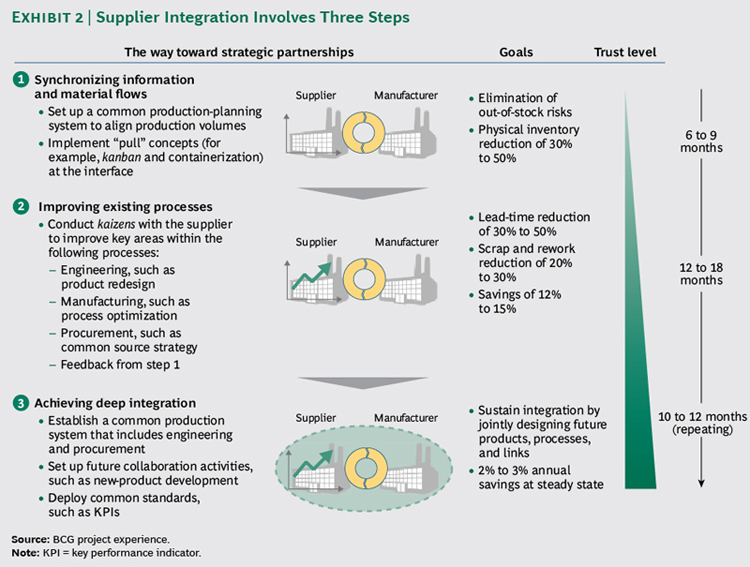
The process of integrating a supplier into a lean production system comprises three basic sequential steps, each achieved with specific tools. (See Exhibit 2.) Each step of the process brings the manufacturer and supplier into closer cooperation. (See “Three Case Studies.”)
Three Case Studies
Each step toward supplier integration involves heightened collaboration between the manufacturer and the supplier. Problems are identified deeper within the organizations and are solved as the manufacturer and the supplier become more integrated.
The two companies also begin to think about their relationship in more strategic terms. In the first step, the manufacturer and supplier work to make the flow of information and materials between them more transparent. In the second step, they exchange insights and best practices on their respective internal operations. By the final step, they have fully leveraged existing lean tools and achieved sufficient integration of their production operations so that they can collaborate on future product design. The following three case studies illustrate this progression.
Synchronize Information and Material Flows
By enhancing transparency, a manufacturer and supplier solved inventory and lead-time problems—and took the first step toward active collaboration.
An automotive manufacturer was dissatisfied with the delivery performance of a valued supplier that required long lead-times for reasons that were not apparent to the manufacturer.
After getting buy-in from the supplier’s senior management, a team of lean specialists from the manufacturer worked with key players from the supplier to conduct value stream mapping (VSM) workshops aimed at coming to an understanding of the supplier’s processes and highlighting areas for improvement. High inventory levels were an obvious issue, so a detailed inventory analysis was conducted to identify possible supply strategies.
On the basis of this analysis, the companies implemented several improvement techniques. A new flexible calculation method for determining safety buffers and standardized processes that ensured the meeting of lot size requirements helped lower inventories. The supplier’s forecasting process was optimized and combined with a statistical analysis of forecasting trends. A new key-performance-indicator cockpit was developed to sustain results and to keep the information flow between the supplier and the manufacturer transparent.
Results. A 10 percent increase in delivery performance, which met the manufacturer’s needs, and a
41 percent reduction in inventories
Lean Tools Typical of This Stage of Integration. VSM, containerization, Pareto analysis, kanban and e-kanban between the manufacturer and the supplier, supermarket, Plan for Every Part, and takt time
Improve Existing Processes
A manufacturer and a supplier that had established a good collaborative relationship worked to identify waste hidden in their production processes, and both continue to share in the gains.
A supplier to a home appliance company was having difficulty containing its costs and identifying sources of waste in its production system. A team of lean experts from the manufacturer and lean production experts from the supplier conducted a two-week-long loss analysis. They looked for opportunities for improvement in four key areas: material flow and logistics, labor, quality, and machine performance.
Their analysis revealed significant machine-performance problems. The supplier’s machines were poorly maintained, which led to frequent process interruptions and breakdowns. Furthermore, the teams saw that machine operators were not sticking to changeover standards consistent with optimal performance, which further increased the amount of time that equipment stood idle.
The supplier implemented total productive maintenance (TPM) with a strong focus on autonomous maintenance and planned maintenance to increase the reliability of its equipment. Then it retrained its operators to implement single-minute exchange of die to reduce changeover times and created systems to ensure that optimal changeover standards were maintained. The supplier also adjusted its sales and operations-planning process to reduce the number of changeovers its machine operators needed to make.
Results. Improvements in the supplier’s overall equipment efficiency, heightened productivity, better labor efficiency, and less scrap, ultimately reducing the supplier’s addressable production costs by 13 percent; higher profit margins for both companies; and the supplier’s application of lean tools to other areas of its operations
Lean Tools Typical of This Stage of Integration. Structured-analysis approach (for example, loss analysis or BCG’s rapid plant-operations diagnostic), TPM, standardized work (including value-added and non-value-added analysis), visual management, root-cause-elimination tools (5 Whys and Ishikawa),poka-yoke, statistical process control, failure mode and effect analysis (FMEA), lean engineering, and procurement tools (for example, common sourcing)
Achieving Deep Integration
The collaboration between a manufacturer and supplier has gone beyond production to forward-looking internal operations such as R&D and product design.
A manufacturer and a technology supplier had leveraged existing lean tools to closely integrate and improve their production systems. However, the manufacturer found that the supplier was having difficulty keeping pace with its accelerating product life cycles. The manufacturer was increasing its production speed and quality while reducing costs, but the supplier’s multiple R&D operations were not able to consistently produce new components to the same standards. A lean team from the manufacturer joined with a lean team from the supplier to analyze the situation. They adopted a lean engineering approach, employing VSM to focus on project execution and on the tools they used.
By identifying waste in the supplier’s R&D operations, the team reduced throughput time. They discovered that R&D operations were not following precise design briefs, lacked strong internal feedback systems, and were not taking sufficient advantage of opportunities for outsourcing.
Results. Supplier’s R&D revamped and failure rate reduced by 28 percent, standardized process methods such as design-to-cost and production preparation process (3P) implemented, more processes outsourced, throughput time reduced by 45 percent, and matching of target cost improved by 74 percent
Lean Tools Typical of This Stage of Integration. Design to cost, design to manufacturing, 3P, VSM, FMEA, and initiative management
Synchronizing Information and Material Flows. This step focuses on optimizing the interface between the supplier and the manufacturer to ensure that the supplier produces and delivers the required quantity of products at the right time. First, the manufacturer must contact the supplier at the most senior level to get buy-in for the entire integration concept. Then, the two companies need to conduct a systematic analysis—using, for example, value stream mapping (VSM)—of the flow of information and materials between them. Next, the manufacturer and the supplier collaborate on developing improvement ideas that will be implemented over the short to medium term. Typically, this means setting up a common production-planning system for aligning production volumes and implementing “pull” concepts. In addition to realizing immediate benefits (for example, eliminating out-of-stock risks and reducing physical inventory), improving information and material flows establishes a base for further improvement and collaboration. Furthermore, it builds a spirit of trust between the supplier and the manufacturer by bringing their respective employees into regular cooperative contact.
Improving Existing Processes. Building on improved material and information flows, the goal of this step is to optimize manufacturing, design, and procurement. It is also intended to deepen the level of trust achieved in the first step.
Existing processes should be analyzed using easy-to-use tools such as VSM, multimoment analysis, and Muda Walks, as well as comprehensive methodologies such as The Boston Consulting Group’s rapid plant-operations diagnostic approach. (RPOD is a methodology for quick diagnosis of a plant’s operations in terms of a set of well-defined cost-improvement levers. The process requires a four-day on-site assessment and one to two weeks of follow-up. RPOD can be used to deliver bottom-line results within a few months or to jump-start a broader lean-transformation effort.) On the basis of these analyses, improvement ideas can be developed and implemented over the medium term. In manufacturing, lean techniques (for example, bill of process, standardized work, and leveling) should be adopted at the shop floor level. In design, improvements may come from product redesign leveraging lean principles. In procurement, improvements may come from finding supplier-manufacturer synergies or common source strategies. This step can be achieved within 12 to 18 months of beginning the integration process.
Achieving Deep Integration. The goal of this step is to achieve and sustain continuous joint improvement over the long term, fully integrating the supplier into the manufacturer’s lean culture. This relationship represents the highest level of trust between a supplier and a manufacturer—a relationship in which the two companies aim to achieve their long-term goals by working cooperatively.
In this step, the two partners should assess their progress in manufacturing, procurement, and engineering, employing tools such as regular run-loss analysis and conducting audits (for example, detailed savings-potential and organizational-capability analyses) to facilitate future collaboration (for instance, cooperative new-product development). An ongoing partnership at this advanced level of development can yield annual production savings of 2 to 3 percent for the manufacturer. This phase can be achieved in 10 to 12 months.
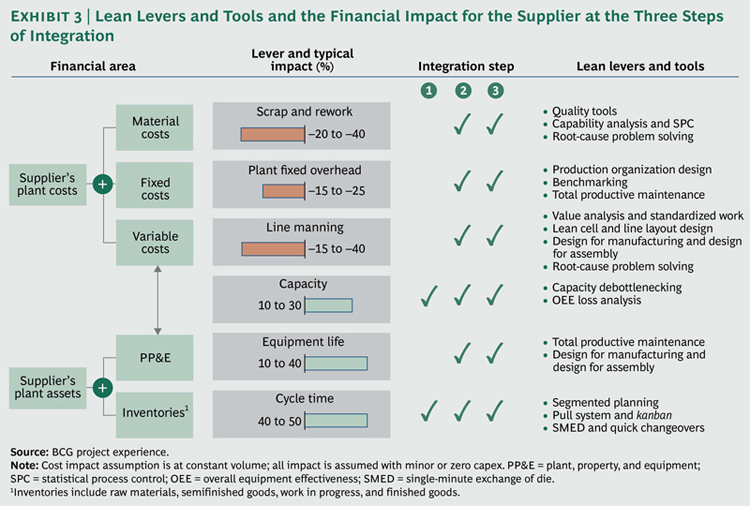
At each step in the process of integration, lean tools are used to activate value drivers and to create financial benefits for the supplier. (See Exhibit 3.)
Five Key Aspects of Integration
Throughout the three basic steps of integration (synchronizing information and material flows, improving existing processes, and achieving deep integration), the manufacturer should stay focused on five aspects of integration. Each one provides opportunities for strengthening the relationship with a supplier as well as potential risks. (See Exhibit 4.)
Supplier Performance Development. The manufacturer should take responsibility for helping the supplier achieve excellence in all areas. This begins with ensuring the reliability of the manufacturer’s own internal production-planning processes before attempting to integrate with a supplier. That done, there are several ways the manufacturer can support the supplier’s development, including workshops involving manufacturer and supplier participation to identify improvement opportunities, support of on-site implementation of lean techniques, establishment of training by experts, and even project management support. Auto manufacturers, for instance, have created supplier support centers that provide immediate on-site operational support and knowledge-sharing systems for improvements.
The manufacturer should neither plan nor control a supplier’s production through automatic enterprise-resource-planning (ERP) systems. Use of ERP systems can make it very easy to lose track of major operations. Additionally, it makes no sense to work on a common production-planning system before it has been determined that the manufacturer’s internal production-planning processes are highly reliable.Furthermore, the manufacturer should not focus on per-piece cost reduction at the outset of integration with a supplier. At the beginning of the process, the most important goal is to gain mutual trust that can be built on later.
Product Design and Development. The manufacturer should leverage the supplier’s expertise in design and manufacturing. That means requesting that the supplier provide feedback on recent product designs. Likewise, the manufacturer should continually look for ways to simplify its product designs in order to trim the supplier base and associated costs.
A key danger to be avoided here is over- or underengineering product design. Much waste is linked to excessive or inadequate product specification. In too many cases, manufacturers neglect the product design issues that suppliers face, even though this is the best starting point for developing approaches that drive savings for both parties.
Control of Intellectual Property. It is important for manufacturers to maintain control of their intellectual property even as they collaborate with suppliers. Key design and production information should stay in-house. This includes component integration. Manufacturers should, however, leverage suppliers’ capabilities to innovate and create win-win situations through, for instance, a system that allows suppliers to offer innovations that manufacturers can consider for use in future products. Manufacturers should be careful that in guarding their intellectual property they do not neglect suppliers’ opinions and ideas about innovations.
Supplier Network Optimization. Manufacturers need to take a long view of their relationships with suppliers, establishing long-term contracts and rewarding suppliers that perform well with additional business. It is important to establish relationships that will last for the life cycle of a product instead of ending with model changes. In addition to building familiarity and trust between manufacturer and supplier, a long-term view also reduces transaction costs. Cooperation and joint team projects with multiple suppliers—that are, naturally, at different stages of integration with the manufacturer’s production system—can help build a strong supplier network and facilitate the development of leading-edge technical products at competitive prices.
Manufacturers should set up a transparent system that lets suppliers know what is expected of them in terms of performance and what they can expect in return (for instance, guarantees of additional business).
It’s critical that manufacturers take care never to penalize suppliers that perform well. An unexpected penalty can permanently damage a relationship and prevent further cooperation.
Economic Benefits to Suppliers. Enduring and profitable manufacturer-supplier relationships are based on fair compensation, particularly for any supplemental or unusual services the manufacturer may request. Sharing benefits is essential for ensuring that the whole program will work. Only if the benefits of the relationship are completely clear, will a supplier provide all the necessary resources and ideas.
Suppliers need to get paid adequately in order to survive. They also need to know that their treatment is equal to that of all comparable suppliers and that excellent performance is the only criterion for additional business.
Suppliers should not get the impression that all changes and improvements benefit solely the manufacturer. The manufacturer must demonstrate the ways that the benefits are shared between manufacturer and supplier.
A manufacturer that integrates suppliers into a lean production system will enjoy immediate benefits, including improved material flows and significant reductions in lead-time and inventories. The process of integration can also lead to sharp reductions in scrap and rework, which means not only lower costs but also better-quality products, higher labor productivity, and reduced time to market.
More broadly, however, the ultimate goal of a supplier integration effort is to create a spirit of partnership with key suppliers. Conducted openly, in a fair and collaborative way, the process can promote greater trust and reliability between the two partners. In addition to short-term financial benefits, the integration of suppliers into a lean production system can lead to the longer-term competitive advantages that come from a strategic partnership. Such advantages include collaboration on new-product development, development of insights into competitors’ activities in the supply market, greater transparency of customer and consumer requirements across the supply chain, development of a shared supplier base, and access to a shared pool of experts on specific topics.
 About bambooinnovator
 Bamboo Innovator