IRobot’s latest product Ava 500 is designed to navigate corporate offices autonomously and facilitate videoconference calls
June 14, 2013 Leave a comment
Meet the Ava 500, the Roomba’s Corporate Cousin
By Brad Stone on June 10, 2013
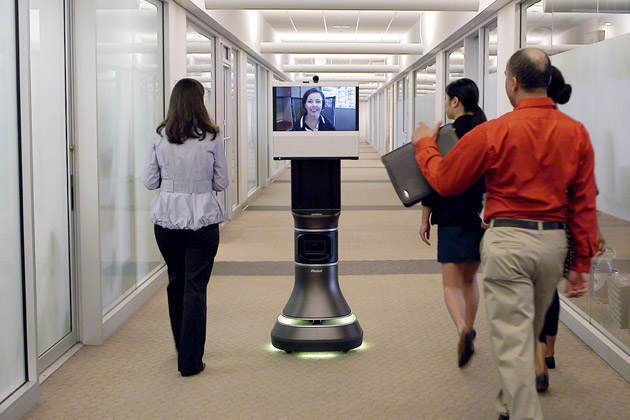
Since the founding of iRobot more than 20 years ago, the Massachusetts Institute of Technology spinout has produced robots that vacuum and mop floors, clean gutters, and patrol war zones. The Bedford (Mass.)-based company has sold more than 9 million home robots and, in the process, has done more than anyone to move the machines out of science fiction and into the real world of affordable devices.
Today, iRobot (IRBT) adds another product to its league of extraordinarily practical machines, the Ava 500. It’s a far cry from the Roomba vacuum, its corporate cousin. The Ava—short for Avatar—is a pricey, wheeled robot designed to navigate corporate offices autonomously and facilitate videoconference calls between workers and their remote colleagues. It comes with a high-definition video screen, some onboard mapping smarts, and Cisco’s TelePresence, a high-quality videoconferencing system meant to create the illusion that far-flung collaborators are sitting across a table from one another. The idea is to “turn an entire office into a high-quality videoconferencing room,” says Colin Angle, iRobot’s chief executive.IRobot won’t start shipping the device until 2014, and the pricing information is preliminary. But it won’t be cheap. IRobot will lease the Ava 500 to customers for between $2,000 and $2,500 a month, Angle estimates, which suggests that it’s not an obvious solution for the average startup or small business. IRobot is announcing it today because it plans soon to start testing the machine with customers. “I think this will break new ground for a bunch of industries, including videoconference and robotics,” says Andrew W. Davis, an analyst at Wainhouse Research.
Angle says iRobot has been trying to crack the videoconference market for years and developed at least six prototypes it never commercialized. One climbed stairs (the Ava 500 does not, but it might one day interface with elevators). Another had an eInk display—the black and white screen on many e-readers—and could mimic emotions. Yet another resembled a Roomba with a camera mounted on top of it. “You felt like you were a rodent crawling along the floor and the resolution wasn’t good enough,” Angle says of that one. “The challenge has always been building an experience, not just a robot, that provides more than just a few minutes of fun.”
As Angle describes it, the Ava 500 will sit parked in the corner of a corporate office, which it has comprehensively mapped on its onboard computer. If a worker in a satellite office wants to initiate a meeting, let’s say with a colleague named “Frank,” he goes to his PC or iPad and schedules a videoconference session. At the appointed time, the robot wakes up, navigates the halls to Frank’s office (dodging gawking colleagues, no doubt), gets into position, and initiates the video call.
Angle says the Ava 500 will be a more flexible alternative to expensive videoconferencing rooms outfitted with cameras and high-definition screens, “which are typically the nicest conference rooms in a building and the most heavily scheduled.”
For iRobot, the Ava 500 represents a new line of business outside its traditional strongholds of the home and battlefield. (A version of it is also being introduced in hospitals). But Angle hopes that the price comes down enough that one day a robot like the Ava 500 could make it into the homes of seniors, to help facilitate medical care and remote family visits. “One of our big company missions has to do with extending independent living,” he says. “With every passing year, there’s a list of things we need to deliver to allow our customer to live independently as the ability to care for their home and live independently degrades.”
Cleaning floors, it turns out, was only the beginning.
The bottom line: Home and defense robot company IRobot is trying to push into office life, but expense will be a barrier.
 About bambooinnovator
 Bamboo Innovator