Lego faces are getting angrier, study finds; Scientist says classic, smiling face of Lego figures is increasingly being replaced, with more themes based on conflict
June 14, 2013 Leave a comment
Lego faces are getting angrier, study finds
Scientist says classic, smiling face of Lego figures is increasingly being replaced, with more themes based on conflict
Alexandra Topping and agencies
The Guardian, Wednesday 12 June 2013
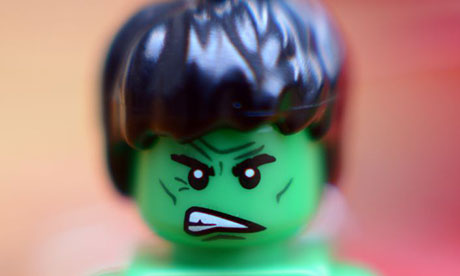
Lego faces are becoming more angry, a New Zealand researcher has found. Photograph: Corbis
Life in Legoland used to be so simple – smiling doctors helped cheerful patients, contented petrol pump operators filled the tanks of satisfied drivers and classrooms of ecstatic children were taught by beaming teachers.
But then life became more complicated. Anger, puzzlement and confusion started to set in – the beatific existence of the Lego figurine was over.
The number of happy faces on Lego toy mini-figures has been decreasing since the 1990s, and the number of angry faces has increased, giving rise to concerns that children could be affected by the negativity of the toys.In a study of 3,655 figures produced between 1975 and 2010, Dr Christoph Bartneck, a robot expert at the University of Canterbury in New Zealand, said the manufacturer appeared to be moving towards more conflict-based themes in its toys. Bartneck’s study considered the range of facial expressions across various Lego sets – now often in themes such as Star Wars, pirates or Harry Potter.
“It is important to study how to create appropriate expressions and how these expressions are perceived by the users. Children’s toys and how they are perceived can have a significant impact on children,” said Bartneck. “We cannot help but wonder how the move from only positive faces to an increasing number of negative faces impacts on how children play.”
The first Lego figures were developed in 1978 and had a classic yellow face with a broad, simple smile, but from 1989 onwards facial expressions began to be more complex as new themes – such as the early Little Pirates – were added to the range. Now a range of expressions including happy, angry, surprised, scared and enigmatic are included in the range.
“It is our impression that the themes have been increasingly based on conflicts. Often a good force is struggling with a bad one,” said Bartneck. “The number of new faces that the Lego company introduces every year is increasing steadily. Lego started producing a greater variety of faces in the 1990s. Happiness and anger seem to be the most frequent emotional expressions.”
Bartneck added that both “good” and “bad” characters now carried a larger range of facial expressions – giving rise to speculation that the figures may just be more in touch with a greater range of emotions. “The facial expressions are not directly matched to good and evil. Even the good characters suffer in their struggle and the villains can have a smug expression. In any case, the variety of faces has increased considerably,” he said.
But there were risks involved in exposing children to a variety of emotions, with small fans likely to remember the anger and fear in their figurines’ faces, as well as their happier moments. Designers of toy faces should take great care to design the expressions and to test their effect since toys played an important role in the development of children, said Bartneck, who will present the paper on his findings at the First International Conference on Human-Agent Interaction in Sapporo, Japan.
Roar Rude Trangbæk, communications manager for Lego, said every toy developed by the manufacturer was tested by a range of expert children, while child psychiatrists, parents and teachers were also consulted. Research conducted for the company found that children, especially boys, enjoyed playing out conflicts between characters, he said. “The conflict between good and evil is nothing new,” said Trangbæk. “But the characters always have classic Lego humour – the good guys always win in the end.”
Trangbæk would not comment on Bartneck’s research directly but added that there was a solution for parents worried about the impact of angry Lego figure faces. “Of course, they can always just switch heads with another figure,” he said.
 About bambooinnovator
 Bamboo Innovator