Innovation: Phil Dumas’s Kevo, a Tap-to-Unlock Door System

Innovation: Phil Dumas’s Kevo, a Tap-to-Unlock Door System

By John Tozzi on June 13, 2013

Innovator Phil Dumas
Age 31
Title CEO of UniKey Technologies, an 11-employee startup founded in 2010 in Winter Park, Fla.
Form and Function
Kevo, a motorized deadbolt lock linked to your iPhone or a dedicated remote control, lets you open your door with the tap of a finger.

tech_innovator25_950


Amazon’s Kindle Worlds is looking to cash in on fan fiction by licensing popular brands. They’re paying authors 35 percent royalties

Amazon Wants to Sell Your Fan Fiction Through Kindle Worlds

By Olga Kharif on June 13, 2013

For those who can’t get enough of The Vampire Diaries or dream of further installments of Gossip Girl, Amazon.com (AMZN)may have the answer: fan fiction. The company’s Kindle Worlds e-book venture has licensed the rights to these two soapy teen drama series, as well as another called Pretty Little Liars, and is inviting amateur writers to develop novels and short stories inspired by the characters and back stories of the original works.

Amazon is trying to tap into one of publishing’s hottest trends. Fanfic websites, as they’re known, include millions of aficionado-penned stories, many dating back well over a decade. One site, FanFiction.net, offers nearly 650,000 stories about Harry Potter alone. Once a niche genre, such sites have gained commercial legitimacy since the Fifty Shades of Greyseries, which sold more than 70 million copies in print, audio, and digitally from March to December 2012. The bondage-romance series, which began as Twilight fan fiction, was a bright spot for the publishing industry last year amid slowing growth of trade e-book sales. (Sales grew 44 percent in 2012 but more than doubled in 2011, according to BookStats, which tracks U.S. publishers.) “The hope is that it could be very big,” says Les Morgenstein, president of the Warner Bros. Television Group division Alloy Entertainment, which owns rights to The Vampire DiariesGossip Girl, and Pretty Little Liars. Read more of this post

Thumbtack: A Local Services Hub to Rival Angie’s List? Companies from Angie’s List to Yelp to HomeAdvisor have tried over the past decade to crack the U.S. market for plumbing, gardening, and other local services by developing an online database for homeowners looking for reliable referrals

Thumbtack: A Local Services Hub to Rival Angie’s List?

By Brad Stone on June 13, 2013

Companies from Angie’s List (ANGI) to Yelp (YELP) to HomeAdvisor have tried over the past decade to crack the U.S. market for plumbing, gardening, and other local services by developing an online database for homeowners looking for reliable referrals. There have been limited successes but no breakout leader, partly because many of the nation’s tens of millions of local small business owners spend relatively little time on the Web and run their businesses the old-fashioned way, with a pen and pocket calendar.

Now there’s a new entrant in this crowded field, Thumbtack. The San Francisco startup has operated quietly for four years, building a database of more than 250,000 service professionals who can pay the company fees for referrals. They include home maintenance workers and a wider range of occupations, from wedding officiants to yoga instructors. Thumbtack planned to announce on June 13 that it has raised $12.5 million from a group of investors, led by Sequoia Capital, that are chasing the chance to build the next great online e-commerce hub. “The long-term vision is to build the Amazon (AMZN)for services,” says Marco Zappacosta, Thumbtack’s 27-year-old chief executive officer. “We want to build the kind of brand that the Yellow Pages had for decades.” Read more of this post

Banks face derivatives shake-up in Asia

June 13, 2013 12:40 pm

Banks face derivatives shake-up in Asia

By Jeremy Grant in Singapore

Global banks trading over-the-counter (OTC) derivatives with some Asian counterparties risk being in breach of US regulations or falling foul of Asian countries’ data secrecy laws as sweeping US rules on such markets take effect.

This latest hurdle to the smooth implementation of the US Dodd-Frank Act is another blow to the growth of Asian OTC markets, which could be derailed if participation becomes too difficult. Read more of this post

Pay for the Bus With a Phone: Mobile Wallet System Coming to China Mobile

Pay for the Bus With a Phone: Mobile Wallet System Coming to China Mobile

June 14, 2013

by C. Custer

1371087136161-315x236

Taking the bus in China isn’t that difficult if you have a transit card you can swipe to pay your fare. But soon, even the transit card may be unnecessary. The Beijing News reported yesterday that China Mobile has partnered with a number of banks (eight so far) and with China UnionPay to create a mobile payment system, and the first part of that system is coming very soon.

Right now, Beijing China Mobile customers who’d like to can visit any of six designated China Mobile shops to switch their SIM cards out for new ones that will allow them to connect their phones to their bank accounts. Soon, Beijing’s public transportation system will let them swipe those phones to pay for bus fares around the city. No transit cards required. Read more of this post

Google now takes one of every three dollars spent on digital advertising—and one of every two on mobile

Google now takes one of every three dollars spent on digital advertising—and one of every two on mobile

By Leo Mirani @lmirani 11 hours ago

Figures out today from eMarketer, a digital marketing research firm, show that Google gobbled up 31.5% of the $116.82 billion companies took in digital advertising last year. (The numbers from eMarketer are based on the total advertising revenue companies like Google earned minus the cost they have to pay affiliates for “traffic acquisition,” which is a fee paid to referrers or through programs such as Google’s AdSense.) That’s down a little from 32% in 2011. But this year Google’s share should reach one-third of expected total advertising revenues of $116.82 billion. The next biggest winner of digital ad revenue is Facebook. Its share for 2012 was a fraction of Google’s: 4.1%. Google is even more dominant in mobile advertising. Of the $8.8 billion companies pulled from mobile advertising, Google accounted for $4.6 billion, or 52.4%. Facebook went from a standing start—zero in 2011—to 5.4% ($470 million) in 2012. It is forecast to more than double its share to 13% ($2 billion) of this year’s $15.82 billion total. Not taking affiliate fees into account, advertising accounted for 95% of Google’s revenues last year.

Companies are using social media to combat online payment fraud, which cost an estimated $3.5 billion last year

Using Social Media to Stop Online Payment Fraud

By Danielle Kucera on June 13, 2013

Users of Facebook (FB), Pinterest, and Twitter share personal details every day. Now credit bureaus and payment companies Equifax (EFX), EBay’s (EBAY) PayPal, WePay, and Intuit (INTU) have begun trials to see whether social posts can help prove identities or detect whether customers are lying about their finances. “We are investing a lot in how can we use unstructured data that is sitting out there in social media that can help us understand a little more about identity,” says Rajib Roy, president of Equifax Identity and Fraud Solutions. Fraud cost U.S. online retailers $3.5 billion last year, according to payment processor CyberSource. Read more of this post

Early Waze backer maps out investment thesis

Early Waze backer maps out investment thesis

By Dan Primack June 13, 2013: 3:18 PM ET

waze-app

When venture capitalist John Malloy first invested in Waze, the company was worth just a few million dollars. Now Google is paying more than $1 billion for it. Malloy explains what he saw back in 2008, and why his bet paid off. FORTUNE — Google (GOOG) this week announced that it will buy social mapping company Waze for a reported $1.1 billion, beating out earlier suitors like Apple (AAPL) and Facebook (FB). So I spent some time on the phone with John Malloy, a general partner with BlueRun Ventures, who led the original $14 million investment in Waze. What follows is an edited transcript of our conversation.

Read more of this post

Stockholm-based Wrapp raises $15 million as social gifting matures

Wrapp raises $15 million as social gifting matures

June 13, 2013: 7:30 AM ET

Stockholm-based Wrapp is locking up more funding and moving headquarters to San Francisco.

By Kurt Wagner, reporter

130613070209-wrapp-620xa

FORTUNE — Stockholm-based Wrapp, the company known for giving away gifts, is on the receiving end of a present from Sand Hill Road this morning — $15 million in funding. Wrapp, whose app enables users to send free and paid gift cards to friends or family using a smartphone or Facebook, today announced a Series B funding round that increases the company’s total fundraising to more than $25 million. Three Series A investors, including Greylock Partners and Atomico, were joined by three new investors, including American Express (AXP), in the new round. Read more of this post

US Coal Exports Plunge Due to Tremendous Asian Oversupply

June 13, 2013, 6:18 p.m. ET

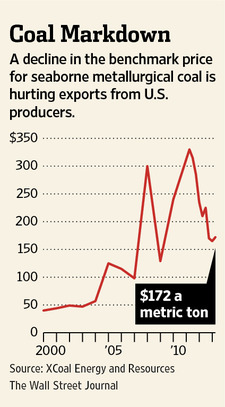
Coal Exports Plunge

Asian Oversupply Leads to 31% Drop in April and Fears of Lower U.S. Profits

By KRIS MAHER

MK-CD997_COAL_NS_20130613181814

The export spigot for coal is beginning to close.

In a troubling sign for U.S. coal producers, shipments fell 31% in April from the prior month, driven largely by an oversupply in Asia for metallurgical coal used in steelmaking. U.S. producers are now at a further disadvantage to overseas competitors because weakening metallurgical-coal prices are making high-cost U.S. production less profitable for export.

“The industry has found itself in a position where there’s a tremendous oversupply,” said Ernie Thrasher, chief executive of XCoal, a U.S. coal trader that works on behalf of U.S. producers who want to sell coal in Asia. Read more of this post

Del Monte is exploring a sale of the canned-food business that made it a household name as the company increasingly focuses on products for dogs and cats.

Updated June 13, 2013, 5:39 p.m. ET

Del Monte Canned-Food Business Is Up for Sale

By DANA MATTIOLI and MIKE SPECTOR

Del Monte Corp. is exploring a sale of the canned-food business that made it a household name, said people familiar with the matter, as the company increasingly focuses on products for dogs and cats.

The San Francisco-based canned-food and pet-food company is gauging interest from potential buyers of the division, the people said, adding that the process is in the early stages. The canned-food business generates about $1.8 billion in sales annually, or about half of the company’s revenue. Read more of this post

Companies listed on the FTSE Bursa Malaysia KLCI Index now generate 45% of their revenue from overseas; the top 10% of firms in the Malaysian equity market capturing an average of 82% of the capital raised over the last five years

Friday June 14, 2013

PM urges EPF, other GLCs to step up involvement in smaller companies

By RAZAK AHMAD
razak@thestar.com.my

KUALA LUMPUR: The Employees Provident Fund (EPF) and other Government-linked investment companies should step up their involvement particularly in high quality mid-cap stocks, said Datuk Seri Najib Tun Razak.

The Prime Minister said the fund management industry, including public sector funds, should set specific objectives to increase the velocity of trades in the shares of such companies. Read more of this post

Goldman offers top clients automated block trading; “Everyone brings a different twist to the way they’re trying to solve a common problem, which is: How do you continue to bring high-touch service in an industry that’s facing downward commissions revenue?”

Updated: Friday June 14, 2013 MYT 9:01:24 AM

Goldman offers top clients automated block trading

NEW YORK: Goldman Sachs Group Inc has quietly offered some top clients a tool that allows them to plug into its trading system and buy or sell large blocks of stock electronically.

The technology is part of a broader platform called Marquee, details of which not been previously reported, but were confirmed to Reuters by Goldman executives. It is the latest attempt by a Wall Street bank to automate block trading, a small sliver of the equities business that is still handled mostly by humans rather than specialized computer programs. Read more of this post

China Local Debt Audit ‘Credit Negative,’ Moody’s Says

China Local Debt Audit ‘Credit Negative,’ Moody’s Says

By Bloomberg News on June 13, 2013

China’s government risks being forced to bail out some local authorities and take over their liabilities after a report from the nation’s audit office showed a jump in borrowings, Moody’s Investors Service said.

The National Audit Office review indicates that total local government direct and guaranteed debt may have risen 13 percent to 12.1 trillion yuan ($2 trillion) by end-2012 from end-2010, Moody’s said, citing its own calculations based on data in the report which showed a 13 percent increase in the debts of a sample 36 local authorities. Read more of this post

Chinese corporate and household debt interest payments as a share of GDP has doubled since 2002 to 12%

June 12, 2013, 11:11 p.m. ET

The Next Move for Beijing

By TOM ORLIK

AM-AY973_CHINAH_NS_20130613045403

A prolonged slowdown in China’s growth sharpens the need for an innovative policy response. Fortunately for Beijing, it has more-creative options than another government spending spree.

The latest indications from the world’s second-largest economy are worrying. Industrial output and investment are decelerating. After stripping out the effect of over-invoicing, export growth is flat lining. It’s all enough to have Goldman Sachs strategist Jiming Ha wondering whether China is on the way to 6% annual growth, well below the first quarter’s 7.7%. Read more of this post

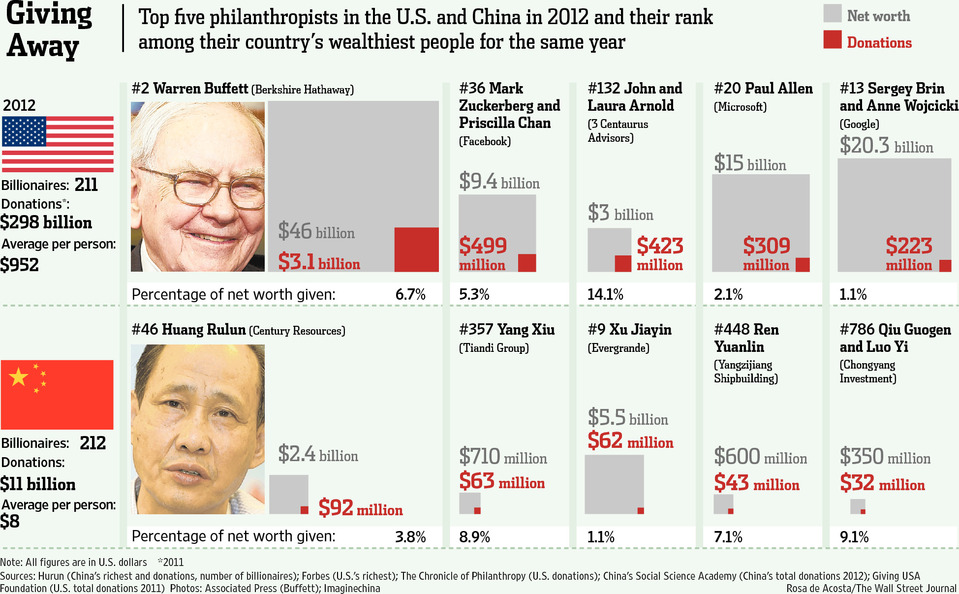
In China, Philanthropy Gains Cachet; people are now eager to show off pictures they took at an earthquake-stricken zone or on visits to rural schools

June 13, 2013, 2:06 p.m. ET

In China, Philanthropy Gains Cachet

By WEI GU

AM-AY971_WEICOL_G_20130613131807

When Warren Buffett and Bill Gates asked 50 of China’s richest people to a philanthropy dinner in Beijing in 2010, a third turned down the invitations, fearing they would be pressed to donate money.

Three years later, rich Chinese are starting to get more comfortable with giving.

Social media are abuzz with pictures of charity dinners and celebrities promoting causes. Displays of wealth are calming down, and people are now eager to show off pictures they took at an earthquake-stricken zone or on visits to rural schools. Read more of this post

Fed Could Drain the Oil Market’s Tank; At around 394 million barrels, U.S. commercial stocks of crude oil, excluding the strategic petroleum reserve, are hovering around their highest levels since the early 1980s

June 12, 2013, 2:56 p.m. ET

Fed Could Drain the Oil Market’s Tank

By LIAM DENNING

There is a shadow looming over oil prices in the shape of a big tank—and a big central bank.

The U.S. last year posted the biggest increase in oil production in the world and largest increase in U.S. history. But is there a shadow in the form of a central bank looming oil prices? Heard on the Street editor Liam Denning reports.

At around 394 million barrels, U.S. commercial stocks of crude oil, excluding the strategic petroleum reserve, are hovering around their highest levels since the early 1980s. Read more of this post

Shocking is the word that describes a report by Korea’s government auditors on the debt of major state-owned companies; During five years under the former Lee Myung-bak administration, the combined debt of nine public enterprises more than doubled, from 128 trillion won ($113 billion) to 284 billion won

2013-06-13 17:32

Public enterprises’ debt

Shocking is the word that describes a report by government auditors on major state-owned companies released Wednesday. During five years under the former Lee Myung-bak administration, the combined debt of nine public enterprises more than doubled, from 128 trillion won ($113 billion) to 284 billion won.

The biggest reason was the “ostrich” fiscal operation of the previous government. While pushing ahead with massive public works, including the controversial four-river refurbishment project, it passed the burden from snowballing budget deficits to state-owned enterprises (SOEs).

That was a most glaring example of irresponsible fiscal management, which does not stop at aggravating the bottom lines of these state firms but puts strict restraints on the succeeding government’s economic operation and eventually leads to heavier burdens on taxpayers. Major, if not the only beneficiaries were large construction firms and officials who received kickbacks from them.  Read more of this post

AustralianSuper, the nation’s biggest industry fund, has tipped a spate of mergers through the $1.6 trillion retirement savings sector as funds seek to take on the wealth arms of the major banks

$62b AusSuper eyes mergers

June 14, 2013

Madeleine Heffernan

AustralianSuper, the nation’s biggest industry fund, has tipped a spate of mergers through the $1.6 trillion retirement savings sector as funds seek to take on the wealth arms of the major banks. Ian Silk, the chief executive of the $62 billion AustralianSuper, has foreshadowed further deals by the fund, following mergers in recent years with the multibillion-dollar funds Westscheme and AGEST. ”It’s pretty clear that the regulators and public policy is pushing in the direction of a smaller number of large funds rather than a large number of smaller funds,” Mr Silk told BusinessDay.

Read more of this post

‘Missing’ superannuation funds reach $18b; For NSW and Victoria, the average estimated lost amount per person with super is about $2500

‘Missing’ super funds reach $18b

June 14, 2013

John Collett

The pile of ”lost” superannuation has risen to $18.1 billion, up from $17.4 billion a year ago.

The latest Westpac Lost Super Report, researched by Core Data, estimates half the population with superannuation funds is likely to have lost some super.

”We are all planning to retire, so why don’t more of us spend just a few minutes to find any lost super?” Westpac head of superannuation Deanne Stewart said.

For NSW and Victoria, the average estimated lost amount per person with super is about $2500. Read more of this post

Private equity firms are sitting on $116 billion of assets trapped in so-called zombie funds that lie dormant but still rake in fees from investors

More than $100 billion trapped in ‘zombie funds:’ industry data

1:00pm EDT

LONDON (Reuters) – Private equity firms are sitting on $116 billion of assets trapped in so-called zombie funds that lie dormant but still rake in fees from investors, research showed on Thursday.

Almost 1,200 private equity funds can be classed as “zombie” – poor-performing funds that have been retained beyond their planned life span and whose managers have little hope of raising more money – according to data from industry tracker Preqin. Read more of this post

Agriculture Prices Slump After Emerging Market Currency Weakness

Agriculture Prices Slump After Emerging Market Currency Weakness

Agricultural commodities fell to the lowest in almost one year as weakening currencies in emerging markets heightened speculation that farmers from Brazil to Indonesia will boost exports, adding to supplies.

The Standard & Poor’s GSCI Agricultural gauge of eight farm commodities including sugar, coffee and soybeans fell 2.3 percent by 5:10 p.m. in London, heading the lowest close since June 19, 2012. Nineteen of 24 emerging market currencies tracked by Bloomberg sild against the dollar by an average 3.2 percent in the past month.

Supplies of everything from soybeans to wheat are set to increase this year as planting rebounded following droughts in the U.S. and Russia in 2012. The global sugar surplus will be a record in the 12 months ending in September, the International Sugar Organization in London estimates. Weaker currencies make overseas sales prices in dollars more attractive. Read more of this post

Silver Faithful Taking $5 Billion Hit in Crossfire: Commodities

Silver Faithful Taking $5 Billion Hit in Crossfire: Commodities

Silver is punishing investors amid diminishing trust in precious metals as a store of wealth and concern that growth is weakening, with $5.2 billion erased from the value of their near-record holdings this year.

Investors expected silver to be one of the biggest gainers in 2013, with a 33 percent return, a Bloomberg survey in December showed. Instead it’s leading a retreat in commodities with a 28 percent plunge to $21.79 an ounce, on track for its worst performance since 1984. While the median prediction from 14 estimates compiled last week is for a rally to $23.50 by Dec. 31, that would still mean a 23 percent drop for the year. Read more of this post

Gold Bears Return as ETP Rout Extends to 17th Week and India, the biggest buyer, announced curbs on imports

Gold Bears Return as ETP Rout Extends to 17th Week: Commodities

Gold traders turned bearish for the first time in a month as investors reduced holdings in exchange-traded products for an unprecedented 17th consecutive week and India, the biggest buyer, announced curbs on imports.

Eighteen analysts surveyed by Bloomberg expect prices to fall next week, with 14 bullish and four neutral, the largest proportion of bears since May 17. Investors sold 490.4 metric tons valued at $21.8 billion through ETPs since Feb. 8 and the 2,124.7 tons left is the least they have held since April 2011, data compiled by Bloomberg show.

Bullion is on track for the first annual drop since 2000 as some investors lose faith in it as a store of value. While the slump into a bear market in April hurt billionaire hedge fund manager John Paulson and producer Newcrest Mining Ltd. (NCM), it spurred purchases of coins and jewelry worldwide. That demand may be threatened in India after the nation raised gold import taxes to contain a record current-account deficit. Read more of this post

Gold Imports by India Seen Tumbling as Curbs Boost Titan’s Costs; “These regulations will affect cash margins of jewelers due to higher cost of funding as equity or unsecured domestic loans will be used to fund purchases and inventory will have to be fully paid for in cash compared with gold on lease earlier”

Gold Imports by India Tumbling as Curbs Boost Titan’s Costs

Gold imports by India, the world’s largest consumer, are plunging as an increase in tax and restrictions on financing shipments boost costs for jewelers, helping the nation contain a record current-account deficit.

Shipments in June will decline as only orders placed before the curbs are being imported now, said Rajesh Mehta, chairman of Rajesh Exports Ltd. (RJEX) Overseas purchases tumbled to an average $36 million a day in the 14 business days through June 7, compared with an average $135 million a day through 13 days until May 20, Raghuram Rajan, chief economic adviser in the Finance Ministry, said in a statement on June 11. Read more of this post

High-end seafood businesses flounder amid spending cut and crackdown on graft and extravagance; “It has been the worst time for seafood-related industries in a decade”

Seafood businesses flounder amid spending cut

Updated: 2013-06-14 02:10

By WANG ZHUOQIONG ( China Daily) Read more of this post

Mollusk-Eating Chinese Fuel Junk-Loan Trawl at Clearwater

Mollusk-Eating Chinese Fuel Junk-Loan Trawl at Clearwater

Clearwater Seafoods Inc. (CLR) plans to join Canadian peers borrowing more in the U.S. leveraged-loan market to finance a 200-foot vessel to harvest clams for China’s mollusk-loving middle class.

The Bedford, Nova Scotia-based company which has doubled sales to Asia since 2008 is planning to issue about $335 million of term loans by early July, said Tyrone Cotie, Clearwater’s treasurer. While some of the money will be used to repay and refinance debt, Clearwater plans to use the rest to build a ship equipped with automated shucking machines to prepare the bivalves for export, he said. Read more of this post

Asahi to Ajinomoto CEOs Betting Abenomics Won’t Spur Inflation

Asahi to Ajinomoto CEOs Betting Abenomics Won’t Spur Inflation

Japan’s consumer goods makers and retailers aren’t buying Abenomics (JNMBMOBE).

Sixth months into an economic program that sparked faster growth and the world’s biggest stocks rally this year, consumer goods companies are still planning for deflation.

“We aren’t thinking about raising prices,” said Akiyoshi Koji, president of Asahi Breweries Ltd. (2502), which makes the country’s best-selling Super Dry beer.

Koji’s closest rival, Kirin Holdings Co. President Senji Miyake, said the signs of an improving economy aren’t enough to prompt a shift from a strategy to expand outside Japan. Their outlook is another hurdle for Prime Minister Shinzo Abe’s campaign to reflate the world’s third-largest economy and end 15 years of deflation. Read more of this post

Dollar Correlates to Stocks in Economy Obama Desires: Currencies

Dollar Correlates to Stocks in Economy Obama Desires: Currencies

The dollar is moving more in tandem with stocks than any time since 2008 in a sign that traders are gaining confidence in the sustainability of the U.S. recovery.

The U.S. Dollar Index and the Standard & Poor’s 500 Index are the most closely correlated since the start of the global financial crisis, according to data compiled by Bloomberg. The gauges started moving more in lockstep last month as the greenback jumped to an almost three-year high and U.S. equities surged to a record.

Traders retreating from emerging markets are seeking America’s currency as everything from jobs to consumer confidence and housing fuel the economy while the euro zone struggles with recession, Japan debases its currency and the U.K. stagnates. Rising U.S. bond yields as the Federal Reserve debates whether to slow bond purchases are adding to the dollar’s allure. Read more of this post

This time, bond investors think a Fed pullback is real

Analysis: This time, bond investors think a Fed pullback is real

1:21pm EDT

By Karen Brettell

NEW YORK (Reuters) – This time, the Fed is serious.

That’s the judgment of U.S. government bond investors who believe the Federal Reserve is close to paring back its $2.5 trillion, 4-1/2-year bond purchase program, and it’s causing turmoil in the U.S. Treasury market. Trading in Treasuries has turned notably more volatile in recent days and volatility may continue as traders try to adjust to a marketplace in flux. In the last six weeks, benchmark 10-year U.S. Treasury note yields have surged to 2.19 percent, from 1.60 percent at the beginning of May.

Read more of this post