The CIC Hot Potato : Why no one wants to lead China’s $500 billion sovereign wealth fund.

The CIC Hot Potato – Economic Observer Online

By Ouyang Xiaohong (欧阳晓红)
Issue 622, June 2, 2013

1359372348108

China’s leaders are anxious to find a new chairman for China Investment Corporation (CIC), the country’s $500 billion sovereign wealth fund.
The former head, Lou Jiwei (楼继伟), left the fund after he was appointed as the country’s new finance minister back in March. Since Lou’s departure, there’s been no official announcement of who is going to take his place over at CIC.
“I guess in the end it will still be Tu Guangshao (屠光绍), the deputy mayor of Shanghai,” a person close to CIC’s senior management told the EO on May 29 with a tone of exasperation in his voice. The unspoken message seemed to be that the people charged with making the decision would look around for another candidate for a while, before returning to their original choice. Read more of this post
How China’s solar boom fizzled and went bust

How China’s solar boom fizzled and went bust

By Jeffrey Ball, Stanford Graduate School of Business 6 hours ago

If one city epitomizes China’s role as cheap manufacturer for the world, it’s Wuxi, a sprawling metropolis of more than 4.5 million people a short bullet-train ride northwest of Shanghai. Out beyond the old town, with its ancient temples and canals, much of modern Wuxi is a massive industrial park, a seemingly endless grid of wide, straight roads fronting squat factories bearing the names of international brands: Epson, Nikon, Panasonic.

Wuxi’s industrial zone also is the epicenter of the global solar-energy industry, a sector now in the throes of convulsive growing pains. Specifically, the zone is home to the gleaming glass-fronted headquarters of Suntech Power Holdings Co., which over the last decade sprang from local startup to world’s largest solar-panel maker — and then, this spring, declared that its main business unit was bankrupt. Read more of this post

How did we get here? A “map” of the Fed’s balance sheet’s history

SATURDAY, JUNE 8, 2013

How did we get here? A “map” of the Fed’s balance sheet’s history

SoberLook.com

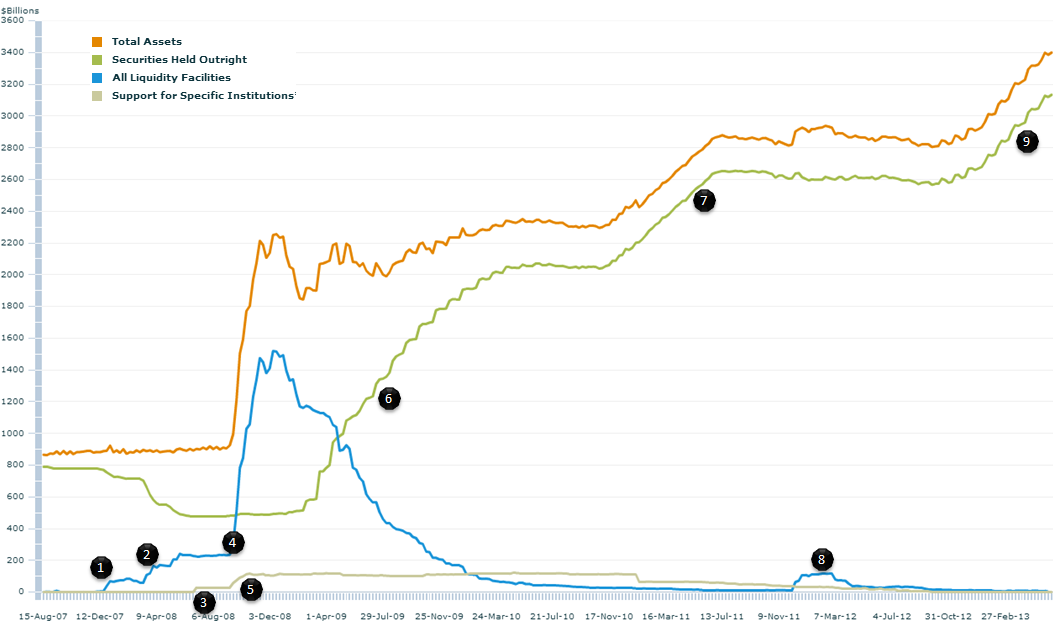
Some in the mass media continue to be confused about the historical trajectory of the Fed’s balance sheet. People have trouble distinguishing between the liquidity facilities provided by the central bank and the various monetary expansion activities. Here is a historical “map” to show how we got here.

Feds Balance sheet Read more of this post

Funds of hedge funds fight for survival as investors withdraw billions of dollars from the sector every quarter, scared off by mixed results and high performance fees

June 9, 2013 7:20 am

Funds of hedge funds fight for survival

By Ellen Kelleher

Funds of hedge funds are being forced into a corner as investors withdraw billions of dollars from the sector every quarter, scared off by mixed results and high performance fees.

The number of funds of hedge funds has fallen steadily in recent years, according to figures from Chicago-based Hedge Fund Research, dropping from 2,462 in 2007 to 1,855 in the first quarter of this year. While outflows have eased since the haemorrhaging seen in 2009, they persist. More than $22bn was removed from funds of funds in 2012 and another $5bn in the first quarter of 2013. Read more of this post

Amazon Expands Into Selling 3D Printer & Supplies

Amazon Expands Into Additive Manufacturing

Kyle Maxey posted on June 10, 2013 | Comment

While Amazon CEO Jeff Bezos may believe that 3D printing is still a long way from changing the way industry makes and distributes products, his online marketplace isn’t shying away from the opportunity to sell the revolutionary technology. In a recent addition to its website, Amazon has decided to add a new section to it’s “Industrial & Scientific” market category – “3D Printers & Supplies”. A quick look around the section gave me the impression that Amazon is still catering to the Maker segment of the 3D Printing community. Among the products available are the MakerBot Replicator2, the LulzBot AO-101, the Airwolf3D and a number of other models. Read more of this post

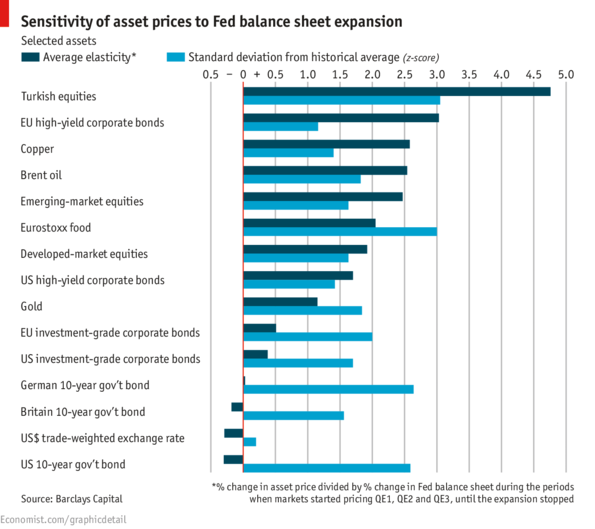
Sensitivity of asset prices to Fed balance sheet expansion

Fed tapering

Jun 11th 2013, 12:09 by Economist.com

WITH short term interest rates at record lows, America’s Federal Reserve has sought to boost its economy by purchasing bonds with newly created money, thereby pushing down bond yields. In November 2008 the central bank announced it would buy up to $600 billion in agency mortgage-backed securities (MBS) and agency debt. The programme was extended in March 2009 by an additional $850 billion, and $300 billion in purchases of Treasury securities. This first episode of this so called quantitative easing, later known as QE1, was followed by two more rounds; QE2 in November 2010 ($600 billion) and QE3 in September last year ($40 billion of MBS and $45 billion of Treasuries each month). QE3, the Fed said, would continue until the outlook for jobs had improved substantially. America’s jobs market has improved, and markets are now reckoning the Fed will start to taper its bond purchases in coming months. According to EPFR Global, a data provider, this has put pressure on bond prices and investors have fled riskier assets; bond fund outflows reached a record in the week ending June 5th. Researchers at Barclays Capital have looked at which assets are most sensitive to the Fed’s balance sheet, by dividing the change in the asset prices over periods of QE, by the change in the size of the Fed’s balance sheet. At present, markets are adjusting to the Fed’s balance sheet merely expanding more slowly than expected. At some point they will have to adjust to its outright shrinkage. Since emerging-market equities and European and American high-yield bonds showed the greatest sensitivity to Fed balance sheet expansion, they could be expected to also fall most when it shrinks. Judged by how an asset deviated from its historical value during QE, Turkish equities and “defensive” stocks (those that do not move with the business cycle, like food) are most vulnerable.

20130615_gdc777_1

End of Cheap Money: Can the World Handle Higher Interest Rates?

06/13/2013 10:47 AM

End of Cheap Money: Can the World Handle Higher Interest Rates?

By Martin Hesse, Anne Seith and Wieland Wagner

For the last five years, the world’s leading central banks have been combatting the crisis with extremely low interest rates and vast bond purchases. Now the American Fed is breaking ranks, as it cautiously suggests a change in its policy — sending the markets into turmoil.

Fuchinobe doesn’t look like the kind of place where speculators have struck it rich. The commuter rail station near the Japanese capital of Tokyo is surrounded by drab apartment buildings and small single-family homes. But the neighborhood is also home to Yuka Yamamoto, 44, a star among Japan’s so-called shufu toshika, or “housewife investors.” Read more of this post

Alibaba’s Alipay App Has A Major Update Again, Wants More Control over Your Mobile Life

Alipay App Has A Major Update Again, Wants More Control over Your Mobile Life

By Tracey Xiang on June 8, 2013

AlipayWallet2

Alipay, the payments company under Alibaba Group, just released a major update of its mobile app, Alipay Wallet  – now only Android versionis available. This version touches more aspects of your mobile life. Here are some of the new features,

Managing your travel itineraries. Now you can add and manage airtickets, hotels and other travel related tickets within the app, and receive notifications of flights and other alerts. Alipay now partners with four Airlines including AirChina, airticket search service Kuxun and hotel service Buding. Read more of this post

Lakala Founder: Third-party Payments Service Are the New SPs and Banks New Telcos

Lakala Founder: Third-party Payments Service Are the New SPs and Banks New Telcos

By Charlie Sheng on June 13, 2013

Sun Taoran is a respected serial entrepreneur and a bestselling author on building startups. He started his first business back from publishing a weekly IT magazine and then shifted to the second company Bluefocus, also the first listed PR company in China. Later on he began to make mobile phones branded Hi-Tech Wealth (also named as the mobile PC), which was quite a hit at the early 00s.. He started up a total of seven companies in different fields and the most recent one is Lakala.

Now founder and chairman of Lakala, one of the biggest third-party payments services in China, Mr. Sun revealed to local media about how he came up with the idea of building such a company and his thoughts on third-party payments sector in China. Read more of this post

‘Australia is a leveraged time bomb waiting to blow’: SocGen

‘Australia is a leveraged time bomb waiting to blow’: SocGen

Business Insider | 13/06/13 | Last Updated: 13/06/12 2:34 PM ET
Australia’s GDP growth expanded merely 0.6% in the first quarter. This was after a 0.6% rise in Q4 2012. Meanwhile, there are a lot of people shorting the Australian dollar.

Minus export growth however, Societe Generale’s Albert Edwards writes that gross national expenditure (GNE) has fallen for two straight quarters.

“One of the biggest economic bubbles in history is now about to go into the Minsky masher,” writes Edwards. This refers to periods of speculation that lead to crisis, and was named after economist Hyman Minsky who wrote about the inherent instability of bull markets. Read more of this post

Overbuilt condo market puts Canadian economy at risk: BoC

Overbuilt condo market puts Canadian economy at risk: BoC

Julian Beltrame, Canadian Press | 13/06/13 | Last Updated: 13/06/13 11:45 AM ET
OTTAWA — An overbuilt and overpriced condominium market is posing a risk to Canadian households, banks and the economy in general, the Bank of Canada warned Thursday in its latest review of the health of the country’s financial system.

New housing already purchased and in the pipeline continues to propel the Canadian real estate market but worries persist about what happens when that tap turns off.

For now, the industry got another bit of good news Monday with Canada Mortgage and Housing Corp. saying new home construction or starts reached the lofty 200,000 level in May on a seasonally adjusted annualized basis. Read more of this post

Real-time translation start-up Lexifone leaves much to be desired; Phone service slow, OK at business talk but garbles daily speech

Real-time translation start-up leaves much to be desired

Phone service slow, OK at business talk but garbles daily speech

BY MAX J. ROSENTHAL

AP JUN 14, 2013

JERUSALEM – An Israeli start-up says it has come up with a way to overcome language barriers when conducting international business: an automated service that provides quick translations between English and seven other languages over the telephone.

Lexifone allows people to get translations without paying hundreds of dollars for human interpreters. The service translates spoken conversations in real time, which Lexifone says is an improvement over free, Web-based services that are typically limited to typing in text. Read more of this post

FSS to monitor Samsung shares to see whether there has been any manipulative activity involved in recent price swings

2013-06-12 17:29

FSS to monitor Samsung shares

By Kim Rahn

130611_p11_concerns

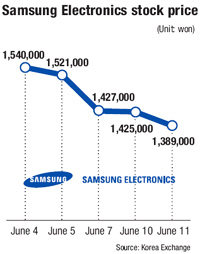
Financial authorities said Wednesday that they will keep a close eye on movements of shares in Samsung Electronics to see whether there has been any manipulative activity involved in recent price swings.

The move came after suspicions of manipulation because of a selling spree led by foreign investors that is considered unusual. Read more of this post

Stocks of Choco Pies are piling up in the warehouses of suppliers because the Gaeseong Industrial Complex has remained shut down for the last two months

2013-06-13 17:15

Choco Pie stocks pile up as Gaeseong closure continues

By Nam Hyun-woo

Stocks of Choco Pies are piling up in the warehouses of suppliers because the Gaeseong Industrial Complex has remained shut down for the last two months.

A large quantity of chocolate-covered marshmallow-filled snacks were sent to the joint industrial complex just north of the Demilitarized Zone (DMZ) because South Korean companies offered incentives to 53,000 Gaeseong workers, including the round chocolate snack. Since incentive money was banned for being too “capitalist,” the snacks were provided instead of currency. North Koreans there were fascinated with the sweet taste. Read more of this post

The Korean government will bring criminal charges against CEOs of large firms that force suppliers and sub-contractors to lower their product prices

2013-06-13

CEOs to be punished for ‘forced price cuts’

By Yi Whan-woo

The government will bring criminal charges against CEOs of large firms that force suppliers and sub-contractors to lower their product prices.

The Fair Trade Commission (FTC), the country’s anti-trust watchdog said on Friday that those convicted will face a maximum fine equal to three times the financial damage suffered by the small businesses. Read more of this post

“The Market Would Have Collapsed” Had The PBOC Drained: Chinese Liquidity Shortage Hits All Time High

“The Market Would Have Collapsed” Had The PBOC Drained: Chinese Liquidity Shortage Hits All Time High

Tyler Durden on 06/13/2013 09:41 -0400

20130613_SHIBOR_0

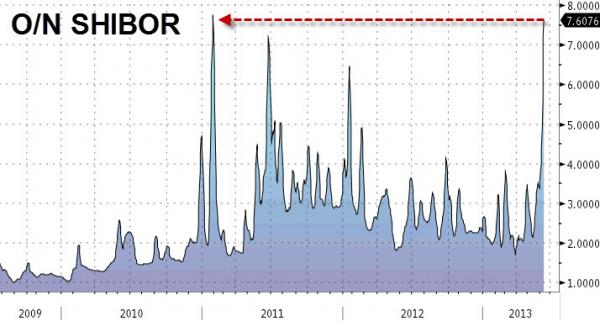
Those who have been following our coverage of the bipolar Chinese liquidity situation (most recently here and here) are well aware of the unique position the world’s fastest (if only on paper) growing economy finds itself in: on one hand, it is the target of massive external hot money flows from both the Fed and the BOJ, which are pushing select inflation in the country higher, manifesting itself best in the real-estate market now higher for 12 consecutive months. On the other hand, the local banking system is in such dire need of liquidity, that not only have various short-term SHIBORs soared to multi-year highs but as Market News reported last week, China Everbright Bank failed to repay 6b yuan ($977m) borrowed from Industrial Bank on time yesterday because of tight liquidity, leading to “chain effect” borrowing in the market overnight and almost ushering in the first bank failure in China. The unprecedented liquidity shortage in China is seen best on the overnight SHIBOR chart below which just hit an all time high. In a nutshell there is zero free liquidity in the system. Which all culminated to last night’s surprising move by the PBOC to step aside from draining funds from the financial system for the first time in three months as even the PBOC now realizes that in the battle against Bernanke and Kuroda’s cash it is about to lose the fight. Read more of this post

Why Local-Mobile Marketing Is Exploding

Why Local-Mobile Marketing Is Exploding

JOSH LUGER JUN. 12, 2013, 2:14 PM 14,255 4

Location-based mobile marketing promises the sky: high conversion rates, surgical targeting, and rich consumer profiles. But does it deliver? According to many accounts, it does. Not surprisingly, retailers, brands, and agencies are scrambling to hone their location-based approaches. These encompass everything from “geo-aware” and “geo-fenced” ad campaigns, to hyper-local efforts keyed to Wi-Fi hotspots, and algorithmic location-based targeting of audience segments like soccer moms, bargain hunters, coffee enthusiasts, etc.

Read more of this post

Gatekeepers of Cable TV Try to Stop Intel

June 12, 2013

Gatekeepers of Cable TV Try to Stop Intel

By BRIAN STELTER

WASHINGTON — As Intel tries something audacious — the creation of a virtual cable service that would sell a bundle of television channels to subscribers over the Internet — it is running up against a multibillion-dollar barricade.

That barricade is guarded by Time Warner Cable and other cable and satellite distributors, which are trying to make it difficult — if not impossible — for Intel to go through with its plan. The distributors are using a variety of methods to pressure the owners of cable channels, with whom they have lucrative long-term contracts, not to sign contracts with upstarts like Intel, that way preserving the status quo. Read more of this post

The houses built on China’s ‘poisoned’ land; Huge areas of contaminated land in Chinese cities like Beijing are being developed into residential districts. But the residents of these developments have no idea

The houses built on China’s ‘poisoned’ land

Gao Shengke Wang Kai

05.06.2013

Huge areas of contaminated land in Chinese cities like Beijing are being developed into residential districts. But the residents of these developments have no idea.

Gao Shengke and Wang Kai have won the prize for Best Investigation atchinadialogue’s and The Guardian’s China Environmental Press Awards – 2013 for their investigation into contaminated earth in Chinese cities. Here is the first of their three-part series of reports.

The excavators are rumbling and dust swirls all about at the second phase of the Kangquan New City construction project in Guanzhuang village, Chaoyang District, outside Beijing’s east fifth ring road. A 20-metre deep pit has been dug on the site. A foul stench rises from the pile of earth that has been removed. Until now, few people knew about the secret that was buried here. This plot of land was previously the site of a factory owned by the Ministry of Railways that made anti-corrosive railway sleepers. The plant was in operation for more than 30 years; many kinds of organic pollutants continuously seeped into the topsoil, deeper soil layers, and into the groundwater. Some seven or eight years ago, the factory was relocated and this plot of ground was left unused. In January 2011, the city administration decided to convert the land into a development for affordable housing and it was taken over by the Residential Construction Service Centre for Civil Servants to build low-cost housing for civil servants from all ministries. Read more of this post

Not Just Solar: The China Car Industry Capacity Problem

June 12, 2013, 6:16 PM

Not Just Solar: The China Car Industry Capacity Problem

By Michael Dunne

Where Chinese solar panels lead, can made-in-China cars be far behind?

China has the capacity to build twice as many solar panels as the world needs–so much so that the Middle Kingdom, according to European officials, has been dumping them overseas. So desperate is the drive to unload extra stock that the Chinese are selling at prices 88% below market value, according to EU trade officials. The EU approved punitive tariffs last week. We’re bound to see a similar, if not quite as extreme, story in cars. By 2018 Chinese and global auto makers, with new factories scattered across China, will be equipped to make more than 30 million cars a year. To put that number in perspective, consider that 30 million cars amount to twice the size of the entire U.S. market. Read more of this post

Japan’s leading appliance retailer getting knocked out of China

Japan’s leading appliance retailer getting knocked out of China

June 12, 2013

By TOKUHIKO SAITO/ Correspondent

NANJING–Tensions over the Senkaku Islands, “obstructive behavior” by rival companies and fierce price wars forced Japan’s leading electric appliance retailer to leave Nanjing only a year after opening a retail shop there.

Yamada Denki Co. had planned to use its store in the southern Chinese city as a starting point to advance into nearby Shanghai, one of the country’s largest cities. Read more of this post

Patchwork of data covers all of us from the cradle to the grave

June 12, 2013 8:11 pm

Patchwork of data covers all of us from the cradle to the grave

By Emily Steel in New York

Data cost

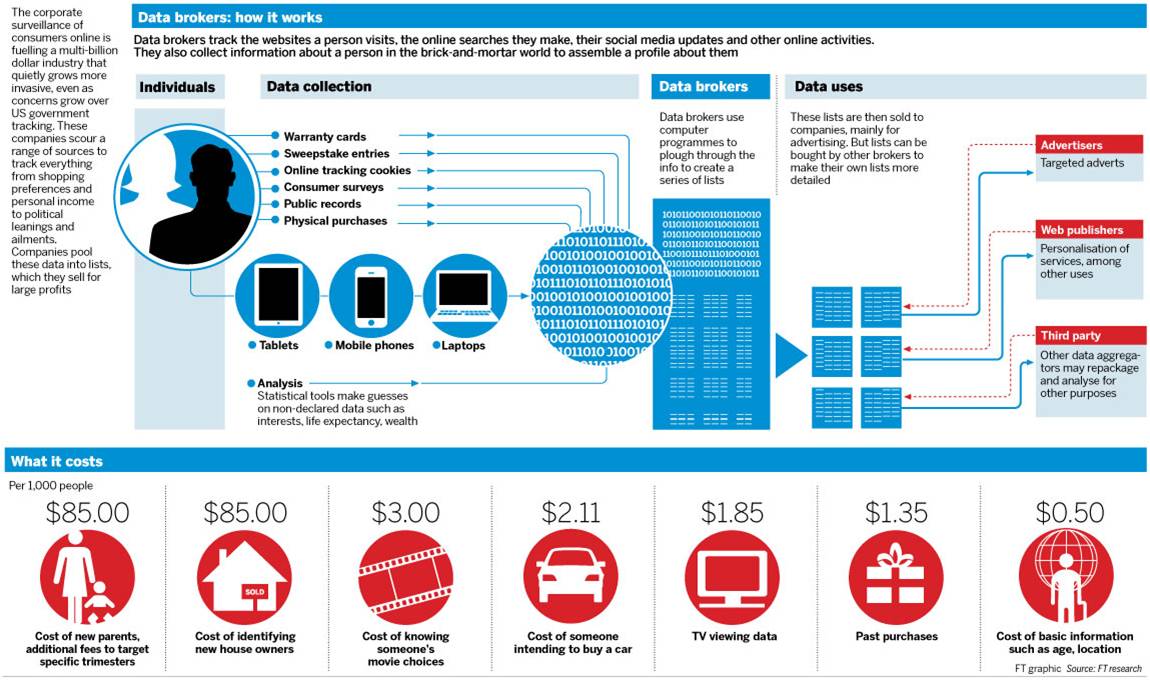
Months before Eleanor Nagle was born, details about her already had been traded for pennies in the corporate market for consumer information.

So-called data brokers scour through baby furniture and maternity store purchases, social media posts, pregnancy email subscriptions, baby registries and birth records, even purchasing details from photography companies that take in-hospital pictures of newborns. All so they can compile up-to-date, accurate lists of new parents, sorted by due date and including everything from the gender of the baby to the mother’s age and household income, to sell to marketers. Read more of this post

China’s proposed ban on the import of low-grade coal is likely to hit small Indonesian producers hard; Indonesia is the world’s biggest exporter of coal for power stations and as much as a third of its exports to China could be blocked if the plan is implemented as currently suggested

June 12, 2013 2:04 pm

Small Indonesian coal miners to be hit by China import ban

By Ben Bland in Jakarta

China’s proposed ban on the import of low-grade coal is likely to hit small Indonesian producers hard but most large miners will only suffer a minimal impact, according to analysts and industry executives.

Indonesia is the world’s biggest exporter of coal for power stations and as much as a third of its exports to China could be blocked if the plan is implemented as currently suggested. Read more of this post

Big data has to show that it’s not like Big Brother

Last updated: June 12, 2013 7:15 pm

Big data has to show that it’s not like Big Brother

By John Gapper

We do not know yet what this new technology of data analysis and artificial intelligence means

Sales of George Orwell’s Nineteen Eighty-Four have risen since Edward Snowdenrevealed how the National Security Agency of the US gains access to telephone records and data from technology companies. So far, if people do not exactly love Big Brother, they are prepared to accept some invasion of their privacy in return for security.

What about “big data”? Companies that hold rapidly expanding amounts of personal information are using new kinds of data analysis and artificial intelligence to shape products and services, and to predict what customers will want. Larry Page, Google’s chief executive, describes his ideal form of technology as “a really smart assistant doing things for you so you don’t have to think about it”. Read more of this post

Banks are tripping over themselves to lend money to Box, the cloud computing start-up, in a race to get a slot on one of the next big Silicon Valley flotations

Last updated: June 12, 2013 6:21 pm

Banks prepare credit to gain edge on Box IPO

By Arash Massoudi in New York and Richard Waters in San Francisco

Banks are tripping over themselves to lend money to Box, the cloud computing start-up, in a race to get a slot on one of the next big Silicon Valley flotations.

At least five banks are in talks to give a credit line to Box, underscoring the lengths they are willing to go to to develop potentially lucrative ties with the next batch of high-profile technology companies expected to come to market. Read more of this post

Private investors to be forced to pay for Japan’s bank failures

Last updated: June 12, 2013 10:52 am

Private investors to be forced to pay for Japan’s bank failures

By Ben McLannahan in Tokyo

Japan is to force losses on investors in troubled banks, brokers and insurers, leading efforts by regulators around the world to lighten the burden on taxpayers.

Under new legislation cleared by Japan’s parliament on Tuesday, holders of new types of preferred shares or subordinated bonds will face losses, or mandatory conversion to common stock, if the Financial Services Agency deems the issuer insolvent.

The FSA will gain its powers to trigger so-called “bail-in” clauses on these instruments – which are compliant with new Basel III rules on bank capital – as early as next spring, assuming that the bill becomes law. Read more of this post

The day the central banks lost control

June 12, 2013 4:13 pm

Markets Insight: Central bank loss of control leads to EM tumble

By Ralph Atkins in London

Fears of stimulus withdrawal trigger rising bond yields but central banks could change tactics, Ralph Atkins

Tear gas and riot police fill Istanbul’s Taksim Square. Investors fret about the growth outlook in India and China. But these were not the main factors behindsharp falls this week in emerging economies’ bond prices, and corresponding rises in yields. Read more of this post

Brainpower alone cannot save India’s growth model; The problems at Infosys raise questions about its role at a national level

June 12, 2013 4:59 pm

Brainpower alone cannot save India’s growth model

By David Pilling

The problems at Infosys raise questions about its role at a national level

For Infosys, a pioneer of India’s outsourcing revolution, the world used to be flat. Now it is looking more pear-shaped.

It was Nandan Nilekani, a co-founder of Infosys, who first put the idea in Thomas Friedman’s head that the world was flattening. Mr Friedman, who was wowed by the oasis of calm and sophistication he found at the company’s shiny Bangalore campus, recalls Mr Nilekani telling him: “Tom, the playing field is being levelled.”

That led him to think about how technology was rendering distance and borders increasingly irrelevant, and accelerating the process by which hundreds of millions of people in emerging countries were pressing into the global workforce. Read more of this post

Asia’s low fertility trap opens opportunities in IVF market

Asia’s low fertility trap opens opportunities in IVF market

Thursday, Jun 13, 2013
Reuters

A looming crisis in Asia as women delay giving birth, leading to low fertility rates that have dire implications for economic growth, is opening huge opportunities for the fast-growing in-vitro fertilization (IVF) industry.

The successful debut of Australia’s Virtus Health Ltd, which this week became the first IVF specialist to list on a stock exchange, is the latest sign that investors are eager to back fertility companies that have plans to expand into Asia’s vast developing markets.

“The market is going to grow massively, there’s no doubt, particularly in India and China we’ve seen huge growth,” said Robert Norman, fertility expert and president of Aspire, an Asia-Pacific industry lobby group. Read more of this post

The Bleak New World of Prenatal Genetics; The emerging market of fetal testing could transform the idea of what’s normal

June 12, 2013, 7:06 p.m. ET

The Bleak New World of Prenatal Genetics

The emerging market of fetal testing could transform the idea of what’s normal.

By MARCY DARNOVSKY AND ALEXANDRA MINNA STERN

OB-XV182_darnov_DV_20130612163733

Four million American women are expecting a child this year, and many of them will encounter something entirely new in human pregnancy. Based on a simple blood draw at an initial prenatal visit, they’ll be able to learn key genetic information about the fetus they’re carrying—and face potentially wrenching decisions about what to do.

These noninvasive prenatal tests, called NIPTs, work by using a sample of cell-free fetal DNA circulating in the mother’s blood to detect chromosomal conditions. The tests’ most frequent target is trisomy 21, the genetic variation that causes Down syndrome in approximately one in every 700 births in the U.S.

Bioethicists, genetic counselors and advocates for disability rights have nervously anticipated the commercial rollout of these tests. Even—or perhaps especially—those who firmly support reproductive rights know that NIPTs have profound implications. Read more of this post