“The Market Would Have Collapsed” Had The PBOC Drained: Chinese Liquidity Shortage Hits All Time High
June 14, 2013 Leave a comment
“The Market Would Have Collapsed” Had The PBOC Drained: Chinese Liquidity Shortage Hits All Time High
Tyler Durden on 06/13/2013 09:41 -0400
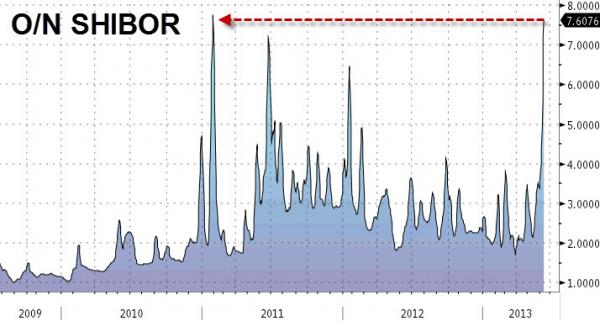
Those who have been following our coverage of the bipolar Chinese liquidity situation (most recently here and here) are well aware of the unique position the world’s fastest (if only on paper) growing economy finds itself in: on one hand, it is the target of massive external hot money flows from both the Fed and the BOJ, which are pushing select inflation in the country higher, manifesting itself best in the real-estate market now higher for 12 consecutive months. On the other hand, the local banking system is in such dire need of liquidity, that not only have various short-term SHIBORs soared to multi-year highs but as Market News reported last week, China Everbright Bank failed to repay 6b yuan ($977m) borrowed from Industrial Bank on time yesterday because of tight liquidity, leading to “chain effect” borrowing in the market overnight and almost ushering in the first bank failure in China. The unprecedented liquidity shortage in China is seen best on the overnight SHIBOR chart below which just hit an all time high. In a nutshell there is zero free liquidity in the system. Which all culminated to last night’s surprising move by the PBOC to step aside from draining funds from the financial system for the first time in three months as even the PBOC now realizes that in the battle against Bernanke and Kuroda’s cash it is about to lose the fight.Bloomberg summarizes:
China’s central bank refrained from draining funds from the financial system for the first time in three months after a cash squeeze pushed up the overnight money-market rate to an all-time high.
The People’s Bank of China hasn’t offered repurchase contracts or bills today, according to two traders required to bid at the auctions. Two calls by Bloomberg News to the PBOC’s media office went unanswered. The central bank has held repo operations every week since February to drain cash and resumed sales of bills in May for the first time since December 2011.
The overnight repo rate, which measures interbank funding availability, touched 9.78 percent on June 8, the highest since May 2006, when the National Interbank Funding Center started compiling the weighted average. China’s financial markets were shut in the first three days of the week for the Dragon Boat Festival holiday. The rate was at 6.32 percent as of 10:39 a.m. in Shanghai today, little changed from June 9. The seven-day repo rate dropped 34 basis points to 5.63 percent.
So what would have happened if the PBOC had continued on its merry way of withdrawing liquidity from the interbank market? Very bad things.
“If the PBOC sold repos or bills today, the market would have collapsed,” said Liu Junyu, a bond analyst at China Merchants Bank Co., the nation’s sixth-biggest lender. “The cash shortage hasn’t eased and banks are still busy borrowing money.”
Which means one thing: any minute now the PBOC, which has moved from a tightening to neutral stance, will have to continue along the spectrum, and quite soon, proceed to once more inject liquidity, either via RRR or an outright Interest Rate cut.
Aside from the fact that this is just the catalyst that gold bugs have been waiting for (recall 2011), this means that the global inflation exporting game is about to go into overdrive as now the Chinese Central Bank is about to join the Fed, the BOJ, and soon the BOE in actively easing. At that point the countdown to the ECB’s joining the race starts, because the real fun will begin only when all global central banks engage in actively injecting liquidity into the system.
 About bambooinnovator
 Bamboo Innovator