Brand Breakout: How Emerging Market Brands Will Go Global
June 23, 2013 Leave a comment
June 19, 2013 4:26 pm
Local brands pursuing global recognition
By Rob Minto
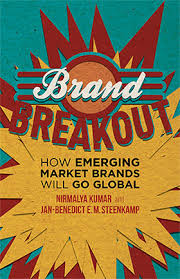
Brand Breakout: How Emerging Market Brands Will Go Global
By Nirmalya Kumar and Jan-Benedict Steenkamp
Palgrave Macmillan, £16.99/$28
Unless you have been living in a world where you reject the notion of product identities, you are a sucker for brands. You may not be aware of it, but branding is why you bought the Financial Times today. It is why you drive the car you drive and it is why you don’t say: “Let me just Bing [rather than Google] that.”
So, given that emerging markets account for more than 40 per cent of global output, why are there no really well-known global emerging market brands?
That is the question put by Nirmalya Kumar of London Business School and UNC Kenan-Flagler’s Jan-Benedict Steenkamp. They think they have the answer. In Brand Breakout, they identify the factors they believe have stopped a big emerging market brand becoming a household name from Rio de Janeiro to Paris to Shanghai.Anyone with more than a passing interest in how global brands develop should take note.
The book outlines eight scenarios that emerging markets brands could follow, such as the Asian tortoise model (gradually moving from cheap to premium products, as with Japanese cars); the national champions route (Airbus and Volkswagen); using a diaspora to enhance brand recognition (Corona); and the most obvious, brand acquisitions.
But there is a definition issue: what is an emerging market? For Kumar and Steenkamp, South Korea is in the “developed market” category. For many investors, it is still “emerging”. This matters because if Korea is an emerging market, Samsung, Hyundai and Kia are emerging market brands. And that undermines the thesis that there are no leading global emerging market brands. Samsung is, according toInterbrand’s 2012 ranking, the ninth best brand in the world.
At least we can agree China is an emerging market. So where are its brands? As the authors point out, if you ask someone in the west to name a Chinese brand, they will almost certainly struggle. But that is not to say there are none. As they note, Chinese brands Haier (appliances) and Lenovo (PCs) are the biggest sellers worldwide in their respective industries.
Of course, emerging markets companies can always buy international brands rather than develop one from scratch. From Jaguar Land Rover (bought by Tata of India) to Weetabix (Bright Food of China), some groups are snapping up western brands. It does not always work. But it will continue.
The authors do not explore too deeply the psychology of brand purchases for the consumers. Is Weetabix now a “Chinese” brand? Not really. The high level of complexity of some products may mean that the emerging market question is too simplistic.
There is also the issue of time. Of the eight potential ways in which the authors say brands may “break out”, some take decades, especially in the case of the “Asian tortoise”, the model of several Japanese and Korean companies. Will the thesis that “there is no precedent of a country evolving into a developed economy without having some global brands emerge from it” hold? Twenty years is a long wait to find out.
No matter: this book is aimed at managers from emerging markets, and those who need to look out for the competition. As such, with its summaries and excellent case studies, it is a worthwhile read for anyone with an interest in how brands are formed and perceptions change.
Which are the brands to look out for in the next few years? Some candidates have already won recognition outside their home countries: Herborist, Zuczug, Natura, Havainas, ICICI and Galanz.
If you know the above, take a point. Everyone else: check back in 2018 to see if they have indeed “broken out”.
Brand Breakout: How Emerging Market Brands Will Go Global [Hardcover]
Nirmalya Kumar (Author), Jan-Benedict E.M Steenkamp (Author)
Book Description
Release date: June 18, 2013
Ask a person on any street in the West to quickly name a brand from an emerging market and you will draw a blank. In fact, a study of western consumers revealed just how low the spontaneous recall of Chinese brands is; emerging market companies are painfully aware of this fact. Many leading companies from emerging markets feel that their country of origin’s image handicaps them and presents an obstacle when selling their products and services to western consumers. In Brand Breakout, marketing experts Nirmalya Kumar and Jan Steenkamp examine how companies from what are now considered emerging markets will successfully reach, and in some cases are already reaching, the developed world as consumer brands. The authors outline eight strategies that emerging market brands can pursue to become truly global consumer brands.
Editorial Reviews
Review
“Products made in China are everywhere in the West, but Chinese brands are rarely seen. Chinese companies now aspire to change this situation. I am excited to read Brand Breakout, and hope more and more Chinese companies can work smart (not just hard) to build Chinese brands on a global scale.”–Zhuo (Joe) Wang, CEO, Shanghai Jahwa United and Chairman, Herborist Cosmetics
“Kumar and Steenkamp’s richly researched book are doing two groups a big favor: helping the brands coming out of emerging markets to go global; and helping mature brands from the West go on alert. This book should be required reading by all global brand executives.”–Philip Kotler, S.C. Johnson Professor of International Marketing, Kellogg School of Management, Northwestern University
“Brand Breakout is the next frontier. A timely reminder to the companies from emerging countries on how they can choose the right way.”–Ravi Kant, Vice Chairman, Tata Motors
“The next set of big global brands will come from emerging countries. Kumar and Steenkamp show the eight routes by which this will happen. Every serious brand strategist needs to see their insights into the future of global branding.”–David A. Aaker, Vice-Chairman, Prophet
“Global brands are ubiquitous but there are still very few from emerging markets. Brand Breakout is essential reading for managers and public policy makers interested in developing global brands from these economies and their impact on global competition.”–Laura D. Tyson, S.K. and Angela Chan Chair of Global Management, University of California, Berkeley and Former Chair of President’s Council of Economic Advisors, Clinton Administration
“Emerging market firms are still better at manufacturing than branding. Brand Breakout provides CEOs with a timely and systematic roadmap of recommendations to change this.”–John Quelch, Professor, Harvard Business School & Former Dean of CEIBS (China Europe International Business School)
“Brand Breakout is a must-read not only for those that run local companies and brands expanding internationally, but for all of us that compete against them in their own territories, and are compelled to win with global brands and strategies against a variety of very local realities.”–Juan Alanis, General Manager, The Estée Lauder Companies Inc., Mexico.
“As two most well-known marketing scholars on emerging markets in the world, Nirmalya Kumar and JB Steenkamp provide a definitive guideline for emerging market brands here. The eight routes proposed in this book lay out a comprehensive roadmap for those aspiring companies and countries to effectively enter global markets, and will have a far-reaching impact in the years to come. It also provides great insights on the transition of the economic development mode of China. A novel and thought-provoking masterpiece!”–Yubo Chen, Professor & Deputy Chair of Marketing, Tsinghua University
“Outstanding book. It is fascinating and undoubtedly a must read piece for managers in both Western and emerging market companies. It was eye-opening to see how Chinese and other emerging market firms are changing from a clear focus on manufacturing and supply chain efficiencies to building brand equities and allocating enough resources behind them. This is our new competition. It seems they now realize that the real value of their companies is in their brands. And it is not until they fully comprehend this that the expansion of these brand equities can really take place; Corona from Mexico is a good example.”–Henry Gomez, Vice-President Business Development for Latin America, Pepsico
“An encouraging and integral reading about how emerging markets companies could rapidly expand the value of their offering. It recognizes how crucial it becomes to unlock value through ‘the art’ of brand building with tangible and relevant principles. Certainly, leveraging the full potential of the crosscultural diaspora strategy will be fundamental for brands determined to thrive in global markets. An extraordinary book with priceless insights that every marketing manager should treasure.”–Leandro Berrone, Marketing VP Cuauhtémoc Moctezuma, Part of the Heineken Company
“Finally a book that hits the marketing bullseye…The future of global brands emerging from Fast Growing Markets. Brilliant, insightful and thoroughly researched. A must read for all marketing and business professionals, from both, developed and emerging economies. I can’t wait to read the saga.”–Alejandro Cardoso, President & CEO Latinamerica Publicis
About the Author
Nirmalya Kumar is professor of Marketing and co-director of Aditya Birla India Centre at London Business School. His research has been widely published in journals such as the Harvard Business Review and Journal of Marketing Research, and he has published six books.
Jan-Benedict E.M. Steenkamp is the C. Knox Massey Distinguished Professor of Marketing and Marketing Area Chair at the University of North Carolina Kenan-Flagler Business School. He has consulted with companies like Procter & Gamble, Kraft, and Johnson & Johnson on branding and strategy, and he has written for the Harvard Business Review, The Wall Street Journal, and the Financial Times, among others.
 About bambooinnovator
 Bamboo Innovator