IKEA’s planned entry into Korea in 2014 is feared to deal a decisive blow to already-struggling furniture makers
June 24, 2013 Leave a comment
2013-06-23 14:59
IKEA faces hurdle in opening store in Korea
Lee Hyo-sik

IKEA’s planned entry into Korea in 2014 is feared to deal a decisive blow to already-struggling furniture makers here. Since December 2011 when the Swedish home furnishing giant announced its plan to establish a presence in the country, it has drawn protests from concerned local furniture firms.They fear IKEA’s pricing advantage the most. The firm outsources production of its do-it-yourself products to manufacturers around the world, enabling it to keep costs and consequently, selling prices, low. IKEA’s effective marketing strategies also concern domestic companies.
IKEA, founded in 1943 in Sweden, is the world’s leading home furnishing company with nearly 340 stores in 43 countries. In 2012, it recorded 27.5 billion euros in global sales. It plans to open its first outlet in Gwangmyeong, Gyeonggi Province, in 2014.
In 2011, the firm bought 78,198 square meters of land for 234.6 billion won ($200 million) from Gwangmyeong City. The firm currently awaits a construction permit from the city government.
“IKEA’s advance, which I think is a sure thing, will reshape the industrial landscape,” said Lee Yong-won, secretary general at the Korea Furniture Association, a lobby group for local furniture makers. “Large firms will enter a life-or-death contest with IKEA. For smaller ones, I think at least 30 percent will be forced out of business.”
Lee said IKEA is capable of selling furniture at half the price of locally-manufactured products, thanks to its purchasing power, and efficient marketing and supply management.
“Local firms import particle boards to produce finished furniture products. They pay an 8 percent tariff when bringing the raw materials into the country,” the secretary general said. “But IKEA will not pay any import duties when bringing its finished goods into the country. This is a serious pricing disadvantage for domestic furniture markers.”
In August 2012, the association jointly set up a “Furniture Industry Development Special Committee” with other interest groups representing furniture markers, as well as furniture companies like Hanssem. The committee is designed to help local firms cope with IKEA’s advance into the local market by introducing measures to strengthen their competitiveness amid intensifying competition.
Furniture shops in Gwangmyeong and nearby cities submitted a petition to the Gyeonggi Provincial Assembly, asking it to stop IKEA from opening its first Korean outlet. In response, the provincial assembly recently approved the petition, pressuring the provincial government not to allow the opening.
Shop owners have also organized a series of rallies in front of Gwangmyeong City Hall and the Gyeonggi Provincial Government. They claim the multinational retail powerhouse will destroy mom-and-pop stores and traditional markets in the area, urging the government to extend financial and other support.
However, the provincial government approved IKEA’s plan for the construction of two six-story store buildings on its 78,200 square-meter site on June 17, according to Gwangmyeong City.
“In return for the construction approval, IKEA has to revise its construction plan in accordance with recommendations made by the provincial government,” a city official said. “We will give a green light to IKEA when it submits a revised scheme. But I think it will take some time for the company to do so.”
A public relations representative for IKEA Korea said it has no specific plan yet as to when it will open its store. “All we can say is we are preparing to open a shop some time in 2014. We are currently waiting to get construction approval from Gwangmyeong City.”
2013-06-23 14:57
Furniture industry in crisis
IKEA’s entry to strike local firms
Lee Hyo-sik
Korea’s furniture industry is on the brink of collapse, due to a combination of factors. Leading furniture makers have seen their bottom lines deteriorate sharply over the past few years.
Because of the continuing real estate market slump, Koreans do not move as often as they used to and thus, do not buy as much furniture as before. A drop in the number of marriages has also cut demand for new furnishings.
Local furniture companies have lost price competitiveness as a result of surging labor, land and other operational costs, paving the way for cheaper foreign imports to capture larger market shares.
In response, they have tried to buy their way out of trouble by making inroads into China and other foreign markets. However, the outward approach has been unsuccessful for most because of their weakened competitiveness and low brand recognition.
The planned entry of Swedish home furnishing giant, IKEA next year is expected to push local producers further into a corner. It plans to open its first outlet on 78,200 square meters of land near the Gwangmyeong KTX station in Gyeonggi Province.
According to the Korea Furniture Association (KFA), the number of furniture makers nationwide has been on a downward slope since 2007.
In 2007, 1,441 firms produced a wide range of office and home furniture. This number went down to 1,289 in 2010 and 1,254 in 2011. Consequently, the number of people involved in the sector also dropped from 35,878 in 2007 to 34,683 in 2011.
In 2012, Korea’s furniture industry was valued at 8.5 trillion won ($7.5 billion), down from 9.9 trillion won in 2008.
KFA Secretary General Lee Yong-won said that the furniture industry as a whole faces a great deal of hardship.
“For furniture makers, things are much worse than in the late 1990s following the Asian financial crisis,” Lee said.
“At the time, the industry underwent drastic restructuring, which weeded out weaker ones. But now everyone, large or small, is suffering because of sluggish consumer demand and the influx of cheaper imports.”
Downside factors
Lee cited the ongoing property market downturn as a main culprit behind the industry-wide slump. “Koreans buy new furnishings when they move into a new house. But these days, they do not purchase homes on expectations that housing prices will decline further. Many just stay put. This has hit home furniture makers hard.”
Similarly, with more young men and women delaying marriage or remaining single in recent years, the demand for beds and other home furniture has declined.
“People also buy household goods when they tie the knot. But many get married late or decide to stay single,” the secretary general said “Even if they wed, they tend to buy less for financial reasons. The nation’s chronically low birthrates also paint a bleak picture for the furniture industry.”
Local furniture makers have also lost competitiveness in price, design and other aspects, Lee said.
“In the old days, furniture was sold if it was cheap, regardless of design and quality. But as Koreans get richer, price is not the only consideration. It has to be modern and stylish,” he said. “But domestic producers have not made sufficient investments over the years to improve their design skills, lagging far behind their counterparts in the United States, Italy and other advanced markets.”
The surge in imports of cheaper furniture from China and Southeast Asia has pushed furniture manufacturers further into a corner. Foreign furnishings have been brought into the country tariff-free since 2004.
“Local firms have been struggling to cope with cheaper imports. They have not been able to raise prices, despite the soaring raw material and labor costs, which have aggravated their bottom lines,” he said. “When IKEA enters the local market, things will turn from bad to worse.”
However, against all these odds, companies must make every effort to remain in business because the livelihoods of tens of thousands of people are at stake, Lee said.
The secretary general suggested that furniture makers undergo full-scale restructuring to boost their price competitiveness. “They should invest more to strengthen their design knowhow to produce what consumers want. Large firms need to step up their overseas marketing to establish a foothold in China and other Asian countries. They should then move into other emerging markets, including the Middle East and South America.”
Struggling furniture makers
In reality, however, most furniture companies are scrambling to stay afloat day-to-day under worsening profitability and snowballing debts.
In particular, those supplying home furniture to construction firms that build apartments have been hit hard by the continued housing market slump.
BIF Boruneo, which was the industry leader in the early 2000s, applied for court receivership last October after failing to service its debts. It went into trouble as its home furniture business incurred huge losses over the past few years.
Livart Furniture and other companies specialized in the domestic home furnishing market have also seen their bottom lines deteriorate in recent years.
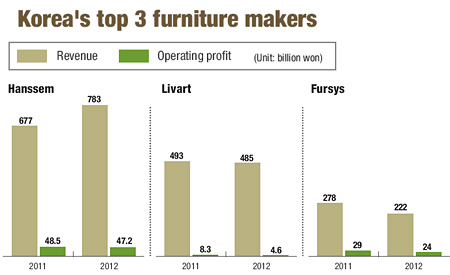
Livart, the nation’s second-largest furniture maker, has been dealt a severe blow by the ongoing market slump. Its revenue dropped 1.6 percent to 485 billion won in 2012 from 493 billion won. Its operating profit plunged 44 percent to 46 billion won from 83 billion during the same period.
However, things will get better for the company as it increasingly makes inroads into Vietnam, Saudi Arabia and Canada, said Katie Kang, a Livart spokeswoman.
“In response to the domestic market decline, we would like to generate up to 30 percent of our sales from overseas markets by 2015,” Kang said. “We will aggressively market office and home furniture in the rapidly growing consumer markets in Southeast Asia and the Middle East.”
In responding to IKEA’s advance into Korea, Kang said Livart has been taking a wide range of measures to boost its competitiveness.
“Among others, we have strengthened our nationwide sales network to more effectively market our new products in a timely manner,” she said. “We will set up more flagship stores to promote Livart as a premium brand, appealing to high-end consumers. We have also launched a low-cost brand to target young consumers who will be the main customer segment for IKEA.”
Fursys, the country’s third-largest furniture maker, has also been reeling from the ongoing domestic market downturn. Its revenue fell 20 percent to 222 billion won last year from 278 billion won in 2011. Its operating earnings also dropped 18 percent to 24 billion won from 29 billion won.
Fursys mostly produces and markets desks, chairs and other office furniture. But many corporations these days refrain from purchasing new items amid the current economic downturn, wreaking havoc on Fursys and other office furnishing makers.
“Like other furniture companies, we have not been exempt from the market slump. I think the sector will likely remain in the doldrums for the foreseeable future,” said Lee Jae-jin, a spokesman for Fursys. “Despite unfavorable conditions, we will do what we do best.”
Lee said Fursys in the future will generate more than 20 percent of its earnings from the Middle East. “We earned 11 percent of our total sales from the region in 2011. We will continue to raise the Middle East sales, and enter other emerging markets. As for IKEA’s entry into Korea, it will not significantly affect our business because the Swedish firm focuses on home furnishings.”
In contrast to the struggling Livart and Fursys, Hanssem and a few other manufacturers that are earning a significant portion of revenue from overseas markets are faring relatively well.
“Hanssem and other furniture makers have been facing hardship in recent years due to the real estate market downturn and other unfavorable conditions,” Hanssem spokesman Kim Dong-sung said. “However, we deal directly with customers through our extensive sales network, while our competitors supply furniture in bulk to builders that construct apartments and other residential housing. With the sluggish housing market, we have been performing much better than our smaller rivals.”
Hanssem, the country’s largest furniture producer earned 783.2 billion won in revenue last year, up 9.9 percent from 677 billion won a year earlier. Its operating profit inched down 3.1 percent to 47.2 billion won from 48.5 billion.
Hanssem has been in a better position to deal with the sluggish domestic demand, thanks to its diversified market portfolio. “We are not a domestic market-oriented company. We are a global manufacturer, with plants in China and the United States. This has made us better able to cope with unfavorable market conditions here.”
The firm plans to mobilize more resources in China to become an industry leader in the world’s fastest growing consumer market.
“We will develop a marketing and sales platform specifically designed for China in the near future. I am positive that we will emerge as the largest furniture firm there. In the end, we will strive to emulate Samsung’s global success,” Kim said.
He then said IKEA’s looming entry into Korea will not compromise Hanssem’s market position. “We are well prepared to compete with the Swedish giant on our home turf. We have been strengthening our price competitiveness and design knowhow. We will also continue to brush upon our one-stop of sales, delivery, installation and after-sales service.”
 About bambooinnovator
 Bamboo Innovator