Falling Debt Prices Roil Market; Fielding Calls From a Pushy Bond Dealer as Buyers Vanish
June 25, 2013 Leave a comment
Updated June 24, 2013, 9:05 p.m. ET
Falling Debt Prices Roil Market
Fielding Calls From a Pushy Bond Dealer as Buyers Vanish
By KATY BURNE, AL YOON and KELLY NOLAN
The rout in the credit markets has gotten so messy some investors are having trouble finding people willing to buy what they are selling.
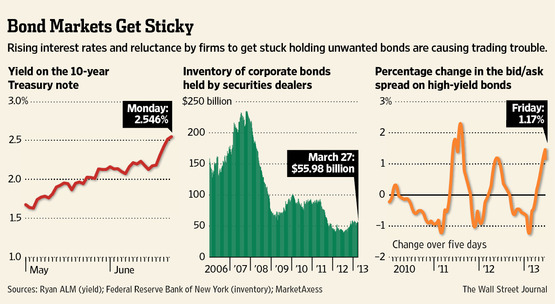
From municipal bonds to corporate debt to mortgage-backed securities, prices fell sharply again Monday, extending big declines that began last week.The yield on the 10-year TreasuryTWE.AU -1.19% note rose to 2.546%, and yields on highly rated municipal bonds maturing in 10 years rose 0.17 percentage point to 2.8%, according to Thomson Reuters Municipal Market Data. Below-investment-grade bonds issued by Tenet Healthcare Corp.THC +4.49% traded at a yield of 7.730% and a price of 95 cents on the dollar, down from 104.375 cents and a yield of 5.939% as recently as June 18.
The selling, which began in May, kicked into high gear last Wednesday, when Federal Reserve Chairman Ben Bernanke improved his economic outlook and accelerated the timetable for considering tapering the Fed’s bond buying. The fast-moving price declines have meant liquidity is drying up in many corners of the bond markets.
Pressure is mounting on fund managers as investors have pulled near-record amounts of cash from the bond markets in recent weeks. Trading desks at Wall Street firms are increasingly worried about the demand for bonds, or liquidity, they can expect from investors, and they don’t want assets that could stick them with losses if prices fall further. Many investors and banks close their books for the second quarter of 2013 at the end of the week.
Richard Prager, global head of trading and liquidity strategies at $3.9 trillion asset manager BlackRock Inc., BLK -1.22% said the firm recently reduced its expectations of the dollar amount of the bonds it could trade by 25% compared with what it would expect is possible in more routine conditions. “Credit markets are not broken,” he said, even though the gap between the price where investors will buy and where others will sell is getting wider. “We are still concerned about liquidity.”
The credit markets aren’t in the deep freeze they were in 2008, when many investors had difficulties selling a range of assets, and Wall Street firms were forced to sharply dial back the risk they took. Since the financial crisis, most banks have used much less borrowed money to operate their businesses, and investors have bought far fewer exotic and complex securities.
But dealers already stock only about one-quarter of the dollar amount of corporate bonds on their inventory shelves that they did before the financial crisis, according to data from the Federal Reserve Bank of New York. And investors have been preparing for lower-octane trading since new regulations emerged in 2010 restricting banks that make bets with their own money.
“We’re coming from an environment where liquidity was already difficult,” said Andrew O’Brien, partner and portfolio manager at Lord, Abbett & Co., whose group manages $45 billion in bonds. He said that, unless there is a buyer already lined up, it is difficult to trade anything.
Mr. O’Brien said his firm has been keeping more cash and U.S. Treasurys on hand. “This is something we’ve been worried about for some time,” he said.
To a degree that has been rare since the financial crisis, many markets are falling simultaneously, adjusting to a future with potentially less central-bank stimulus. Also weighing on markets are concerns about growth in China, whose economic expansion has been a boost to U.S. stability.
Pressure on Wall Street trading desks crystallized Monday for Christopher Sullivan, chief investment officer at the United Nations Federal Credit Union. He said he received three emails and two phone calls that day from a sales contact at a Wall Street firm pleading with him to buy mortgage-backed securities. Mr. Sullivan said “no” each time. The last call included an apology from the contact, saying his trading desk demanded he push the bonds.
The financial landscape looks quite different from six weeks ago. Then, some Wall Street firms were gobbling up risky mortgage bonds backed by subprime loans.Lloyds Banking Group LLOY.LN -0.98% PLC sold $8.7 billion of such bonds in May to Wall Street firms eager to capitalize on prices for similar debt that had been rising over the past 18 months.
Now, trading is a slog in the market for mortgage debt not backed by government agencies, say investors and traders. Only 69.5% of such bonds put up for sale through lists circulated through and by Wall Street dealers changed hands in June, according to trade database Empirasign Strategies, down from 89.2% in the previous month.
Earlier this year, low-rated companies could borrow cash to pay a special dividend to their owners. That market is now mostly shut. Monday, headphones maker Beats Electronics LLC pulled a debt deal that would have paid its owners a dividend, citing market conditions.
The quickly falling prices have shaken investors in the often sleepy municipal-bond market, and trading has become choppy.
Burton Mulford, portfolio manager at Eagle Asset Management, said he put up for sale Monday morning four blocks of bonds each averaging about $2 million in size and only received about two bids on each bond. “In a good market, we’d see 20 to 25 bids,” said Mr. Mulford, whose firm oversees about $2 billion in munis.
Dealer R. Seelaus & Co.’s head of municipal bonds, Michael Cornell, said he has never seen more bonds up for sale in his 20-year career. “I’ve got people calling me that I haven’t talked to since 2008 because they can’t get a bid,” he said.
Corporations and investors have been eager to buy derivatives that protect them against rising rates, said dealers. The cost of such derivatives, which allow the investor to sell Treasury futures at a specific price, has gone up.
Dealers don’t want to take the risk of being on the other side of that trade, or betting rates will fall, so they are selling Treasury bonds to hedge their exposures, exacerbating the rise in yields.
“We’re beginning to see the process feed upon itself,” said Edward Lashinski, director of global strategy and execution for RBC Capital Markets’ futures group
 About bambooinnovator
 Bamboo Innovator