The China Dream a far cry from the American Dream – it’s Meng
June 26, 2013 Leave a comment
The China Dream a far cry from the American Dream – it’s Meng
Created: 2013-6-20 0:16:59, Updated: 2013-6-21 12:41:38
Author:Thorsten Pattberg
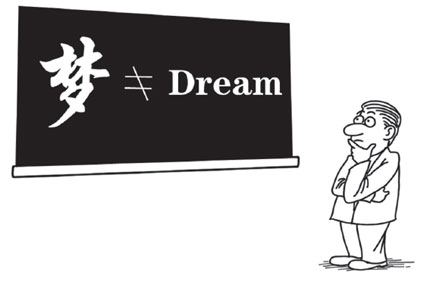
Many Western commentators translate Zhongguo Meng as “Chinese Dream,” thereby patronizing China’s socio-cultural originality and marketing it as a franchise of the “American Dream.”
But are the two civilizations really sleeping on the same pillow?
What is that – a “China Dream”- if not first a Western translation?Few people in China actually said “dream.” That’s because they speak Chinese in China.
The difference between what Western media thinks China dreams and what China actually says is of great significance for the future global language.
China should compete for her names as she competes for everything else.
Dream vs Meng
Everyone has heard about the brand “American Dream,” which – if US policy makers’ wishes came true – was now being replicated by the Communist Party of China to better the lives of the people.
As if China could not draw up designs on her own; as if a “China Dream” had to have its epistemological roots in the West, only to be shipped under US trademark to Asia, a ship full of freedom, equality, Hollywood, McDonalds, and other Occidental technicalities.
Certainly, many Chinese people may pay lip service to oneness (tian ren he yi) and great harmony (da tong), as they work hard, study vigorously and try to climb out of poverty. (A common joke goes that the “Beijing Dream” is about clean air and water.) But we leave that here for now.
Zhongguo Meng is about achieving the rejuvenation of the Chinese nation back to its former pomp, an element that is strikingly missing in the “American dream.”
Meng is what the Chinese dream, and let us not forget that China has memories of dynasties and emperors, of rujia, fojiao, and daojiao (Confucianism, Buddhism, and Taoism), and that she is a spiritual wenming, a category beyond the narrow European definitions of nation, state, culture, and civilization.
Little wonder then that meng is attached to centuries of a very different quality and color than that of America.
Confucian values and priorities differ from Puritan ones. East Asia has a unique tradition of shengren and junzi: archetypes of wisdom as unique as, say, philosophers and saints. Chinese promote xiao (filial piety), xue (the love for learning), li (ritual) and thousands of other non-European concepts.
Translation distorts reality
We would all see Chinese “creativeness” crystal-clearly, if translation was put on hold, if only for a few years. Translation is a human strategy – older than the stone age – to annihilate one’s opponent beyond the mere physical removal of his body from the world.
That’s why, by the way, linguists speak about the “death” of cultures. It was never meant to be just a metaphor.
Some scholars have argued with me that English is entirely sufficient to describe China. After all, it’s just anyone’s “dream,” right?
That not only shows disregard for new knowledge; it is also a cultural death threat against Asia.
The West only sees China through – often biblical and philosophical – European translations, and because all European vocabularies look familiar to Westerners, it has often been concluded, prematurely, that China was some place of zero originality.
As if the Chinese people for the last 3,000 years didn’t invent a thing.
It is often claimed that before the arrival of the Europeans the Chinese had no sense of intellectual property rights.
This “cultural weakness” is observable every second in China as some Chinese compatriot gives away his name to some foreign company: “You can call me Mike, ok?”
Of course, that’s all history and we cannot change the past. But China must tighten security to its genius and should accommodate the global future: If Meng were to become a key Chinese terminology of the 21st century, why translate it as American?
Does this look Western to you – 中国梦? No? That’s because it isn’t.
Thorsten Pattberg is research fellow at The Institute for Advanced Humanistic Studies at Peking University. He can be reached at pattberg@pku.edu.cn.
Editor’s note:
Dear readers, you are welcome to write for us about your own Zhongguo Meng? what you dream to do while in China.
 About bambooinnovator
 Bamboo Innovator