If Cable Is Dying, Why Is It Still Making So Much Money?
June 27, 2013 Leave a comment
If Cable Is Dying, Why Is It Still Making So Much Money?
By Derek Thompson
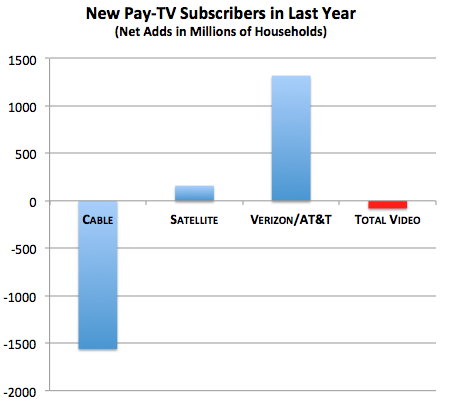
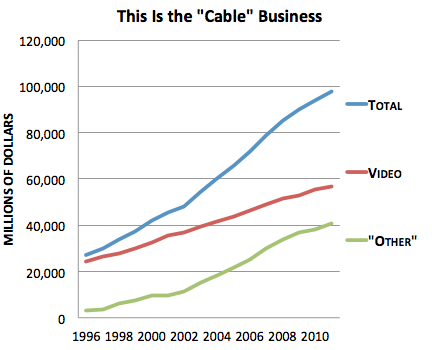
Every few weeks, some tech writer holds up a media analyst report allegedly showing, once and for all, that the cable guys have finally lost, and the cord-cutters have finally won. One week, that report might come. It will really be something. This is not that week. Let’s start with news that might appear to be the death throes of cable. Cable companies’ TV subscribers collapsed by more than 1.5 million in the last year, according to Leichtman Research Group. (The Big Two, Comcast and Time Warner Cable, have declined by more than 900,000, alone.) In fact, the trend has been underway for a while. Cable TV customers peaked in the late 1990s and have since fallen to early Clinton-era levels (SNL Kagan data) But the cable companies aren’t exclusively in the business of selling TV. They’re really in the business ofcommunications infrastructure, which is TV, phone, and Internet. The Internet business in particular has done very well for them. Since cable video subs peaked in the late 1990s, the industry has added 45 million high-speed Internet customers (SNL Kagan data, again). The two most important reasons why cable is still making more and more money every year, despite a structural decline in cable TV subs, is that they’ve successfully gleaned more money per customer: both by charging more for television and by getting households to buy more than just TV. For example, 40 percent of Comcast customers take three products (e.g.: video, phone, and Internet) and 70 percent take two products (e.g.: video and Internet). Cable ≠ video, and nothing says it more clearly than the latest earnings reports from the Big Two:Comcast, the largest provider of pay-TV in the country; and Time Warner Cable, the second largest cable provider (but behind DirecTV and Dish in total video subs). Comcast’s total revenue is almost twice TWC’s, but their businesses are remarkably similar. Upshot: If you equate “cable” with TV, you are literally getting only half the story. Cable providers are in the business of communications transport. They’re still in business because selling communications access is still a pretty good business, with high barriers to entry and voracious demand.

 About bambooinnovator
 Bamboo Innovator