The Middling Kingdom: By 2030, China will have more people over 65 than the U.S. has people. It stands to be the first global power to get old before getting rich
June 27, 2013 Leave a comment
June 26, 2013, 4:27 p.m. ET
The Middling Kingdom
By 2030, China will have more people over 65 than the U.S. has people. It stands to be the first global power to get old before getting rich.
HOWARD FRENCH
Outside of world wars and market cataclysms, the relative trajectories of major powers usually trace gradual curves rather than abruptly rising or falling. After the 2008 financial crisis, however, commentators in China and to a lesser extent in the West suggested that the U.S. had hit an inflection point. China, they said, was zooming toward parity as a world power, and perhaps more.
In recent months, for somewhat less obvious reasons including Beijing’s increasing pushiness in East Asia and the country’s just-completed once-a-decade leadership transition, this conversation has been shifting again, at least in the West. America’s relative decline is anything but assured, many analysts have begun to proclaim, with some adding that China’s rise to global pre-eminence any time soon is highly unlikely.Timothy Beardson’s sprawling “Stumbling Giant: The Threats to China’s Future” joins a far-ranging group of books making the latter case. Edward Luttwak, in his 2012 book, “The Rise of China vs. the Logic of Strategy,” for example, argues that what he calls China’s “all-round military aggrandizement,” coupled with the country’s very fast economic growth, is essentially self-canceling. If China continues along this path, with double-digit increases of military expenditures and ever more assertive behavior, the result will not be a stronger China but rather a country increasingly countered by balancing neighbors and more distant powers.
In his recent “China Goes Global: The Partial Power,” David Shambaugh, one of America’s foremost scholars of Chinese affairs, performed perhaps the most comprehensive examination of China’s strengths and weaknesses, concluding that “the elements of China’s global power are actually surprisingly weak and very uneven” and that “China is not as important, and it is certainly not as influential, as conventional wisdom holds.”
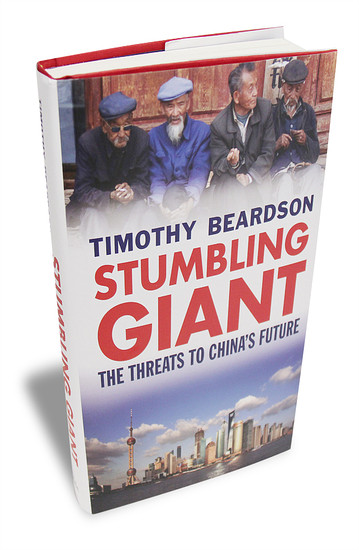
Stumbling Giant
By Timothy Beardson
(Yale, 517 pages, $35)
In “Stumbling Giant,” Mr. Beardson, a banker with long experience in East Asia, argues that a combination of terrible demographics and conservative, reform-averse leadership makes it unlikely that China will ever attain world leadership or superpower status.
By 2030, China will have more people over the age of 65 than the U.S. has people, and its working-age population is already beginning what will be a steep and hard-to-manage decline. When the U.S., Japan and South Korea attained levels of aging similar to China’s today, Mr. Beardson writes, “they each had a per capita GDP of around $15,000; the figure for China in 2011 was about $4,300.”
The actuarial implications of this are staggering. China stands to become the first aspiring global power that becomes old before it can become rich. As citizens of Japan, Northern Europe and, increasingly, the U.S. well know, it is hard for even high-income countries to meet the health and retirement burdens of the elderly.
This task will be vastly more difficult, Mr. Beardson argues, for China, a country with a meager social safety net. In a couple of decades, it will have hundreds of millions of citizens with expensive chronic diseases and perhaps 150 million people in need of institutional care.
“China has a limited window of opportunity—maybe twenty years—to make its economic breakthrough. Otherwise it risks being caught in a ‘middle income’ trap,” Mr. Beardson writes in the introduction. Toward the end, he writes that “China can continue to rise but the threats [it faces are] so serious and so widespread, and the domestic policy response so timid, that it is inconceivable that China will overtake the United States this century.”
These are reasonable, if debatable, observations, however lacking in originality or particular insight. But most of the book is a woolly compendium of bric-a-brac gleaned from research, years of reading and plentiful surmise. Mr. Beardson’s book aims to be even more comprehensive than Mr. Shambaugh’s, though he brings none of the discipline of a scholar to his task. “Stumbling Giant” has the encyclopedic feel of something from a bygone century, when isolated thinkers committed everything they had learned about the universe to a single book.
Mr. Beardson holds forth on subjects as varied as land tenure, education, dynastic history and science. Sometimes the results are provocatively interesting, such as his claim that the emergence of large international concessions in cities like Shanghai and Tianjin in the late 19th century—an aspect of what China speaks of today as a “century of humiliation”—”constituted the largest cultural transfer in human history,” with Western traders and industrialists providing invaluable knowhow in industry and finance. That China suffered humiliation is undeniable, but this claim is a refreshing counterpoint to the manipulatively nationalistic way in which the history of this era is taught in China.
Much more often, one is left bewildered or simply numbed. At one point, Mr. Beardson writes that China “has never been at the center of world affairs.” For most of world history, no country was, but for centuries China, the center of gravity for much of Asia, came as close to meeting this standard as any. Sub-chapters, meanwhile, often begin with banal observations like “There are many different views of the years from 1949 until Mao’s death in 1976” and “There is a potential in China for further major change in Party, state and nation.”
Worse, though, is the pretense of expertise in virtually everything as the author rambles from subject to subject. This has the perverse effect of robbing any particular argument of authority. “This is not an encyclopedia of modern Chinese civilization,” Mr. Beardson writes. “It does not celebrate all the many achievements of China in science and medicine, contemporary art, commerce, cuisine, sport or space.” Amid the huge catalog of topics glancingly touched upon, it’s a wonder that he left these out.
Mr. French teaches at the Columbia University Graduate School of Journalism. His next book is “China’s Second Continent: How a Million Migrants are Building a New Empire in Africa.”
 About bambooinnovator
 Bamboo Innovator