Behind the Krispy Kreme turnaround; The doughnut chain has slowly repaired its business and built a foundation that it hopes will protect it against future blow-ups
June 28, 2013 Leave a comment
Behind the Krispy Kreme turnaround
June 27, 2013: 12:23 PM ET
The doughnut chain has slowly repaired its business and built a foundation that it hopes will protect it against future blow-ups.
By Beth Kowitt, writer
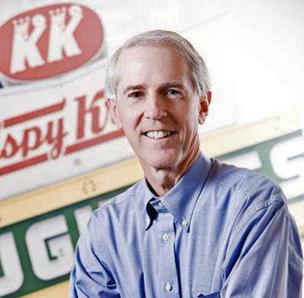
FORTUNE — It was only after three years of year-over-year revenue and gross profit growth, 18 consecutive quarters of same-store sales increases, and an eight-year high on the stock that Krispy Kreme Doughnut’s (KKD) executives finally turned to one another and acknowledged that they had turned the company around. The hesitant optimism at the doughnut enterprise, best known for its Original Glazed doughnut, is understandable. Krispy Kreme had been a growth company before — until it imploded in the mid-2000s. Profits tumbled after the company grew too quickly, and an SEC investigation of its accounting practices led to high-level departures. A previous unsuccessful turnaround attempt led to talk of having to sell the chain. “It was just a constant turmoil of, ‘is the company going to make it?'” says CFO Doug Muir.Krispy Kreme’s anxious past has informed the company’s current strategy, which has been predicated on slowly repairing the business and building a foundation that protects against future blow-ups.
“That’s a big perception and fear out there on the part of the public,” says CEO Jim Morgan. “We’ve learned an awful lot from the past. From day one, we told shareholders, ‘we are not the place to be if what you want is sudden fortune.'” Morgan, who became CEO in 2008, witnessed the turmoil first-hand as a board member since 2000.
The company just committed to a U.S. expansion effort for the first time in a decade. “People thought we were gun shy, too cautious,” Muir explains. “We said, ‘When we’re ready. We’re not gun shy. We’re prudent. We watched this thing blow up last time.'”
International growth helped carry Krispy Kreme as management rebuilt its U.S. market. The doughnut chain now has 532 stores in 21 countries outside the U.S., in addition to its 241 U.S. stores. Saudi Arabia and Mexico are its biggest markets by store count after the U.S.
In the U.S., Krispy Kreme refurbished its stores and rethought its model for new locations. The original Krispy Kremes had retail in the front, manufacturing in the middle, and a loading dock in the back to deliver to the wholesale market — think big-box and convenience stores. The stores, some of which were 5,000 to 6,000 square feet, made sense during the Krispy Kreme craze, when opening weeks brought in $200,000 in retail and wholesale was a bigger part of the business. (A Krispy Kreme factory store typically does $35,000 a week in sales, excluding wholesale.)
The new store format, of which there will be seven by the end of the year, will have smaller footprints of around 2,300 square feet. They’ll be retail only, no wholesale component, which will allow managers to run a simpler operation that focuses on the consumer.
With less than 300 stores in the U.S., Krispy Kreme is more of a destination concept than one of convenience. But smaller stores with lower overhead will make it easier to open new locations, making the brand more accessible to its customers. The company is also looking into special venues — serving transportation hubs, such as its only New York City location in Penn Station, or sporting arenas like its spot in the Bank of America Stadium in Charlotte, N.C., CEO Morgan’s hometown.
As a result of the new, retail-only store approach, wholesale is shrinking as a percentage of Krispy Kreme’s total business. The company eventually wants to come up with a longer shelf-life product for the wholesale market. Its Original Glazed doughnuts are, at best, good for 48 hours, which isn’t conducive to a long supply chain.
Beyond store format, the company still has a long to-do list. Muir and the marketing team are working on getting the technology in place to support a loyalty card program. Rather than rolling out new menu options, which the company says it will do eventually, it’s trying to focus on giving people more reasons to eat doughnuts — or “creating more doughnut occasions,” as Morgan likes to say.
Krispy Kreme is also pushing into beverages with a revamped coffee line. “We’re never going to be Starbucks or Dunkin’ or McDonald’s in terms of how powerful beverage can be,” Morgan said, but he would like to take beverages from 12% of the business to 20%.
The one thing Morgan and his cohort didn’t have to fix? The doughnuts. “We inherited an incredible brand,” he says.
Krispy Kreme has been somewhat of a trail-glazer, you might say.
Founded in 1937, the company will be celebrating its 75th anniversary this week with celebrations in the Triad and nationwide. I sat down with Krispy Kreme Doughnut Corp. CEO Jim Morgan this week and talked about the Winston-Salem-based doughnut maker’s determined efforts to grow domestically and internationally and to better market its coffee and other beverages as well.
Krispy Kreme — which has 4,000 employees, 550 of whom are in the Triad —has had a bumpy ride over the past decade. The company (NYSE: KKD) went from Wall Street darling after its 2000 IPO to financial troubles just four years later that were at least partially a result of expanding too quickly.
Today, the company appears poised for smarter growth and is gaining market share and improving profit margins under Morgan’s leadership.
You can read just a bit of what Morgan shared with us below. The rest of the interview is available in Friday’s print edition of The Business Journal.
Krispy Kreme plans to nearly double the number of international stores from 460 to 900 by fiscal year 2017. Why is this strategy working? You give credit to the brand. Where we go people are lined up to be there. It’s amazing. You wouldn’t think Thailand would even be aware of it, but for many weeks there was always a line at that shop. When you look at the potential in places like China and India, it’s pretty enormous. It’s kind of exciting to see that even though it’s the biggest part of who we are, it’s nowhere near a mature stage. There are years and years of growth out there for us.
What’s been the customer response overseas? It seems to really hit the international palate by and large. Secondly, they really see it as an experience. You can tell at the opening when they line up and get excited. We’ve done a great job of adapting some of the flavors and fillings and icings to local tastes and local palates. We become a part of their culture and that’s why it’s very critical to partner with the franchisee, who is absolutely ingrained in that culture and who is knowledgeable and can bring those thoughts and ideas and suggestions to us.
Regarding domestic market growth, what are your expectations? I almost want to talk in terms of the coming decade. If you look at the time between now and 2020, for example, I think we’ll all be disappointed if we don’t have some multiple of stores than we have now. We will probably replicate to some degree the international model in having a number of “fresh” shops in the more urban areas. We have a fresh shop in Penn Station [in New York City], pedestrian traffic coming by, coffee-and-a-doughnut, and a little bit of a different model than most of our stores here where it’s free-standing factory.
Krispy Kreme expects to triple coffee sales to 12 percent of company sales over the next three years, taking total beverage sales up to 20 percent of store sales. Do you think coffee and doughnuts sales will eventually be 50/50? I don’t think so. A lot of our doughnuts are sold by the dozens, it’s the biggest part of our business. Over 50 percent of our transactions are by the dozen or more. And we want that. I am very aware of successful models that other quick-service restaurants have where beverage is very, very dominant and do extremely well. McDonald’s has gone that route, Starbucks obviously, Dunkin’ Donuts.
Favorite doughnut? You give me a hot glazed right off the curve and that’s still my flavor.
 About bambooinnovator
 Bamboo Innovator