French auto maker Peugeot Citroën woes reflect a broader problem in Europe, where countries promoted national car champions, and delayed meaningful restructuring
June 28, 2013 Leave a comment
June 27, 2013, 11:56 a.m. ET
Peugeot’s Troubles Are Piling Up
French Car Maker Said to Have Approached GM for Assistance
SAM SCHECHNER, DAVID PEARSON and JEFF BENNETT

French auto maker PSA Peugeot Citroën UG.FR +5.47% is running out of ways to cope with a steep sales slide and expanding losses.
One potential ally, General Motors Co., GM +1.69% on Thursday said it has no current plan to invest additional funds in the family-controlled auto maker, its latest refusal to get involved in a potential rescue.
People familiar with the matter said Peugeot in recent months had asked its U.S. development partner to inject more cash. GM has considered buying some smaller pieces, such as its powertrain operations, but has made no decisions, some of those people added.Peugeot has been exploring other avenues. In recent months, the French company talked to its Chinese partner, Dongfeng Motor Corp., about taking a potential stake in Peugeot or extending an industrial alliance, another person familiar with the matter said. It remains unclear if those talks will advance.
“We have no intention of investing additional funds into PSA at this time,” a GM spokesman said in an email on Thursday. A Peugeot spokesman declined to comment, saying “We don’t comment on rumors.” Dongfeng couldn’t be reached for immediate comment.
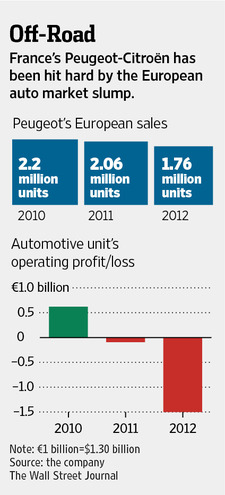
The lack of a clear new deal leaves Peugeot—Europe’s second-largest auto maker—with dwindling options to turn itself around. In the battered European market where automobile sales are at a 20-year low, Peugeot’s sales in the first five months of this year were 14% below the year-earlier period. The company has been losing market share steadily to rivals such as market leader Volkswagen AG VOW.XE +1.01% of Germany. PSA’s 11% share in the first five months was a full percentage point lower, year-to-year.
PSA consumed €3 billion ($3.9 billion) in cash last year, and has said it plans to reduce that spending rate by half this year, a task that could be complicated by diminishing sales.
So far, Peugeot has responded to the European financial crisis by proposing to cut 11,000 jobs and renegotiate labor pacts. It also struck a deal with GM last year to sell the American company a 7% stake for about $400 million and to share development costs for a new round of vehicles. A person close to Peugeot said the company is on track to meet its guidance for cash utilization this year.
GM went into the Peugeot alliance last year with the objective of reviving its money-losing Opel unit, which also has been hit hard by the European downturn and excess production capacity. But the partnership deal is taking longer to get started than expected, and some of the joint-venture’s plans haven’t materialized, a source of tension between the two companies, according to people familiar with the matter.
There is debate inside Peugeot whether its efforts will be enough to stem the red ink if the market doesn’t recover, say people familiar with the discussions.
There also is concern in the French government, which would like to avoid having to buy a stake in the company, said people familiar with the matter.
“They’re burning cash, and even if they have a big cushion, I just don’t see it stopping anytime soon,” said one person familiar with the discussions at the French government. France already owns a stake in Peugeot rival Renault RNO.FR +0.27%SA.
Any new investment likely would dilute the control of France’s Peugeot family, which is increasingly willing to let it go if necessary, according to people familiar with the matter. The family, which founded the company in the early 19th century holds roughly 38.1% of the shareholder vote.
“They know they are going to lose control. It is just a matter of when,” said a person close to the company.
Reuters earlier reported the family’s willingness to give up control and the approach to GM.
Family control has been part of the problem. For two centuries, the Peugeot family has jealously guarded the company’s independence, in recent decades spending billions on stock buybacks to boost its control, while stifling deals that could have expanded the company’s scope beyond Europe.
The company and family championed a strategy of one-off deals with competitors including Toyota Motor Corp. 7203.TO +1.02% and Fiat SpA, F.MI -0.18% giving itself the vehicle lineup of a bigger company without resorting to alliances that would have threatened its independence. That has left Peugeot with good technology, but too few of its own customers outside Europe, up against increasingly global competition.
Peugeot’s woes also reflect a broader problem in Europe, where countries promoted national car champions, and delayed meaningful restructuring. The European approach contrasts radically with that of the Obama administration, which in 2008 and 2009 agreed to rescue GM and Chrysler Group LLC on condition that they slash jobs and close plants in bankruptcy restructurings. Today, both companies are out of bankruptcy, solidly profitable and Chrysler is majority owned by Fiat.
 About bambooinnovator
 Bamboo Innovator