China could reform its state businesses by stealth

June 27, 2013 7:08 pm

China could reform its state businesses by stealth

By Nicholas Lardy

Raising rates will force weak enterprises to sell assets, be taken over or give up, says Nicholas Lardy

Short-term interest rates in China’s interbank market jumped to historic highs last week. As well as creating turmoil in markets around the world, the move raised questions about the competence of the country’s management of monetary policy, its growth prospects and the trajectory of economic reform under the new leadership of President Xi Jinping and Li Keqiang, prime minister. Read more of this post

Asia faces test of faith as crisis deepens; The trouble with hidden leverage is that it doesn’t stay hidden forever

June 27, 2013 10:04 am

Markets Insight: Asia faces test of faith as crisis deepens

By Henny Sender

Fed tapering plans and China slowdown are already hurting

Brokerage houses are working full time to print charts showing that the emerging markets of Asia are in much better shape to withstand the end of the US Federal Reserve’s easy money policies than they were in 1997 when the Asian financial crisis was formally inaugurated with the devaluation of the Thai baht on July 2 of that year.

Their favourite shows that all the basket cases of 16 years ago now have foreign exchange reserves that are twice as large as their short-term debt. Read more of this post

Monthly Economic Data Aren’t Reliable; The Fed charts policy based on constantly shifting jobs numbers

June 27, 2013, 7:45 p.m. ET

Monthly Economic Data Aren’t Reliable

The Fed charts policy based on constantly shifting jobs numbers.

SAMUEL RINES

Today, nearly every useful U.S. economic indicator—from GDP growth to employment to housing data—is incorrect when it is initially released. Better data do become available, and revised estimates are made public as time passes. But economic policy and business decisions are made with initial data that are plainly inaccurate—and this can lead to mistakes, including hasty changes in direction.

In October 2008, the annualized change in GDP for the third quarter (July-September) was initially reported by the government at -0.3%. The initial GDP estimate for the fourth quarter was -3.8% and then -6.1% for the first quarter of 2009. Finally, the initial GDP estimate for the second quarter of 2009 provided a sigh of relief at -1%. That sequence of numbers seemed more like a typical downturn. Read more of this post

Minsheng Bank tells the story of Beijing’s credit worries

Minsheng Bank tells the story of Beijing’s credit worries

Thu, Jun 27 2013

By Lawrence White and Michael Flaherty

HONG KONG (Reuters) – The funding crunch prompted by China’s central bank was meant to teach a lesson to the Chinese banks that continue to embrace risky lending tactics. A look at the funding and loan figures at mid-sized lender China Minsheng Banking Corp. (600016.SS: QuoteProfileResearch) helps explain why the People’s Bank of China (PBOC) made its move. The PBOC’s refusal to inject cash into the money market system last week caused a spike in inter-bank lending rates. Suddenly, banks used to borrowing at 3 percent saw the rate at which their peers would lend to them jump as high as 25 percent.

Read more of this post

French auto maker Peugeot Citroën woes reflect a broader problem in Europe, where countries promoted national car champions, and delayed meaningful restructuring

June 27, 2013, 11:56 a.m. ET

Peugeot’s Troubles Are Piling Up

French Car Maker Said to Have Approached GM for Assistance

SAM SCHECHNER, DAVID PEARSON and JEFF BENNETT

MK-CE341_PEUGEO_NS_20130627181811MK-CE342_PEUGEO_NS_20130627173904

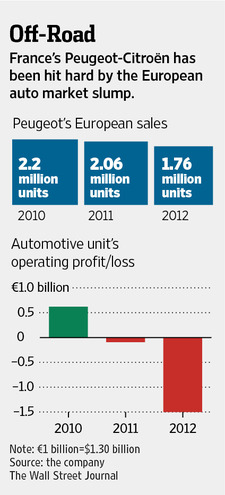
French auto maker PSA Peugeot Citroën UG.FR +5.47% is running out of ways to cope with a steep sales slide and expanding losses.

One potential ally, General Motors Co., GM +1.69% on Thursday said it has no current plan to invest additional funds in the family-controlled auto maker, its latest refusal to get involved in a potential rescue.

People familiar with the matter said Peugeot in recent months had asked its U.S. development partner to inject more cash. GM has considered buying some smaller pieces, such as its powertrain operations, but has made no decisions, some of those people added. Read more of this post

China’s Reform Moment: The Communist Party can’t afford to cling to a broken status quo

June 27, 2013, 12:09 p.m. ET

China’s Reform Moment

The Communist Party can’t afford to cling to a broken status quo.

The recent credit crunch in China has highlighted the need for financial reform. But lurking behind this drama is a bigger story: All of China’s economy is nearing a growth and reform watershed. The question is whether Beijing’s new leaders are willing to give up some political control to maintain the growth they need to retain political legitimacy.

The problem is that China’s old economic model is running out of steam. Growth slowed to 7.7% last year, a 13-year low, and then to 7.3% for the first three months of this year. HSBC‘s HSBA.LN +0.72% latest survey of manufacturing sentiment found the most pessimistic outlook in nine months, with companies expecting more rapid economic deterioration. Indicators such as slack domestic shipping and electricity consumption point to greater weakness than the official GDP data suggest. Read more of this post

Google Inc. is developing a videogame console and wristwatch powered by its Android operating system

Updated June 27, 2013, 6:07 p.m. ET

Google Is Developing Android Game Console

AMIR EFRATI

Google Inc. GOOG +0.39% is developing a videogame console and wristwatch powered by its Android operating system, according to people familiar with the matter, as the Internet company seeks to spread the software beyond smartphones and tablets.

With the game machine and digital watch, Google is hoping to combat similar devices that Apple Inc. AAPL -1.08% may release in the future, according to the people.

Google is also preparing to release a second version of an Android-powered media-streaming device, called Nexus Q, that was unveiled last year but not sold to the public, these people said. Read more of this post

Loans Make A Comeback As Bonds Fade in Asia

June 27, 2013, 2:01 p.m. ET

Loans Make A Comeback As Bonds Fade in Asia

PRUDENCE HO And FIONA LAW

Loans, once the preferred fundraising tool for Asian companies, are back in favor.

Asia’s loan market took a back seat to bonds last year, as investors seeking yield at a time of low interest rates piled into emerging-market bond funds. Now, with interest rates heading up, raising money with bonds is getting expensive and bankers say companies are looking to loans instead.

For their part, Asia’s cash-rich banks are more willing to lend than they were in the wake of the European debt crisis. Many of the European banks that retreated from emerging-market lending two years ago are coming back as lenders in the region. Read more of this post

Cheap money can’t buy a strong economy

Cheap money can’t buy a strong economy

By Robert J. Samuelson, Published: June 24

We are now discovering the limits of cheap money.

For more than four years, central banks around the world — led by the Federal Reserve — have aggressively pumped money into their economies to stimulate faster revival. These infusions are huge. From 2007 to today, the assets of major central banks nearly doubled from $10.4 trillion to $20.5 trillion, reports the Bank for International Settlements (BIS) in its just-released annual report. When these assets (bonds, mortgages and other financial instruments) are purchased, the sellers receive cash. The outpouring of cash aims to lower interest rates, push up stock prices and real estate values, and restore confidence and stronger economic growth. Read more of this post

Time to declutter annual reports, says accounting rule setter

Time to declutter annual reports, says accounting rule setter

7:52am EDT

LONDON, June 27 (Reuters) – A global accounting standard setter has pledged a bonfire of the boilerplates to rid annual company reports of unnecessary disclosures that confuse investors.

Hans Hoogervorst, chairman of the International Accounting Standards Board (IASB), said book-keeping rules will be changed to cut swathes through irrelevant sections of ballooning annual statements. Read more of this post

Hong Kong Stocks Fail to Lure JPMorgan With Worst Developed Drop

Hong Kong Stocks Fail to Lure JPMorgan With Worst Developed Drop

Hong Kong stocks are set for the biggest decline among developed markets this half as concern about China’s economy drives valuations 22 percent below the five-year average.

The Hang Seng Index tumbled 9.8 percent in 2013, trailing the Standard & Poor’s 500 Index by the most in 15 years and wiping more than $145 billion from the value of shares. The losses dragged the gauge’s valuation to 9.7 times estimates earnings, compared with a five-year average of 12.5, according to data compiled by Bloomberg. Read more of this post

Japan Institutions Cut Shares to New Low in Snub to Abe

Japan Institutions Cut Shares to New Low in Snub to Abe

Japan’s biggest quarterly rally in 25 years did little to entice institutional investors, whose stock holdings fell to the lowest proportion of overall holdings ever in March.

The country’s insurers, lenders and trust banks pared their Japanese shares to 28 percent of total market value, the lowest ever, as of March 31, according to Japan Exchange Group Inc. (8697) Holdings have fallen from a peak of 44.1 percent in 1988. Fukoku Mutual Life Insurance Co. and Sompo Japan Nipponkoa Asset Management Co. are betting Prime Minister Shinzo Abe’s policies will fail to defeat deflation or restore sustainable growth. Read more of this post

Junk Bonds Drop Below Par as Asia Suffers China

Junk Bonds Drop Below Par as Asia Suffers China: Credit Markets

For the first time since August, junk bonds are trading below par amid speculation that companies will have a harder time meeting debt payments as the Federal Reserve prepares to reduce its extraordinary stimulus measures and China reins in its shadow-banking system.

Average prices on speculative-grade corporate notes dropped to 99.42 cents on the dollar on June 25, from a record 106.04 cents in May, according to Bank of America Merrill Lynch’s Global High Yield Index. The declines were led by Asia, which saw prices tumble to 97.2 cents, the lowest level in a year. Read more of this post

Four Milestones Made U.S. the World’s Craft Beer Champ

Four Milestones Made U.S. the World’s Craft Beer Champ

The Brewers Association, the main trade group for U.S. beer-makers, announced June 20 that the number of American breweries had surpassed 2,500, more than at any time since at least the 1880s and more than in any other nation.

The vast majority (more than 2,300) are craft breweries, independently owned companies that make beer on a small scale using traditional ingredients. There are also, according to the association, as many as 1,559 breweries in the planning stages, most of them craft.

This growth shouldn’t be surprising, given that craft beer’s share of the $99 billion U.S. beer market increased to $10.2 billion in 2012, from $8.7 billion in 2011. Read more of this post

Apps for Kids Are Data Magnets; FTC Rules to Kick In

June 27, 2013, 8:02 p.m. ET

Apps for Kids Are Data Magnets; FTC Rules to Kick In

JEREMY SINGER-VINE and ANTON TROIANOVSKI

MK-CE345_KIDAPP_G_20130627183305

While 7-year-old Eros ViDemantay played with a kid’s app on his father’s phone, tracing an elephant, behind the scenes a startup company backed by Google Inc.GOOG +0.39% was collecting information from the device—including its email address and a list of other apps installed on his phone.

“My jaw dropped,” says Lee ViDemantay, Eros’s father and a fifth-grade teacher at the Los Angeles Unified School District. “Why do they need to know all that?” The app, called “How to Draw—Easy Lessons,” also sent two of the phone’s main ID numbers. Read more of this post

Momo: With 40 Million Users, China’s Top Flirting App Adds Stickers, Virtual Currency, and VIPs

Momo: With 40 Million Users, China’s Top Flirting App Adds Stickers, Virtual Currency, and VIPs

June 28, 2013

by Steven Millward

Momo-App-Adds-Stickers-Virtual-Currency-and-VIPs

Momo, China’s top flirting and hook-up app, has updated to v4.0 on both iPhone and Android and added a bunch of new features – all of which are aimed at monetization.

Ever since we first looked at Momo in late 2011 the app has been fairly minimal (in a good way), but the new raft of features adds a lot more to the dating app. The biggest departure for the app – which has just surpassed 40 million users – is an optional VIP membership that costs $2 for one month, or a cheaper annual package is $17. As a VIP Momo user, you get useful things like telephone support, the ability to follow more than 100 people, extra avatar options, and lots more. Read more of this post

Artist Growth wants its data-analytics software to become a one-size-fits-all financial tool for the music industry

Artist Growth’s Management Software for the Music Business

By Adam Satariano on June 27, 2013

http://www.businessweek.com/articles/2013-06-27/artist-growths-management-software-for-the-music-business

From Napster to Spotify and Rdio, there’s been no shortage of innovation in digital music services. Not so when it comes to business-side tasks such as managing ticket sales, touring expenses, or an artist’s array of social media accounts. Financial management software made by companies such as Oracle (ORCL) and Salesforce.com (CRM) hasn’t really clicked with musicians and record label executives because it isn’t tailored to the music industry, says Scott Booker, the manager of psychedelic rock band the Flaming Lips. “People who are creating software don’t typically understand the intricacies of how the music business works,” says Booker, who’s also the chief executive officer of the Academy of Contemporary Music at the University of Central Oklahoma. “We all do things in a haphazard way.” Read more of this post

Innovation: JPEGmini Shrinks Photo Files Without Sacrificing Quality

Innovation: JPEGmini Shrinks Photo Files Without Sacrificing Quality

By Caroline Winter on June 27, 2013

Innovators: Sharon Carmel and Dror Gill
Ages: 42 and 46
Founder/CEO and CTO of Beamr, a Tel Aviv-based media technology company

Form and function
An image compression technology that radically reduces the file size of photographs (and soon videos) without sacrificing quality perceptible to the human eye. “We take an image, make it five times smaller, but always guarantee that the JPEGmini image looks exactly like the original.” —Dror Gill

tech_innovation27__01__950


Your Guide to China’s Fabs, or Chinese Online Design Goods Retailers

Your Guide to China’s Fabs, or Chinese Online Design Goods Retailers

By Tracey Xiang on June 20, 2013

I hate to write about ‘Chinese copies’ or ‘China’s XXX’. But you’d be urged to write about China’s Fabs when Tencent, the Chinese Internet giant, invested in the US company. There are Chinese services, such as Xipin, that did claim they were ‘China’s Fabs’. However we cannot count all the online design goods retailers as Fab copies.

To be fair, unlike services such as group-buying, you don’t have to copy Fab in order to sell designer goods online or pivot now and then. Some of the sites I’d list in this post started with Etsy model and later added flash sales or other services. What I feel sorry to tell you is that their webpages look alike in layout and the only difference I can tell between them is goods they sell. Read more of this post

Marc Andreessen: Beijing Should Be Another Silicon Valley, But….

Marc Andreessen: Beijing Should Be Another Silicon Valley, But….

KIM-MAI CUTLER

posted 3 hours ago

Marc Andreessen, the Netscape co-founder and namesake behind venture capital firm Andreessen Horowitz, said that he’s skeptical that efforts globally to recreate the Silicon Valley ecosystem will succeed.

Even the most promising city and rival to the U.S.’s Silicon Valley, Beijing, faces lots of potential complications because laws around contracts aren’t as straightforward as they could be, he said. Outside of the U.S., Beijing is one of the cities that is able to consistently produce tech giants like Baidu (although Alibaba’s headquarters are in Hangzhou and Tencent is based in Shenzhen). Read more of this post

Seriously, why is software so hard for non-software companies?

Seriously, why is software so hard for non-software companies?

BY SARAH LACY 
ON JUNE 27, 2013

Becoming a Web business isn’t as easy as it looks. Take the weight loss giant Jenny Craig. I’m on my second day of the program in an effort to lose baby weight. I picked Jenny Craig, because I know people who’ve had success on it, and I love the idea of someone else planning meals for me. Part of the reason I can’t eat more healthy is my busy schedule.

Going into the strip mall weight loss centers was a non-starter — again, given my schedule, the fact that there’s not one near my house, and that it arbitrarily closes early on certain days. Fortunately we live in an era where software is eating the world. Read more of this post

DirecTV, which Buffett’s Berkshire owns 3.8% with investment cost at $45.9 per share, Overstated Its Brazilian Subscribers by 200,000

DirecTV Overstated Its Brazilian Subscribers by 200,000

DirecTV (DTV), the largest U.S. satellite-TV provider, will take a pretax charge of $25 million after an internal investigation found that it had overstated subscriber numbers in Brazil by hundreds of thousands. The shares fell. Beginning in 2012, some Sky Brasil employees improperly credited customer accounts to reduce or eliminate churn, the El Segundo, California-based company said in a filing. The number of Sky Brasil subscribers on December 31 was about 100,000 lower than previously reported to Brazilian regulators and 200,000 lower than cited on March 31, the company said. DirecTV, which had considered buying Vivendi SA’s Brazilian phone and Internet unit before withdrawing from a bidding war in March, reported a record number of Latin American customers in the first quarter. Gross additions in the region jumped 14 percent to 1.2 million in the first quarter, driven by demand in Brazil, Argentina and Colombia. Sky Brasil’s ongoing churn in Brazil will be higher than previously anticipated, the company said today. The $25 million expense covers capitalized installation costs and subscriber related equipment held by the terminated customers, according to the filing. DTV fell 3.6 percent at $58.90 at 9:39 a.m. New York time, for the biggest intraday decline since Feb. 14. Through yesterday, the shares had advanced 22 percent this year, while the Standard & Poor’s 500 Index added 12 percent.

To contact the reporter on this story: Niamh Ring in New York at nring@bloomberg.net

Square’s website for small businesses takes on e-commerce giants

Square’s website for small businesses takes on e-commerce giants

2:06pm EDT

By Gerry Shih

SAN FRANCISCO (Reuters) – Since 2010, Square Inc’s matchbox-sized card readers have steadily supplanted credit card machines in coffee shops and corner stores across the United States.

Now, the company, one of Silicon Valley’s most highly valued private firms, is diving into a market as expansive the internet itself.

Square launched a shopping website this week called Square Market to serve as an online storefront and payment processor for small businesses, a move that pits the closely held company, valued at $3.25 billion, against popular e-commerce destinations such as eBay Inc, Amazon.com Inc and Etsy. Read more of this post

Microsoft Seeks End to Dinosaur-Era Software Upgrade Cycle

Microsoft Seeks End to Dinosaur-Era Software Upgrade Cycle: Tech

Microsoft Corp (MSFT)., which for decades has refreshed its popular Office corporate software just once about every three years, says it will soon switch to weekly updates.

It’s a radical shift as Microsoft overhauls its Internet-based programs, seeking to stay in sync with the fast-changing technology industry.

For much of Microsoft’s 38-year history, infrequent upgrades made sense for businesses seeking predictable improvements. That’s changed as nimbler entrants such as Dropbox Inc., Box Inc., Jive Software Inc (JIVE) (JIVE). and Google Inc. refine features and deliver automatic updates over the Web. That tinkering has helped lure customers and put pressure on margins at Microsoft’s biggest division, which accounted for $24 billion in sales last year, or a third of the total. Read more of this post

CHART OF THE DAY: The Mortgage Rate Surge Is Unlike Anything We’ve Seen In 26 Years

CHART OF THE DAY: The Mortgage Rate Surge Is Unlike Anything We’ve Seen In 26 Years

SAM RO JUN. 27, 2013, 12:11 PM 1,074 2

The Federal Reserve’s quantitative easing (QE) program involves the monthly purchases of $85 billion worth of Treasury and mortgage bonds.  These purchases have helped keep interest rates historically low. But in the last few months, Fed officials have started talking about tapering QE some time in the near future. The bond markets have been going nuts, selling off in anticipation of the taper. And this has been causing interest rates to surge all over the world. One notable rate that’s been going crazy are mortgage interest rates. “The average 30-year fixed-rate mortgage rose from 3.93 percent last week to 4.46 percent this week; the highest it has been since the week of July 28, 2011,” said the analysts at Freddie Mac. “This represents the largest weekly increase for the 30-year fixed since the week ended April 17, 1987.” Crazy. Fortunately, the markets have been able to absorb them. “Higher mortgage rates may dampen some housing market activity but the effect will be muted by the high level of buyer affordability, and home sales should remain strong,” said Freddie Mac’s Frank Nothaft.  “For instance, existing home sales in May rose to its strongest pace since November 2009 and new home sales were the most seen since July 2008. In addition, the 12-month growth in the S&P/Case-Shiller® 20-city home price index for April of 12.1 percent was the largest since April 2006.”

moneygame-cotd-062713

Why Executive Teams Shouldn’t Write “Culture Decks”; Genuine culture is organic, not imposed

Why Executive Teams Shouldn’t Write “Culture Decks”

by Cheryl Morris  |   8:00 AM June 27, 2013

Boston is teeming with entrepreneurship. The “startup renaissance” that followed the financial crisis of 2009 has led to as many acquisitions as it has public companies.

For the founders and CEOs of many startups, the recent influx of additional tech giants to Boston like AmazoneBay, and Twitter means that hiring—especially when it comes to engineers—will become even more challenging. With far deeper pockets than early- and mid-stage startups, these tech giants will be vying for the same talent our startup ecosystem has been fostering. How can young startups continue to attract and retain great talent? One of the keys may lie in culture. Read more of this post

Behind the Krispy Kreme turnaround; The doughnut chain has slowly repaired its business and built a foundation that it hopes will protect it against future blow-ups

Behind the Krispy Kreme turnaround

June 27, 2013: 12:23 PM ET

The doughnut chain has slowly repaired its business and built a foundation that it hopes will protect it against future blow-ups.

By Beth Kowitt, writer

post-krispy-kreme-Jim Morgan-304

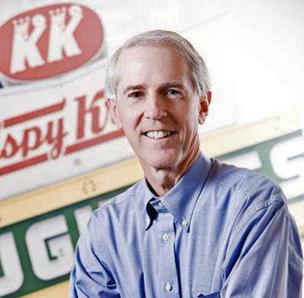
FORTUNE — It was only after three years of year-over-year revenue and gross profit growth, 18 consecutive quarters of same-store sales increases, and an eight-year high on the stock that Krispy Kreme Doughnut’s (KKD) executives finally turned to one another and acknowledged that they had turned the company around. The hesitant optimism at the doughnut enterprise, best known for its Original Glazed doughnut, is understandable. Krispy Kreme had been a growth company before — until it imploded in the mid-2000s. Profits tumbled after the company grew too quickly, and an SEC investigation of its accounting practices led to high-level departures. A previous unsuccessful turnaround attempt led to talk of having to sell the chain. “It was just a constant turmoil of, ‘is the company going to make it?'” says CFO Doug Muir. Read more of this post

The Fed Signals a Slowdown; Traders Head for the Exits; As interest rates rise, the values of bonds and popular dividend-paying stocks are falling

June 22, 2013, 8:26 p.m. ET

The Fed Signals a Slowdown; Traders Head for the Exits

TOM LAURICELLA

SJ-AG550_23LEDE_G_20130621164218 OB-XY166_23LEDE_G_20130621160958

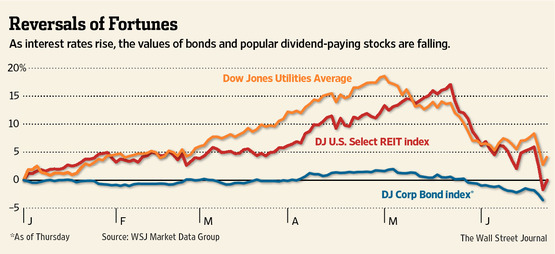
The sharp selloff in the bond market is a wake-up call for investors. But in some cases, it’s also an opportunity. Many bond market funds are now showing losses for the year: Yields have jumped sharply, and prices correspondingly have fallen, because the Federal Reserve seems increasingly likely to scale back its efforts to stimulate the economy. But more broadly, sharp selloffs in higher-yielding investments have revealed where investors may have overpaid for those income streams. That was especially the case in high-dividend stocks, such as utilities, which many investors tend to view as havens. Also taking a big hit: yield-rich real-estate investment trusts. This abrupt shift in recent weeks highlights the importance of having at least part of a portfolio positioned for rates making a sustained rise. That could include owning go-anywhere bond funds whose fate isn’t linked to rates staying low. Read more of this post

In India, Gold-Related Shares Melt Down

Jun 27, 2013

In India, Gold-Related Shares Melt Down

By Ashutosh Joshi

Gold-related Indian companies have seen their shares hammered this week, as global gold prices hit a three-year low and the Indian government’s efforts to restrict gold imports hit bottom lines.

Shares of jewelers such as Tribhovandas Bhimji Zaveri Ltd 534369.BY +0.54%PC JewellerLtd. 534809.BY +1.96%, and Gitanjali Gems Ltd. 532715.BY -9.99% have fallen by as much as 40% this week as overseas funds, especially, have dumped holdings. Investors fear that recent efforts by the Indian government to curb gold imports will hurt the jewelers’ profit margins. Read more of this post

Wal-Mart, Others Wary of India’s Multibrand Retail Sector as Political Support Wanes

June 27, 2013, 9:24 a.m. ET

Wal-Mart, Others Wary of India’s Multibrand Retail Sector as Political Support Wanes

Overhaul of Retail Sector Divides Parties

RAJESH ROY

Global retailers hoping to invest in India’s recently opened retail sector are holding back as political support for foreign tie-ups appears to be crumbling.

“Some prospective investors have…generally conveyed that they will have to address apprehensions of their boards” while planning their investments, according to a document prepared by India’s Department of Industrial Policy and Promotion during Trade Minister Anand Sharma’s visit to London recently. Read more of this post