Asia’s Fashion E-Commerce is Huge, and Americans Don’t Understand the Market (INFOGRAPHIC)

Asia’s Fashion E-Commerce is Huge, and Americans Don’t Understand the Market (INFOGRAPHIC)

June 21, 2013

by Enricko Lukman

SP eCommerce recently released an interesting infographic about Asia’s fashion e-commerce industry. Regular readers should know that this vertical e-commerce is definitely on the rise in Asia, topped by the recent boost of confidence from Zalora’s $100 million funding round and Reebonz’s recent $40 million investment. The infographic tells us Asia is the biggest offline retail market in the world. When it comes to e-retail, Asia’s market is going to grow so big that Alibaba’s transaction volume this year alone will eclipse the transaction volume of all US’ e-commerce companies combined. The fashion industry is the fastest growing segment in Asia’s e-commerce industry, and we’re seeing a lot of US brand retailers eyeing the Asian market with mostly online presence. But according to surveys conducted by the SP eCommerce team, consumers don’t think US brands really understand how to win over the local online Asian market. One such case is not catering to cash on delivery, a popular local payment method.


fashion-ecommerce-asia-infographic

Sizing Up Big Data, Broadening Beyond the Internet; Virtually every field, from science to sports to public health, is being transformed by data-driven discovery and decision-making

JUNE 19, 2013, 11:09 PM

Sizing Up Big Data, Broadening Beyond the Internet

By STEVE LOHR

In his young career, Jeffrey Hammerbacher has been a scout on the frontiers of the data economy.

In 2005, Mr. Hammerbacher, then a freshly minted Harvard graduate, did what many math and computing whizzes did. He went to Wall Street as a “quant,” building math models for complex financial products. Read more of this post

How Mobile Coupons Are Driving An Explosion In Mobile Commerce

How Mobile Coupons Are Driving An Explosion In Mobile Commerce

JOSH LUGER JUN. 19, 2013, 4:06 PM 4,943 2

bii_mcommerce2_users-1

As recently as late 2010, mobile commerce was only 3% of e-commerce. By the end of last year’s holiday shopping season, that number had risen to 11%, according to comScore. That’s approximately $18.6 billion in consumer spending – and that doesn’t even include travel-related purchases, which comScore counts separately. New mobile merchandising trends — merchandising being the art of selling people products they didn’t know they wanted — like mobile catalogs and coupons are helping to drive this explosion. Thanks in part to this new ecosystem of retail and shopping apps, mobile-generated retail spend could rise to 15% of retail e-commerce by the end of this year.   Read more of this post

Unable to Reach Deal, Europe Plans New Talks on Bank Rescues

June 21, 2013

Unable to Reach Deal, Europe Plans New Talks on Bank Rescues

By JAMES KANTER

LUXEMBOURG — European Union finance ministers haggled early into Saturday morning over rules to lessen the chances that taxpayers will bear the burden if banks collapse, but they failed to reach a deal.

“We ran out of time,” Michael Noonan, the Irish finance minister, told reporters as he left the meeting here. “There are still core issues outstanding, so we’ll need a full meeting next week, and there’s no guarantee it will reach conclusion.” Read more of this post

China’s WMP whack, revisited; Wealth management products will borrow money from the banks at quarter-end to repay investors just prior to the quarter-end.

The WMP whack, revisited

Joseph Cotterill | Jun 19 17:56 | 18 comments | Share

AllianceB_Chinesebanks

It’s getting (a bit) clearer of late that China’s interbank crunch is deliberate policy. Still, although of course “We cannot use as fast money supply growth as in the past, or even faster, to promote economic growth” sounds very serious, it’s a bit woolly. Why so keen to withhold official liquidity from Chinese banks, and continue withholding it, right now? Read more of this post

An unwind in the great Chinese over-invoicing carry-trade?

An unwind in the great Chinese over-invoicing carry-trade?

Izabella Kaminska

| Jun 20 16:16 | 8 comments | Share

Screen-Shot-2013-06-20-at-15.44.18-590x409 Screen-Shot-2013-06-20-at-15.47.47 Screen-Shot-2013-06-20-at-16.05.28 Screen-Shot-2013-06-20-at-16.06.38 Screen-Shot-2013-06-20-at-16.23.36 Screen-Shot-2013-06-20-at-16.19.04-590x260 Screen-Shot-2013-06-20-at-16.20.51

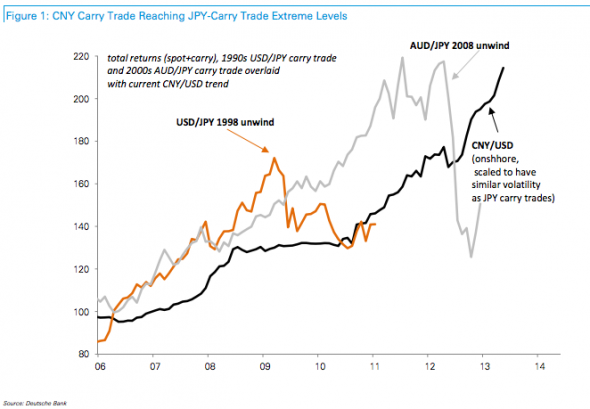
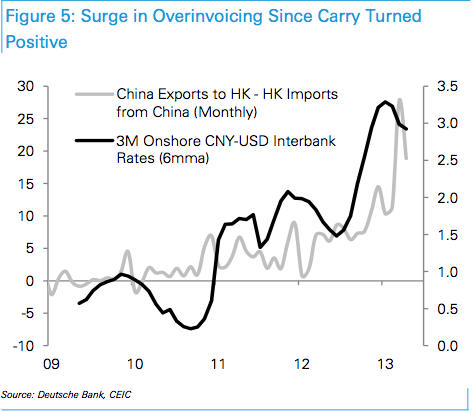
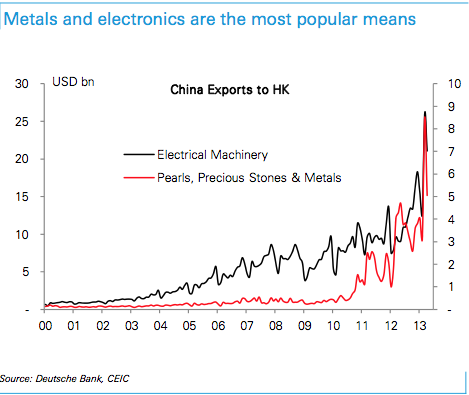
The popular explanation for the rise in Chinese repo rates is being linked to the government’s desire to rein in the shadow banking sector. That is to say the tightness is intentional. But what if it isn’t. What if it has more to do with the unwind of yet another carry trade? Deutsche Bank’s Bilal Hafeez made a strong case for this interpretation last week. We think it’s worth revisiting the argument. There are three main factors that need to be considered, he argued:

Adjusted for volatility China now offers the highest FX carry in the world. This, he says, has led to a surge in flows into the CNY (and CNH) by both onshore and offshore entities over the last few years. The performance of the carry was reaching breaking point last week. Any combination of higher US yields, regulatory clampdown or higher FX volatility or CNY appreciation could trigger an unwind. And as he warned, the demise of the carry trade would then remove an important channel of cheap funding for the Chinese economy. Read more of this post

Even Starbucks gets the China real estate blues; “If even Starbucks cannot afford it, how on earth could normal people pay for property in China?”

Even Starbucks gets the China real estate blues

Jun 21, 2013 5:46pm by beyondbrics

By Gu Yu and Kathrin Hille

China’s soaring property prices have been a problem for a long time. But this week, it was not the country’s nascent middle class complaining about rising rents. It was Starbucks. On Friday afternoon, the US coffee chain closed the coffee shop that had been its first in China. And if its staff is to be trusted, the reason was skyrocketing rent prices.

Read more of this post

Who’s Manipulating Derivative Indexes and Why; How to think about the Libor scandal and its astonishingly proliferating offspring

June 21, 2013, 6:31 p.m. ET

Who’s Manipulating Derivative Indexes and Why

How to think about the Libor scandal and its astonishingly proliferating offspring.

By HOLMAN W. JENKINS, JR.

Is Ewan McGregor, who played Nick Leeson in the movie about the Barings bank bust, available for a sequel? He would find an oddly similar character in Tom Hayes, the former UBS UBSN.VX -1.93% and Citibank employee charged in this week’s latest financial scandal of the century. Read more of this post

Unwinding the world’s biggest economic experiment; When the Fed does change direction, tightening often comes in a rapid series of interest rate rises

June 21, 2013 5:51 pm

Unwinding the world’s biggest economic experiment

By Gavyn Davies

When the Fed does change direction, tightening often comes in a rapid series of interest rate rises

On Wednesday, the chairman of the Federal Reserve announced that the greatest experiment in the history of central banking might be nearing its end. Ben Bernanke’s announcement included many caveats, but the financial markets did not miss the message. Since 2009, the central bank has been buying financial assets – US Treasury bonds and some types of corporate debt – paid for by an expansion of the monetary base (so-called “printing money”). This kept interest rates low, which damaged savers but helped indebted businesses and households. It has also been the major prop for financial markets. Within about a year, if the Fed’s plans come to fruition, the US government deficit will need to be financed from private sector savings – not by the central bank. Asset markets will be left to fend for themselves as the biggest buyer withdraws from the arena. Read more of this post

The world is still being held hostage by its rotten banks

June 21, 2013 7:29 pm

The world is still being held hostage by its rotten banks

By John Plender

Another financial crisis is probable and it would be much more damaging to the global economy

In the midst of this turbulent summer in the markets, the revolving door at the top of British banking has been spinning unexpectedly fast. At the Bank of England,Sir Mervyn King, the governor, is shortly to be replaced by the governor of the Canadian central bank, Mark Carney. The abrupt recent announcement of the impending departure of deputy governor Paul Tucker preceded the appointment ofCharlotte Hogg, head of retail banking at Santander, as the Bank’s first chief operating officer. In the private sector, Stephen Hester recently found himself brutally ejected from his role as chief executive of Royal Bank of Scotland. Many in the City of London were disconcerted by the timing of the Tucker announcement and the Hester defenestration. Read more of this post

Japan Rocked By The Biggest Wagyu Beef Ponzi Scheme Ever; $4.34 billion ponzi scheme defrauded 73,000 investors

Japan Rocked By The Biggest Wagyu Beef Ponzi Scheme Ever

STEVEN PERLBERG JUN. 21, 2013, 9:37 AM 5,840 6

Wikimedia Commons

Three former managers of a Japanese wagyu farm were arrested Tuesday on suspicion that they lead a beefy, $4.34 billion ponzi scheme that defrauded 73,000 investors, the Wall Street Journal reports. Wagyu — the “caviar of beef” — retails for hundreds of dollars a pound. Farmers add beer or sake to the coddled cows’ food and massage them to prevent muscle cramps. The managers of the Agura farm offered investors a “wagyu beef ownership system” with promised annual returns of 8%. They claimed the investors would profit from the calves born to purchased cows. From the Journal:

In reality, there weren’t as many cows as the number sold. According to the former managers, the farm had to file for bankruptcy after being hit by the double whammy of falling beef prices and lower sales following the 2011 Fukushima nuclear accident. (The farm is located less than 100 kilometers from the Fukushima plant.) That left 73,000 investors with losses totaling around ¥420 billion ($4.34 billion), according to lawyers for the plaintiffs.

Agura had reported to investors that they kept 90,000 to 100,000 breeding cows. Investigators found the number wasn’t quite as meaty — at 60,000. The case may be one of the biggest consumer fraud episodes in recent Japanese history. Read more of this post

Startup CipherCloud claims that by using its software, companies can legally upload sensitive defense-technology data to public online services

June 21, 2013, 6:38 p.m. ET

Startup Pushes Encryption, but Doubts Arise

By JOEL SCHECTMAN

Startup CipherCloud is making an impressive claim. The San Jose, Calif.-based vendor says that by using its software, companies can legally upload sensitive defense-technology data to public online services such as Google Inc.’sGOOG -0.43% cloud-based email servers.

CipherCloud has gained significant traction in the burgeoning market for helping companies keep online data secure, and while its defense-related business is small, it says it has more than 1.2 million corporate end users across 10 industries. Read more of this post

China Is Investing in Automated Car Technology

June 21, 2013, 3:54 PM ET

China Is Investing in Automated Car Technology

Steve Rosenbush, Deputy Editor

One California startup says it is providing key driverless car technology to an increasing number of customers around the world, including in China, where the state-controlled economy could help companies in the race against U.S. rivals such as Google Inc.

David Hall, founder and CEO of Velodyne Acoustics Inc., makes the high-definition laser sensors that have turned out to be a critical enabling technology in the development of automated vehicles. The question now is how quickly the market for that technology will mature. It could be as soon as five years, depending upon whom you ask. Read more of this post

How HTC Lost Its Way With Smartphones

Updated June 21, 2013, 7:58 a.m. ET

How HTC Lost Its Way With Smartphones

By EVA DOU and ARIES POON

TAIPEI—After product fumbles and two years of share price declines, HTC Corp.2498.TW -0.60% Chief Executive Peter Chou knows the inevitable question is coming.

“I know you guys want to ask, will I quit,” Mr. Chou says in an interview at the Taiwanese smartphone maker’s headquarters on the outskirts of Taipei. “There are a lot of rumors that say I would quit, but I never said that. I’m not going to find another job.” Read more of this post

How lipstick maker Revlon turned around its business with I.T.

How Revlon turned around its business with I.T.

By Ki Mae Heussner | GigaOM.com, Published: June 21

Lipstick maker Revlon isn’t likely the first company you’d think of when you think high tech. But part of what helps the global brand push more cosmetics to consumers is an IT infrastructure based on a private cloud.

Since 2007, the company has implemented a common cloud strategy that puts all of its data in one place and better enables it to align its business goals with its technology, said David Giambruno, Revlon’s SVP and CIO, at GigaOM’s Structure 2013 conference in San Francisco. The company “literally normalized all the data at Revlon,” he said, adding that their internal cloud runs more than 500 applications run on its internal cloud and averages 14,000 transactions a second. Read more of this post

Patent Policy That Cripples Innovation

June 21, 2013, 7:18 p.m. ET

A Welcome Turn Away From Patents

By MATT RIDLEY

The economist Arthur Laffer is reputed to have drawn his famous curve—showing that beyond a certain point higher taxes generate lower revenue—on a paper napkin at a dinner with Dick Cheney and Donald Rumsfeld in the Washington Hotel in 1974. Read more of this post

Beer Institute: Warehouse Fees Raise Costs for Metal Consumers

Updated June 21, 2013, 4:37 p.m. ET

Beer Institute: Warehouse Fees Raise Costs for Metal Consumers

By TATYANA SHUMSKY

A trade group that represents many of the world’s largest beer brewers has lodged a complaint with the London Metal Exchange, saying the exchange hasn’t done enough to alleviate supply bottlenecks in its warehouse system that the trade group says have raised the price of aluminum used in beer cans. Read more of this post

China Faces Fallout of Self-Made Cash Crisis

Updated June 21, 2013, 7:41 p.m. ET

China Faces Fallout of Self-Made Cash Crisis

Central Bank’s Attack on Informal Lenders Criticized as Too Aggressive; Borrowing Costs Ease Somewhat but Remain High

By BOB DAVIS in Beijing and SHEN HONG in Shanghai

WO-AO276_CCENTR_G_20130621180608

China’s central bank is wrestling with a liquidity crunch of its own creation.

A cash shortage that has sent short-term interest rates as high as 25% earlier this week and alarmed the world’s markets, eased a bit Friday. Traders said the People’s Bank of China, may have asked big state banks to refrain from hoarding cash and release more funds to ease the liquidity squeeze. But the top priority for the central bank, acting on instructions from China’s political leadership, continues to be taming runaway informal lending. Read more of this post

Stanley Druckenmiller On China’s Future And Investing In The New Normal

Stanley Druckenmiller On China’s Future And Investing In The New Normal

Tyler Durden on 06/14/2013 19:38 -0400

From Goldman Sachs

Stan Druckenmiller is Chairman and Chief Executive Officer of Duquesne Family Office. He founded Duquesne Capital Management in 1981, which he ran until he closed the firm in 2010. Previously, he was a Managing Director at Soros Fund Management, where he served as Lead Portfolio Manager of the Quantum Fund and Chief Investment Officer of Soros

Interview with Stan Druckenmiller

Hugo Scott-Gall: What are the risks of investing in China that are not well understood in your view? Read more of this post

Hedge fund Grandmaster sees stock market crash in China

Hedge fund Grandmaster sees stock market crash in China

Thu, Jun 20 2013

By Laurence Fletcher

MONTE CARLO, Monaco (Reuters) – Former chess grandmaster-turned hedge fund manager Patrick Wolff is betting on a stock market crash in China, where he says corruption and bad debts have spiralled to dangerous levels.

Speaking to Reuters on the sidelines of the GAIM conference in Monaco this week, Wolff said investors were too focused on trying to work out when easy money policies will taper off in the United States and ignoring a looming correction in China. Read more of this post

Brazil Tycoon Eike Batista’s Empire on Edge

June 20, 2013, 7:09 p.m. ET

Brazil Tycoon’s Empire on Edge

By LUCIANA MAGALHAES and JOHN LYONS

SÃO PAULO, Brazil—Just months after he unveiled it, Brazilian commodity tycoonEike Batista‘s bid to rebalance his unsteady oil, mining and shipping empire is nearly in tatters, overtaken by a shift in investor sentiment against emerging-market and commodity businesses like those owned by the former powerboat racer. The value of Mr. Batista’s assets has plunged, undermining a strategy set in March to raise capital by selling stakes in his companies to new partners to ensure the viability of his cash-intensive businesses.

Read more of this post

Bond Auctions Fail From Russia to Korea as Brazil Protests Rage; Brazilians spend as much as 26% of their income to ride the bus

Bond Auctions Fail From Russia to Korea as Brazil Protests Rage

Developing nations around the world are scaling back or canceling billions of dollars of bond sales as borrowing costs climb the most since 2008, just as spending needs increase amid slowing economic growth.

Romania’s Finance Ministry rejected all bids at a seven-year bond sale yesterday because of market volatility, while South Korea raised less than 10 percent of the amount planned in an auction of inflation-linked bonds. Russia scrapped a sale of 15-year ruble-denominated bonds June 19, the second time it canceled an auction this month, and Colombia pared an offering of 20-year peso debt by 40 percent. A cash shortage led to failures last week of China Ministry of Finance debt sales. Read more of this post

Montgomery County, troubled by its pension fund’s recent performance, turned to Vanguard founder John Bogle for advice. His take: Park money in low-cost index funds. The fund is taking his advice

June 20, 2013, 8:04 p.m. ET

Pension Fund Takes Neighborly Advice

By MICHAEL CORKERY and KIRSTEN GRIND

MI-BW686A_INDEX_G_20130620182107

When officials with Montgomery County, Pa., became troubled by their pension fund’s investment fees and recent performance, they turned to a neighbor for advice. His take: Park money in low-cost index funds. And that is what they are doing, a move that highlights the growing frustration many pension officials feel toward expensive Wall Street investment managers. The county is now shifting nearly all its $470 million in pension assets to a handful of index funds run by Vanguard Group Inc. Read more of this post

Central Banks and the Borrowing Addiction; From 1980 to 2010, overall U.S. debt grew as fast as GDP. From 1950 to 1980, it was a small fraction of growth

June 20, 2013, 7:11 p.m. ET

Central Banks and the Borrowing Addiction

From 1980 to 2010, overall U.S. debt grew as fast as GDP. From 1950 to 1980, it was a small fraction of growth.

By ROMAIN HATCHUEL

OB-XX840_Hatchu_G_20130620181843

Have financial markets become a giant crack house? Investors have certainly been acting like a bunch of junkies lately.

Any hint that their main dealer—otherwise known as Federal Reserve Chairman Ben Bernanke—might start cutting down his generous supply of cash sets them off in a frenzy. Mr. Bernanke’s latest comments on Wednesday, signaling a sooner-than-previously anticipated tapering off of the Fed’s monetary easing, triggered a sharp global selloff in practically every asset class. Read more of this post

Twitter’s Vine, a smartphone app that makes it simple to record and share snippets of video, Start Creeping Up on Facebook

June 20, 2013, 4:27 p.m. ET

Vines Start Creeping Up on Facebook

By ROLFE WINKLER

Lately, Facebook FB +1.67% is having trouble inventing social services of its own. That is a risk for investors who take comfort in the network’s sheer ubiquity.

As Internet usage shifts from desktop computers to mobile devices, rival social services are the ones offering innovative ways to share photos and videos as well as to communicate with friends. Given the huge advertising business Facebook has grafted onto such activities—generating $1.2 billion of revenue in the first quarter alone—it is problematic if users migrate elsewhere. The latest hot social service is Vine, a smartphone app that makes it simple to record and share snippets of video. Owned by Twitter, Vine’s app is ranked among the top 10 for the iPhone and has gathered more than 13 million registered users since launching in January. Read more of this post

The leadership changes in Louis Dreyfus and Bunge are a good reminder that chief executives do not stay forever – and a wake-up call for some big trading houses facing a “key-man risk”

June 21, 2013 8:52 am

Commodities traders need to wake up to key-man risk

By Javier Blas in Hong Kong

The leadership changes in Louis Dreyfus Commodities and Bunge are a good reminder that chief executives do not stay forever – and a wake-up call for some big trading houses facing a “key-man risk”.

The names of the chief executives of trading titansGlencoreWilmar, Trafigura and Vitol are so closely associated with their firms that they are almost inseparable. But at some point Ivan Glasenberg, Kuok Khoon Hong, Claude Dauphin and Ian Taylor will retire. Read more of this post

Thailand’s Ruinous Rice Subsidy; Yingluck Shinawatra’s bid to corner the rice market rots away

Updated June 20, 2013, 5:03 p.m. ET

Thailand’s Ruinous Rice Subsidy

Yingluck Shinawatra’s bid to corner the rice market rots away.

On Wednesday Thailand agreed to cut the price it pays for farmers’ rice crops by 20%, in what may be the first step in unwinding a disastrous rice subsidy program. This retreat won’t undo the fiscal damage already done by the two-year-old scheme, which saw the government buy local rice harvests for as much as 50% above market rates and then fail to engineer a similar price hike globally. But it does provide a good lesson in the dangers of meddling with markets. Read more of this post

Largest Bitcoin Exchange Halts U.S. Dollar Withdrawals

June 21, 2013, 11:01 a.m. ET

Largest Bitcoin Exchange Halts U.S. Dollar Withdrawals

Mt. Gox, the world’s largest bitcoin trading exchange, said it has halted withdrawals of customer funds in U.S. dollars as it makes systems improvements.

The Tokyo-based exchange said on its website Thursday that cash withdrawals in U.S. dollars are suspended while it makes the upgrades amid rising customer use. Read more of this post

Seat in China’s Parliament Pays Dividends for CEOs

June 20, 2013, 4:07 PM

Report: Seat in China’s Parliament Pays Dividends for CEOs

Top of Form

When China’s parliament, the National People’s Congress, meets once a year to vote through the Communist Party’s policy decisions, something like a carnival atmosphere prevails. Read more of this post

China Says Alibaba Investment Service May Face Penalties, illustrating the challenge the e-commerce giant and other Chinese technology firms face as they expand into new businesses

June 21, 2013, 12:23 p.m. ET

China Says Alibaba Investment Service May Face Penalties

By PAUL MOZUR

BEIJING—China on Friday said a new Alibaba Group Holding Ltd. investment service didn’t comply with regulations, illustrating the challenge the e-commerce giant and other Chinese technology firms face as they expand into new businesses.

The decision was disclosed the same day that the Communist Party’s main mouthpiece published an interview with Alibaba Chairman Jack Ma in which he said China’s financial regulators were “excessive.” While it wasn’t clear whether the two were linked, it offered a reminder that Alibaba will be under a public and official spotlight ahead of an expected initial public offering. Read more of this post