Ambow Education setback teaches Baring a lesson in China investing as stock had lost 87 percent of its value; The company’s market capitalisation, which peaked at $1 billion, is now $70 million

Ambow setback teaches Baring a lesson in China investing

Tue, Jun 18 2013

By Matthew Miller and Stephen Aldred

June 18 (Reuters) – Baring Asia Private Equity, with $5 billion in assets under management, has a reputation as one of the savviest investors in China.

But the Hong Kong-based firm is now sitting on an $43 million paper loss from a $57 million investment in New York Stock Exchange-listed Ambow Education Holdings Ltd., the latest example of how even the smartest money managers continue to get trapped in risky Chinese investments. Read more of this post

Wall Street REIT Success Gives Investors Hangover Part II

Wall Street REIT Success Gives Investors Hangover Part II

Investors in companies buying mortgage bonds are discovering that coming late to the party can still leave them with the biggest hangover.

Mortgage real-estate investment trusts raised $7.4 billion in the first quarter by selling new shares, the most in two years, just before a plunge in the value of the firms. American Capital Agency Corp. (AGNC) has declined 17 percent since offering $2 billion in February and Armour Residential REIT Inc. (ARR) has slumped 24 percent after raising $444 million that month. Read more of this post

China Carbon Permits Trade 22% Below Europe on Market Debut

China Carbon Permits Trade 22% Below Europe on Market Debut

China traded its first carbon dioxide permits for 22% less than today’s price in Europe as the nation inaugurated the Shenzhen Emissions Exchange as part of its plan to limit heat-trapping gases linked to climate change.

The permits were priced from 28 yuan to 30 yuan ($4.90) a metric ton, according to Chen Hai’ou, chief executive officer and president of the exchange. That compares with 4.70 euros a ton ($6.30) today for European Union permits on London’s ICE Futures Europe exchange, the world’s biggest carbon market by traded volume. Read more of this post

Americans Exporting More Oil First Time Since ’70s

Americans Exporting More Oil First Time Since ’70s

The U.S. oil boom is moving Congress closer than it has been in more than three decades to easing the ban on exporting crude imposed after the Arab embargo.

Advances such as hydraulic fracturing are leading to record production that may outstrip refinery capacity within 18 months to three years, said Benjamin Salisbury, a senior energy policy analyst at FBR Capital Markets Corp. in Arlington, Virginia. Net petroleum imports now account for about 40 percent of demand, down from 60 percent in 2005, according to the U.S. Energy Information Administration, the Energy Department research unit. Read more of this post

Promises and Lies: Can Observers Detect Deception?

Promises and Lies: Can Observers Detect Deception

Jingnan Cecilia Chen George Mason University – Interdisciplinary Center for Economic Science (ICES)

Daniel Houser George Mason University – Department of Economics

May 2, 2013
GMU Interdisciplinary Center for Economic Science Department of Economics Paper No. 13-14

Abstract: 
Although economic and social relationships can involve deception (Gneezy 2005), such relationships are often governed by informal contracts that require trust (Berg et al.1995). While important advances have been made concerning deception in economics, the research has focused little on written forms of communication. Are there certain systematic cues that signal written communications as dishonest? Are those signals accurately detected and used by message receivers? We fill this gap by studying messages written in a novel three-person trust game; (we call it the “Mistress Game”). We find that: (1) messages that use encompassing terms, or a greater number of words, are significantly more likely to be viewed as promises; and (2) promises that mention money are significantly more likely to be trusted. Notwithstanding the latter finding, we find senders who mention money within their promises to be significantly less likely to keep their word than those who do not; observers respond to cues but in the wrong way.

Professionalism in Business: Insights from Ancient Philosophy

Professionalism in Business: Insights from Ancient Philosophy

Lila Despotidou Athens University of Economics and Business – Department of Management Science and Technology

Gregory Prastacos Stevens Institute of Technology – Wesley J. Howe School of Technology Management

June 18, 2013
Howe School Research Paper No. 2013-13

Abstract: 
Business schools have the responsibility to inspire professional culture in future managers. This means that they have to provide them not only with the expertise, knowledge and skills required in their field of specialization, but also with a sense of responsibility toward others and society at large. This need has been increasingly evident during the period of the global financial crisis, and a number of initiatives have been reported by business schools worldwide to address the issue. In this paper we examine the issue of professionalism in business management from two perspectives: business practice, and relation to ancient philosophy. Drawing from the literature, we propose a framework defining professionalism as composed of three patterns: a) possession of a systematic body of knowledge, b) commitment to a good broader than self-interest, and c) an overall ethical character of the activity and ethical conduct. We show how these patterns are reflected to the expectations that corporations have from business practitioners. We further demonstrate that substantial elements of business professionalism are strongly related to core values and principles introduced in the social and political thought of ancient philosophers, and thus suggest that ancient philosophy could be used as a means for inspiring professionalism in business managers.

More than Meets the Eye: Convertible Bond Issuers’ Concurrent Transactions

More than Meets the Eye: Convertible Bond Issuers’ Concurrent Transactions

Brian J. Henderson George Washington University – Department of Finance

Bo Zhao George Washington University

June 4, 2013

Abstract: 
In recent years, over 60% of convertible bond issuers conduct concurrent transactions; including share repurchases, call option purchases, warrant sales, seasoned equity offerings, and stock lending program initiations. We show that the determinants of issuers’ choice of concurrent transactions vary; and include controlling earnings dilution, the supply of capital available from convertible arbitrageurs, and investment opportunities. Our results suggest that in the convertible bond market, the influence of capital supply, as measured by flows to convertible arbitrage hedge funds, extends beyond the issuance decision and influences the security design and use of concurrent transactions. Additionally, the announcement effects suggest that concurrent transactions signal managers’ information regarding future earnings.

News-Driven Return Reversals Liquidity Provision Ahead of Earnings News; six-fold increase in short-term return reversals during earnings announcements relative to non-announcement periods

News-Driven Return Reversals: Liquidity Provision Ahead of Earnings News

Eric C. So Massachusetts Institute of Technology (MIT) – Sloan School of Management

Sean Wang University of North Carolina – Kenan-Flagler Business School

June 7, 2013

Abstract: 
This study documents a six-fold increase in short-term return reversals during earnings announcements relative to non-announcement periods. Following prior research, we use reversals as a proxy for expected returns market makers demand for providing liquidity. Our findings suggest that market makers demand higher expected returns prior to earnings announcements because of increased inventory risks that stem from holding net positions through the release of anticipated earnings news. These findings indicate that increases in market makers’ inventory risks result in reduced liquidity through a channel distinct from adverse selection risks and that pre-announcement demand for liquidity provision results in predictable variation in earnings announcement returns. We also use pre-announcement option prices to show that return reversals increase when there is greater expected volatility during earnings announcements. Collectively, our findings suggest that uncertainty regarding anticipated information events elicits predictable increases in expected returns to liquidity provision and that these increases significantly affect the dynamics and information content of market prices.

Do Sovereign Wealth Funds Make Informed Investment Decisions? Target firm returns are reduced following SWF investment

Do Sovereign Wealth Funds Make Informed Investment Decisions?

Bong Soo Lee Florida State University

Francis Haeuck In Monash University – Department of Accounting and Finance; Financial Research Network (FIRN)

June 9, 2013

Abstract: 
Recent studies find that target firm returns are reduced following sovereign wealth fund (SWF) investment. Although risk is also reduced following SWF investment, they find that SWF investment is associated with a reduction in the compensation of risk.In this paper, weexamine the hypothesis that sovereign weal funds’ poor performance is partly due to their poor information about the target firms and find some support for the hypothesis.

A Review and Synthesis of ‘Cost Stickiness’ Literature

A Review and Synthesis of ‘Cost Stickiness’ Literature

Mahfuja Malik Boston University

November 9, 2012

Abstract: 
Traditional cost accounting holds the assumption that cost changes proportionately with activity. Anderson et al. (2003) show that cost increases more when activity rises than decreases less when activity falls by an equivalent amount, a behavior that they refer to as “cost stickiness”. By following Anderson et al. (2003) researchers investigate the determinants, consequences and different aspects of cost stickiness. However, some studies raise questions about the validity of the inference made by Anderson et al. (2003). Over the last few years many authors highlight some new aspects such as earnings forecasts error, agency problem and earnings management that relate to cost stickiness. The objective of this paper is to review and synthesize the growing body of research on cost stickiness. Lack of theoretical support, merely insights provided by the literature and some inconclusive findings suggest that there are ample research opportunities to improve the understanding in this area.

Are Aggressive Reporting Practices Indicative of Risk-Taking Corporate Environments?

Are Aggressive Reporting Practices Indicative of Risk-Taking Corporate Environments?

Mary Margaret Frank University of Virginia – Darden School of Business

Luann J. Lynch University of Virginia – Darden School of Business

Sonja O. Rego Indiana University – Kelley School of Business

Rong Zhao University of Calgary

March 31, 2012
Darden Business School Working Paper No. 1066846

Abstract: 
We examine whether firms with aggressive financial and tax reporting also have greater risk-taking corporate environments. We use investing, financing and operating policies and measures of firm risk to assess a firm’s risk-taking environment. We separate our analyses into the periods before and after the Sarbanes-Oxley Act (SOX) because prior evidence suggests SOX affected reporting and risk-taking practices. Our results provide strong evidence that before SOX, firms with greater risk-taking environments also engaged in more aggressive reporting. Our results also suggest that SOX eliminated the positive association between corporate risk-taking environments and aggressive reporting. Results from shareholder valuation tests indicate that in the pre-SOX time period, shareholders valued aggressive reporting – but not corporate risk-taking – at a premium. However, the passage of SOX substantially altered how shareholders assess aggressive reporting and corporate risk-taking.

China’s State-Owned Enterprises: How Much Do We Know? From CNOOC to Its Siblings

China’s State-Owned Enterprises: How Much Do We Know? From CNOOC to Its Siblings

Duanjie Chen University of Calgary – The School of Public Policy

June 6, 2013
SPP Research Paper No. 6-19

Abstract: 
China’s state-owned enterprises (SOEs) are sometimes compared to Canadian Crown corporations, such as VIA Rail or the CBC. But that comparison is not only profoundly inaccurate, it can also be a dangerous assumption to make when crafting Canadian economic policy. China’s SOEs have been actively buying up interests in major Canadian resource firms. But that phenomenon has much more serious implications for Canada than if these were, say, state-owned European firms, such as Norway’s Statoil. China’s SOEs do not operate by the normal rules of commerce. They are, in fact, a very powerful tool of the Chinese government’s industrial policy, which is aimed at a ruthless expansion of its global economic empire. The spectacular growth of China’s SOEs over the last two decades, at a rate unrivalled by virtually any other sector on earth, has been driven by the will of the Chinese government, which provides cheap or free inputs — such as access to capital and real estate — in order to create globally dominant corporate powers. There is also the Chinese competitive advantage that comes with not just lower wages for workers but also behaviour that would be considered irresponsible in a Western context. Placing a lower priority on human rights, the environment, social justice and corporate rectitude give China and its SOEs an edge that have helped them in their goal of leapfrogging competing world economic powers, including Canada. Without these explicit and implicit subsidies, China’s SOEs have actually proven to be far less economically competitive than their private-sector rivals. Chinese SOEs are not publicly accountable the way that Crown corporations in Canada are. Chinese SOEs are run by appointees of the Communist party, whose first duty is to the state, the majority or even sole shareholder of SOEs. Unlike Canada’s Crown corporations, which are designed to fill in market-failure gaps or provide public service, China’s SOEs are permitted to chase profits in sectors that do not even fall within their primary mandate. And unlike Canada, China jealously guards the sectors in which its SOEs exert absolute or strong control, disallowing any private-sector competitors — domestic or foreign — free entry. When Canada’s federal government last December granted approval to the takeover of Nexen Inc. it made it clear that this would be the “end of a trend” of Chinese SOEs controlling acquisition of major Canadian energy firms. Such takeovers would be allowed only in exceptional circumstances from now on. That is how it should be. Canada’s business sector should contribute to market-driven economic growth, through efficient management and upright corporate behavior. It should not be allowed to become an instrument in China’s distorted and often disreputable drive toward global hegemony.
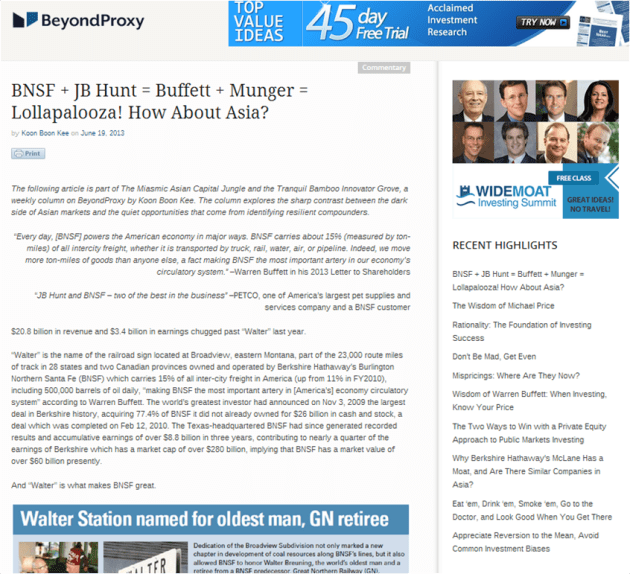
BNSF + JB Hunt = Buffett + Munger = Lollapalooza! How About Asia? Bamboo Innovator is featured in BeyondProxy.com, where value investing lives

Bamboo Innovator is featured in BeyondProxy.com, where value investing lives:

  • BNSF + JB Hunt = Buffett + Munger = Lollapalooza! How About Asia? (BeyondProxy)

BNSF

Some Autistic Children Don’t Find Pleasure in Voices because of a physical disconnect between the brain regions involved in speaking and those linked to rewards

Some Autistic Children Don’t Find Pleasure in Voices

Children with autism spectrum disorder may not perceive human voices as pleasurable because of a physical disconnect between the brain regions involved in speaking and those linked to rewards, a study suggests.

Brain imaging determined that the connections between the two brain regions were stronger in children who don’t have the disorder than in those diagnosed with it, said Daniel Abrams, the lead author. That’s important because communication problems are key diagnostic criteria for autism.

One in 50 U.S. children are diagnosed with autism or a related disorder, according to the Centers for Disease Control and Prevention. The majority have difficulty using language effectively, including being unable to grasp nuances of speech such as rhythm and tone, according to the National Institutes of Health. The newest research, published in the Proceedings of the National Academy of Sciences, is the first to suggest why. Read more of this post

Netflix Push Into Kids’ TV Shows With DreamWorks

Netflix Rises on Deal for Exclusive DreamWorks Programs

Netflix Inc. (NFLX), the dominant subscription video-streaming service, rose as much as 6 percent after agreeing to a multiyear deal with DreamWorks Animation SKG Inc. (DWA) to obtain original programming.

Netflix shares climbed $12.72 to $226.71 at 10:18 a.m. in New York, the biggest intraday increase since April 23. The stock has more than doubled this year. DreamWorks jumped 5.2 percent to $24. Read more of this post

Online Video-Ad Startups Rivaling Google Seen Near IPOs

Online Video-Ad Startups Rivaling Google Seen Near IPOs

Demand for Web commercials played alongside video clips is fueling growth at marketing startups, putting such companies as Tremor Video Inc., YuMe Inc. and Adap.tv Inc. on course for initial public offerings this year.

All three have picked bankers or are in discussions to sell shares to the public, according to people familiar with their plans, who asked not to be identified because the information hasn’t been publicly disclosed. Read more of this post

GE Hiring Thousands of Engineers to Build Industrial Web to connect everything from jet engines to medical-imaging machines to the Web and help customers run equipment more efficiently.

GE Hiring Thousands of Engineers to Build Industrial Web

General Electric Co. (GE) is hiring thousands of engineers near San Francisco in a push to connect everything from jet engines to medical-imaging machines to the Web and help customers run equipment more efficiently.

“We’ve opened a software center in East Bay, hiring thousands of software engineers to basically bring all the great innovation you’ve seen in Silicon Valley now to industry,” Beth Comstock, chief marketing officer at GE, said at the Bloomberg Next Big Thing Summit in Half Moon Bay, California. Read more of this post

Australia eyes Buddha and baccarat to lure Chinese tourists

Australia eyes Buddha and baccarat to lure Chinese tourists

Mon, Jun 17 2013

By Jane Wardell

SYDNEY (Reuters) – Australia’s coastal Wyong region outside Sydney, a pretty stretch of pristine beaches and wildlife-filled wetlands, isn’t high on the travel agenda of most Chinese tourists.

But the local mayor and a Chinese businessman have big plans to change that – by building a A$500 million ($480 million) theme park that will include a full-size replica of Beijing’s Forbidden City and a nine-storey temple housing a giant Buddha. Read more of this post

China Insiders Sell Most Shares in May in 4 Years, UBS Says

China Insiders Sell Most Shares in May in 4 Years, UBS Says

Major shareholders, senior management and individuals with stakes of more than 5 percent sold a net 24.7 billion yuan ($4 billion) of Chinese A shares in May, the most for a month since June 2009, UBS AG said.

The biggest sales were in computer-related shares, media and “special equipment” sectors, UBS strategists including Qin Xia wrote in a report dated today. Net stakes rose only in chemical raw materials and telecom operations, while the sell-off in smaller companies as a percentage of the free-float reached new post-2008 highs, they wrote.

Insiders sold as the Shanghai Composite Index climbed 5.6 percent in May, the biggest advance since December, and as more locked-up shares became tradable. The benchmark index has slumped 6.5 percent in June as data from exports to industrial production pointed to slowing growth and higher money-market rates signaled tighter liquidity. Read more of this post

China Foreign-Investment Gains Ease as Economic Slowdown Deepens

China Foreign-Investment Gains Ease as Economic Slowdown Deepens

Foreign direct investment in China rose in May by the least in four months, a sign of concern that growth is slowing in the world’s second-biggest economy.

Inbound non-financial investment increased 0.3 percent from a year earlier to $9.26 billion, the Ministry of Commerce said today in a statement in Beijing, after a 0.4 percent gain in April. China’s outbound investment rose 20 percent in the first five months of the year to $34.3 billion, compared with a 27.4 percent pace in January-April.

The report follows data indicating capital inflows slowed last month while growth decelerated in exports, industrial production and lending. Confidence is fading in an economic rebound this quarter, with investment banks from Morgan Stanley to Barclays Plc cutting their 2013 expansion forecasts. Read more of this post

GM Vows to Show China That Cadillac of Autos Isn’t Audi

GM Vows to Show China That Cadillac of Autos Isn’t Audi

As Vincent Qiu weighed his options for buying a new sport-utility vehicle in Beijing, he was drawn to the Cadillac SRX.

The SUV’s aggressive chrome grille, massive vertical headlamps and sharp creases along the body make the vehicle unique on China roads, where the rounded and organic shapes of Volkswagen AG (VOW)’s Audi and General Motors Co. (GM)’s Buick are popular.

“You can easily spot Audis on the roads, but not Cadillacs,” Qiu, 41, who runs an office-supply company, said last week in an interview. “But it is a big-ticket purchase and in the end my wife talked me into playing it safe and buying something that is more popular.” He bought an Audi Q5. Read more of this post

China Emission Trading Experiment Unlikely to Ease Cities’ Smog

China Emission Trading Experiment Unlikely to Ease Cities’ Smog

China’s plan to set up markets to trade emissions will make it second only to Europe in efforts to put a price on pumping carbon into the atmosphere. For cities choking on the nation’s smog, expect little relief.

Seven pilot carbon-trading programs are scheduled to start this year, with the first opening today in Shenzhen, followed by Beijing, Shanghai, Guangdong, Tianjin, Chongqing and Hubei. They are set to regulate 800 million to 1 billion tons of emissions by 2015 in the world’s biggest cap-and-trade program after Europe’s, according to Bloomberg New Energy Finance. Read more of this post

Craft Brewers Chug Away Heady Pressure by Bankers to Sell

Craft Brewers Chug Away Heady Pressure by Bankers to Sell

SweetWater Brewing Co. Chief Executive Officer Freddy Bensch gets plenty of solicitations from potential acquirers.

One stands out: a handwritten note with a crisp $50 bill from a banker begging for a meeting. The greenback was so pristine and odd a gesture that Bensch wondered if it was real.

“We took that $50 bill over to the pub and spent it on beers and they accepted it,” said Bensch, who co-founded the maker of hoppy 420 Extra Pale Ale and chocolaty Exodus Porter with a college roommate. “We didn’t accept the meeting. We toasted him when we were buying beers with his 50.” Read more of this post

Rubber Poised for Record Glut as Shippers End Curbs

Rubber Poised for Record Glut as Shippers End Curbs: Commodities

Rubber is headed for the biggest glut on record, prolonging the bear market that began in April, as supply exceeds demand for a third year and Southeast Asian exporters ended curbs on shipments.

The surplus will expand 57 percent to 490,000 metric tons this year, enough to meet U.S. demand for six months, according to RCMA Commodities Asia Group, the Singapore-based company that has traded rubber for nine decades. Futures in Tokyo, a global benchmark, will drop at least another 4.9 percent to 225 yen a kilogram ($2,373 a ton) by the end of December, according to the median of 16 analyst estimates compiled by Bloomberg. Five anticipate 200 yen, a price last seen in 2009. Read more of this post

EU Car Sales Fall to 20-Year Low as Joblessness at Record

EU Car Sales Fall to 20-Year Low as Joblessness at Record

European Union car sales in May fell to a 20-year low as rising joblessness caused by a recession in the euro region contributed to falling demand at PSA Peugeot Citroen (UG), Renault SA (RNO) and General Motors Co. (GM)

Registrations in the 27-member EU dropped 5.9 percent to 1.04 million vehicles from 1.11 million cars a year earlier, reaching the lowest level for the month since 1993, the Brussels-based European Automobile Manufacturers’ Association, or ACEA, said today in a statement. Including figures from Switzerland, Norway and Iceland, sales in May fell 5.9 percent to 1.08 million cars. Read more of this post

Protests Show Brazilian Dream Fading as Rousseff Popularity Ebbs

Protests Show Brazilian Dream Fading as Rousseff Popularity Ebbs

Francisco Soares, a 32-year-old Brasilia electrician, felt good about life two years ago when he started commuting in his first car, blasting the music and passing packed buses. Since then, bills started piling up, the cost of living jumped and last week he had to sell his wheels.

After a decade that saw 40 million people rise from poverty, Brazil’s middle class finds itself squeezed by faster inflation, rising debt and a weaker currency. Consumers are spending less at supermarkets and hairdressers as the classic weekend event, a prime cut barbecue, becomes a stretch for some. Continuing a wave of protests sparked by an increase in bus fares, demonstrators surrounded Congress in Brasilia yesterday and set a car on fire in Rio de Janeiro as tens of thousands marched in major cities. Read more of this post

Road building revival offers rare hope for India infrastructure overhaul

Road building revival offers rare hope for India infrastructure overhaul

Mon, Jun 17 2013

By Matthias Williams and Swati Pandey

NEW DELHI/MUMBAI (Reuters) – K. Ramchand, managing director at one of India’s biggest road builders, is doing something unusual to help dispel the gloom pervading much of the country’s infrastructure sector today: bidding for new projects.

His company, IL&FS Transportation Networks Ltd (ILFT.NS: QuoteProfileResearchStock Buzz), signed a $300 million contract in April to build a six-lane highway. The project will link an eastern industrial zone afflicted by some of India’s worst traffic snarls to mining districts such as Dhanbad, the nation’s coal capital. Read more of this post

Analysis: Companies may turn to courts on U.S. natural gas export push

Analysis: Companies may turn to courts on U.S. natural gas export push

1:59am EDT

By Ayesha Rascoe

WASHINGTON (Reuters) – U.S. companies hoping to export natural gas are frustrated by lengthy delays and rule changes as they await U.S. Department of Energy approval of their applications and may turn to the courts to speed up the process.

Both the slow pace of decisions on applications to ship U.S. liquefied natural gas abroad and the process for making those decisions could be challenged, legal sources say.

Potential strategies could be laid out during a House of Representatives panel on Tuesday, which will focus on the current impediments to U.S. LNG exports. Read more of this post

It’s Just Like Magic: The Economics of Harry Potter

It’s Just Like Magic: The Economics of Harry Potter

Darwyyn Deyo George Mason University – Department of Economics

Marta Podemska-Mikluch Beloit College

May 31, 2013

Abstract:      
Do the laws of economics apply in the magical world of Harry Potter? We argue that even though J.K Rowling placed her characters in a world of magic, wizards remain subject to the implications of scarcity and must obey economic principles. As a result, the series is abundant with illustrations of choice within constraint, marginal thinking, the power of incentives, and the role of institutions. The contents of the books, along with their extraordinary popularity, provide a tool powerful enough to inspire students to adopt the economic way of thinking for life. We demonstrate the pedagogical potential of the series by providing examples for each of Mankiw’s Ten Key Principles of Economics.

Asia’s Enron: Satyam (Sanskrit Word for Truth)

Asia’s Enron: Satyam (Sanskrit Word for Truth)

Elisabetta Basilico University of St. Gallen

Hugh Grove University of Denver

Lorenzo Patelli University of Denver – School of Accountancy; SDA Bocconi; Benedictine College

2012
Journal of Forensic & Investigative Accounting, Vol. 4, Issue 2, 2012

Abstract: 
In this paper, we analyze the 2009 scandal of Satyam, one of India’s largest information technology companies and provider of computer software and business process outsourcing to large companies around the world; including General Motors, Nestlé, and General Electric. We discuss financial and non-financial red flags. Specifically, we apply five financial fraud prediction measures and examine corporate governance elements. The results of our analyses suggest the importance of integrating financial and non-financial indicators. Supplementing financial indicators with non-financial red flags enables us to present the reverse KISS principle by Hilb (2005).