The Gift of Doubt: Albert O. Hirschman and the power of failure.

THE GIFT OF DOUBT

Albert O. Hirschman and the power of failure.

by Malcolm GladwellJUNE 24, 2013

Hirschman was a planner who saw virtue in the fact that nothing went as planned. Illustration by Ricardo Martinez.

In the mid-nineteenth century, work began on a crucial section of the railway line connecting Boston to the Hudson River. The addition would run from Greenfield, Massachusetts, to Troy, New York, and it required tunnelling through Hoosac Mountain, a massive impediment, nearly five miles thick, that blocked passage between the Deerfield Valley and a tributary of the Hudson.

James Hayward, one of New England’s leading railroad engineers, estimated that penetrating the Hoosac would cost, at most, a very manageable two million dollars. The president of Amherst College, an accomplished geologist, said that the mountain was composed of soft rock and that tunnelling would be fairly easy once the engineers had breached the surface. “The Hoosac . . . is believed to be the only barrier between Boston and the Pacific,” the project’s promoter, Alvah Crocker, declared. Read more of this post


12 Of The Shrewdest Business Maneuvers Of All Time

12 Of The Shrewdest Business Maneuvers Of All Time

MAX NISEN AND ALEXANDRA MONDALEK JUN. 17, 2013, 8:54 AM 14,405 6

The success of failure of a business can come down to one single bold decision. A recent thread on Quora asked users to name the “the shrewdest, smartest maneuver you’ve ever seen in business.” We’ve broken out some of the best answers, including critical decisions by Bill Gates, Steve Jobs, and Henry Ford. Bill Gates originally wrote a PC operating system for IBM. He convinced them to let him sell it to others, starting him on the way to becoming the richest man in the world.

Bill Gates using an early version of Microsoft Excel

bill-gates-originally-wrote-a-pc-operating-system-for-ibm-he-convinced-them-to-let-him-sell-it-to-others-starting-him-on-the-way-to-becoming-the-richest-man-in-the-world

Via Quora user Prakul Agarwal:

Back in the 1980s, IBM asked Bill Gates to produce the operating system for its PCs. He licensed an operating system from Tim Patterson (QDOS) for $50,000, modified it, named it MS-DOS, and sold it to IBM. Gates managed to convince IBM to let him market the system separately, because IBM thought all of the money was in hardware. When other companies started to build their own PCs, MS-DOS was the standard, and Microsoft made a fortune.  Read more of this post

Becoming a Better Judge of People

Becoming a Better Judge of People

by Anthony K. Tjan  |   9:00 AM June 17, 2013

In business and in life, the most critical choices we make relate to people. Yet being a good judge of people is difficult. How do we get better at sizing up first impressions, at avoiding hiring mistakes, at correctly picking (and not missing) rising stars?

The easy thing to do is focus on extrinsic markers — academic scores, net worth, social status, job titles. Social media has allowed us to add new layers of extrinsic scoring: How many friends do they have on Facebook? Who do we know in common through LinkedIn? How many Twitter followers do they have?

But such extrinsic credentials and markers only tell one part of a person’s story. They are necessary, but not sufficient. What they miss are the “softer” and more nuanced intrinsic that are far more defining of a person’s character. You can teach skills; character and attitude, not so much. Read more of this post

In the Google age, approach to education needs a rethink

In the Google age, approach to education needs a rethink

Would a person with good handwriting, spelling and grammar and instant recall of multiplication tables be considered a better candidate for a job than, say, one who knows how to configure a peer-to-peer network of devices, set up an organisation-wide Google calendar and find out where the most reliable sources of venture capital are, I wonder? The former set of skills is taught in schools, the latter is not.

BY SUGATA MITRA –

4 HOURS 32 MIN AGO

Would a person with good handwriting, spelling and grammar and instant recall of multiplication tables be considered a better candidate for a job than, say, one who knows how to configure a peer-to-peer network of devices, set up an organisation-wide Google calendar and find out where the most reliable sources of venture capital are, I wonder? The former set of skills is taught in schools, the latter is not.

In school examinations, learners must reproduce facts from memory, solve problems using their minds and paper alone. They must not talk to anyone or look at anyone else’s work. They must not use any educational resources, certainly not the Internet. Read more of this post

Montreal Mayor Arrested by Quebec Anti-Corruption Police; charges are linked to illegal payments in two real-estate transactions

Montreal Mayor Arrested by Quebec Anti-Corruption Police

Montreal Mayor Michael Applebaum faces 14 criminal charges, including fraud and breach of trust, after being arrested today by Quebec’s anti-corruption task force as part of a bribery case.

The charges are linked to two real-estate transactions that involved “tens of thousands of dollars” in illegal payments between 2006 and 2011, Robert Lafreniere, head of Quebec’s anti-corruption unit, told reporters at a televised press conference in Montreal today. Applebaum was arrested at his home, police said in a statement posted on the provincial government’s website. Read more of this post

Bank of England governor Sir Mervyn King: “There’s always been a willingness to be overly impressed by people who appear to be extraordinarily financially successful”

June 14, 2013 11:58 am

Lunch with the FT: Sir Mervyn King

By Martin Wolf

The Bank of England governor talks to the FT’s Martin Wolf about exits, euro solutions and the ‘audacity of pessimism’

Sir Mervyn King, who is to end 10 years as governor of the Bank of England at the end of the month, has organised this lunch himself. Uli in Notting Hill, he has explained in advance, is a favourite local restaurant, specialising in east Asian food. It is normally closed on Saturday lunchtime but Sir Mervyn has arranged for it to be opened especially for us. He has also asked the owner, Michael, to choose the food. The result is as excellent as it is excessive: soft-shelled crab; spicy scallops; Mongolian lamb, Singaporean laksa (a soup); steamed turbot; lamb curry; special fried rice; aubergine in sweet chilli; and seafood udon (noodles). The meal is devastatingly large. Read more of this post

Forget Lab Rats: Testing Asthma Drugs on a Microchip that could provide a better read on how a drug will work

Updated June 17, 2013, 7:02 p.m. ET

Forget Lab Rats: Testing Asthma Drugs on a Microchip

By JONATHAN D. ROCKOFF

MK-CE070_ORGANC_G_20130617152312MK-CE076B_ORGAN_G_20130617182408

A chip engineered to replicate a human lung.

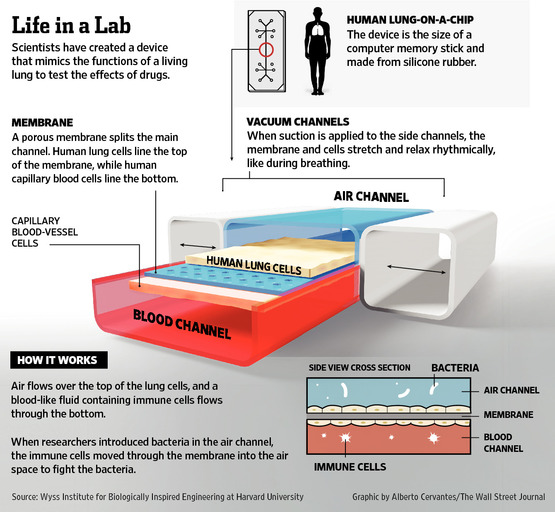
Forget lab rats. Some researchers are now testing medicines on a silicon chip that could provide a better read on how a drug will work.

These scientists are building “organs on a chip,” spooling together the important cells that make up, say, a lung, and then mimicking the key functions of the organ. Then researchers test to see what kind of impact a potential drug has on this lung-like system, created on a chip that is only a few inches long.

Companies are starting to tinker with this new technology, mostly for internal decision-making, since health regulators haven’t yet authorized their use in decisions about whether a compound can enter human testing. Read more of this post

Researchers from the Navy, the NASA and academia are studying causes and potential treatments of motion sickness, hoping to formulate better products for situations that range from the extreme to the mundane

June 17, 2013, 7:00 p.m. ET

New Views of Motion Sickness

Travel-Related Nausea Puzzles Scientists Amid Search for a Better Remedy; Ginger Root or a Nasal Spray?

By SUMATHI REDDY

It’s the medical nuisance that stumps everyone from NASA to the Navy: how to combat motion sickness. Sumathi Reddy looks at the latest research into why it happens, and what to do to keep it at bay.

Researchers from the Navy, the National Aeronautics and Space Administration and academia are studying causes and potential treatments of motion sickness, hoping to formulate better products for situations that range from the extreme (space!) to the mundane (road trip to Grandma’s, anyone?). Read more of this post

How old-economy firm Haier succeeded without Western-style razzmatazz

How old-economy firm succeeded without Western-style razzmatazz

Created: 2013-6-18

Author:Bill Fischer, Umberto Lago, and Fang Liu

LESS than 30 years from near-bankruptcy to global leadership; reinvention at least three times; trusting nearly 80,000 people to accept leadership roles in self-organizing, autonomous work units. Is it yet another new economy, Silicon Valley razzamatazz success story? Not at all.  This is about a Chinese company making home appliances, and it’s an incredible story about what is possible in old-economy, commodity markets.
Read more of this post

Online financial services threaten China’s traditional banks

Online financial services threaten China’s traditional banks

Kung Chun-jung and Staff Reporter

2013-06-16

The rapid emergence of the internet industry in China, which provides a broad range of online financial services, has posed a severe threat to the traditional banking and financial sectors, the money page of Chinese internet portal NetEase reports.

The emerging trend of online third-party payments, peer-to-peer (P2P) lending and P2P microfinance services has significantly eaten into the benefits offered by the established financial sector, the report said. Read more of this post

Foreign fast food chains in China experiencing confidence crisis

Foreign fast food chains in China experiencing confidence crisis

Staff Reporter

2013-06-18

Foreign fast food chains are facing a series of challenges that have hit their sales in China, which has become a key market after the companies’ rapid expansion in the country, the financial site of Chinese portal Tencent reported.

Yum Brands, which owns chains including KFC and Pizza Hut and controls 0.2% of the fast food market in China, posted a 13% drop in same-store sales at its over 5,200 outlets across the country in March, and forecast a further fall of 29% in April. Read more of this post

Chinese regulators seek to increase the public’s role in rooting out IPO fraud

Tuesday, June 18, 2013

Chinese regulators seek to increase the public’s role in rooting out IPO fraud

China likes to keep its business to itself, often going so far as to label some corporate finances as state secrets. Few places have been more secretive than the securities market, where the China Securities Regulatory Commission (CSRC) passes opaque judgments on which firms get to IPO, and when.

After years of poor performance of mainland exchanges, where companies are frequently found to be ridden with fraud, China’s top securities regulator has finally deigned to give the public a glimpse of the companies they could buy into.  Read more of this post

Canada has more Subway stores per capita than it does in the United States and store traffic in Canada is higher than at U.S. outlets

Subway thrives in Canada while avoiding beverage wars

Hollie Shaw | 13/06/17 | Last Updated: 13/06/17 5:29 PM ET

subway

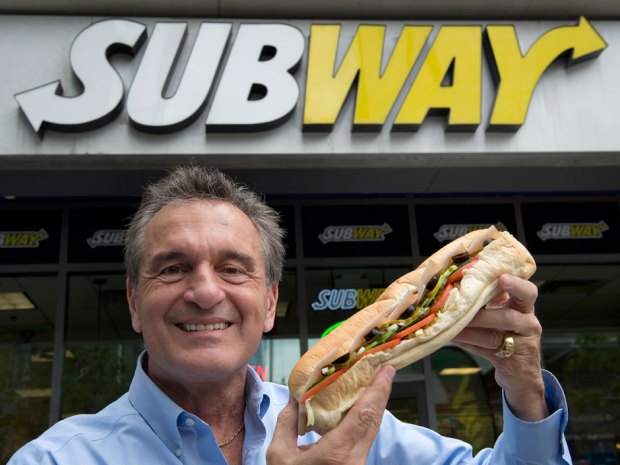
Peter J. Thompson/National PostFred DeLuca, president and co-founder of Subway at the franchise’s 127 Bremner Boulevard Toronto location. Mr. DeLuca borrowed US$1,000 to start the business with a friend in 1965.

TORONTO • Subway Restaurants keeps growing steadily in Canada even though the fast-food sandwich purveyor has not followed rivals McDonald’s and Tim Hortons in appealing to coffee-loving Canadians. Read more of this post

Google’s Waze Deal Said to Give BlueRun 19-Fold Return

Google’s Waze Deal Said to Give BlueRun 19-Fold Return

Google Inc. (GOOG)’s $1.1 billion acquisition of Waze Inc. produced a 19-fold return for BlueRun Ventures, the biggest investor in the mobile-mapping company, a person familiar with the matter said.

Led by John Malloy, BlueRun had a stake of 15 percent in Waze that was worth more than $165 million at the time of sale, said the person, who asked not to be identified because the information isn’t public. The firm invested a total of $8.7 million in Waze, starting in 2008, Malloy said.

Waze is the first investment for BlueRun that’s fetched more than $1 billion since PayPal Inc., another portfolio company, was acquired by EBay Inc. (EBAY) in 2002. BlueRun, which changed its name from Nokia Venture Partners in 2005, has raised $540 million for its last two funds, Malloy said. About 65 percent of the portfolio is in mobile startups like Waze, which was founded in Israel, he said. Read more of this post

How to make it in America, the Waze way; With its high-profile acquisition by Google, the navigation start-up has shown other technology companies a route to combining Israeli expertise with a small U.S. presence.

How to make it in America, the Waze way

With its high-profile acquisition by Google, the navigation start-up has shown other technology companies a route to combining Israeli expertise with a small U.S. presence.

By Omer Shubert | Jun.17, 2013 | 6:31 PM

Outside the Silicon Valley offices of Waze, the day after Google purchased the Israeli navigation start-up for over a billion dollars, two Japanese tourists celebrated having found one of the company’s retail stores.

They could be excused for their confusion. The company’s offices – located in Palo Alto, California – are sandwiched between a Mexican restaurant and a furniture store. Down the block, the neighborhood turns high-class residential, featuring opulent homes with immaculately manicured yards. It’s not a place where you would expect to a hot, young high-tech company.

On the inside, the offices turned out to be even more out of step with stereotypical Silicon Valley culture. They were an open space about 650 square feet across, somewhat reminiscent of a one-bedroom Tel Aviv apartment. Read more of this post

How mobile payments might be the global money-laundering machine criminals have dreamed about

How mobile payments might be the global money-laundering machine criminals have dreamed about

By Josh Meyer @JoshMeyerDC June 17, 2013

Earlier this month, US prosecutors took down the global currency exchange Liberty Reserve and charged it with being the largest online money laundering operation in history, the “bank of choice for the criminal underworld.” More than a million customers used the Costa Rica-based company to wash more than $6 billion,according to an indictment. Besides drug traffickers, it alleged, Liberty Reserve’s illicit users included a wide array of gangsters and thugs, and criminal organizations engaged in credit card and investment fraud, identity theft, computer hacking, and child pornography.

But while Liberty Reserve and similar currency exchanges are getting a lot of attention these days from regulators and enforcement agencies, another global money-laundering frontier is not: mobile payments. Millions of people now use their mobile phones to do their banking, especially in developing parts of the world, and their numbers are growing daily. And hidden among them are criminals who some experts believe are engaged in just as wide a range of criminal activity as those using Liberty Reserve, albeit on a smaller scale—for now. Read more of this post

LinkedIn targets business news eyeballs

LinkedIn targets business news eyeballs

PUBLISHED: 6 HOURS 18 MINUTES AGO | UPDATE: 1 HOUR 5 MINUTES AGO

LESLIE KAUFMAN

LinkedIn came of age as the staid social media platform for business professionals: reliable, utilitarian and, well, boring.

Unlike Twitter or Facebook, which are hives of message activity that attract constant monitoring, LinkedIn for years warranted little more than an intermittent update to a résumé, or a check on a job search.

Then, in October, LinkedIn began offering its own content, called Influencers, which consists of a select group of people in leadership positions posting their musings on life, careers and the secrets of success in both. Suddenly, LinkedIn was filled with new age chief executive talk. Read more of this post

Fashion designer Lisa Ho’s company will shut its doors after administrators failed to find a buyer of her business; “Lisa Ho is an iconic Australian fashion brand and one of the bastions of fashion landscape in last 30 years”

Lisa Ho to close its doors forever

by: By Melissa Hoyer

From:news.com.au

June 18, 2013 1:18PM

617060-200bd84a-d7c3-11e2-a48a-dd6939d70aef

Fashion designer Lisa Ho’s (L) label is reportedly riddled with $11m in debt.

WELL-REGARDED industry stalwart and a star performance at the recent Australian fashion week weren’t enough to keep designer brand Lisa Ho in business, with stores set to close.

Today, administrators for the Lisa Ho Group, Barry Taylor and Todd Gammel of HLB Mann Judd, announced that despite considerable interest, ‘a sale of the Lisa Ho Group business as a going concern has not been achieved within the sale program’.

Discussions are continuing with a number of interested parties in relation to the purchase of intellectual property, stock and other assets of the Lisa Ho Group.

“The Administrators are now focused on an orderly closure of the remaining Lisa Ho Group stores.”

For the past 30 years the Lisa Ho label followed a modern, fashion-now aesthetic but like most fashion retailers, particularly following the GFC, there has been thwarted demand growth and increased competition of numerous online retailers. Read more of this post

Fidelity’s Anthony Bolton to Stop Managing China Fund and return to retirement after it failed to match the returns of the U.K. trust that made his reputation

Fidelity’s Anthony Bolton to Stop Managing China Fund

Anthony Bolton will give up managing the Fidelity China Special Situations fund and return to retirement after it failed to match the returns of the U.K. trust that made his reputation.

Bolton, 63, will be succeeded by Dale Nicholls, manager of Fidelity’s Pacific Fund since 2003, Fidelity said in a statement today. The handover will be completed in April 2014, almost four years after China Special Situations became the nation’s largest equity fund to be listed on the London Stock Exchange.

Over 28 years running the U.K.-focused Fidelity Special Situations fund, Bolton delivered average annual returns of 19.5 percent, transforming a 10,000 pound ($15,720) investment in 1979 into 1.49 million pounds in 2007, according to Morningstar Inc. After coming out of retirement to start China Special Situations in April 2010, the fund has lost about 15 percent, matching the MSCI China Index’s decline in British pound terms. Read more of this post

Case study: Li-Ning lost out to foreign rivals in China

June 17, 2013 4:56 pm

Case study: Li-Ning lost out to foreign rivals in China

By Hellmut Schütte, Sumelika Bhattacharyya and Jocelyn Probert

The story

Gymnast Li Ning became a Chinese hero in 1984 when he won six medals at the Los Angeles Olympics, the country’s first appearance at a summer games in 32 years. By 1990 he had set up his own sportswear company, Li-Ning. It was an immediate hit, and in 1999 the company’s revenues in China reached Rmb700m, more than twice Nike’s Rmb300m and Adidas’s Rmb100m.

The challenge

The growing spending power of China’s middle-class consumers and their appetite for foreign brands, combined with the surging popularity of basketball and football – with which Nike and Adidas were associated – helped the two overseas companies win more sales in China than Li-Ning. Read more of this post

Myanmar’s old friend China is left wondering where it went wrong; President Thein Sein said he personally despises Beijing’s influence over its smaller, poorer neighbour

June 17, 2013 1:04 pm

Myanmar’s old friend China is left wondering where it went wrong

By Jamil Anderlini in Naypyidaw

In the surreal Burmese capital Naypyidawit’s hard to miss the gleaming convention centre built by a Chinese state-owned construction company and donated to the military junta a few years ago in a gesture of bilateral amity.

But earlier this month, as more than 900 executives from across the globe gathered in the complex for Burma’s first ever World Economic Forum, the Chinese presence was conspicuously absent. According to the official WEF list, only 16 participants were from mainland China.

For decades after the founding of the People’s Republic, American foreign policy was obsessed by the question of “who lost China?” Read more of this post

Samsung’s Kitchen ambition; Can the Korean electronics giant pull a smartphone-like win in the home?

Samsung’s Kitchen ambition

June 17, 2013: 10:25 AM ET

Can the Korean electronics giant pull a smartphone-like win in the home? 

By Stephanie N. Mehta, deputy managing editor

FORTUNE — Can Samsung Electronics conquer kitchen appliances in the same way it has conquered televisions and smartphones?

The Korean tech conglomerate, already the market leader in sales of TVs and mobile phones with advanced computing capabilities, says it also aims to be the world’s No. 1 purveyor of home appliances by 2015. That’s a lofty goal considering that today it is the No. 5 player in refrigerators and automatic washer/dryers, according to market share data from Euromonitor International, and isn’t in Euromonitor’s top 5 in dishwashers, ovens or microwaves.

But Boo-Keun Yoon, co-CEO of Samsung Electronics, believes the company can win over global consumers by bringing innovation and a high-tech approach to refrigerators, ovens, air conditioners, and washing machines. “These are products that consumers are very emotional about, but there’s a lot of room for innovation in home appliances.” Yoon says. Read more of this post

How big companies can beat the patent chaos of India

How big companies can beat the patent chaos of India

June 17, 2013: 1:59 PM ET

There are several companies that are doing well in India by adapting to the market instead of the other way around.

By Ravi Venkatesan

FORTUNE — Multinational pharmaceutical companies agree on one thing — that India is one of the hardest places in the world for Big Pharma to compete thanks to price controls, compulsory licensing of drugs, poor intellectual property protection, and a host of capable generic competitors.

The recent decision by India’s Supreme Court to deny patent protection to Novartis (NVS) for a reformulated version of an anticancer drug has just added more fuel to the fire, provoking drug companies and the U.S. Chamber of Commerce to unleash angry warnings that it would cut off investment to the world’s most populous democracy and ultimately limit access to lifesaving medications. The judgment adds to a growing list of trade tensions between India, the U.S., and Europe at a time when India desperately needs more foreign investment to restart its slowing economy. Read more of this post

Korea rising: From rags to riches

2013-06-17 20:33

Korea rising: From rags to riches

This is the final of a 10-part series of Korean history from its mythological, ancient beginning until the present day. This project is sponsored by several companies and public agencies including Merck Korea, eBay Korea, Daewoo Securities and Korea Post. ― ED.

By Kim Tae-gyu and Kevin N. Cawley
The end of World War II on Aug. 15, 1945 brought about the independence of Korea after 35 years of brutal Japanese colonial rule. However, the initial euphoria of the people did not last long.

Against the will of the Korean people who sought to have their own government ruling the entire Korean Peninsula, a United Nations arrangement led to its division along the 38th parallel ― a demarcation that lasts until today. Read more of this post

Abenomics for Women Undermined by Men Dominating in Japan

Abenomics for Women Undermined by Men Dominating in Japan

By Isabel Reynolds and Takashi Hirokawa  Jun 17, 2013

Japanese Prime Minister Shinzo Abe has vowed to elevate the role of women in the world’s third-largest economy. He might start with his own party.

Abe called for women filling 30 percent of senior positions in all parts of society by 2020, in an April 19 speech showcasing his growth strategy. Now, his Liberal Democratic Party is fielding nine female candidates out of 79 for next month’s election to the upper house of parliament — about 11 percent. Read more of this post

Samsung under pressure amid growing health fears faced by workers working in their plants

June 17, 2013 8:43 am

Samsung under pressure amid growing health fears

By Simon Mundy in Hwaseong

As thousands of workers stream out of Samsung Electronics’ semiconductor plant in the South Korean town of Hwaseong, Mr Lee, a 58-year-old restaurant owner, regards them with mixed emotions. The factory across the road guarantees his livelihood – about two-thirds of his customers work there, he estimates. But his views on the plant have shifted after it suffered two leaks of hydrofluoric acid gas in the past six months, which killed one worker and hospitalised several others.

“Everyone here has the same feeling,” he says. “On the one hand Samsung is great for business, but on the other, perhaps there are health risks. And lots of people are worried about the effect on property prices.” As Samsung has grown into one of the world’s largest corporations, it has found itself under growing scrutiny from activists and official bodies both at home and abroad. In Europe it has become a target for competition authorities, while its Chinese factories were the subject of allegations of illegal practice last year by China Labor Watch, a New York-based group. Read more of this post

From the ashes of Webvan, Amazon builds a grocery business

From the ashes of Webvan, Amazon builds a grocery business

A worker walks past Amazon Fresh delivery vans parked at an Amazon Fresh warehouse in Inglewood

Sun, Jun 16 2013

By Alistair Barr

SAN FRANCISCO (Reuters) – The online grocery start-up Webvan may have been the single most expensive flame-out of the dot-com era, blowing through more than $800 million in venture capital and IPO proceeds in just over three years before shutting its doors in 2001. Twelve years later, though, Webvan is rising from the dead – in the form of an online grocery business called AmazonFresh. Four key Amazon.com Inc executives – Doug Herrington, Peter Ham, Mick Mountz and Mark Mastandrea – are former Webvan officials who have spent years analyzing and fixing the problems that led to the start-up’s demise. Kiva Systems, the robotics company that Amazon bought last year for $775 million in one of its largest-ever acquisitions, was built on ideas and technologies originally developed at Webvan and is a key part of the AmazonFresh strategy.

Read more of this post

Corning Bendable Willow™ Glass will help enable new, thinner applications and could revolutionize display manufacturing

Corning Is Working On A Bendable Version Of Its Gorilla Glass

JULIE BORT JUN. 17, 2013, 7:23 PM 1,144 1

One of the cool new technologies coming soon from the labs at Corning is a type of glass that’s so bendable, you’d swear it was plastic.  It’s called Willow Glass, and it’s designed to be used as a touchscreen, or for high-temperature displays, Corning’s Dr. Waguih Ishak, a vice president for Corning West Technology Center, said Monday on stage at Bloomberg’s Next Big Thing Summit. Think about that for a minute. With a bendable display, a watch computer could be adjusted to fit anyone’s wrist, no matter how big or small.  Ishak said that the glass would be available for devices by the end of 2013 or early 2014. Apple is using bendable glass in its as-yet unreleased “smart watch,” Nick Bilton of The New York Times reported in February.  Tech blogger Robert Scoble, who joined Ishak on stage during the presentation, said Willow Glass would work well with such a product.  “If I’m Tim Cook at Apple, I’d be looking at that for a watch with a flexible surface, a display with touch-sensor applications,” Scoble said.

Corning Launches Ultra-Slim Flexible Glass

Corning® Willow™ Glass will help enable new, thinner applications and could revolutionize display manufacturing

CORNING, N.Y., June 04, 2012 – Corning Incorporated (NYSE: GLW) announced the launch of Corning® Willow™ Glass, an ultra-slim flexible glass, which could revolutionize the shape and form of next-generation consumer electronic technologies. The company made the announcement today at the Society for Information Display’s Display Week, an industry tradeshow in Boston. Corning Willow Glass will help enable thin, light and cost-efficient applications including today’s slim displays and the smart surfaces of the future. The thinness, strength, and flexibility of the glass has the potential to enable displays to be “wrapped” around a device or structure. As well, Corning Willow Glass can be processed at temperatures up to 500° C. High temperature processing capability is essential for today’s high-end displays, and is a processing condition that cannot be supported with polymer films. Corning Willow Glass will enable the industry to pursue high-temperature, continuous “roll-to-roll” processes – similar to how newsprint is produced – that have been impossible until now. Read more of this post

Spain’s high-speed trains and abandoned stations

Published: Tuesday June 18, 2013 MYT 8:47:00 AM

Spain’s high-speed trains and abandoned stations

ONBOARD MADRID-ALICANTE HIGH-SPEED TRAIN: A one-track dirt road used by local farmers is the main access to a magnificent glass-and-steel train station in the small city of Villena, on Spain’s latest high-speed rail route.

It is a spanking new 4,500 square meter building – essentially in the middle of nowhere.

The central government financed the rail route, inaugurated on Monday, between Madrid and Alicante on the Costa Blanca. The Valencia regional government was supposed to fund works to connect it to the nearby motorway and Villena, home to 35,000.

But it ran out of money, leaving the station high and dry. Read more of this post

Bond stampede fear spurs race for reform

June 17, 2013 5:53 pm

Bond stampede fear spurs race for reform

By Stephen Foley, Vivianne Rodrigues and Tracy Alloway in New York

If there is one thing that keeps bond investors awake at night, it is the fear of a stampede for the exit. And for good reason: there could be a pile-up in the doorway, leading to extreme market swings. After the scares of the past month, the race is on to find ways to improve liquidity in the bond market, where, unlike stocks, it can often be tricky to find buyers and sellers. Ben Bernanke, Federal Reserve chairman, is expected this week to try to undo some of the concerns about a disorderly rise in interest rates, which he triggered in May with talk that the US central bank may begin to taper its monetary stimulus. That led to a run-up in market rates and record weekly outflows from fixed-income funds. Read more of this post