Chinese corporate and household debt interest payments as a share of GDP has doubled since 2002 to 12%

June 12, 2013, 11:11 p.m. ET

The Next Move for Beijing

By TOM ORLIK

AM-AY973_CHINAH_NS_20130613045403

A prolonged slowdown in China’s growth sharpens the need for an innovative policy response. Fortunately for Beijing, it has more-creative options than another government spending spree.

The latest indications from the world’s second-largest economy are worrying. Industrial output and investment are decelerating. After stripping out the effect of over-invoicing, export growth is flat lining. It’s all enough to have Goldman Sachs strategist Jiming Ha wondering whether China is on the way to 6% annual growth, well below the first quarter’s 7.7%. Read more of this post

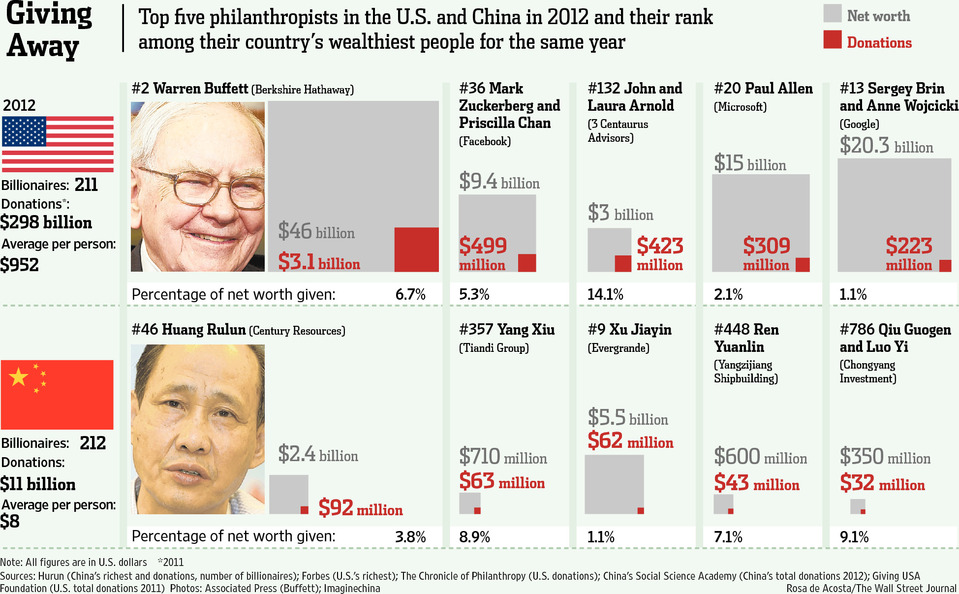
In China, Philanthropy Gains Cachet; people are now eager to show off pictures they took at an earthquake-stricken zone or on visits to rural schools

June 13, 2013, 2:06 p.m. ET

In China, Philanthropy Gains Cachet

By WEI GU

AM-AY971_WEICOL_G_20130613131807

When Warren Buffett and Bill Gates asked 50 of China’s richest people to a philanthropy dinner in Beijing in 2010, a third turned down the invitations, fearing they would be pressed to donate money.

Three years later, rich Chinese are starting to get more comfortable with giving.

Social media are abuzz with pictures of charity dinners and celebrities promoting causes. Displays of wealth are calming down, and people are now eager to show off pictures they took at an earthquake-stricken zone or on visits to rural schools. Read more of this post

Fed Could Drain the Oil Market’s Tank; At around 394 million barrels, U.S. commercial stocks of crude oil, excluding the strategic petroleum reserve, are hovering around their highest levels since the early 1980s

June 12, 2013, 2:56 p.m. ET

Fed Could Drain the Oil Market’s Tank

By LIAM DENNING

There is a shadow looming over oil prices in the shape of a big tank—and a big central bank.

The U.S. last year posted the biggest increase in oil production in the world and largest increase in U.S. history. But is there a shadow in the form of a central bank looming oil prices? Heard on the Street editor Liam Denning reports.

At around 394 million barrels, U.S. commercial stocks of crude oil, excluding the strategic petroleum reserve, are hovering around their highest levels since the early 1980s. Read more of this post

Shocking is the word that describes a report by Korea’s government auditors on the debt of major state-owned companies; During five years under the former Lee Myung-bak administration, the combined debt of nine public enterprises more than doubled, from 128 trillion won ($113 billion) to 284 billion won

2013-06-13 17:32

Public enterprises’ debt

Shocking is the word that describes a report by government auditors on major state-owned companies released Wednesday. During five years under the former Lee Myung-bak administration, the combined debt of nine public enterprises more than doubled, from 128 trillion won ($113 billion) to 284 billion won.

The biggest reason was the “ostrich” fiscal operation of the previous government. While pushing ahead with massive public works, including the controversial four-river refurbishment project, it passed the burden from snowballing budget deficits to state-owned enterprises (SOEs).

That was a most glaring example of irresponsible fiscal management, which does not stop at aggravating the bottom lines of these state firms but puts strict restraints on the succeeding government’s economic operation and eventually leads to heavier burdens on taxpayers. Major, if not the only beneficiaries were large construction firms and officials who received kickbacks from them.  Read more of this post

AustralianSuper, the nation’s biggest industry fund, has tipped a spate of mergers through the $1.6 trillion retirement savings sector as funds seek to take on the wealth arms of the major banks

$62b AusSuper eyes mergers

June 14, 2013

Madeleine Heffernan

AustralianSuper, the nation’s biggest industry fund, has tipped a spate of mergers through the $1.6 trillion retirement savings sector as funds seek to take on the wealth arms of the major banks. Ian Silk, the chief executive of the $62 billion AustralianSuper, has foreshadowed further deals by the fund, following mergers in recent years with the multibillion-dollar funds Westscheme and AGEST. ”It’s pretty clear that the regulators and public policy is pushing in the direction of a smaller number of large funds rather than a large number of smaller funds,” Mr Silk told BusinessDay.

Read more of this post

‘Missing’ superannuation funds reach $18b; For NSW and Victoria, the average estimated lost amount per person with super is about $2500

‘Missing’ super funds reach $18b

June 14, 2013

John Collett

The pile of ”lost” superannuation has risen to $18.1 billion, up from $17.4 billion a year ago.

The latest Westpac Lost Super Report, researched by Core Data, estimates half the population with superannuation funds is likely to have lost some super.

”We are all planning to retire, so why don’t more of us spend just a few minutes to find any lost super?” Westpac head of superannuation Deanne Stewart said.

For NSW and Victoria, the average estimated lost amount per person with super is about $2500. Read more of this post

Private equity firms are sitting on $116 billion of assets trapped in so-called zombie funds that lie dormant but still rake in fees from investors

More than $100 billion trapped in ‘zombie funds:’ industry data

1:00pm EDT

LONDON (Reuters) – Private equity firms are sitting on $116 billion of assets trapped in so-called zombie funds that lie dormant but still rake in fees from investors, research showed on Thursday.

Almost 1,200 private equity funds can be classed as “zombie” – poor-performing funds that have been retained beyond their planned life span and whose managers have little hope of raising more money – according to data from industry tracker Preqin. Read more of this post

Agriculture Prices Slump After Emerging Market Currency Weakness

Agriculture Prices Slump After Emerging Market Currency Weakness

Agricultural commodities fell to the lowest in almost one year as weakening currencies in emerging markets heightened speculation that farmers from Brazil to Indonesia will boost exports, adding to supplies.

The Standard & Poor’s GSCI Agricultural gauge of eight farm commodities including sugar, coffee and soybeans fell 2.3 percent by 5:10 p.m. in London, heading the lowest close since June 19, 2012. Nineteen of 24 emerging market currencies tracked by Bloomberg sild against the dollar by an average 3.2 percent in the past month.

Supplies of everything from soybeans to wheat are set to increase this year as planting rebounded following droughts in the U.S. and Russia in 2012. The global sugar surplus will be a record in the 12 months ending in September, the International Sugar Organization in London estimates. Weaker currencies make overseas sales prices in dollars more attractive. Read more of this post

Silver Faithful Taking $5 Billion Hit in Crossfire: Commodities

Silver Faithful Taking $5 Billion Hit in Crossfire: Commodities

Silver is punishing investors amid diminishing trust in precious metals as a store of wealth and concern that growth is weakening, with $5.2 billion erased from the value of their near-record holdings this year.

Investors expected silver to be one of the biggest gainers in 2013, with a 33 percent return, a Bloomberg survey in December showed. Instead it’s leading a retreat in commodities with a 28 percent plunge to $21.79 an ounce, on track for its worst performance since 1984. While the median prediction from 14 estimates compiled last week is for a rally to $23.50 by Dec. 31, that would still mean a 23 percent drop for the year. Read more of this post

Gold Bears Return as ETP Rout Extends to 17th Week and India, the biggest buyer, announced curbs on imports

Gold Bears Return as ETP Rout Extends to 17th Week: Commodities

Gold traders turned bearish for the first time in a month as investors reduced holdings in exchange-traded products for an unprecedented 17th consecutive week and India, the biggest buyer, announced curbs on imports.

Eighteen analysts surveyed by Bloomberg expect prices to fall next week, with 14 bullish and four neutral, the largest proportion of bears since May 17. Investors sold 490.4 metric tons valued at $21.8 billion through ETPs since Feb. 8 and the 2,124.7 tons left is the least they have held since April 2011, data compiled by Bloomberg show.

Bullion is on track for the first annual drop since 2000 as some investors lose faith in it as a store of value. While the slump into a bear market in April hurt billionaire hedge fund manager John Paulson and producer Newcrest Mining Ltd. (NCM), it spurred purchases of coins and jewelry worldwide. That demand may be threatened in India after the nation raised gold import taxes to contain a record current-account deficit. Read more of this post

Gold Imports by India Seen Tumbling as Curbs Boost Titan’s Costs; “These regulations will affect cash margins of jewelers due to higher cost of funding as equity or unsecured domestic loans will be used to fund purchases and inventory will have to be fully paid for in cash compared with gold on lease earlier”

Gold Imports by India Tumbling as Curbs Boost Titan’s Costs

Gold imports by India, the world’s largest consumer, are plunging as an increase in tax and restrictions on financing shipments boost costs for jewelers, helping the nation contain a record current-account deficit.

Shipments in June will decline as only orders placed before the curbs are being imported now, said Rajesh Mehta, chairman of Rajesh Exports Ltd. (RJEX) Overseas purchases tumbled to an average $36 million a day in the 14 business days through June 7, compared with an average $135 million a day through 13 days until May 20, Raghuram Rajan, chief economic adviser in the Finance Ministry, said in a statement on June 11. Read more of this post

High-end seafood businesses flounder amid spending cut and crackdown on graft and extravagance; “It has been the worst time for seafood-related industries in a decade”

Seafood businesses flounder amid spending cut

Updated: 2013-06-14 02:10

By WANG ZHUOQIONG ( China Daily) Read more of this post

Mollusk-Eating Chinese Fuel Junk-Loan Trawl at Clearwater

Mollusk-Eating Chinese Fuel Junk-Loan Trawl at Clearwater

Clearwater Seafoods Inc. (CLR) plans to join Canadian peers borrowing more in the U.S. leveraged-loan market to finance a 200-foot vessel to harvest clams for China’s mollusk-loving middle class.

The Bedford, Nova Scotia-based company which has doubled sales to Asia since 2008 is planning to issue about $335 million of term loans by early July, said Tyrone Cotie, Clearwater’s treasurer. While some of the money will be used to repay and refinance debt, Clearwater plans to use the rest to build a ship equipped with automated shucking machines to prepare the bivalves for export, he said. Read more of this post

Asahi to Ajinomoto CEOs Betting Abenomics Won’t Spur Inflation

Asahi to Ajinomoto CEOs Betting Abenomics Won’t Spur Inflation

Japan’s consumer goods makers and retailers aren’t buying Abenomics (JNMBMOBE).

Sixth months into an economic program that sparked faster growth and the world’s biggest stocks rally this year, consumer goods companies are still planning for deflation.

“We aren’t thinking about raising prices,” said Akiyoshi Koji, president of Asahi Breweries Ltd. (2502), which makes the country’s best-selling Super Dry beer.

Koji’s closest rival, Kirin Holdings Co. President Senji Miyake, said the signs of an improving economy aren’t enough to prompt a shift from a strategy to expand outside Japan. Their outlook is another hurdle for Prime Minister Shinzo Abe’s campaign to reflate the world’s third-largest economy and end 15 years of deflation. Read more of this post

Dollar Correlates to Stocks in Economy Obama Desires: Currencies

Dollar Correlates to Stocks in Economy Obama Desires: Currencies

The dollar is moving more in tandem with stocks than any time since 2008 in a sign that traders are gaining confidence in the sustainability of the U.S. recovery.

The U.S. Dollar Index and the Standard & Poor’s 500 Index are the most closely correlated since the start of the global financial crisis, according to data compiled by Bloomberg. The gauges started moving more in lockstep last month as the greenback jumped to an almost three-year high and U.S. equities surged to a record.

Traders retreating from emerging markets are seeking America’s currency as everything from jobs to consumer confidence and housing fuel the economy while the euro zone struggles with recession, Japan debases its currency and the U.K. stagnates. Rising U.S. bond yields as the Federal Reserve debates whether to slow bond purchases are adding to the dollar’s allure. Read more of this post

This time, bond investors think a Fed pullback is real

Analysis: This time, bond investors think a Fed pullback is real

1:21pm EDT

By Karen Brettell

NEW YORK (Reuters) – This time, the Fed is serious.

That’s the judgment of U.S. government bond investors who believe the Federal Reserve is close to paring back its $2.5 trillion, 4-1/2-year bond purchase program, and it’s causing turmoil in the U.S. Treasury market. Trading in Treasuries has turned notably more volatile in recent days and volatility may continue as traders try to adjust to a marketplace in flux. In the last six weeks, benchmark 10-year U.S. Treasury note yields have surged to 2.19 percent, from 1.60 percent at the beginning of May.

Read more of this post

Preferred Shares ETF Drops as Yields Rise on Fed Speculation

Preferred Shares ETF Drops as Yields Rise on Fed Speculation

An exchange-traded fund that mimics a basket of preferred shares is suffering the worst four-day stretch in 20 months amid deepening concern the Federal Reserve will pare unprecedented stimulus.

The iShares S&P U.S. Preferred Stock Index Fund has dropped 5.7 percent from an almost five-year peak on May 8, in the worst four-day rout since October 2011.

Perpetual preferred stocks, whose fixed dividends mean they trade like bonds, have lost 5.6 percent as of yesterday since peaking on May 8, compared with the 1.2 percent drop in the Standard & Poor’s 500 Index (SPX), according to data compiled by Bank of America Merrill Lynch and Bloomberg. Read more of this post

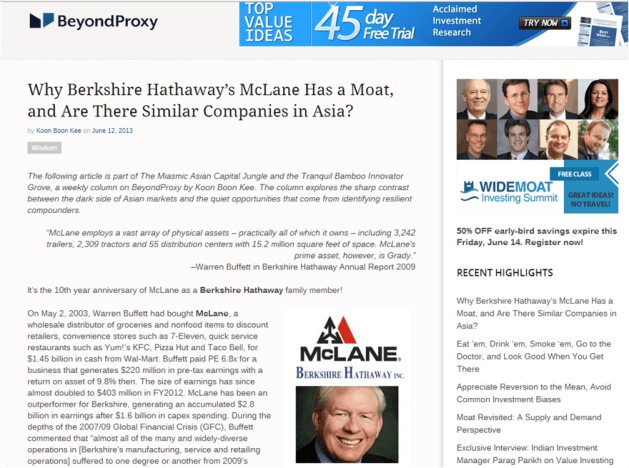
Why Berkshire Hathaway’s McLanee Has a Moat, and Are There Similar Companies In Asia? Bamboo Innovator is featured in BeyondProxy.com, where value investing lives

Bamboo Innovator is featured in BeyondProxy.com, where value investing lives:

Why Berkshire Hathaway’s McLanee Has a Moat, and Are There Similar Companies In Asia? (BeyondProxy)

McLane

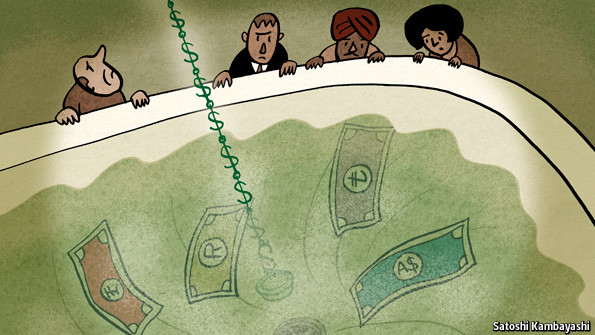
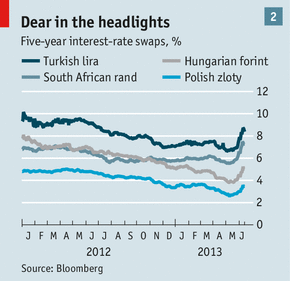
The Fed and emerging markets: The end of the affair; The prospect of less quantitative easing in America has rocked currency and bond markets in the emerging world

The Fed and emerging markets: The end of the affair; The prospect of less quantitative easing in America has rocked currency and bond markets in the emerging world

Jun 15th 2013 | JOHANNESBURG |From the print edition

20130615_FND001_120130615_FNC798_020130615_FNC803_0

THERE are many reasons why a fund manager might want to sell the rand. South Africa’s economy is barely growing. Unemployment, at 25% of the workforce, is on a par with the grimmest parts of the euro zone. The mining industry is beset by labour unrest just as commodity prices are falling. The country’s large trade deficit is a sign that local producers are struggling in vain against foreign competition. The rand has fallen by 16% against the US dollar this year. Only the Syrian pound and Venezuelan bolívar have fared worse. Read more of this post

The high cost of sad workers; Not happy at your job? Your company is paying for it in innovation potential

Not happy at your job? Your company is paying for it in innovation potential.

By Vivek Wadhwa, Updated: June 13, 2013

A Nov. 2011 paper from European Union-backed academic institution evoREG makes the case that happiness is both integral to the innovation process and oddly enough simultaneously misunderstood. The authors find happiness to be both an input factor as well as an output factor of the innovation process. In other words, happiness leads to more innovation, and when directed properly, innovation creates more happiness for societies. Read more of this post

Financial advisers will no longer be able to recommend risky, unusual or complex funds to ordinary investors following a ban by the UK’s new financial regulator

June 7, 2013 6:36 pm

UK regulator bans promotion of ‘risky’ investments

By Elaine Moore

Financial advisers will no longer be able to recommend risky, unusual or complex funds to ordinary investors following a ban by the UK’s new financial regulator.

From January 1 2014, promotion of unregulated collective investment schemes such as traded life policy settlements, overseas property and fine wine, will be limited to sophisticated or wealthy clients, defined as those with an income above £100,000 a year, or more than £250,000 to invest. Read more of this post

Brick by Brick: How LEGO Rewrote the Rules of Innovation and Conquered the Global Toy Industry

Brick by Brick: How LEGO Rewrote the Rules of Innovation and Conquered the Global Toy Industry

by David Robertson  (Author) , Bill Breen  (Author)

16054798

Brick by Brick takes you inside the LEGO you’ve never seen. By following the teams that are inventing some of the world’s best-loved toys, it spotlights the company’s disciplined approach to harnessing creativity and recounts one of the most remarkable business transformations in recent memory.
Brick by Brick reveals how LEGO failed to keep pace with the revolutionary changes in kids’ lives and began sliding into irrelevance. When the company’s leaders implemented some of the business world’s most widely espoused prescriptions for boosting innovation, they ironically pushed the iconic toymaker to the brink of bankruptcy. The company’s near-collapse shows that what works in theory can fail spectacularly in the brutally competitive global economy.
It took a new LEGO management team – faced with the growing rage for electronic toys, few barriers to entry, and ultra-demanding consumers (ten-year old boys) – to reinvent the innovation rule book and transform LEGO into one of the world’s most profitable, fastest-growing companies.
Along the way, Brick by Brick reveals how LEGO:
– Became truly customer-driven by co-creating with kids as well as its passionate adult fans
– Looked beyond products and learned to leverage a full-spectrum approach to innovation
– Opened its innovation process by using both the “wisdom of crowds” and the expertise of elite cliques
– Discovered uncontested, “blue ocean” markets, even as it thrived in brutally competitive red oceans
– Gave its world-class design teams enough space to create and direction to deliver
built a culture where profitable innovation flourishes
Sometimes radical yet always applicable, Brick by Brick abounds with real-world lessons for unleashing breakthrough innovation in your organization, just like LEGO. Whether you’re a senior executive looking to make your company grow, an entrepreneur building a startup from scratch, or a fan who wants to instill some of that LEGO magic in your career, you’ll learn how to build your own innovation advantage, brick by brick. Read more of this post

Lego faces are getting angrier, study finds; Scientist says classic, smiling face of Lego figures is increasingly being replaced, with more themes based on conflict

Lego faces are getting angrier, study finds

Scientist says classic, smiling face of Lego figures is increasingly being replaced, with more themes based on conflict

Alexandra Topping and agencies

The Guardian, Wednesday 12 June 2013

Lego faces are becoming more angry, a New Zealand researcher has found

Lego faces are becoming more angry, a New Zealand researcher has found. Photograph: Corbis

Life in Legoland used to be so simple – smiling doctors helped cheerful patients, contented petrol pump operators filled the tanks of satisfied drivers and classrooms of ecstatic children were taught by beaming teachers.

But then life became more complicated. Anger, puzzlement and confusion started to set in – the beatific existence of the Lego figurine was over.

The number of happy faces on Lego toy mini-figures has been decreasing since the 1990s, and the number of angry faces has increased, giving rise to concerns that children could be affected by the negativity of the toys. Read more of this post

Steven Spielberg and George Lucas: The Movie Industry Is About To Implode

STEVEN SPIELBERG: The Movie Industry Is About To Implode

HENRY BLODGET JUN. 13, 2013, 10:17 AM 12,274 34

spielberg_lucas

Steven Spielberg and George Lucas made some startling comments at USC yesterday, David Cohen of Variety reports. The two movie moguls said the movie industry is about to implode. What’s happening, Spielberg and Lucas said, is that Hollywood is betting ever more heavily on a handful of massive-budget general-interest blockbusters each year, while losing the regular movie-going audience to the Internet and TV. And soon, Spielberg predicted, some of these humongous bets will blow up, demolishing the industry: “They’re  going for the gold,” said Lucas of the studios. “But that isn’t going to work forever. And as a result they’re getting narrower and narrower in their focus. People are going to get tired of it. They’re not going to know how to do anything else.” Spielberg noted that because so many forms of entertainment are competing for attention, [the studios] would rather spend $250 million on a single film than make several personal, quirky projects. “There’s eventually going to be a big meltdown,” Spielberg said. “There’s going to be an implosion where three or four or maybe even a half-dozen of these mega-budgeted movies go crashing into the ground and that’s going to change the paradigm again.” Lucas predicts that the movie-theater industry will soon evolve into something like Broadway, where huge blockbuster movies are shown for long periods on huge screens and tickets cost fantastic amounts of money: Lucas predicted that after that meltdown, “You’re going to end up with fewer theaters, bigger theaters with a lot of nice things. Going to the movies will cost 50 bucks or 100 or 150 bucks, like what Broadway costs today, or a football game. It’ll be an expensive thing. … (The movies) will sit in the theaters for a year, like a Broadway show does. That will be called the ‘movie’ business.” “There’ll be big movies on a big screen, and it’ll cost them a lot of money. Everything else will be on a small screen. It’s almost that way now. ‘Lincoln’ and ‘Red Tails’ barely got into theaters. You’re talking about Steven Spielberg and George Lucas can’t get their movies into theaters.” Read more of this post

The Astronomical Math Behind UPS’ New Tool to Deliver Packages Faster; The cost to UPS per year if each driver drives just one more mile each day than necessary is $30 million

The Astronomical Math Behind UPS’ New Tool to Deliver Packages Faster

BY MARCUS WOHLSEN

06.13.13

In a sense, all business boils down to math. But some companies have tougher equations to solve than others.

At UPS, the average driver makes about 120 deliveries per day, says Jack Levis, the shipping giant’s director of process management. To figure out how many different possible routes that driver could travel, just start multiplying: 120 * 119 * 118 * . . . * 3 * 2 * 1. The end result, Levis likes to say, far exceeds the age of the Earth in nanoseconds.

If that number sounds big, imagine having to make those calculations for 55,000 drivers every day. Until recently, UPS used a software tool that gave drivers a general route to follow but allowed wide latitude for human judgement along the way. Over the next five years, however, the company will roll out widely a more exacting algorithm designed to steer drivers away from well-worn paths toward often counterintuitive routes calculated to make delivery faster. Read more of this post

Oakmark’s Bill Nygren: Easier Today to Be a Value Investor Than When I Started

June 12, 2013, 7:13 P.M. ET

Nygren: Easier Today to Be a Value Investor Than When I Started

By Brendan Conway

Bill Nygren, manager of Oakmark Fund (OAKMX), isn’t having the line that active fund managers are hampered by the last few years’ market volatility, high-speed trading or other modern boogeymen. Asked by an audience member at the Morningstar Investment Conference whether it’s more difficult to be a fund manager today than in the past — a theme in the conference’s opening panel — Nygren argued it’s actually easier. The junior analysts his company hires are “definitely” smarter than recruits were when he started out. But that’s not the defining factor, he explained. “One of the things that has changed is the time horizon of investors,” Nygren said. “Investors might be smarter than 20 or 30 years ago, but they are focused on such a different time period than what we are looking for. I’ve seen sell-side reports [where they argue,] ‘It might take more than two quarters for the good news to start coming out.’” He chuckles. “[Ours is] 5 to 7 years. [So] there’s actually less competition for cheap stocks today than when I started in the business,” he said. “Indexing, the percentage of momentum investors, very short term events — I think is higher than ever. [It] makes it easier for a long-term value investor to do well.”

The 10 Things Innovative Companies Do To Stay On Top

The 10 Things Innovative Companies Do To Stay On Top

JULIE BORT JAN. 25, 2013, 10:09 AM 50,035 3

Innovation isn’t this abstract thing that some companies have and some don’t. Innovation is actually a business skill that executives and employees can develop and master. So says Booz & Company management consultants Barry Jaruzelski, John Loehr, and Richard Holman. The authors of Booz’s annual “Global Innovation 1,000 report” named the most innovative companies in the world for 2012 and studied what makes them so. In addition to looking at what these 1,000 companies do right, it also surveyed some 700 companies not on the list to find out how they come up with new products and services.

No. 10: Innovative companies systematically create new ideas Read more of this post

Pepsi’s Chief Design Officer On How To Invest In Innovation

Pepsi’s Chief Design Officer On How To Invest In Innovation

KATHLEEN DAVISENTREPRENEUR 10 MINUTES AGO 110

The fast-paced business world is focused on results and returns, but truly innovative companies have a culture focused on long-term gains where innovation can thrive. Mauro Porcini, the chief design officer of PepsiCo, argues that true innovation isn’t about creating the “next big thing” to capture their fleeting attention. He says companies should instead focus on connecting with customers on a more meaningful level.
Porcini spoke at the World Innovation Forum in New York today about the evolution of “design thinking,” a form of creative problem solving. “Design thinking is not a job; it’s a lifestyle,” he says. “There’s no difference for a design thinker between life and work.”
He offers these insights to foster a company culture where innovation can thrive. Read more of this post

Shaolin Temple Pilots: Monks can be astronauts, says abbot

Shaolin Temple Pilots: Monks can be astronauts, says abbot

Tsai Meng-yu and Staff Reporter

2013-06-13

C403X0191H_2013資料照片_N71_copy1

A young Shaolin monk displays his mastery of gravity in Kaifeng, Henan province. (Photo/Xinhua)

Shaolin monks can also practice Buddhist teachings in outer space because Buddhism depicts a boundless universe, and even believes in life outside Earth, the temple’s abbot says.

Shi Yongxin, head of the temple in Henan province known as the home of Chinese kung fu, told the state newswire Xinhua said that those who master the teachings of Buddhism can reach buddhahood and travel to other worlds, which could be the outer space of popular imagination. Read more of this post

Luxury Ecosystems: Controlling Your Brand While Letting It Go

Luxury Ecosystems: Controlling Your Brand While Letting It Go

by Antonio Achille, Jean-Marc Bellaiche, and Vincent Lui

JUNE 12, 2013

Luxury-Ecosystems-ex1_large_tcm80-136287 Luxury-Ecosystems-ex2_large_tcm80-136292 Luxury-Ecosystems-ex3_large_tcm80-136281 Luxury-Ecosystems-ex4_large_tcm80-136284

Overview

Not so long ago, Nokia was a powerhouse in the mobile-phone business—arguably the industry’s dominant brand worldwide, with a market capitalization that had made the company one of the largest blue chips in Europe.

Then along came Apple.

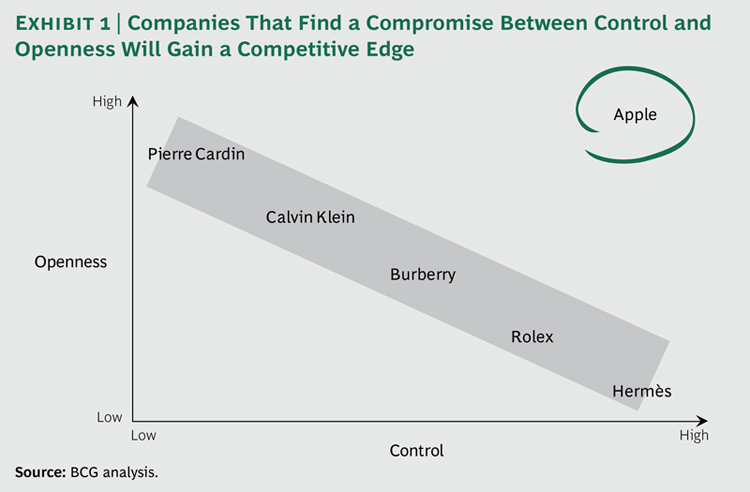
The iPhone shattered the prevailing ideas of value creation in personal mobile communications. Apple was not just making and selling a product, it was bringing together a range of attractive offerings from a whole universe of partners, large and small. Yet despite the size and diversity of this universe, the offerings were tightly integrated: Apple was guaranteeing a homogenous and pleasing experience for the customer—a crucial factor in its success. Read more of this post