Integrating Suppliers: Moving Impact from Lean Programs to the Next Level

Integrating Suppliers: Moving Impact from Lean Programs to the Next Level
by Thomas Frost, Holger Gottstein, Christian Greiser, and Robert Tevelson

JUNE 04, 2013

Overview
Integrating-Suppliers-ex1_large_tcm80-135656 Integrating-Suppliers-ex-sidebar_large_tcm80-135652 Integrating-Suppliers-ex2_large_tcm80-135660 Integrating-Suppliers-ex3_large_tcm80-135663 Integrating-Suppliers-ex4_large_tcm80-135666

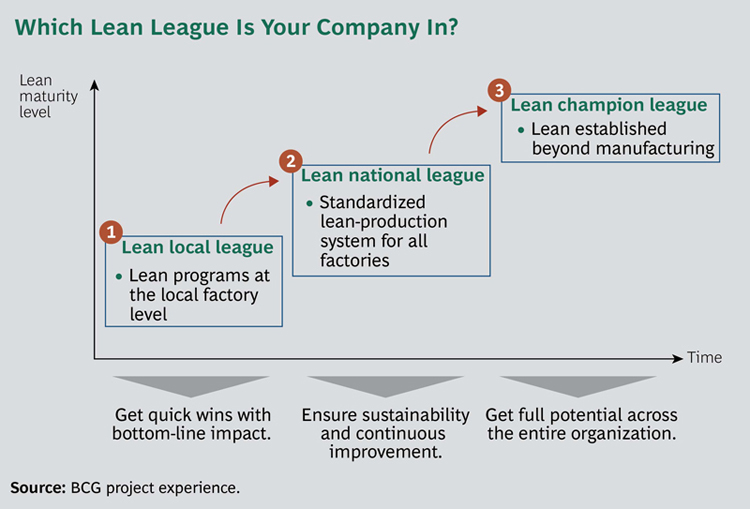
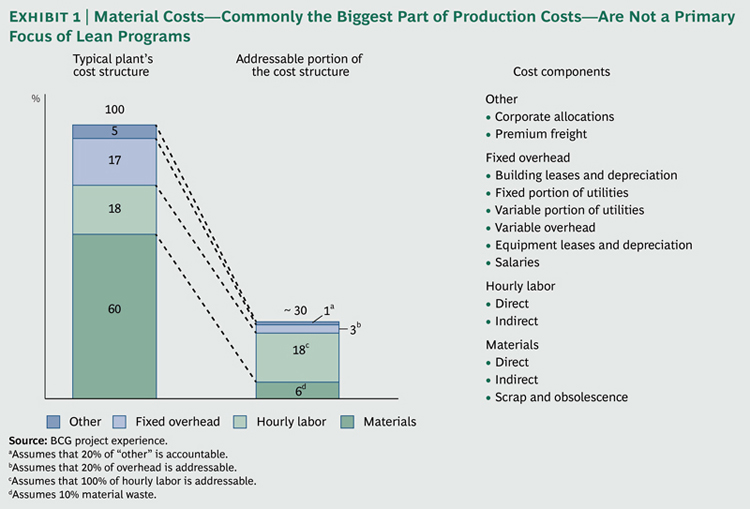
Many manufacturers that have applied lean concepts to their operations find that although they do achieve significant savings, their production costs remain high. This is, in most cases, attributable to material costs, which, depending on industry can range from 60 to 80 percent of total production costs. (See Exhibit 1.)

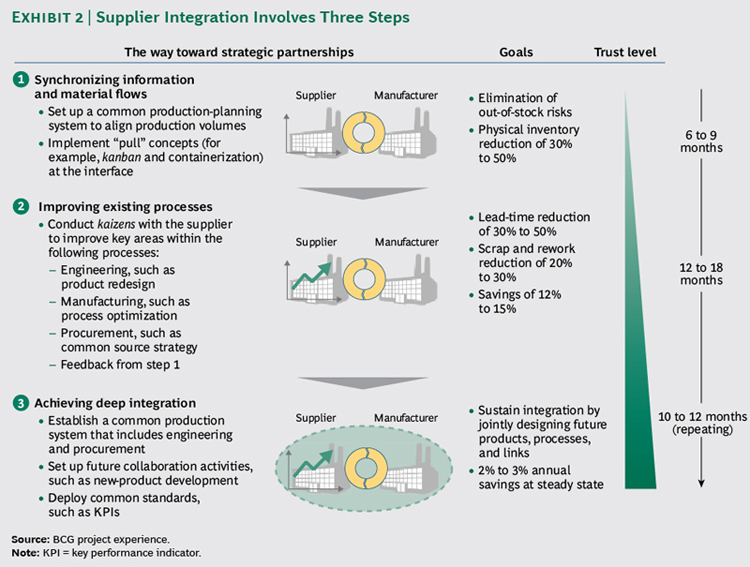
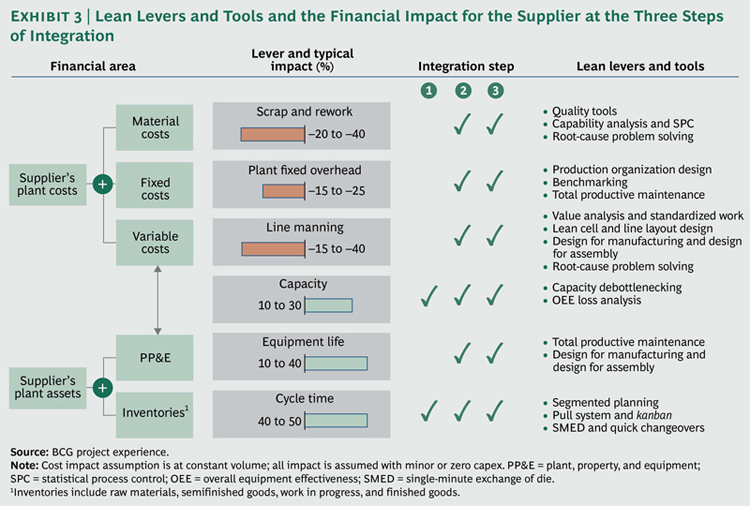
The challenge for these manufacturers is to discover how to extend lean concepts and practices beyond the walls of their own factories. The most effective way is to forge links with key suppliers on the basis of lean principles. In addition to yielding cost savings, this kind of collaboration can form the foundation of a profitable strategic partnership. More than simply an approach to eliminating waste in procurement, creating such relationships means leveraging existing lean techniques to the fullest and using them to transform a manufacturer’s entire supply chain. Read more of this post
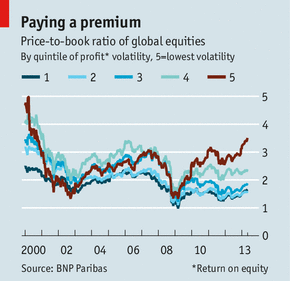
Quality Street: The latest fashion in equity investing; Quality stocks now trade at around 3.5 times their book (or asset) value

Quality Street: The latest fashion in equity investing

Jun 15th 2013 |From the print edition

20130615_FNC785

EQUITY investors have had a turbulent time over the past 15 years, including a dotcom boom and bust, the financial crisis in 2008 and the rise and fall of the mining sector. So it is hardly surprising that they have become a little choosy about the stocks they favour.

Orrin Sharp Pierson, a strategist at BNP Paribas, points to a huge preference among investors in recent years for “quality” stocks. He defines such stocks as those with the least volatile profits. As the chart shows, when the market was bottoming in late 2008 and early 2009 there was little difference in valuation between high-quality and low-quality companies. But the gap has widened steadily ever since. Quality stocks now trade at around 3.5 times their book (or asset) value. Read more of this post

Guggenheim Partners: Treasurys Are a ‘Ponzi Market’

Jun 13, 2013

Guggenheim Partners: Treasurys Are a ‘Ponzi Market’

By Steven Russolillo

Scott Minerd, global chief investment officer at Guggenheim Partner, minces few words in his characterization of how the Fed’s easy-money policies have distorted the Treasury market over the years.

“The U.S. Treasurys market could now be described as a Ponzi market,” Minerd told clients Wednesday evening. Read more of this post

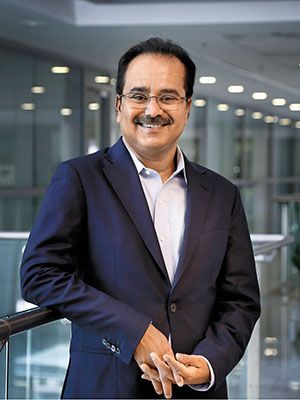
Samvardhana Motherson Group’s VC Sehgal says it is a mistake building a business solely with the idea that your children can inherit it

VC Sehgal: We entrepreneurs are a bit insecure, that’s why we control

by VC Sehgal | Jun 13, 2013

topimg_21837_vc_sehgal_300x400

Samvardhana Motherson Group’s VC Sehgal says it is a mistake building a business solely with the idea that your children can inherit it

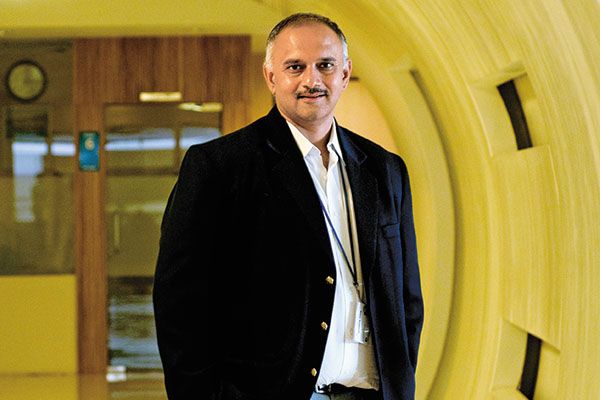
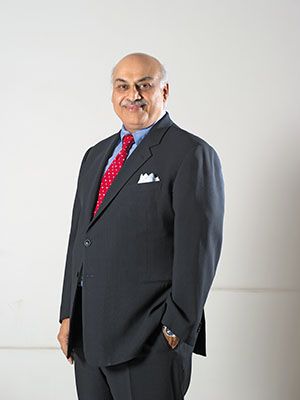
VC Sehgal is the chairman of the $5.4 billion Samvardhana Motherson Group, one of India’s largest auto components companies. In his 40-year-long career, Sehgal has dabbled in various businesses—silver trading, selling housing cables and polyester chips. But he finally found his calling in manufacturing wiring harness for automobiles. An Australian citizen, Sehgal travels more than 300 days in a year meeting customers across the globe

The year 1994-95 was very interesting because there was a directive from the Indian government which wanted us to localise fast. We had to travel to Japan a lot because our main collaborates [Sumitomo] were there and I found that travelling was increasing more and more. Then we had Maruti requesting us to localise very intricate parts which were under patents, so there were a lot of conflicts and I had to also travel a lot to Europe and look for second sources. Because I was travelling a lot, I appointed one person who would be responsible for the whole company and every aspect/problem would first be reported to him  Read more of this post

India’s Persistent Systems’ founder Anand Deshpande: My employees asked me, was it my company or our company?

Anand Deshpande: My employees asked me, was it my company or our company?

by Anand Deshpande | Jun 10, 2013

topimg_21823_anand_deshpande_600x400

Anand Deshpande is founder, CEO and managing director of Persistent Systems. Prior to setting up the Pune-based company in 1990, he worked at Hewlett-Packard Laboratories in Palo Alto, California. Every month, he spends about two weeks meeting his customers in the US. Ram Charan, Jim Collins, Clayton Christensen and CK Prahalad are among his favourite management thinkers

Anand Deshpande realised he needed to make a transition from a programmer to a sales manager in order to grow Persistent

Before I started persistent systems, i was doing research work at HP Labs in Palo Alto. When I came back to India, my ambition was to start a high-end, tech-focussed company that wouldn’t compromise my résumé in some sense. I started Persistent in 1990 and we were working on some interesting projects. The idea was to be very niche. For the first three or four years, we were doing that kind of work. I felt I achieved what I had intended to. And I was doing what I liked doing. After three or four years, some employees told me, “Fine. This is what you are doing for yourself but what about us?” In effect, their question was, “Is this your company or is this our company?”   Read more of this post

Dr Reddy’s GV Prasad: You can never have a company totally dependent on one person

GV Prasad: You can never have a company totally dependent on one person

by GV Prasad | Jun 12, 2013

topimg_21829_gv_prasad_300x400

Except for a brief period when GV Prasad ran his family’s construction business, he has been in the pharmaceutical industry for over 25 years. Following the merger of Cheminor Drugs, where he was the managing director, with Dr Reddy’s Laboratories (DRL) in 2000, Prasad became the executive vice chairman and chief executive officer of the merged entity. In April 2013, with the passing away of Dr K Anji Reddy, Prasad became the chairman of DRL. He lives in Hyderabad and, when time permits, ind

Dr Reddy’s Laboratories’ GV Prasad says that an organisation must be able to sustain changing ownership, technologies, products and strategies

When I came back to india after graduation in the us, I knew I wanted to start a business but what that would be I didn’t know. I joined the family business for a while and then set up a bulk drugs company, Benzex Labs, with my parents’ money. It was 1985, also the year I got married. I ran the business for over a year. Unfortunately, it didn’t do very well and Dr Reddy’s Laboratories (DRL), which was in the neighbourhood and expanding very aggressively, wanted to acquire it. And acquire it did, after my father decided with Dr [K Anji] Reddy that pharmaceuticals was a business he wanted to exit. I wasn’t part of that decision though.  Read more of this post

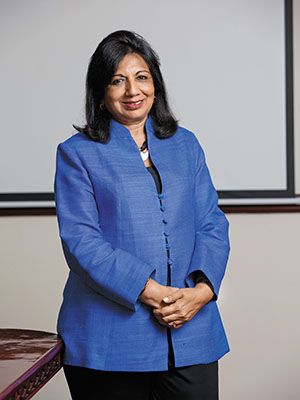
Kiran Mazumdar-Shaw talks about Biocon’s fallout with Pfizer which was perhaps the company’s most significant event since its insulin analogues breakthrough

Kiran Mazumdar-Shaw: Instead of having bad blood with a good company,I decided to part amicably

by Kiran Mazumdar-Shaw | Jun 6, 2013

topimg_21813_kiranmazumdar_mk_300x400

Kiran Mazumdar-Shaw is the chairman and managing director of Biocon, a company she founded in 1978. Over the years, she’s transformed the industrial enzyme company into an integrated biopharmaceutical business that focuses on key therpeutic areas of diabetes, oncology and auto-immune diseases. Along the way, she also set up two subsidiaries—Syngene and Clinigene

Kiran Mazumdar-Shaw talks about Biocon’s fallout with Pfizer which was perhaps the company’s most significant event since its insulin analogues breakthrough

Biocon’s journey in the insulin space was itself an inflection point at that time. When we chose to transform ourselves from enzymes to a biopharmaceutical company, we decided to leverage the existing enzyme technologies. Pichia technology was one of them—a platform to which a simple peptide like insulin lent itself easily. We could have done many things with it, developed many proteins but we chose insulin. The rationale was simple: Diabetes is a pandemic, there’s unmet need in India, and the cost of therapy [is high]. Read more of this post

India’s state-run banks’ bad debts are making economic recovery harder

State-run banks’ bad debts are making economic recovery harder

Jun 15th 2013 | MUMBAI |From the print edition

20130615_FNC794

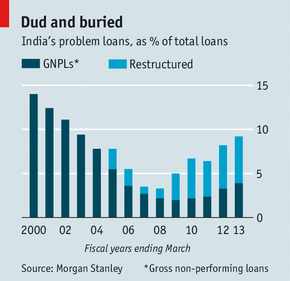
WHEN India loosened its rules on how banks deal with bad debts in 2008, the financial crisis was raging. The aim, sensible enough, was to give breathing room to borrowers in temporary difficulty because of a shock that originated thousands of miles away in America’s housing market. Five years on, however, the policy has come back to haunt the country’s financial industry.

Bank loans are usually classified as either performing or non-performing. If non-performing, lenders must build up reserves against potential losses. In 2008 the Reserve Bank of India (RBI), the supervisor, permitted the widespread use of an intermediate category of “restructured” loans. The terms of these loans had been watered down to help the borrower but banks could assume any difficulties were a blip and avoid building up provisions. Read more of this post

The “third arrow” of reform has fallen well short of its target; time for Shinzo Abe to rethink

The “third arrow” of reform has fallen well short of its target; time for Shinzo Abe to rethink

Jun 15th 2013 |From the print edition

20130615_LDD001_0

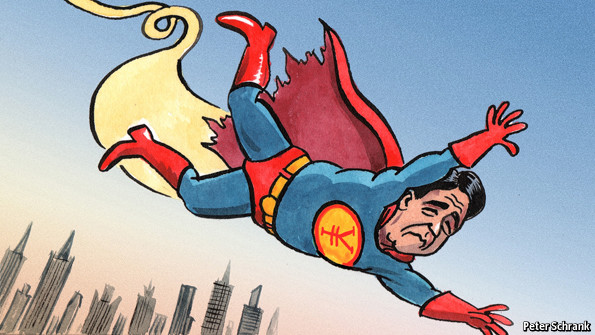
EARLIER this year Shinzo Abe, Japan’s prime minister, unveiled the first two “arrows” of his three-point economic plan—monetary easing and fiscal stimulus—and hinted at structural reforms to come. Japan’s stockmarket soared by 80% in six months. Mr Abe’s approval rating soared, too. Then, after months of euphoria, at the end of May, bond-market jitters about the radical easing plans helped to spark a sell-off in shares. Now Mr Abe’s eagerly awaited “third arrow” of structural reforms has fallen well short of the rings, let alone the bull’s eye. Indeed, it is so wide of the mark that one is left wondering if Abenomics has failed before it even properly began. Read more of this post

KKBOX, Taiwan’s biggest cloud-based music service provider, said Tuesday it is looking to expand further into new markets in Asia and hopes to become a leading regional subscription service brand

Music service KKBOX eyes further expansion in Asia

CNA

2013-06-13

KKBOX, Taiwan’s biggest cloud-based music service provider, said Tuesday it is looking to expand further into new markets in Asia and hopes to become a leading regional subscription service brand.

The market share leader in Taiwan and Hong Kong, KKBOX is now eyeing the Thai, Indonesian and Australian markets after successfully gaining a presence in Japan on June 1, Izero Lee, KKBOX’s CEO, was quoted as saying by local media. Read more of this post

“Tmura is the Hebrew word for change or metamorphosis and also means value for money; it is also a play on the word truma”, which means donation”

An unexpected winner in the Waze exit: a not-for-profit Israeli fund

Founded in attempt to entice the high-tech community to get more involved in Israeli non-profits, the Tmura fund is slated to receive $1.5 million from Waze’s sale to Google.

By Inbal Orpaz | Jun.12, 2013 | 4:58 PM |  2

The enormous exit for Waze, the Israeli navigation app start-up sold to Google for $1.03 billion, has created long list of new millionaires – including the company’s management. Founder Ehud Shabtai, who is also the chief technology officer, will receive $63 million. Amir Shinar, founder and head of research and development, will receive $51 million. Uri Levine, founder and president, will receive $30 million.

One of those profiting is a bit unusual in high tech-terms: Tmura – The Israeli Public Service Venture Fund, founded by Yadin Kaufmann. Read more of this post

Waze employees clinch most lucrative exit in Israeli history; Each of the company’s 100 employees will be getting an average of $1.2 million

Waze employees clinch most lucrative exit in Israeli history

Each of the company’s 100 employees will be getting an average of $1.2 million.

By Amir Teig | Jun.13, 2013 | 9:12 AM |  2

The 100 employees of the Israeli navigation app developer Waze stand to receive a total of $120 million, as a result of Google’s acquisition of the company, making this the most lucrative exit ever for employees of an Israeli startup. The global search giant confirmed on Tuesday that it had agreed to purchase Waze for $1.15 billion.

Prime Minister Benjamin Netanyahu called Waze CEO Noam Bardin on Tuesday evening to congratulate him on the sale. “We fought to keep the company in Israel,” Bardin said in response. “We’ll help you close the hole in the budget,” he added, partially in jest but also in pride.

Of the $1.15 billion that Google transferred into the account of Waze’s shareholders’ trustee, $1.03 billion will be going to the company’s owners, which include institutional investors, funds and other investors. Read more of this post

Who will be the next Waze? “Globes” selects some of Israel’s most promising start up candidates for the next big exit

Who will be the next Waze?

“Globes” selects some of Israel’s most promising start up candidates for the next big exit.

12 June 13 19:55, Roy Goldenberg

In the wake of the impressive exit by Waze Ltd., “Globes” presents ten Israeli Internet start ups which could produce the next big exit.

Wix Ltd.

Business: Easy-to-use online platform for building websites

CEO: Avishai Avrahami

Chances of sale/IPO: Last week, the company filed a draft prospectus with the US Securities and Exchange Commission (SEC) for an IPO on Wall Street

Estimated company value: $400 million

Estimated revenue in 2012: $40 million

Capital raised: $66 million

Prominent investors: Bessemer Venture PartnersBenchmark Capital, DAG, Mangrove Capital Partner, Insight Venture Partners, and private investors. Read more of this post

The fall of Israel’s Better Place: When vision isn’t enough; From the very beginning, the electric-car company lacked a solid business model. Its collapse is sad, but no surprise

The fall of Israel’s Better Place: When vision isn’t enough

From the very beginning, the electric-car company lacked a solid business model. Its collapse is sad, but no surprise.

By Ora Coren | May.26, 2013 | 5:41 PM |  5

At a lecture three years ago Shai Agassi, the founder of the Better Place electric car venture, accused the state of Israel of lacking vision.

The state had refused to give him a $150 million grant to build a factory making electric cars in Beit She’an, Agassi griped. It also declined to offer him a gift in the form of a large plot of land in the Negev to generate solar power. Read more of this post

Silicon Valley isn’t waiting around for Startup Nation; Israel is a wonderful source of innovation, creativity and development. But it needs to get over itself

Silicon Valley isn’t waiting around for Startup Nation

Israel is a wonderful source of innovation, creativity and development. But it needs to get over itself.

By Oded Hermoni | Jun.13, 2013 | 12:57 PM

Israelis tend to take Israel’s hi-tech industry for granted. Tell them that investors are daunted by security risks and they shrug, confident that tiny Israel is at the center of the technological universe and has no match in knowledge, innovation and creativity.

The question of government support for Intel goes right to the heart of the problem.

Intel Israel is the largest Israeli high-tech employer. It is responsible for 10% of Israeli industrial export and 20% of high-tech export. And it is being taken for granted, as is the expectation that it will continue to work in Israel and invest in building new plants. Read more of this post

Jiuding Capital: China’s “PE Factory” Breaks Down; Harvard Business School case study praise of Jiuding’s “dazzling results” look more like relics from a bygone era in less than 18 months

Jiuding Capital: China’s “PE Factory” Breaks Down

Peter Fuhrman(中文名傅成)是中国首创(www.chinafirstcapital.com) 的董事长。他作为高级主管,在私募股权投资、风险投资、科技行业和美国、中国及欧洲成功的中小企业有着30年的工作经验。英国剑桥大学经济学硕士。 Peter Fuhrman is chairman, founder and Chief Executive Officer of China First Capital, 中国首创,  (www.chinafirstcapital.com), a leading China-focused specialist investment bank and advisory firm for private capital markets and M&A transactions in China.

June 11th, 2013

Less than 18 months ago, Harvard Business School published one of its famed “cases” on Kunwu Jiuding Capital (昆吾九鼎投资管理有限公), praising the Chinese domestic private equity firm for its ” outstanding performance ” and “dazzling investment results”. (Click here to read abridged copy.) Today, the situation has changed utterly. Jiuding’s “dazzling results”, along with that HBS case, look more like relics from a bygone era. Read more of this post

The CIC Hot Potato : Why no one wants to lead China’s $500 billion sovereign wealth fund.

The CIC Hot Potato – Economic Observer Online

By Ouyang Xiaohong (欧阳晓红)
Issue 622, June 2, 2013

1359372348108

China’s leaders are anxious to find a new chairman for China Investment Corporation (CIC), the country’s $500 billion sovereign wealth fund.
The former head, Lou Jiwei (楼继伟), left the fund after he was appointed as the country’s new finance minister back in March. Since Lou’s departure, there’s been no official announcement of who is going to take his place over at CIC.
“I guess in the end it will still be Tu Guangshao (屠光绍), the deputy mayor of Shanghai,” a person close to CIC’s senior management told the EO on May 29 with a tone of exasperation in his voice. The unspoken message seemed to be that the people charged with making the decision would look around for another candidate for a while, before returning to their original choice. Read more of this post

How China’s solar boom fizzled and went bust

How China’s solar boom fizzled and went bust

By Jeffrey Ball, Stanford Graduate School of Business 6 hours ago

If one city epitomizes China’s role as cheap manufacturer for the world, it’s Wuxi, a sprawling metropolis of more than 4.5 million people a short bullet-train ride northwest of Shanghai. Out beyond the old town, with its ancient temples and canals, much of modern Wuxi is a massive industrial park, a seemingly endless grid of wide, straight roads fronting squat factories bearing the names of international brands: Epson, Nikon, Panasonic.

Wuxi’s industrial zone also is the epicenter of the global solar-energy industry, a sector now in the throes of convulsive growing pains. Specifically, the zone is home to the gleaming glass-fronted headquarters of Suntech Power Holdings Co., which over the last decade sprang from local startup to world’s largest solar-panel maker — and then, this spring, declared that its main business unit was bankrupt. Read more of this post

How did we get here? A “map” of the Fed’s balance sheet’s history

SATURDAY, JUNE 8, 2013

How did we get here? A “map” of the Fed’s balance sheet’s history

SoberLook.com

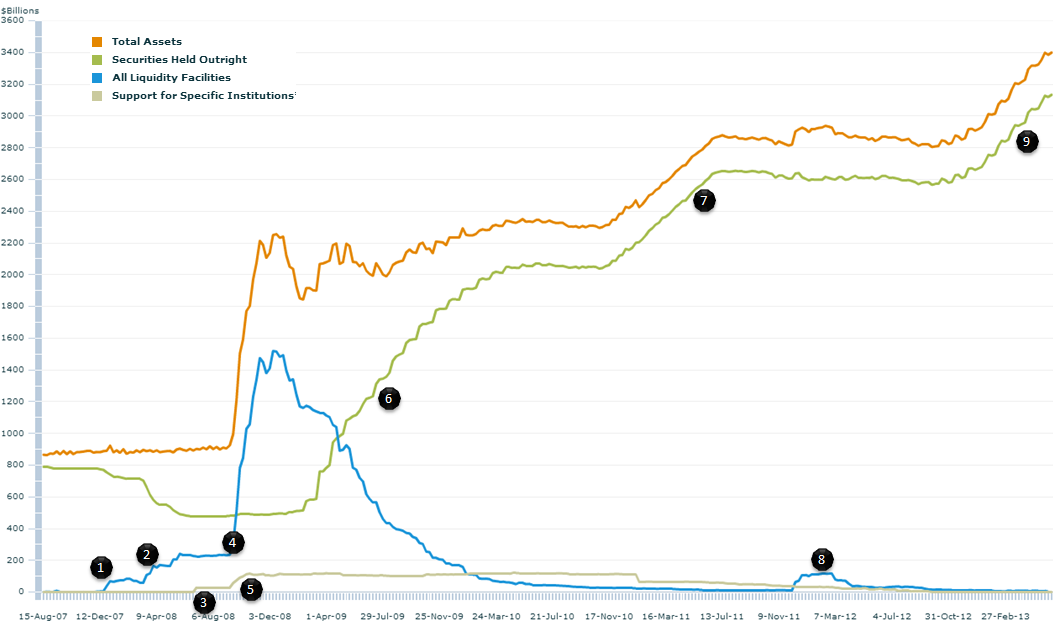
Some in the mass media continue to be confused about the historical trajectory of the Fed’s balance sheet. People have trouble distinguishing between the liquidity facilities provided by the central bank and the various monetary expansion activities. Here is a historical “map” to show how we got here.

Feds Balance sheet Read more of this post

Funds of hedge funds fight for survival as investors withdraw billions of dollars from the sector every quarter, scared off by mixed results and high performance fees

June 9, 2013 7:20 am

Funds of hedge funds fight for survival

By Ellen Kelleher

Funds of hedge funds are being forced into a corner as investors withdraw billions of dollars from the sector every quarter, scared off by mixed results and high performance fees.

The number of funds of hedge funds has fallen steadily in recent years, according to figures from Chicago-based Hedge Fund Research, dropping from 2,462 in 2007 to 1,855 in the first quarter of this year. While outflows have eased since the haemorrhaging seen in 2009, they persist. More than $22bn was removed from funds of funds in 2012 and another $5bn in the first quarter of 2013. Read more of this post

Amazon Expands Into Selling 3D Printer & Supplies

Amazon Expands Into Additive Manufacturing

Kyle Maxey posted on June 10, 2013 | Comment

While Amazon CEO Jeff Bezos may believe that 3D printing is still a long way from changing the way industry makes and distributes products, his online marketplace isn’t shying away from the opportunity to sell the revolutionary technology. In a recent addition to its website, Amazon has decided to add a new section to it’s “Industrial & Scientific” market category – “3D Printers & Supplies”. A quick look around the section gave me the impression that Amazon is still catering to the Maker segment of the 3D Printing community. Among the products available are the MakerBot Replicator2, the LulzBot AO-101, the Airwolf3D and a number of other models. Read more of this post

Sensitivity of asset prices to Fed balance sheet expansion

Fed tapering

Jun 11th 2013, 12:09 by Economist.com

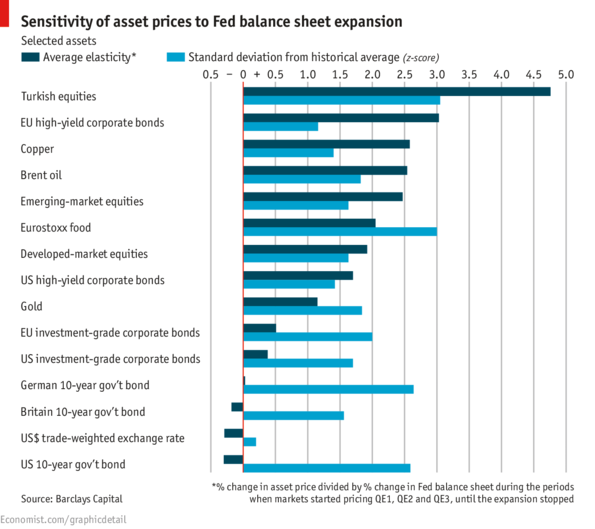
WITH short term interest rates at record lows, America’s Federal Reserve has sought to boost its economy by purchasing bonds with newly created money, thereby pushing down bond yields. In November 2008 the central bank announced it would buy up to $600 billion in agency mortgage-backed securities (MBS) and agency debt. The programme was extended in March 2009 by an additional $850 billion, and $300 billion in purchases of Treasury securities. This first episode of this so called quantitative easing, later known as QE1, was followed by two more rounds; QE2 in November 2010 ($600 billion) and QE3 in September last year ($40 billion of MBS and $45 billion of Treasuries each month). QE3, the Fed said, would continue until the outlook for jobs had improved substantially. America’s jobs market has improved, and markets are now reckoning the Fed will start to taper its bond purchases in coming months. According to EPFR Global, a data provider, this has put pressure on bond prices and investors have fled riskier assets; bond fund outflows reached a record in the week ending June 5th. Researchers at Barclays Capital have looked at which assets are most sensitive to the Fed’s balance sheet, by dividing the change in the asset prices over periods of QE, by the change in the size of the Fed’s balance sheet. At present, markets are adjusting to the Fed’s balance sheet merely expanding more slowly than expected. At some point they will have to adjust to its outright shrinkage. Since emerging-market equities and European and American high-yield bonds showed the greatest sensitivity to Fed balance sheet expansion, they could be expected to also fall most when it shrinks. Judged by how an asset deviated from its historical value during QE, Turkish equities and “defensive” stocks (those that do not move with the business cycle, like food) are most vulnerable.

20130615_gdc777_1

End of Cheap Money: Can the World Handle Higher Interest Rates?

06/13/2013 10:47 AM

End of Cheap Money: Can the World Handle Higher Interest Rates?

By Martin Hesse, Anne Seith and Wieland Wagner

For the last five years, the world’s leading central banks have been combatting the crisis with extremely low interest rates and vast bond purchases. Now the American Fed is breaking ranks, as it cautiously suggests a change in its policy — sending the markets into turmoil.

Fuchinobe doesn’t look like the kind of place where speculators have struck it rich. The commuter rail station near the Japanese capital of Tokyo is surrounded by drab apartment buildings and small single-family homes. But the neighborhood is also home to Yuka Yamamoto, 44, a star among Japan’s so-called shufu toshika, or “housewife investors.” Read more of this post

Alibaba’s Alipay App Has A Major Update Again, Wants More Control over Your Mobile Life

Alipay App Has A Major Update Again, Wants More Control over Your Mobile Life

By Tracey Xiang on June 8, 2013

AlipayWallet2

Alipay, the payments company under Alibaba Group, just released a major update of its mobile app, Alipay Wallet  – now only Android versionis available. This version touches more aspects of your mobile life. Here are some of the new features,

Managing your travel itineraries. Now you can add and manage airtickets, hotels and other travel related tickets within the app, and receive notifications of flights and other alerts. Alipay now partners with four Airlines including AirChina, airticket search service Kuxun and hotel service Buding. Read more of this post

Lakala Founder: Third-party Payments Service Are the New SPs and Banks New Telcos

Lakala Founder: Third-party Payments Service Are the New SPs and Banks New Telcos

By Charlie Sheng on June 13, 2013

Sun Taoran is a respected serial entrepreneur and a bestselling author on building startups. He started his first business back from publishing a weekly IT magazine and then shifted to the second company Bluefocus, also the first listed PR company in China. Later on he began to make mobile phones branded Hi-Tech Wealth (also named as the mobile PC), which was quite a hit at the early 00s.. He started up a total of seven companies in different fields and the most recent one is Lakala.

Now founder and chairman of Lakala, one of the biggest third-party payments services in China, Mr. Sun revealed to local media about how he came up with the idea of building such a company and his thoughts on third-party payments sector in China. Read more of this post

‘Australia is a leveraged time bomb waiting to blow’: SocGen

‘Australia is a leveraged time bomb waiting to blow’: SocGen

Business Insider | 13/06/13 | Last Updated: 13/06/12 2:34 PM ET
Australia’s GDP growth expanded merely 0.6% in the first quarter. This was after a 0.6% rise in Q4 2012. Meanwhile, there are a lot of people shorting the Australian dollar.

Minus export growth however, Societe Generale’s Albert Edwards writes that gross national expenditure (GNE) has fallen for two straight quarters.

“One of the biggest economic bubbles in history is now about to go into the Minsky masher,” writes Edwards. This refers to periods of speculation that lead to crisis, and was named after economist Hyman Minsky who wrote about the inherent instability of bull markets. Read more of this post

Overbuilt condo market puts Canadian economy at risk: BoC

Overbuilt condo market puts Canadian economy at risk: BoC

Julian Beltrame, Canadian Press | 13/06/13 | Last Updated: 13/06/13 11:45 AM ET
OTTAWA — An overbuilt and overpriced condominium market is posing a risk to Canadian households, banks and the economy in general, the Bank of Canada warned Thursday in its latest review of the health of the country’s financial system.

New housing already purchased and in the pipeline continues to propel the Canadian real estate market but worries persist about what happens when that tap turns off.

For now, the industry got another bit of good news Monday with Canada Mortgage and Housing Corp. saying new home construction or starts reached the lofty 200,000 level in May on a seasonally adjusted annualized basis. Read more of this post

Real-time translation start-up Lexifone leaves much to be desired; Phone service slow, OK at business talk but garbles daily speech

Real-time translation start-up leaves much to be desired

Phone service slow, OK at business talk but garbles daily speech

BY MAX J. ROSENTHAL

AP JUN 14, 2013

JERUSALEM – An Israeli start-up says it has come up with a way to overcome language barriers when conducting international business: an automated service that provides quick translations between English and seven other languages over the telephone.

Lexifone allows people to get translations without paying hundreds of dollars for human interpreters. The service translates spoken conversations in real time, which Lexifone says is an improvement over free, Web-based services that are typically limited to typing in text. Read more of this post

FSS to monitor Samsung shares to see whether there has been any manipulative activity involved in recent price swings

2013-06-12 17:29

FSS to monitor Samsung shares

By Kim Rahn

130611_p11_concerns

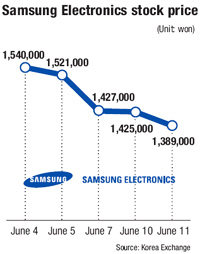
Financial authorities said Wednesday that they will keep a close eye on movements of shares in Samsung Electronics to see whether there has been any manipulative activity involved in recent price swings.

The move came after suspicions of manipulation because of a selling spree led by foreign investors that is considered unusual. Read more of this post

Stocks of Choco Pies are piling up in the warehouses of suppliers because the Gaeseong Industrial Complex has remained shut down for the last two months

2013-06-13 17:15

Choco Pie stocks pile up as Gaeseong closure continues

By Nam Hyun-woo

Stocks of Choco Pies are piling up in the warehouses of suppliers because the Gaeseong Industrial Complex has remained shut down for the last two months.

A large quantity of chocolate-covered marshmallow-filled snacks were sent to the joint industrial complex just north of the Demilitarized Zone (DMZ) because South Korean companies offered incentives to 53,000 Gaeseong workers, including the round chocolate snack. Since incentive money was banned for being too “capitalist,” the snacks were provided instead of currency. North Koreans there were fascinated with the sweet taste. Read more of this post