The Korean government will bring criminal charges against CEOs of large firms that force suppliers and sub-contractors to lower their product prices

2013-06-13

CEOs to be punished for ‘forced price cuts’

By Yi Whan-woo

The government will bring criminal charges against CEOs of large firms that force suppliers and sub-contractors to lower their product prices.

The Fair Trade Commission (FTC), the country’s anti-trust watchdog said on Friday that those convicted will face a maximum fine equal to three times the financial damage suffered by the small businesses. Read more of this post
“The Market Would Have Collapsed” Had The PBOC Drained: Chinese Liquidity Shortage Hits All Time High

“The Market Would Have Collapsed” Had The PBOC Drained: Chinese Liquidity Shortage Hits All Time High

Tyler Durden on 06/13/2013 09:41 -0400

20130613_SHIBOR_0

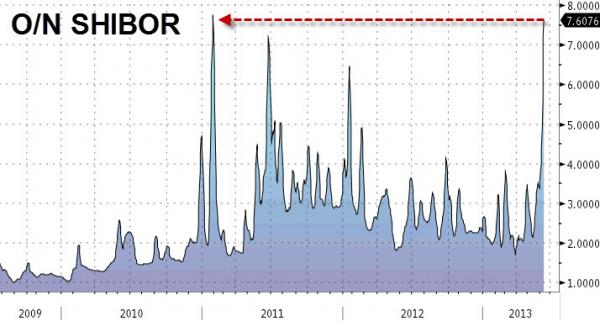
Those who have been following our coverage of the bipolar Chinese liquidity situation (most recently here and here) are well aware of the unique position the world’s fastest (if only on paper) growing economy finds itself in: on one hand, it is the target of massive external hot money flows from both the Fed and the BOJ, which are pushing select inflation in the country higher, manifesting itself best in the real-estate market now higher for 12 consecutive months. On the other hand, the local banking system is in such dire need of liquidity, that not only have various short-term SHIBORs soared to multi-year highs but as Market News reported last week, China Everbright Bank failed to repay 6b yuan ($977m) borrowed from Industrial Bank on time yesterday because of tight liquidity, leading to “chain effect” borrowing in the market overnight and almost ushering in the first bank failure in China. The unprecedented liquidity shortage in China is seen best on the overnight SHIBOR chart below which just hit an all time high. In a nutshell there is zero free liquidity in the system. Which all culminated to last night’s surprising move by the PBOC to step aside from draining funds from the financial system for the first time in three months as even the PBOC now realizes that in the battle against Bernanke and Kuroda’s cash it is about to lose the fight. Read more of this post

Why Local-Mobile Marketing Is Exploding

Why Local-Mobile Marketing Is Exploding

JOSH LUGER JUN. 12, 2013, 2:14 PM 14,255 4

Location-based mobile marketing promises the sky: high conversion rates, surgical targeting, and rich consumer profiles. But does it deliver? According to many accounts, it does. Not surprisingly, retailers, brands, and agencies are scrambling to hone their location-based approaches. These encompass everything from “geo-aware” and “geo-fenced” ad campaigns, to hyper-local efforts keyed to Wi-Fi hotspots, and algorithmic location-based targeting of audience segments like soccer moms, bargain hunters, coffee enthusiasts, etc.

Read more of this post

Gatekeepers of Cable TV Try to Stop Intel

June 12, 2013

Gatekeepers of Cable TV Try to Stop Intel

By BRIAN STELTER

WASHINGTON — As Intel tries something audacious — the creation of a virtual cable service that would sell a bundle of television channels to subscribers over the Internet — it is running up against a multibillion-dollar barricade.

That barricade is guarded by Time Warner Cable and other cable and satellite distributors, which are trying to make it difficult — if not impossible — for Intel to go through with its plan. The distributors are using a variety of methods to pressure the owners of cable channels, with whom they have lucrative long-term contracts, not to sign contracts with upstarts like Intel, that way preserving the status quo. Read more of this post

The houses built on China’s ‘poisoned’ land; Huge areas of contaminated land in Chinese cities like Beijing are being developed into residential districts. But the residents of these developments have no idea

The houses built on China’s ‘poisoned’ land

Gao Shengke Wang Kai

05.06.2013

Huge areas of contaminated land in Chinese cities like Beijing are being developed into residential districts. But the residents of these developments have no idea.

Gao Shengke and Wang Kai have won the prize for Best Investigation atchinadialogue’s and The Guardian’s China Environmental Press Awards – 2013 for their investigation into contaminated earth in Chinese cities. Here is the first of their three-part series of reports.

The excavators are rumbling and dust swirls all about at the second phase of the Kangquan New City construction project in Guanzhuang village, Chaoyang District, outside Beijing’s east fifth ring road. A 20-metre deep pit has been dug on the site. A foul stench rises from the pile of earth that has been removed. Until now, few people knew about the secret that was buried here. This plot of land was previously the site of a factory owned by the Ministry of Railways that made anti-corrosive railway sleepers. The plant was in operation for more than 30 years; many kinds of organic pollutants continuously seeped into the topsoil, deeper soil layers, and into the groundwater. Some seven or eight years ago, the factory was relocated and this plot of ground was left unused. In January 2011, the city administration decided to convert the land into a development for affordable housing and it was taken over by the Residential Construction Service Centre for Civil Servants to build low-cost housing for civil servants from all ministries. Read more of this post

Not Just Solar: The China Car Industry Capacity Problem

June 12, 2013, 6:16 PM

Not Just Solar: The China Car Industry Capacity Problem

By Michael Dunne

Where Chinese solar panels lead, can made-in-China cars be far behind?

China has the capacity to build twice as many solar panels as the world needs–so much so that the Middle Kingdom, according to European officials, has been dumping them overseas. So desperate is the drive to unload extra stock that the Chinese are selling at prices 88% below market value, according to EU trade officials. The EU approved punitive tariffs last week. We’re bound to see a similar, if not quite as extreme, story in cars. By 2018 Chinese and global auto makers, with new factories scattered across China, will be equipped to make more than 30 million cars a year. To put that number in perspective, consider that 30 million cars amount to twice the size of the entire U.S. market. Read more of this post

Japan’s leading appliance retailer getting knocked out of China

Japan’s leading appliance retailer getting knocked out of China

June 12, 2013

By TOKUHIKO SAITO/ Correspondent

NANJING–Tensions over the Senkaku Islands, “obstructive behavior” by rival companies and fierce price wars forced Japan’s leading electric appliance retailer to leave Nanjing only a year after opening a retail shop there.

Yamada Denki Co. had planned to use its store in the southern Chinese city as a starting point to advance into nearby Shanghai, one of the country’s largest cities. Read more of this post

Patchwork of data covers all of us from the cradle to the grave

June 12, 2013 8:11 pm

Patchwork of data covers all of us from the cradle to the grave

By Emily Steel in New York

Data cost

Months before Eleanor Nagle was born, details about her already had been traded for pennies in the corporate market for consumer information.

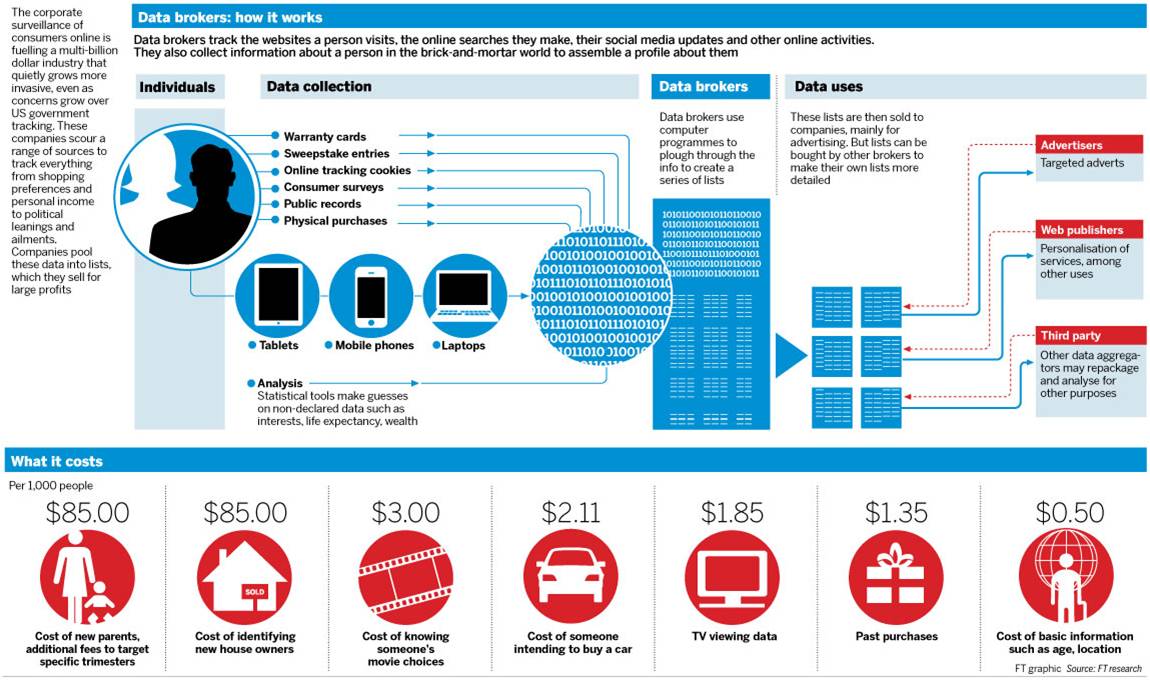
So-called data brokers scour through baby furniture and maternity store purchases, social media posts, pregnancy email subscriptions, baby registries and birth records, even purchasing details from photography companies that take in-hospital pictures of newborns. All so they can compile up-to-date, accurate lists of new parents, sorted by due date and including everything from the gender of the baby to the mother’s age and household income, to sell to marketers. Read more of this post

China’s proposed ban on the import of low-grade coal is likely to hit small Indonesian producers hard; Indonesia is the world’s biggest exporter of coal for power stations and as much as a third of its exports to China could be blocked if the plan is implemented as currently suggested

June 12, 2013 2:04 pm

Small Indonesian coal miners to be hit by China import ban

By Ben Bland in Jakarta

China’s proposed ban on the import of low-grade coal is likely to hit small Indonesian producers hard but most large miners will only suffer a minimal impact, according to analysts and industry executives.

Indonesia is the world’s biggest exporter of coal for power stations and as much as a third of its exports to China could be blocked if the plan is implemented as currently suggested. Read more of this post

Big data has to show that it’s not like Big Brother

Last updated: June 12, 2013 7:15 pm

Big data has to show that it’s not like Big Brother

By John Gapper

We do not know yet what this new technology of data analysis and artificial intelligence means

Sales of George Orwell’s Nineteen Eighty-Four have risen since Edward Snowdenrevealed how the National Security Agency of the US gains access to telephone records and data from technology companies. So far, if people do not exactly love Big Brother, they are prepared to accept some invasion of their privacy in return for security.

What about “big data”? Companies that hold rapidly expanding amounts of personal information are using new kinds of data analysis and artificial intelligence to shape products and services, and to predict what customers will want. Larry Page, Google’s chief executive, describes his ideal form of technology as “a really smart assistant doing things for you so you don’t have to think about it”. Read more of this post

Banks are tripping over themselves to lend money to Box, the cloud computing start-up, in a race to get a slot on one of the next big Silicon Valley flotations

Last updated: June 12, 2013 6:21 pm

Banks prepare credit to gain edge on Box IPO

By Arash Massoudi in New York and Richard Waters in San Francisco

Banks are tripping over themselves to lend money to Box, the cloud computing start-up, in a race to get a slot on one of the next big Silicon Valley flotations.

At least five banks are in talks to give a credit line to Box, underscoring the lengths they are willing to go to to develop potentially lucrative ties with the next batch of high-profile technology companies expected to come to market. Read more of this post

Private investors to be forced to pay for Japan’s bank failures

Last updated: June 12, 2013 10:52 am

Private investors to be forced to pay for Japan’s bank failures

By Ben McLannahan in Tokyo

Japan is to force losses on investors in troubled banks, brokers and insurers, leading efforts by regulators around the world to lighten the burden on taxpayers.

Under new legislation cleared by Japan’s parliament on Tuesday, holders of new types of preferred shares or subordinated bonds will face losses, or mandatory conversion to common stock, if the Financial Services Agency deems the issuer insolvent.

The FSA will gain its powers to trigger so-called “bail-in” clauses on these instruments – which are compliant with new Basel III rules on bank capital – as early as next spring, assuming that the bill becomes law. Read more of this post

The day the central banks lost control

June 12, 2013 4:13 pm

Markets Insight: Central bank loss of control leads to EM tumble

By Ralph Atkins in London

Fears of stimulus withdrawal trigger rising bond yields but central banks could change tactics, Ralph Atkins

Tear gas and riot police fill Istanbul’s Taksim Square. Investors fret about the growth outlook in India and China. But these were not the main factors behindsharp falls this week in emerging economies’ bond prices, and corresponding rises in yields. Read more of this post

Brainpower alone cannot save India’s growth model; The problems at Infosys raise questions about its role at a national level

June 12, 2013 4:59 pm

Brainpower alone cannot save India’s growth model

By David Pilling

The problems at Infosys raise questions about its role at a national level

For Infosys, a pioneer of India’s outsourcing revolution, the world used to be flat. Now it is looking more pear-shaped.

It was Nandan Nilekani, a co-founder of Infosys, who first put the idea in Thomas Friedman’s head that the world was flattening. Mr Friedman, who was wowed by the oasis of calm and sophistication he found at the company’s shiny Bangalore campus, recalls Mr Nilekani telling him: “Tom, the playing field is being levelled.”

That led him to think about how technology was rendering distance and borders increasingly irrelevant, and accelerating the process by which hundreds of millions of people in emerging countries were pressing into the global workforce. Read more of this post

Asia’s low fertility trap opens opportunities in IVF market

Asia’s low fertility trap opens opportunities in IVF market

Thursday, Jun 13, 2013
Reuters

A looming crisis in Asia as women delay giving birth, leading to low fertility rates that have dire implications for economic growth, is opening huge opportunities for the fast-growing in-vitro fertilization (IVF) industry.

The successful debut of Australia’s Virtus Health Ltd, which this week became the first IVF specialist to list on a stock exchange, is the latest sign that investors are eager to back fertility companies that have plans to expand into Asia’s vast developing markets.

“The market is going to grow massively, there’s no doubt, particularly in India and China we’ve seen huge growth,” said Robert Norman, fertility expert and president of Aspire, an Asia-Pacific industry lobby group. Read more of this post

The Bleak New World of Prenatal Genetics; The emerging market of fetal testing could transform the idea of what’s normal

June 12, 2013, 7:06 p.m. ET

The Bleak New World of Prenatal Genetics

The emerging market of fetal testing could transform the idea of what’s normal.

By MARCY DARNOVSKY AND ALEXANDRA MINNA STERN

OB-XV182_darnov_DV_20130612163733

Four million American women are expecting a child this year, and many of them will encounter something entirely new in human pregnancy. Based on a simple blood draw at an initial prenatal visit, they’ll be able to learn key genetic information about the fetus they’re carrying—and face potentially wrenching decisions about what to do.

These noninvasive prenatal tests, called NIPTs, work by using a sample of cell-free fetal DNA circulating in the mother’s blood to detect chromosomal conditions. The tests’ most frequent target is trisomy 21, the genetic variation that causes Down syndrome in approximately one in every 700 births in the U.S.

Bioethicists, genetic counselors and advocates for disability rights have nervously anticipated the commercial rollout of these tests. Even—or perhaps especially—those who firmly support reproductive rights know that NIPTs have profound implications. Read more of this post

Lululemon’s chairman sold $50 million worth of stock in the firm through a prearranged trading plan just days before shares slid on the unexpected news the CEO would depart

Updated June 12, 2013, 9:39 p.m. ET

Timing of Stock Sales Favors Lululemon Insider

By SUZANNE KAPNER

MK-CD970_LuLU_G_20130612183006

Lululemon Athletica Inc. LULU -5.23% Chairman Dennis “Chip” Wilson sold $50 million worth of stock in the company four days before the shares plummeted on the unexpected news that the yoga-gear maker’s chief executive would step down.

The sales were made as part of a prearranged trading plan known as a 10b5-1, which lets executives buy or sell shares in their own company according to preset conditions even if they have inside information at the time of the sale that could affect the stock price. Read more of this post

ESPN Ends Game for 3-D Channel for Now

Updated June 12, 2013, 7:52 p.m. ET

ESPN Ends Game for 3-D Channel for Now

By CHRISTOPHER S. STEWART

Television viewers like to watch big screens, really big screens—and even little ones. But so far, it seems, there aren’t too many who want to watch in three dimensions.

That is a conclusion at least that can be drawn from ESPN’s decision disclosed Wednesday to pull the plug on its three-year-old ESPN 3D network, citing “low adoption of 3D in the home.” Read more of this post

Nostalgia Swells for Mandela Era; As Markets Fall, South Africans Lament Nation’s Dimmed Prospects

Updated June 12, 2013, 7:46 p.m. ET

Nostalgia Swells for Mandela Era

As Markets Fall, South Africans Lament Nation’s Dimmed Prospects; Statesman Responds to Treatment

By PATRICK MCGROARTYDEVON MAYLIE and PETER WONACOTT

WO-AO138_MANDEL_G_20130612181507

JOHANNESBURG—With their former president in the hospital and their nation’s economic promise unfulfilled, South Africans are suffering from a powerful moment of Nelson Mandela nostalgia.

On Wednesday, President Jacob Zuma elicited rare across-the-aisle cheers from parliament when he said the 94-year-old statesman was responding to treatment after five days in a Pretoria hospital for a lung infection. “We are very happy with the progress that he is now making following a difficult few days,” Mr. Zuma said in Cape Town.

Mr. Zuma’s comments lightened what has been a hard week for South Africa. On Tuesday—amid both the latest news of Mr. Mandela’s failing health and declines in emerging-market assets across the globe—South Africa’s rand fell to a four-year low against the dollar. The Johannesburg Stock Exchange posted its steepest one-day drop in 20 months. Read more of this post

In Southeast Asia, the Web Gets Tangled Amid Dissent

Updated June 12, 2013, 8:42 p.m. ET

In Southeast Asia, the Web Gets Tangled Amid Dissent

By CHUN HAN WONG

WO-AO149_ASIAWE_G_20130612185114

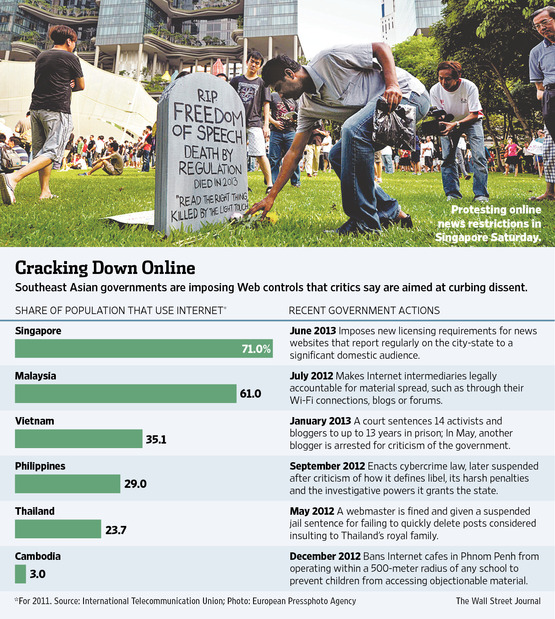
Southeast Asian governments are reaching for new legal tools and raw state powers as the Internet increasingly enables younger citizens to criticize their long-serving political leaders.

Not all these countries are as effective as China and its famed “Great Firewall,” which filters everything from microblog posts to ordinary Internet searches. But the speed with which countries such as Singapore, Malaysia, Cambodia and Vietnam are moving to impose Web controls is worrying human-rights advocates, who fear further curbs on Internet freedoms could suppress free speech and strip these economies of their vitality. Read more of this post

Cosco Highlights Doubts Over China Deals; why investors in Hong Kong-listed units of Chinese state giants are sometimes concerned that the interests of the parent companies come first in asset sales

Jun 12, 2013

Cosco Highlights Doubts Over China Deals

By Joanne Chiu

AM-AY953_AMONEY_NS_20130612130603

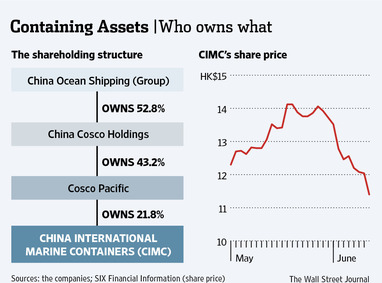
Cosco Pacific Ltd. 1199.HK -3.49%’s plan to sell its stake in a container maker back to its parent sheds light on why investors in Hong Kong-listed units of Chinese state giants are sometimes concerned that the interests of the parent companies come first in asset sales.

On Thursday, shareholders of the port operator will vote on a plan to sell its 21.8% stake in China International Marine Containers 000039.SZ -3.29%(Group) Co. to its ultimate parent: state-controlled China Ocean Shipping (Group) Co., or Cosco Group. CIMC has been hurt by the rout in trade since the financial crisis, but is still the world’s largest container maker and accounts for almost a fifth of Hong Kong-listed Cosco Pacific’s earnings. Read more of this post

Bank Indonesia raised its benchmark interest rate by a quarter of a percentage point to 6%, the second time in two days the central bank has surprised market participants

June 13, 2013, 3:36 a.m. ET

Bank Indonesia Raises Benchmark Rate Again

By FARIDA HUSNA And I MADE SENTANA

AI-CB567_INDORA_NS_20130613042103

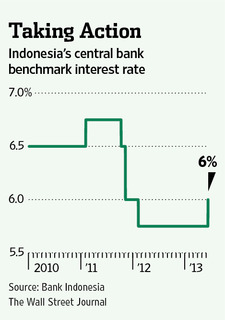
JAKARTA—Bank Indonesia raised its benchmark interest rate by a quarter of a percentage point to 6%, as it works to rein in inflation expectations and support a weakening rupiah following recent outflows.

It is the second time in two days the central bank has surprised market participants as it is widely perceived to be dovish, after having kept the benchmark rate at a historic low since February 2012.

Late Tuesday, the bank raised its overnight deposit rate by 0.25 percentage point to 4.25%, effective Wednesday, to improve sentiment toward the rupiah. The currency has fallen against the U.S. dollar to its lowest since 2009 as foreign investors pulled money from emerging markets, and as domestic investment decisions are influenced by the prospect of slowing growth. Read more of this post

Debt Makes Comeback In Buyouts

Updated June 12, 2013, 6:45 p.m. ET

Debt Makes Comeback In Buyouts

By MATT WIRZ

MI-BW555_EQUITY_NS_20130612183911

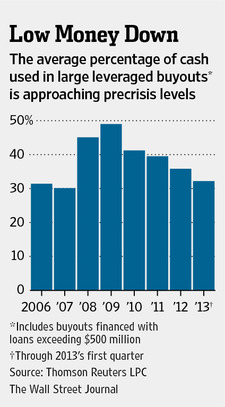
Shareholders in BMC Software Inc. BMC -0.18% will receive $6.9 billion to sell the corporate-software developer to a group of private-equity firms. But the buyers, led by Bain Capital LLC and Golden Gate Capital, only intend to pay $1.25 billion in cash out of their own pockets. The rest will come from debt raised by BMC to finance its takeover.

The little-noticed acquisition is another milestone in the return of cheap debt and higher-risk deals to Wall Street: The cash put down by BMC’s private-equity buyers is the lowest as a percentage of the purchase price of any buyout with loans exceeding $500 million since 2008, according to data-provider Thomson Reuters LPC. Read more of this post

Madoff Evoked in N.Z. as Ponzi Scheme Loses $317 Million

Madoff Evoked in N.Z. as Ponzi Scheme Loses $317 Million

New Zealand charged a 63-year-old financial adviser with running the biggest Ponzi scheme ever alleged in the South Pacific nation.

The Serious Fraud Office and Financial Markets Authority allege David Ross defrauded investors of about NZ$400 million ($317 million) through his closely-held Ross Asset Management Ltd., which collapsed in November last year. He will face four charges of false accounting and one of theft in the Wellington District Court, the agencies said in a joint statement today.

“It’s yet to be seen if he’s New Zealand’s Bernie Madoff, but the amounts were high by New Zealand standards and hurt a lot of people,” said Wellington barrister Kevin Sullivan. Read more of this post

Danger Maps Backed by Alibaba Pinpoint Chinese Pollution; “Real-estate agents and websites who want to boost transactions won’t tell you this kind of information”

Danger Maps Backed by Alibaba Pinpoint Chinese Pollution

As pollution concerns rise in China, Liu Chunlei is boosting environmental awareness among the nation’s 564 million Internet users with help from the charitable arm of Alibaba Group Holding Ltd (ALIBABZ).

Danger Maps, a website Liu started last year, allows people to look up sites such as toxic-waste treatment facilities, oil refineries and power plants. Liu has plotted about 6,000 pollution sources based on government data and user input on Baidu Map, China’s equivalent of Google Maps.“Real-estate agents and websites who want to boost transactions won’t tell you this kind of information,” said Liu, 35, who created Danger Maps after learning that the Shanghai apartment he bought in 2007 was near a landfill — something he wasn’t informed of when negotiating the purchase. Read more of this post

Extra Food Means Nothing to Stunted Kids With Bad Water: Health

Extra Food Means Nothing to Stunted Kids With Bad Water: Health

Aameena Mohammed gives her 20-month-old daughter Daslim Banu plenty to eat. The girl’s mother supplements breast milk with eggs, soup and rice to help her grow. The extra food doesn’t help. Daslim still weighs only as much as a healthy infant half her age.

Mohammed’s home, in one of the poorest districts of the south Indian city of Vellore, is among the 65 percent of India’s homes without running water and safe sewage disposal. Feces and urine collect next to the doorway in an open drain — the source of odor permeating the tin-roofed shack and of the microbes likely retarding the toddler’s growth. Read more of this post

Hong Kong Chief Executive Pledges Property Curbs to Stay; “This is not the time to relent.”

Hong Kong Chief Executive Pledges Property Curbs to Stay

Hong Kong, the world’s most expensive home market, will not ease its real-estate curbs until there’s a steady supply of new properties as the government seeks to address concerns that it favors developers.

Earlier actions have brought down prices and rents, and the government can do more if needed, Chief Executive Leung Chun-ying, 58, said in an interview in New York.

“There’s a voice out there in the Hong Kong community that the government should ease off,” the former property surveyor said yesterday. “This is not the time to relent.” Read more of this post

Emerging-Market Bond Anxieties Surging by Most Since 2008

Emerging-Market Bond Anxieties Surging by Most Since 2008

The biggest drop in perceived creditworthiness for emerging-market borrowers since the credit crisis is deepening as speculation intensifies that central banks will scale back record stimulus.

Prices on the Markit CDX Emerging Markets index, a credit-default swaps benchmark for debtor nations from Latin America to the Middle East and Asia, have tumbled 4 cents in the two weeks through yesterday to 107 cents on the dollar. The decline is the biggest since the failure of Lehman Brothers Holdings Inc. reverberated across financial markets and caused the index to plunge 6.7 cents in the period ended Nov. 18, 2008. Read more of this post

Indonesia’s Delayed Fuel Decision Haunts Rupiah: Southeast Asia

Indonesia’s Delayed Fuel Decision Haunts Rupiah: Southeast Asia

Indonesia’s government needs to rein in fuel subsidies that have spurred a current-account deficit to support efforts by the central bank to stabilize the weakening rupiah, economists say.

Rupiah forwards rose the most in a year yesterday after Bank Indonesia increased the rate it pays lenders on overnight deposits and said it was ready to buy government debt in the secondary market to maintain monetary stability. Still, the spot rate weakened 0.3 percent to 9,860 a dollar, the most since May 16, according to prices from local banks compiled by Bloomberg. Read more of this post

Human Genome Project Spurred $966 Billion Sciences Boom

Human Genome Project Spurred $966 Billion Sciences Boom

The $14.5 billion investment by the U.S. in the Human Genome Project, completed a decade ago, has paid off more than 60-fold in new jobs, drugs and a rapidly expanding genetics industry, an analysis has found.

The endeavor to map human DNA in its entirety created $966 billion in economic impact and $59 billion in federal tax revenue, according to the study released today by United for Medical Research and Battelle, two research advocacy groups.

Dozens of companies have started with the knowledge gained from the project, leading to new diagnostic tests and development of medicines that can be matched with gene variants linked to disease. The project triggered a new era in the life sciences, with new oncology drugs and screenings among the early developments in the field, said Greg Lucier, chief executive officer of Life Technologies Corp. (LIFE) Read more of this post