Maps That Live and Breathe With Data; largely missing from Google’s Maps is the social component; With Waze, the mob is the map, and like a mob, it can be churning with energy

June 10, 2013

Maps That Live and Breathe With Data

By VINDU GOEL

SAN FRANCISCO — Maybe real estate agents should start selling mobile phones on the side. Why? Because with phones, as with homes, location is everything. As mobile phones become all-in-one tools for living, suggesting where to eat and the fastest way to the dentist’s office, the map of where we are becomes a vital piece of data. From Facebook to Foursquare, Twitter to Travelocity, the companies that seek the attention of people on the go rely heavily on location to deliver relevant information, including advertising. Maps that are dynamic, adapting to current conditions like traffic or the time of day, are the most useful of all. The importance of such maps to mobile services helps explain why Google is deep in negotiations to buy Waze, a social mapping service used by millions of drivers around the world, for more than $1 billion. Although a final agreement has not yet been struck, people with knowledge of the discussions say that an acquisition could be announced as soon as this week. Read more of this post

Tech start-ups: Innovation hubs all over world seek to follow Silicon Valley lead

June 11, 2013 12:13 am

Tech start-ups: Innovation hubs all over world seek to follow Silicon Valley lead

By Jonathan Moules, Enterprise Correspondent

When Peter Alfred-Adekeye founded cloud-computing business Multiven in 2005, he was in the obvious place to do it – Silicon Valley. Five years later, however, he relocated his operation to Zurich, one of the least likely cities for start-ups.

Some might imagine the move away from the global entrepreneurship capital would be shocking to a serial entrepreneur such as Mr Alfred-Adekeye. Admittedly the relocation was partly forced after his US work visa was rescinded. Read more of this post

China Everbright Bank placed itself directly in the firing line when reports it had defaulted started to circle

Swimming naked in China

David Keohane

| Jun 10 12:19 | 5 comments | Share

China Everbright Bank placed itself directly in the firing line of terrible puns last week when reports it had defaulted started to circle.

Thankfully, Anne Stevenson-Yang from J Capital read into the news a bit further than most:

The interbank defaults last Thursday provided definitive, if indirect, proof that the cash coming into China is for financial investment and interest arbitrage. It masquerades as a trade surplus but is not. With the tightening of the domestic central bank credit window, Chinese banks are heavily dependent on these inflows for the cash they need to roll over loans. That is why the banks immediately went into distress when regulators decided to clamp down on fraud on the trade account. Read more of this post

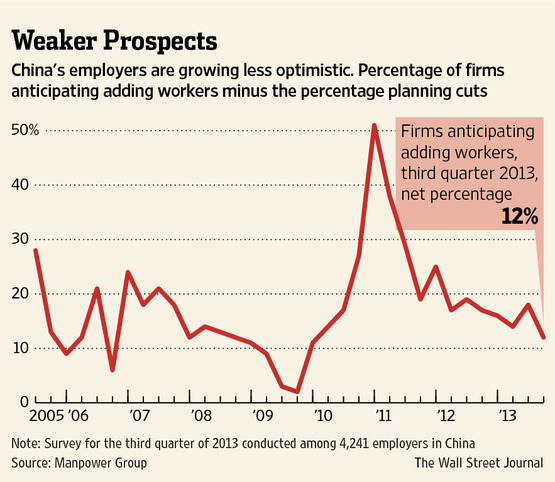
Strains Show in China’s Job Market; Labor Strife Increases as High Wages, Low Demand Send Some Employers Packing, While Others Close

Updated June 11, 2013, 2:27 a.m. ET

Strains Show in China’s Job Market

Labor Strife Increases as High Wages, Low Demand Send Some Employers Packing, While Others Close

WO-AO102A_CLabo_G_20130610181508

BEIJING—A wave of strikes and worker protests in China’s southern export belt is a fresh sign that slowing growth and rising wages have started to pinch the labor market on the world’s factory floor.

China Labour Bulletin, a Hong Kong-based labor group, has recorded 201 cases of labor disputes, including strikes, in the first four months of the year in China, almost double the number of cases in the same period last year. In the export hub of Shenzhen alone, 17 cases have been recorded. Read more of this post

Shock over departure of creative director behind Mulberry’s rise to top

Shock over departure of creative director behind Mulberry’s rise to top

Shares plunge 8% on news of Emma Hill’s decision to quit after rumoured row with company’s chief executive

Simon Neville and Lauren Cochrane

The Guardian, Monday 10 June 2013 22.56 BST

MULBERRY Emma HillMulberry shares graphic

Emma Hill has announced her intention to quit Mulberry. Photograph: Mulberry

The woman widely credited with transforming Mulberry from a quiet British fashion house into a must-have global brand has shocked the luxury goods world, and the City, by announcing her intention to quit, in a move that wiped nearly £40m off the company’s value. Emma Hill joined Mulberry as creative director at the depth of the recession in 2008 and, hitching the firm’s conservative reputation to hipster royalty such as Alexa Chung and Lana Del Rey, helped spur a fivefold increase in its share price. Mulberry issued a terse confirmation that one of the industry’s most successful partnerships is coming to an end, amid rumours of a falling out between Hill and the chief executive, Bruno Guillon, over the company’s direction. Read more of this post

Australian Dollar Plunges as Home Loans Dive; Australia Insolvencies Hit Record

Australian Dollar Plunges as Home Loans Dive; Australia Insolvencies Hit Record; Worst is Yet to Come

Posted: 10 Jun 2013 08:32 PM PDT

Mike “Mish” Shedlock

Curve Watchers Anonymous has its eye on the Australian dollar. As expected, it has taken a big dive in conjunction with a housing bust and a slowdown in China that impacts the demand for commodities.

The only thing surprising to me about this plunge is how long it took, but here we are.
Aussie Falls to Lowest in More Than Two Years
Bloomberg reports Aussie Falls to Lowest in More Than Two Years as Home Loans Slow

Australia’s dollar fell to the lowest in more than two years versus the greenback after home-loan approvals grew at the slowest pace in three months, boosting the case for further cuts to borrowing costs. Read more of this post

Global shale resources are vast enough to cover more than a decade of oil consumption, according to the first-ever US assessment of reserves from Russia to Argentina.

June 10, 2013 7:53 pm

World has 10 years of shale oil, reports US

By Gregory Meyer in New York

Global shale resources are vast enough to cover more than a decade of oil consumption, according to the first-ever US assessment of reserves from Russia to Argentina.

The US Department of Energy estimated “technically recoverable” shale oil resources of 345bn barrels in 42 countries it surveyed, or 10 per cent of global crude supplies. The department had previously only provided an estimate for US shale reserves, which it on Monday increased from 32bn barrels to 58bn. Read more of this post

What are the Characteristics of Firms that Engage in Earnings Per Share Management Through Share Repurchases?

What are the Characteristics of Firms that Engage in Earnings Per Share Management Through Share Repurchases?

Kathleen A. Farrell University of Nebraska-Lincoln

Jin Yu Saint Cloud State University – G. R. Herberger College of Business

Yi Zhang Prairie View A&M University

July 2013
Corporate Governance: An International Review, Vol. 21, Issue 4, pp. 334-350, 2013

Abstract: 
Manuscript Type. Empirical. Research Question/Issue. This study examines US firms’ share repurchases during 1997–2006 to determine what factors are associated with firms that use share repurchases to manage earnings per share (EPS). Specifically, we analyze firm and governance characteristics associated with firms that engage in share repurchases that increase annual EPS by at least one cent in a given year and that had EPS less than or equal to annual EPS forecast prior to the share repurchase. Research Findings/Insights. We find that growth firms are less likely to use share repurchases to increase EPS for earnings management purposes. We also provide evidence that firms with a more independent board, a separation of the roles of CEO and chairman of the board, or a low entrenchment index (E‐Index) are less likely to engage in earnings management through share repurchases. Finally, we find evidence that high CEO share ownership restrains managers from using share repurchases as a mechanism to manage EPS. Theoretical/Academic Implications. Our empirical results support some of the best practices advocated by various shareholders groups regarding corporate governance. Also, strong shareholder rights can mitigate incentives to manage earnings, highlighting the importance of corporate governance mechanisms/provisions in ensuring the integrity of the financial reporting system. Practitioner/Policy Implications. This research is important to investors in the face of the growing popularity of share repurchases. In particular, our study suggests strong corporate governance, strong shareholder rights, and high percentage CEO stock ownership discourages repurchase‐based earnings management.

Bamboo Innovator mentioned on TEDxWallStreet

TEDxWallStreet

Byron Wien’s 20 Lessons Learned Throughout His Investing Career: Read all the time

Byron Wien’s 20 Lessons Learned Throughout His Investing Career

Posted: 10 Jun 2013 11:20 AM PDT

MarketFolly.com

Byron Wien is Vice Chairman at Blackstone and prior to that worked at hedge fund Pequot Capital and Morgan Stanley.  Earlier this year, he released an addendum to his usual commentary about lessons he’s learned in 80 year investing career.  His words of wisdom are below:
Byron Wien’s 20 Lessons Learned
1.  Concentrate on finding a big idea that will make an impact on the people you want to influence.  The Ten Surprises, which I started doing in 1986, has been a defining product.  People all over the world are aware of it and identify me with it.  What they seem to like about it is that I put myself at risk by going on record with these events which I believe are probable and hold myself accountable at year-end.  If you want to be successful and live a long, stimulating life, keep yourself at risk intellectually all the time. Read more of this post
Fitch warns on risks from shadow banking in China; “A 1 percent NPL ratio has little signaling value when 36% of all outstanding credit resides outside Chinese banks’ loan portfolios”

Fitch warns on risks from shadow banking in China

12:56pm EDT

FRANKFURT (Reuters) – China’s unregulated shadow banking sector poses an increasing risk to the country’s financial stability that could spread to other countries, credit rating agency Fitch said on Monday. China has tens of thousands of non-bank lenders that are providing increasing amounts of credit to businesses and government outside the mainstream, regulated banking sector, a situation that is stoking systemic risk, Fitch said. There is little visibility on where the money is going, who is lending it or what the credit quality of assets is, meaning traditional warning signs of trouble will not function properly. “It is a wild west atmosphere in many respects and that is one of the reasons why we are so worried,” Fitch Senior Director Charlene Chu told a conference in Frankfurt. Regulators had little insight into the non-bank sector. “It is a material risk because a growing amount of credit is being extended through channels that they don’t have transparency or control over,” Chu said. Read more of this post

Pimco Wary on Asia Junk Debt as Slowdown Hurts Company Profits

Pimco Wary on Asia Junk Debt as Slowdown Hurts Company Profits

Investors should be wary of high-yield borrowers as slowing growth in Asia threatens profitability, according to Pacific Investment Management Co., manager of the world’s biggest fixed-income fund.

Companies in Asia outside Japan almost tripled junk bond sales to $19.2 billion this year compared with $6.85 billion during the same period in 2012, data compiled by Bloomberg show. China’s economy will slow to average 6 percent to 7.5 percent annual expansion during the next five years from 9 percent the past five, weighing on the region’s growth, according to a report from Newport Beach, California-based Pimco.

“The slow-growth landscape favors higher-quality credits and warrants caution on higher yielding names that could become impaired in an environment where profits will be challenged,” Tokyo-based Tomoya Masanao, the head of portfolio management for Japan, wrote in the report due for release today. “The emphasis should move away from risk assets that have benefited purely from the central bank liquidity wave in which valuations have become detached from fundamentals.” Read more of this post

CT Scans in Children May Trigger 5,000 Cancers in U.S.

CT Scans in Children May Trigger 5,000 Cancers in U.S.

The radiation from 4 million annual computerized tomography scans in U.S. children younger than 15 may lead to almost 5,000 cancers each year in the future, a study found.

The use of CT scans of the head, abdomen or pelvis, chest or spine in children 14 years and younger more than doubled from 1996 to 2007 before beginning to decline through 2010, according to research released today by JAMA Pediatrics. Those at greater risk for cancer were younger patients, girls, and those who underwent CT scans of the abdomen/pelvis or the spine rather than other areas of the body, the researchers said. Read more of this post

Intel, which has been using Sponsors of Tomorrow as its marketing theme since 2009, is replacing the phrase with a less ethereal entreaty: Look Inside

Intel: The inside job

New York — Intel, which has been using Sponsors of Tomorrow as its marketing theme since 2009, is replacing the phrase with a less ethereal entreaty: Look Inside. The new theme purposely echoes the Intel Inside cooperative advertising programme it has been running since 1991 with companies like Dell, which buys Intel’s chips. The idea is for each theme to reinforce the persuasive effect of the other.

BY –

5 HOURS 26 MIN AGO

New York — Intel, which has been using Sponsors of Tomorrow as its marketing theme since 2009, is replacing the phrase with a less ethereal entreaty: Look Inside. The new theme purposely echoes the Intel Inside cooperative advertising programme it has been running since 1991 with companies like Dell, which buys Intel’s chips. The idea is for each theme to reinforce the persuasive effect of the other.

Said Ms Deborah Conrad, Vice-President and Chief Marketing Officer at Intel: “Look Inside is a call to action, and Intel Inside says ‘Hey, here I am’.” The new theme also “serves all our new businesses and existing businesses”, she added, whereas Sponsors of Tomorrow was perceived, not surprisingly, as less relevant to Intel’s current products. Read more of this post

India Rate-Cut Room Dented as Rupee Drops Most in Asia to Record; “Currency stability has become a new worry”

India Rate-Cut Room Dented as Rupee Drops Most in Asia to Record

The slump in the rupee to a record low has narrowed the Reserve Bank of India’s scope to cut interest rates next week for a fourth straight meeting. Governor Duvvuri Subbarao will keep the repurchase rate at 7.25 percent on June 17, 10 of 18 analysts said in a Bloomberg News survey. The rest called for a reduction to 7 percent. The currency’s 6.6 percent drop versus the dollar this quarter, the biggest in Asia, threatens to make imports more expensive. The rupee reached its weakest level yesterday, weighed down by an unprecedented current-account deficit, the slowest Indian economic expansion in a decade and speculation the dollar will gain if the U.S. scales back monetary stimulus. Subbarao said May 30 that depreciation may stoke inflation and increase the cost of servicing foreign-currency debt.

“Currency stability has become a new worry,” said Rajeev Malik, an economist at CLSA Asia-Pacific Markets in Singapore. “A rate cut is unlikely to do much in reviving growth, but it will renew the pressure on the rupee to weaken further.” Read more of this post

Hard part begins in Myanmar’s quest for foreign investment; “Actually there isn’t that much investment coming in,” Nobel Peace laureate and opposition leader Suu Kyi

Hard part begins in Myanmar’s quest for foreign investment

NAYPYITAW — In a cramped auditorium in Myanmar’s capital, pro-democracy champion Aung San Suu Kyi had a message for the world’s business elite: Her country is teeming with foreign investors scouting for opportunities in one of Asia’s final frontier markets, but not many are actually investing.

BY –13 HOURS 3 MIN AGO

NAYPYITAW — In a cramped auditorium in Myanmar’s capital, pro-democracy champion Aung San Suu Kyi had a message for the world’s business elite: Her country is teeming with foreign investors scouting for opportunities in one of Asia’s final frontier markets, but not many are actually investing.

Interviews with foreign and local business leaders on the sidelines of last week’s World Economic Forum in the Myanmar capital, Naypyitaw, show why.

Shoddy infrastructure, opaque regulations, red tape, recent bouts of sectarian violence and lingering uncertainty over US sanctions are hampering large-scale foreign investment in the country, strategically nestled between India and China. “Actually there isn’t that much investment coming in,” Nobel Peace laureate and opposition leader Suu Kyi told reporters. Read more of this post

Casino Dubai’s Rebound Pitch Ignored by Global Investors

Casino Dubai’s Rebound Pitch Ignored by Global Investors

Dubai is back with the big plans. What it doesn’t have are the biggest property investors.

Surging home prices in parts of Dubai and rebounding shopping and tourism markets are prompting developers to announce projects on a scale not seen since the emirate’s property market collapsed in 2008. So far, sovereign wealth, pension and insurance funds are staying away even as they splurge on real estate elsewhere.

“It’s a thin market and it has a reputation of being something of a casino,” said Richard Price, chief executive for Asia at CBRE Global Investors, which manages $93 billion of property assets. “I struggle to think of any real client appetite for exposure.” Read more of this post

History may repeat itself for Mexico, Peru as Fed eyes exit

History may repeat itself for Mexico, Peru as Fed eyes exit

Sun, Jun 9 2013

By Krista Hughes

MEXICO CITY (Reuters) – Mexico and Peru’s popularity among foreign investors means they are among the emerging market economies most exposed to losses when the United States finally moves to take its foot off the monetary accelerator. History shows that when U.S. interest rates jump – widely anticipated when the Federal Reserve begins reducing its $85 billion a month bond purchases – new foreign investment in Peruvian and Mexican financial assets drops by almost two-thirds. Bonds in Brazil, Colombia and Peru also sold off and major Latin American currencies fell on average 5.5 percent on the mere hint of a limit to the cheap cash that has pushed many emerging markets to record highs. Read more of this post

Amazing baby photos!

Dad’s amazing flying baby photos

2013-06-09 02:54:17 GMT2013-06-09 10:54:17(Beijing Time)  SINA.com

That’s one busy baby! Emil Nyström, a Sweden-based photographer has created a photo series starring his infant daughter, doctoring the images so she’s placed in all sorts of crazy scenarios—soaring through the air on the back of a plane, slicing fruit with a katana sword, fixing a car engine—you know, all the stuff babies do. “My ideas and inspiration come from different places,” Nyström said. “Luckily, I haven’t had too many challenges. The main thing is to prepare the setup well. And because my baby isn’t too good at long working hours, if i get 15 minutes [of shots] I’ve had a good day.” And your day will be better after checking out these photos.

U169P5029T2D597759F24DT20130609105417U169P5029T2D597759F26DT20130609105417U169P5029T2D597759F28DT20130609105417U169P5029T2D597759F31DT20130609105417U169P5029T2D597759F32DT20130609105417U169P5029T2D597759F34DT20130609105417U169P5029T2D597759F36DT20130609105417

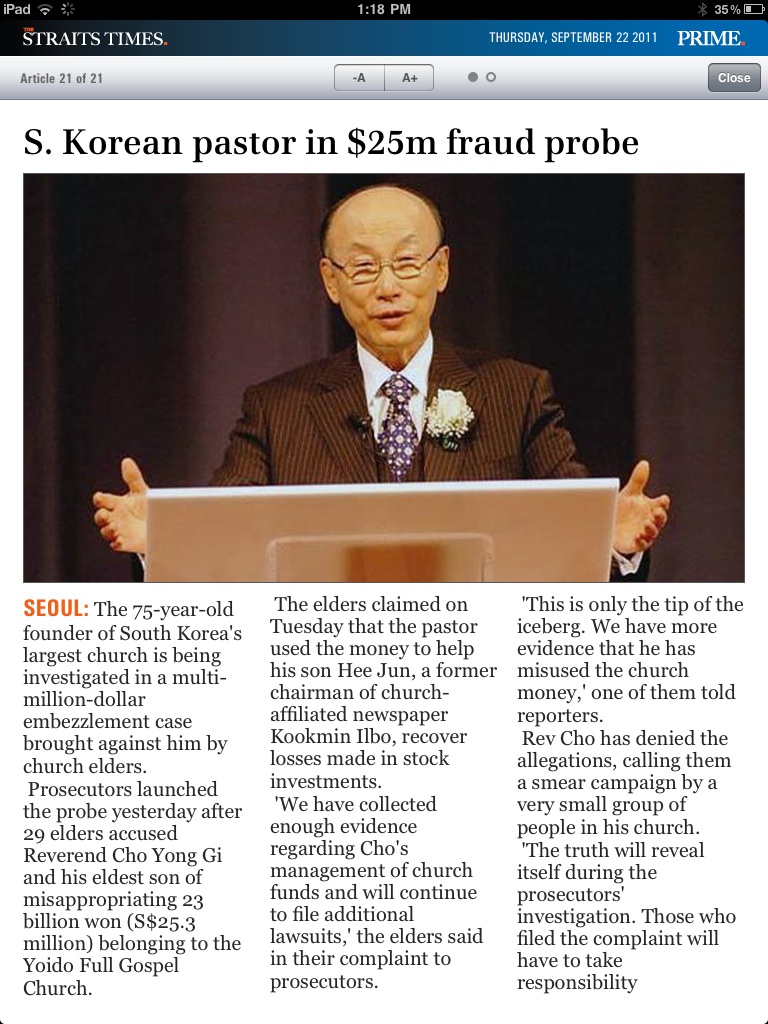
Korean prosecutors will chase the leader of world’s largest Christian congregation for allegedly stealing tens of billions of won in worshippers’ money and underpaying taxes

2013-06-09 16:50

Pastor Cho in trouble

Korean Christianity’s illness befalls Full Gospel Church 

By Kim Tong-hyung

Prosecutors will chase the leader of world’s largest Christian congregation for allegedly stealing tens of billions of won in worshippers’ money and underpaying taxes.
Their decision to indict Cho Yong-gi, founder and pastor of the Yoido Full Gospel Church, on Saturday was another kick in the teeth for the country’s mighty but increasingly unpopular protestant church, frequently described as greedy, dishonest and socially regressive. Cho and some members of the church’s senior leadership have fallen out spectacularly in recent years as the 77-year-old minister came under constant accusations of corruption and nepotism. A group of church elders in 2011 filed a complaint with prosecutors claiming that Cho diverted more than 20 billion Korean won (about $18 million) in the church’s fund to acquire the stocks of a company owned by his son, Hee-jun, at prices dramatically higher than market value in 2002. The younger Cho, former chairman of the church-affiliated newspaper Kookmin Ilbo, currently serving a jail term for an unrelated financial crime, had sustained heavy losses from stock investments then.

pastor davidchoyonggicho_part174275284Yoido-Full-Gospel-Church-Seoulseo51 Read more of this post

Embracing your Dragon Boat Festival holiday which commemorates the death of Qu Yuan, an upright minister who found it impossible to put into practice those ambitions and ideals in a corrupt era

Embracing your Dragon Boat Festival holiday

F201306081123062392330573

Hometown of Qu Yuan prepare to mark upcoming Dragon Boat Festival

The 5th day of the 5th month of the lunar year is an important day for the Chinese people. The day is called Duan Wu Festival, or Dragon Boat Festival, celebrated everywhere in China. This festival dates back to about 2,000 years ago with a number of legends explaining its origin. The best-known story centers on a great patriotic poet named Qu Yuan. Read more of this post

Why have a ‘culture’ and what value does it add?

Why have a ‘culture’ and what value does it add?

Robert Hooijberg, Dan Denison and Nancy Lane | Business | Sat, June 08 2013, 3:29 PM

Paper Edition | Page: 16

Managers regularly ask us whether we think it is a good idea for their organizations to have a culture and what value it might add. The question is interesting because it presumes a company does not already have a culture. This is a myth.

All organizations inevitably have a culture; they do not have a choice. Its culture consists of its values and principles as they are expressed through management and employee behaviors and the organization’s systems and processes. An organization’s culture often reflects the values of its founders: Whether it’s Sam Walton of WalMart or Steve Jobs for Apple, one can clearly see the impact its founder and his or her values on what happens in that organization.  Read more of this post

How to Demotivate Your Best Employees; Many companies hand out awards such as “employee of the month,” but do they work to motivate performance? Not really, says professor Ian Larkin. In fact, they may turn off your best employees altogether

How to Demotivate Your Best Employees

by Dina Gerdeman | Jun 10, 2013

Many companies hand out awards such as “employee of the month,” but do they work to motivate performance? Not really, says professor Ian Larkin. In fact, they may turn off your best employees altogether

It would seem to make sense that when companies recognize their workers with awards, they are likely to see a boost in morale and perhaps even inspire them to work harder.

It turns out that sometimes rewarding employees for good behavior can actually backfire, leading to a drop in motivation and productivity.  Read more of this post

Thousands of people attended prayers to celebrate what would have been the 92nd birthday of the late Indonesian President Suharto in Solo, Central Java

Suharto’s Birthday Keeps Discussion Alive

By Imron Rosyid Taufikur on 11:36 pm June 9, 2013.

SAN7046-1024x695

A guide gives a tour around Suharto’s memorial park in Bantul, Yogyakarta, which was unveiled on Saturday. (JG Photo/Aiera Maharani)

Thousands of people attended prayers to celebrate what would have been the 92nd birthday of the late President Suharto in Solo, Central Java, on Saturday. Read more of this post

Canada’s Entrepreneur of the Year, Alan Ulsifer of FYidoctors, has transformed the optical industry by creating a giant network of opticians who bring new products and diagnostics technology to clients from coast to coast

World entrepreneurs reaffirm business is the best route to change, reform and prosperity

Rick Spence | 13/06/09 | Last Updated: 13/06/07 2:09 PM ET

0607ulsifer

Canada’s Entrepreneur of the Year, Alan Ulsifer of FYidoctors, has transformed the optical industry by creating a giant network of opticians who bring new products and diagnostics technology to clients from coast to coast.

MONACO — “Entrepreneurs make the world work better.” That was the message from Ernst & Young’s incoming chief executive, Mark Weinberger, as he kicked off the World Entrepreneur of the Year conference last week in Monte Carlo. A full 47 countries (including first-time participants Uruguay and Serbia) sent their entrepreneurial champions to the combined competition/professional-development/networking session, and the enthusiasm was infectious. Read more of this post

The Turkish founder of Greek yoghurt business Chobani has been named the world’s best entrepreneur for building a $1bn (£640m) turnover business in less than six years

Yoghurt tycoon named world’s best entrepreneur

The Turkish founder of a Greek yoghurt business has been named the world’s best entrepreneur for building a $1bn (£640m) turnover business in less than six years.

Chobani, which launched in the UK last year, has annual sales of almost $1bn and around 3,000 staff.

By James Hurley

3:48PM BST 09 Jun 2013

Hamdi Ulukaya, who launched New York-based Chobani in 2007, won the Ernst & Young World Entrepreneur of the Year competition in Monte Carlo on Saturday night.

Mr Ulukaya, who was described by judges as the “personification of every immigrant’s American dream”, pipped 48 entrepreneurs to the prize, including Lance Uggla, founder of British financial information firm Markit. Chobani, now America’s biggest yoghurt business, began with just five employees after Mr Ulukaya bought a closed factory from US food giant Kraft using a government loan. Read more of this post

Washington Post Media’s Katharine Weymouth on why running the business is tough; “You have to fail. You have to make mistakes in order to have the successes”

June 9, 2013 1:50 pm

Katharine Weymouth, publisher, Washington Post Media

By Emily Steel

b57ef33aedf0400ec8f61be2eac990c5cn_image.size.washington-post

New edition: Katharine Weymouth is the fifth member of the Graham family to be publisher of Washington Post Media; From left: publisher Katharine Weymouth, former executive editor Ben Bradlee, former chairman and C.E.O. Katharine Graham, current executive editor Marcus Brauchli, and chairman and C.E.O. Don Graham.

Scotch-taped to the door of Katharine Weymouth’s office in the executive suite of theWashington Post headquarters are printouts of two photographs she took during a visit last year to Facebook’s Silicon Valley headquarters.

In bold, red, capital letters, one poster asks: “What would you do if you weren’t afraid?” The other reads: “Done is better than perfect.”

The proclamations are a constant reminder to the publisher of one of the US’s most venerable newspapers to embrace the Valley’s culture of endorsing failure – a somewhat foreign notion in the world of traditional media.

“You have to fail. You have to make mistakes in order to have the successes,” she says. “We in the media are not very forgiving of traditional organisations making mistakes.” Read more of this post

Family businesses ‘need to bridge generations’

Family businesses ‘need to bridge generations’

Watchiranont Thongtep
The Nation
June 10, 2013 1:00 am

Family businesses appear to be a key mainstream of global business. But bridging the gaps between the founding and new generations is important for long-term stability, an expert suggests.

“More than 80 per cent of the companies in the country were started and operate as a family business. Once the company grows up, a smooth transition in family management is crucial for sustainability,” Akachai Apisakkul, dean at the School of Business at the University of the Thai Chamber of Commerce (UTCC), told The Nation recently. Read more of this post

Taiwan’s Formosa Plastic/Petrochemicals Heir Claims $4 Billion of Assets Misappropriated by Late Patriarch’s Financial Advisers

Plastic Heir Claims $4 Billion of Assets Misappropriated

Winston Wong, the eldest son and estate administrator of deceased Taiwan petrochemicals tycoon Wang Yung-ching, sued two Hong Kong companies, claiming they misappropriated $4 billion in assets. Hong Kong’s High Court on May 2 named Wong as administrator of his father’s estate. Wong filed a lawsuit today against Jao Chien Fang and Chang Pen-yuan, formerly his father’s financial advisers, as well as Hua Yang Investment (H.K.) Ltd. and Winson International Investments Ltd. He accused the defendants of acting dishonestly to misappropriate his father’s assets, and is seeking their return plus interest. “This is an important and humbling moment as I stand in my father’s shoes as administrator and continue the efforts to identify and recover everything that should have been declared in his estate,” Wong said in a statement today. Today’s suit adds to litigation that Wong has filed in the U.S., Taiwan, Bermuda and Hong Kong over Wang’s holdings since his death in 2008 at the age of 91. The $4 billion held in Hong Kong includes power plants in China and real estate, with Wong estimating the total value of his late father’s assets at about $18 billion. Read more of this post

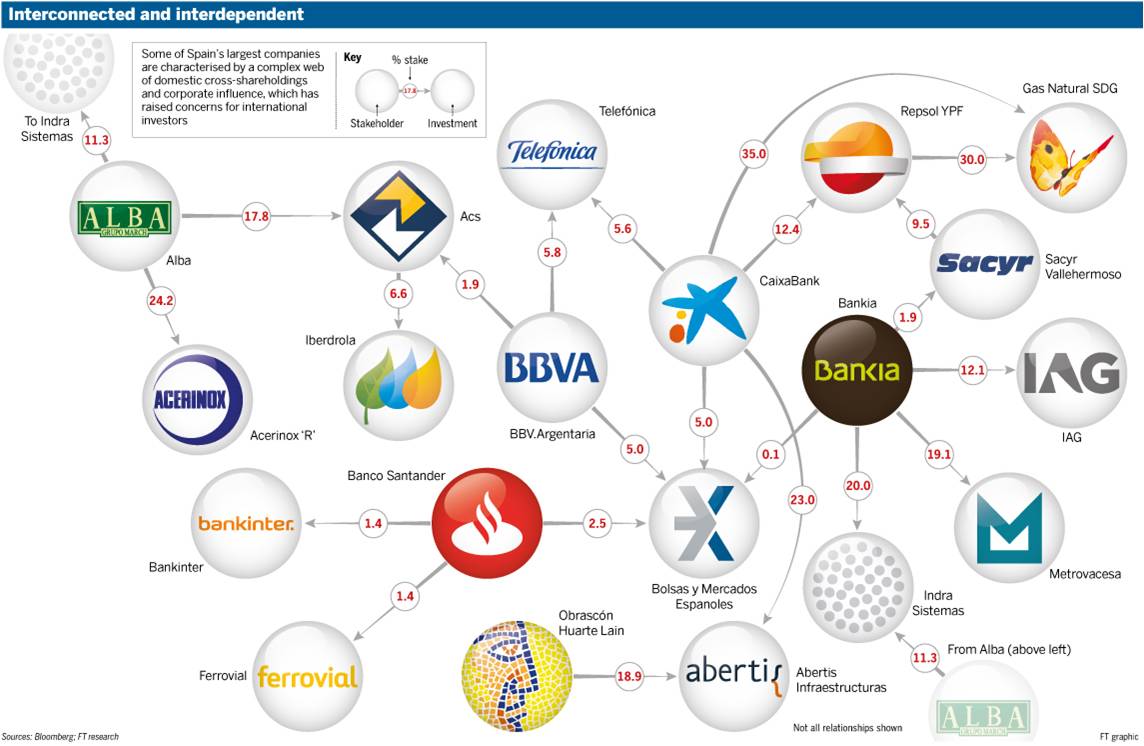
Spain’s ownership web set to untangle

June 9, 2013 12:53 pm

Spain’s ownership web set to untangle

By Miles Johnson in Madrid

Spain

Spanish business, it is said, can be a small place. Whether they are sharing bottles of rioja at upmarket Madrid restaurants, or the same classrooms, or even the same blood, large parts of the country’s business elite have ties that stretch back generations. This cosy, interconnected world is epitomised by the nexus of cross-shareholdings between banks and many of Spain’s largest companies, largely constructed during the past two decades. Out of the 35 companies in the Ibex stock index, 15 are connected to another member though a significant shareholding. If Bankia, the nationalised savings bank recently dropped from the index, were included, that figure would rise to 19. With the financial crisis having ripped through the balance sheets of the caja system, corporate Spain is undergoing an upheaval. As capital-strapped lendersare forced to sell non-core holdings, this long-standing and complicated web of cross-shareholdings is at risk of disappearing. Read more of this post