The 50 Best Performing S&P 500 Stocks in 2013

The 50 Best Performing S&P 500 Stocks in 2013

FRIDAY, JUNE 7, 2013 AT 02:03PM

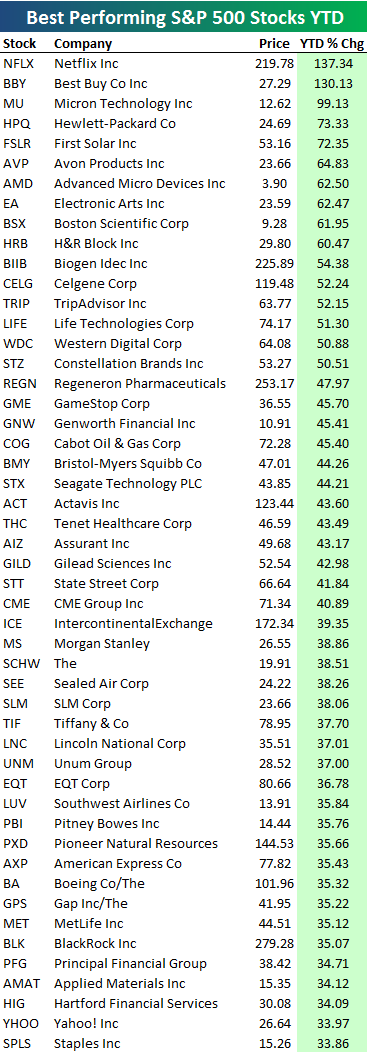
As of 2 PM today, the average stock in the S&P 500 is up 16.94% so far in 2013.  And nearly all stocks in the index are up on the year.  Of the 500 members, 453 of them are in the green this year, while just 47 are in the red. Below is a list of the 50 best performing stocks in the S&P 500 year to date.  As shown, two stocks — Netflix (NFLX) and Best Buy (BBY) — are up more than 100%.  Go figure! Micron (MU) ranks third with a YTD gain of 99.13%, followed by Hewlett-Packard (HPQ) at 73.33% and First Solar (FSLR) at 72.35%.  AVP, AMD, EA, BSX and HRB round out the top ten. One stock that’s clearly not on the list of 2013’s best performing stocks is Apple (AAPL).  Apple is actually down 16.98% YTD, ranking it as the 7th WORST stock in the index on the year.

bestspxytd


The Downside of Entrepreneurial Success; They hit the jackpot once, and then think they have the magic

June 7, 2013, 1:57 p.m. ET

The Downside of Entrepreneurial Success

They hit the jackpot once, and then think they have the magic. It’s up to financial advisers to burst their bubble.

By DAISY MAXEY

WE-AA509_ENTREP_G_20130607161951

Sometimes, the worst thing that can happen to an entrepreneur is being successful.

So say many financial advisers who tell tales of entrepreneurs who hit it big—only to let success go their heads. It’s then up to the advisers to somehow keep their clients from taking subsequent risks that threaten their financial future. Financial adviser Tony DaRoza, for instance, remembers all too well the client who did so well he ended up losing $100 million. After selling his first technology company and taking his second public, the client took only enough money off the table to ensure that his family would be fine and that his children could go to college, recalls Mr. DaRoza, a managing director at the Merrill Lynch Wealth Management unit of Bank of America Corp. BAC +1.36% in San Francisco. Most of the rest disappeared when the tech bubble burst, he says. The problem, Mr. DaRoza says, rests with the “gambling mentality” of some entrepreneurs. A bit of a risk-taking bent is a good thing; it’s how entrepreneurs make their fortune. But after one or several successful business ventures, entrepreneurs may begin to believe they’re infallible. And for some it isn’t just their own endeavors they’re certain of; their confidence in taking risks may kick in when they are approached by a persuasive colleague, acquaintance or family member seeking money for a new venture. Read more of this post

Imperial Family’s car woes sparked Toyota whistleblower; What if a car crash hurt or even killed Crown Prince Naruhito, Japan’s heir to the Imperial throne?

Imperial Family’s car woes sparked Toyota whistleblower

The giant carmaker insists it has overcome its deadly 2009-11 crises; critics say problems have just been buried

BY DAVID MCNEILL

SPECIAL TO THE JAPAN TIMES

JUN 9, 2013

In 2008, Toyota faced an embarrassing problem: The Imperial Family’s luxury Century Royal, used to carry Crown Prince Naruhito around Japan, was a dud. Memos flew back and forth between managers and senior engineers trying to find the cause of what appeared to be a speed-control fault. “This is a very difficult situation,” fretted one engineer. “The Imperial Household Agency feels there is risk if it should recur.”

The unspoken concern was clear: What if a crash hurt or even killed Japan’s heir to the Imperial throne?

The problem seemed rooted in electronics — but its solution was elusive, even to all those trained minds. Toyota replaced the gas pedal, the throttle system and the engine computer at its own expense. Read more of this post

Dark sides of Toyota’s drive to be No. 1

Dark sides of Toyota’s drive to be No. 1

BY DAVID MCNEILL

SPECIAL TO THE JAPAN TIMES

JUN 9, 2013

Like most corporate giants, Toyota isn’t all squeaky clean. Yet in their book “Toyota no Shotai” (“The True Colors of Toyota”) published in Japanese in 2006, Hajime Yokota and Makoto Sataka catalog the Japanese media’s timidity when it comes to covering the nation’s top advertiser.

In May 2004, an accident resulting in death occurred in Toyota’s Tsutsumi factory in the city of Toyota, Aichi Prefecture. Yet, as the book details, the mainstream media ignored the event for months, along with allegations made by the victim’s father that it was the result of Toyota’s emphasis on efficiency.

The book also references how, after a Toyota employee murdered his wife and child in 1992, editors in the mainstream media mostly ignored his connections to Toyota — instead referring to him as “a resident of the city of Toyota.” Read more of this post

Toyota has “lost something. It used to have this godlike reputation for quality. But now it has shown that it has feet of clay”; “Toyota said we were all one big family. But now they are betraying us.”

How even the mightiest can sometimes succumb to their own success

BY DAVID MCNEILL

SPECIAL TO THE JAPAN TIMES

JUN 9, 2013

Toyota was famously slow to respond to the glut of claims of sudden acceleration problems afflicting some of its vehicles — at least until a now-notorious recording of an emergency 911 call made from one of the passengers stuck in 45-year-old California Highway Patrolman Mark Saylor’s speeding Lexus on Aug. 28, 2009.

“We’re doing 120 (mph [193 kph]). We’re in trouble … we can’t … there’s no brakes,” said the caller, moments before the car crashed at a San Diego intersection and burst into flames, killing everyone inside — Saylor, his wife, daughter and brother-in-law. Read more of this post

GungHo’s Popular ‘Puzzle & Dragons’ Is Upending the Industry Hierarchy, Challenging Leaders Such as Nintendo

June 9, 2013, 8:26 p.m. ET

A Smartphone Game Breathes Fire

GungHo’s Popular ‘Puzzle & Dragons’ Is Upending the Industry Hierarchy, Challenging Leaders Such as Nintendo

By MAYUMI NEGISHI

MK-CD871_JDRAGO_G_20130609184213

When told in May that mobile-game hit “Puzzle & Dragons” had catapulted his company’s market value past that of Nintendo Co., 7974.OK +1.71% the chief executive of GungHo Online Entertainment Inc. 3765.JA +14.85% didn’t feel a burst of pride.

“It made me feel lousy. I felt embarrassed,” said Kazuki Morishita about being compared with the videogame giant, whose “Super Mario Bros.” influenced his decision to create videogames. “We haven’t even reached the level of the ground Nintendo is standing on, in terms of the ability to create.”

The rise of GungHo as a possible peer to Nintendo is emblematic of how smartphone games are fomenting a revolution in the videogame sector. Increasingly, sophisticated touch screens on smartphones have given low-cost game designers as much of a chance as established and large game makers to reach millions of new players. Read more of this post

Cash Scarcity Threatening Berlin’s Thriving Startup Scene

Cash Scarcity Threatening Berlin’s Thriving Startup Scene

Naren Shaam spoke virtually no German and knew only one person in Berlin. That didn’t keep him from founding his travel planning website, GoEuro, there.

“Berlin was the right choice,” said the 30-year-old Harvard Business School graduate, who now has 20 people working for him at his offices in an old industrial building. “I would do it again here.”

Young people like Shaam have made the German capital a global hotbed for startups, drawn by a raw, artsy atmosphere that rivals Brooklyn’s as an icon of global hip. The city is home to 2,500 fledgling tech companies, employing some 30,000 people, according to the Federal Association of German Startups, which was set up in the city last year. Read more of this post

Large Companies Making the Cloud Their Own

June 9, 2013, 5:35 PM ET

Large Companies Making the Cloud Their Own

Michael Hickins

Bill Smyth, a global business manager at conglomerate 3M Co. , is in charge of developing new online products such as the 3M Visual Attention Service, which helps marketers identify the most effective elements of their websites. Not so long ago, the development of that product would have required the support of the company’s IT department, which would have had to tap 3M’s capital budget to order special servers, a time-consuming and bureaucratic process. But this time, Mr. Smyth simply rented the necessary resources on his own from Azure Microsoft Corp. ’s cloud-based computing service. That allowed him to bypass the IT department and the capital budget allocation process, and access computing power through a Microsoft website within minutes or hours instead of weeks or months. Read more of this post

Google’s growth in India is being hampered by poor technological infrastructure that is unable to keep pace with the demands of hundreds of millions of new internet users

June 9, 2013 11:29 pm

Google highlights India bandwidth threat

By James Crabtree in Mumbai

Google’s growth in India is being hampered by poor technological infrastructure that is unable to keep pace with the demands of hundreds of millions of new internet users, says the US-based search group’s Indian head. India is the world’s third most populous online nation, with 150m net users, while the country is likely to surpass the US for second place behind China during the next two years. But a combination of sluggish bandwidth and counterproductive government policy threaten to slow India’s online economy, says Rajan Anandan, Google’s managing director in India. “The single biggest constraint to the growth of the internet in India is bandwidth. It’s patchy. You don’t have a lot of speed,” Mr Anandan says. “It is very, very important that we solve the bandwidth infrastructure problems. That is priority number one, two, three and four.” Read more of this post

New stamping ground for Nike and Adidas as 3D shoes kick off

June 9, 2013 6:35 pm

New stamping ground for Nike and Adidas as 3D shoes kick off

By Barney Jopson in New York

Nike and Adidas are embracing 3D printing to speed up the shoemaking process, using the technology to make multiple prototype versions at a previously impossible speed.

While 3D printing has generated hype over potential home use – including gun making – it is becoming an important complement to the multinationals’ labour-intensive Asian factories.

3D printers lay down particles of plastic, metal or even wood in thin layers that build up into solid objects. The footwear makers are using them to print and modify prototype plastic soles with studs, or cleats, for football and running shoes. Read more of this post

Alzheimer Research Cuts Show Folly of Sequestration: Albert Hunt

Alzheimer Research Cuts Show Folly of Sequestration: Albert Hunt

Many Republicans, and Democrats, never thought the automatic across-the-board spending cuts known as sequestration would take effect. After all, they might produce dangerous, if unintended, consequences such as potentially bankrupting the U.S. health-care system, along with millions of families. Typical Washington hyperbole, right? It actually is happening under sequestration, which kicked in three months ago, a product of America’s political dysfunction. Because the cuts only affect the margins of a wide array of defense and domestic discretionary programs, there mostly hasn’t been an immediate pinch; the public backlash has been minimal. The long-term consequences, in more than a few cases, are ominous. There’s no better case study than Alzheimer’s disease. With the sequestration-enforced cuts at the National Institutes of Health, research to find a cure or better treatment is slowing. Alzheimer’s, the most common form of dementia, is the sixth leading cause of death in the U.S. Five million Americans are afflicted with the disease. It costs about $200 billion a year, creating a severe strain for public health care and many families. Then there’s the emotional toll: The Alzheimer’s Association estimates that caregivers had an additional $9 billion of health-care costs last year. Read more of this post

South Korea’s conglomerate STX bankruptcy filing is a reminder of the prolonged slump in the marine-transport business; STX Group has $9 billion in total debt

June 9, 2013, 11:44 a.m. ET

STX Bankruptcy Filing Reflects Global Slump in Shipping

By KYONG-AE CHOI and KANGA KONG

SEOUL—The bankruptcy filing by what once was a major profit driver of one of South Korea’s conglomerates is a reminder of the prolonged slump in the marine-transport business. STX Pan Ocean Co., 028670.SE -14.93% the bulk-transportation unit of STX Group,011810.SE -2.03% the country’s 13th-biggest company by assets, filed for court receivership Friday after failing to find a buyer. STX Group had put up for sale its almost 36% interest in STX Pan Ocean, but no buyers came forward. The company, which is listed in Seoul and Singapore, was valued at $231 million in early April but that fell to $170 million by the end of last week. “A combination of a sharp decline in freight rates, a delayed industry recovery, oversupply of ships due to an increased production at Chinese shipyards and higher fuel costs drove up debt and squeezed margins,” STX Pan Ocean said Friday. The decline in the shipping and shipbuilding industries since the 2008 financial crisis has hit STX Group particularly hard. About 90% of the group’s sales come from those businesses. Its other main business, construction, also has been hit by the global economic downturn. “Even if a company ran one of the three businesses—shipping, shipbuilding and construction—it would be hard to survive today. STX has all of them,” said an executive who left STX late last year. STX Group, with more than 10 trillion won, or $9 billion, in total debt, has sold 1.13 trillion won in assets as part of a 2.5 trillion won asset sale plan announced in May of last year. STX has said it would continue to cut its workforce, wages and benefits. It has already cut the number of executives and annual salaries by around a fifth. Read more of this post

The rise of the real collateral ‘mining’ business; The market has under-estimated the degree to which commodity producers, by means of collateral manufacturing, have been propping up commodity prices the past five years

The rise of the real collateral ‘mining’ business

Izabella Kaminska | Jun 05 21:45 | 12 comments | Share

FT Alphaville was cordially invited to talk about the collateralisation of commodities at two separate conferences this past month. We thank IHS Global and the Association des Economiste Quebcois for the opportunity. The crux of our argument was that you can’t really understand what’s going on in commodity markets unless you appreciate that commodities are no longer a pure consumption-based market. More to the point, that marginal prices are increasingly being dictated by the market’s alternative collateral, store-of-value, and safe-asset role in the global economy. This is being fuelled by a general scarcity of quality collateral in the market. For those interested, a copy of our presentation slides can be found here.

To summarise the key points:

The market has under-estimated the degree to which commodity producers, by means of collateral manufacturing, have been propping up commodity prices the past five years. Collateral manufacturing refers to the distinct production of commodities to cater to the demands of the financial sector, rather than to real consumable physical demand. In some way, commodity producers have been playing the role of property developers in what might otherwise be described as the subpriming of commodities. Just like property developers in the naughties, commodity producers have been producing commodities in response to demand that would not be there if not for subsidisation by an investment class keen to overpay for exposure to the asset class. Read more of this post

For Australia, the Asian Century might be already over after just 13 years

Our Asian future requires a change of mind

June 10, 2013

Matthew Kidman

A structural shift is on, and we have to capitalise on it rather than throw our hands in the air and blame the government.

Politicians and economists have us convinced that we are now in the Asian Century. Asia is the new version of the ”sleeping giant” that has been awoken from its 600-year slumber and is rapidly becoming the driving economic force of the 21st century. A changing of the guard from North America to a dynamic population of close to 4 billion led by the industrious Chinese.

For Australia, the Western culture attached to Asia, this is viewed as a fabulous opportunity to enhance our already prosperous existence, while other Westerners such as Europe and the US slowly fall by the wayside. Read more of this post

The Philippine Stock Exchange (PSE) is trimming its listing boards to two, with emphasis on making sure companies planning to go public are viable

PSE trims listing boards to two

By Neil Jerome Morales (The Philippine Star) | Updated June 9, 2013 – 12:00am

MANILA, Philippines – The Philippine Stock Exchange (PSE) is trimming its listing boards to two, with emphasis on making sure companies planning to go public are viable.

The operator of the country’s sole stock exchange said the Securities and Exchange Commission has approved the PSE’s rules creating the two-board system: the Small, Medium and Emerging (SME) board and the Main Board. Read more of this post

Yum! Brands struggling to revive Little Sheep, once the largest hot pot chain in China which it acquired for $587m in May 2011

Yum! Brands struggling to revive Little Sheep hot pot chain

Wu Jui-ta and Staff Reporter

2013-06-10

CC16X0070H_2011資料照片_N71_copy1

Little Sheep, once the largest hot pot chain in China, saw its sales and revenue fall last year after it was acquired by US fast good giant Yum! Brands, reports our Chinese-language sister paper Commercial Times. The chain is now now feeling the pinch of a shrinking clientele and declining sales, and is dragging down the overall performance of the fast good giant. Last year, the group’s overall sales in China rose annually by 24% to 6.9 billion yuan (US$1.1 billion), while its food-sector profit in China rose by 18.1% year-on-year, according to Yum! Brands figures. It overall profits last year also saw an increase of 18.5%, excluding the poor performance of the Little Sheep chain. Yum! Brands has attempted to change the image of Little Sheep since its acquisition in 2011, hiking up its prices across China late last year in an attempt to reestablish it as a high-end restaurant chain. The average cost of eating at the restaurant rising from 70 yuan (US$11) to over 90 yuan (US$15). Industry insiders said that the move to increase prices is the direct cause of the restaurant’s poor performance, as it has driven many of its old clients away, adding that Yum! Brands may have to reevaluate their business model for the chain.

Yum’s Little Sheep: tasty meal or indigestion?

Thursday, 06 June, 2013, 5:16pm
Comment›Blogs
Doug Young

An interesting new Chinese media report is questioning whether US fast food giant Yum (NYSE: YUM) is spoiling the Little Sheep chain of hot pot restaurants it acquired just a year ago. The numbers released by Yum certainly don’t look very so-so, and comments by an unnamed restaurant official don’t paint a very rosy picture either for Little Sheep under Yum’s management. But it’s probably still too early to say whether this acquisition will be a success, and I would still be willing to bet we’ll see Little Sheep start making some new and exciting moves later this year.  Read more of this post

China’s domestic beauty and personal care firms fighting back international rivals

China’s domestic beauty and personal care firms fighting back international rivals

Staff Reporter

2013-06-10

Domestic firms within China’s beauty and personal care industry have gradually taken back some of the lost ground from international rivals, grabbing back 25% of the market share to reach a total 45%, while foreign brands such as Procter & Gamble and Unilever continue to underperform, Beijing’s Economic Observer reports.

Guangzhou Blue Moon, which grabbed just 14% of China’s laundry detergent market in 2007, has now taken 63% of the market share, while other domestic brands such as the cosmetics and personal health care product maker Softto has also seen a positive turn around in the market. Read more of this post

65% of Chinese said that fortune involves immoral practices, as only morally degraded people can amass a big fortune, while the remaining 35% believed that fortune involves skill, as only hard-working people can become rich

Fortune linked to immorality: survey

Staff Reporter

2013-06-10

According to an online survey regarding the concept of fortune in China, 65% of the respondents said that fortune involves immoral practices, as only morally degraded people can amass a big fortune, while the remaining 35% believed that fortune involves skill, as only hard-working people can become rich, according to Phoenix New Media, who conducted the report.

The survey results conform to the negative views concerning wealth prevailing in Chinese society, as China’s increased polarization between rich and poor has lead many to become anti-rich, believing the country’s most wealthy must act immorally to amass their fortunes. Read more of this post

Huaxi village is a microcosm of China’s predicament. Like China itself, Huaxi can no longer rely entirely on its struggling steel mills, real estate projects. So the village’s autocratic leaders build a hotel taller than the Chrysler Building in the middle of nowhere but many of those staying there are villagers who pay their way with subsidies from the authorities

Last updated: June 9, 2013 7:28 pm

Economy: Out of proportion

By Jamil Anderlini

A model village that is proving to be a microcosm of the nation

Dizzying heights: Huaxi village has built a hotel taller than the Chrysler Building but many of those staying there are villagers who pay their way with subsidies from the authorities

On a clear day, you can see the 72-storey Longwish Hotel from more than 20km away, rearing up above the lush paddy fields of Huaxi village in southern Jiangsu province.

The ostentatious skyscraper, with 826 rooms, cuts an incongruous sight in a village of only 2,100 people; it is even crowned with a giant golden ball holding a revolving restaurant staffed by elegant waitresses from North Korea. Taller than New York’s Chrysler Building and the Shard in London, Longwish was completed in 2011 at a cost of more than Rmb3bn ($490m). The only problem is that it is hard to fill so many rooms. During a quiet lunchtime, the North Korean waitresses perform traditional dances for a handful of inattentive locals who now live in the hotel with the help of subsidies from the village authorities. Read more of this post

Beijing’s New War on the Constitution; Xi Jinping and other ‘neo-Dengists’ are re-asserting the Party’s position above the law

June 9, 2013, 2:04 p.m. ET

Beijing’s New War on the Constitution

Xi Jinping and other ‘neo-Dengists’ are re-asserting the Party’s position above the law.

By MINXIN PEI

The weekend’s meeting between U.S. President Barack Obama and Chinese President Xi Jinping naturally focused attention on nettlesome security issues, such as cyber espionage and North Korea, that have highlighted the fragility of U.S.-China relations in recent months. But the California summit, however useful it was, is a less important event than the ongoing ideological battle in Beijing that concerns where Mr. Xi plans to take China and what his much-touted “China dream” is really about.

Little noticed by the outside world, the Chinese propaganda machine has, since mid-May, launched a ferocious campaign against the idea of constitutional rule. Nearly all the most important official newspapers, such as the People’s Daily, the People’s Liberation Army Daily, and Party Construction (a journal published by the party’s Department of Propaganda) , have carried lengthy articles denouncing the idea of constitutional rule as bourgeois and subversive. In the Chinese context, “constitutional rule” means no more than placing the Communist Party under the rule of the existing Chinese constitution. But even such a modest proposal seems too radical. The party’s message in response is becoming clear: The Communist Party is above the constitution. Read more of this post

China’s Leaders Face Test of Growth Resolve After May Slowdown

China’s Leaders Face Test of Growth Resolve After May Slowdown

China’s new leaders face a test of their resolve to forgo short-term stimulus for slower, more-sustainable growth after May trade, inflation and lending data trailed estimates, signaling weaker global and domestic demand.

Industrial production rose a less-than-forecast 9.2 percent from a year earlier and factory-gate prices fell for a 15th month, National Bureau of Statistics data showed yesterday in Beijing. Export gains were at a 10-month low and imports dropped after a crackdown on fake trade invoices while fixed-asset investment growth moderated and new yuan loans declined. Read more of this post

China is moving to stem a surge in credit that could produce a wave of bad debts and financial failures, but it risks slowing the world’s second-largest economy

Updated June 9, 2013, 8:15 p.m. ET

Slower China Credit Is Risk to Growth

Government’s Measures to Stem a Previous Surge in Borrowing Could Hamper Economic Expansion

By BOB DAVIS

AI-CB451_CECON_NS_20130609112404

BEIJING—China is moving to stem a surge in credit that could produce a wave of bad debts and financial failures, but it risks slowing the world’s second-largest economy.

Total social financing, China’s widest measure of credit, fell by about one-third to 1.19 trillion yuan ($194 billion) in May from April, the second month of substantial decline, the People’s Bank of China said Sunday. And new bank loans, a subset of total social financing, also have fallen substantially in the past two months.

Total social financing consists of all manner of financing including banks, trusts, financing companies, trade credit, corporate bonds, certain kinds of interbank lending and informal lending by individuals, among other kinds of credit. Read more of this post

No Easy Solution for World’s Traffic Woes, Experts Find

No Easy Solution for World’s Traffic Woes, Experts Find

By Nivell Rayda on 11:13 am June 9, 2013.
Leipzig, Germany. Faced with budget constraints due to the global financial and economic slowdown, funding infrastructure is a major issue for governments around the world, requiring decision makers and academics to find innovative funding sources and solutions.

Speaking at a three-day summit held by the International Transport Forum in Leipzig, Dave Wetzel, chairman of the Professional Land Reform Group in the United Kingdom, said that the key was to get money from those benefiting most from infrastructure and transportation projects — land owners instead of people using the various modes of transportation. Read more of this post

If there were a large rise in bond yields, investors would not be cushioned by high bond coupons as they were in 1994, when coupons of 8% were common, compared with 2% or lower

June 7, 2013 6:31 pm

Why bonds aren’t heading for a repeat of 1994

By Jim Leaviss

A more open Fed has given up the power to shock, says Jim Leaviss

Like many bond investors, I  remember 1994  well. I was working on the gilt desk at the Bank of England, and having seen only steadily falling yields in my career,it felt like carnage. But you might be surprised at how modest the losses for bond investors actually were that year. Although the benchmark US interest rate went from 3 per cent to 5.5 per cent, the US Treasury Bond index saw losses of just 3.2 per cent. These were recouped in spades in 1995, when Treasuries returned 18.6 per cent. Many investors see strong parallels between the situation in the US back then, and today. After years of fantastic returns for bond investors, could the Federal Reserve be thinking of raising rates, or exiting itsquantitative easing programme? However, the situation today is different. On the negative side, if there were a large rise in bond yields, investors would not be cushioned by high bond coupons as they were in 1994, when coupons of 8 per cent were common, compared with 2 per cent, or lower, today. So total returns for today’s bonds for the same rise in yields would be much less. Read more of this post

Emerging market companies are getting three times as much funding from the bond markets as they are from bank syndicates, the biggest gap in at least a decade

June 9, 2013 7:08 pm

EM groups look to bonds rather than banks

By Michael Stothard in London

Emerging market companies are getting three times as much funding from the bond markets as they are from bank syndicates, the biggest gap in at least a decade, as regulatory changes prompt structural shifts in global corporate funding.

Companies based in Asia, Africa and Latin America borrowed half as much from banks in the second quarter compared with the same period last year, while marketborrowing has risen by two-thirds, according to Dealogic. Read more of this post

Emerging market jolt puts deficit countries at risk

Emerging market jolt puts deficit countries at risk

Fri, Jun 7 2013

By Natsuko Waki and Sujata Rao

LONDON, June 7 (Reuters) – Major developing countries with big foreign financing needs are acutely vulnerable to the risk of a sudden stop in investment flows which has unnerved emerging markets in recent weeks.

Emerging economies such as South Africa, Indonesia, India, Turkey and Poland are on the front line as investors reconsider exposure to markets which have attracted trillions of dollars of cheap money printed by developed world central banks.

Waves of stimulus cash have barrelled into emerging bonds rather than equities, leaving countries with heavy financing needs – especially in local currency debt – vulnerable to any abrupt withdrawal. Read more of this post

These CDO Names Don’t Cry ‘Wolf’? The CDO comeback is déjà vu for some investors burned by collateralized debt obligations that blew up during the financial crisis

Updated June 9, 2013, 7:49 p.m. ET

These CDO Names Don’t Cry ‘Wolf’

By JEANNETTE NEUMANN

MI-BW460_CDONAM_DV_20130609182456

The CDO comeback is déjà vu for some investors burned by collateralized debt obligations that blew up during the financial crisis. But history probably won’t repeat itself in one peculiar way. Creators of the deals are showing little interest in bestowing them with the sort of aspirational, exuberant, mythological, over-the-top and sometimes inexplicable names common before the crisis hit.

Creative License: Names of some CDOs sold to investors before the credit crisis hit

Bonifacius LTD.: “Bonifacius” means “good fate” in Latin

Empyrean Finance: “The highest heaven or heavenly sphere,” according to Merriam-Webster

Pampelonne CDO II LTD.: Refers to a swanky beach in the Mediterranean resort of Saint-Tropez

Sunrise CDO I LTD.: Got the nickname “Sunset” because of losses

Zohar III LTD.: “Zohar” means “brightness” and is the definitive work of Kabbalah Read more of this post

Gazprom’s Demise Could Topple Putin; In May 2008, Gazprom’s market capitalization was $369 billion; $83 billion now.

Gazprom’s Demise Could Topple Putin

No large company in the world has been so spectacularly mismanaged as Russia’s state-dominated natural-gas corporation Gazprom OAO. (GAZP) In the last decade, its management has made every conceivable mistake.

Even so, Russian President Vladimir Putin denies the very existence of a crisis and maintains his support for Alexei Miller, the chief executive officer since 2001. Gazprom’s situation is serious not only because it is Russia’s biggest company by market value, but because Putin is its real chairman. Where Gazprom goes, so does Russia and the Putin government.

In May 2008, Gazprom was one of the world’s most valuable companies with a market capitalization of $369 billion. Miller boasted that it would be the first global company to reach $1 trillion. Today, its market value has plummeted to $83 billion and the decline continues. Although it claimed the largest net income of any global company in 2011 at $44.5 billion and still at $38 billion in 2012, its price-earnings ratio has dropped to a fatally low 2.4 for 2013. It has no credibility with shareholders. Read more of this post

How We Spend Our Days Is How We Spend Our Lives: Annie Dillard on Presence Over Productivity

How We Spend Our Days Is How We Spend Our Lives: Annie Dillard on Presence Over Productivity

“The life of sensation is the life of greed; it requires more and more. The life of the spirit requires less and less.”

The meaning of life has been pondered by such literary icons as Leo Tolstoy (1904), Henry Miller (1918), Anaïs Nin (1946), Viktor Frankl (1946), Italo Calvino (1975), and David Foster Wallace (2005). And though some have argued that today’s age is one where “the great dream is to trade up from money to meaning,” there’s an unshakable and discomfiting sense that, in our obsession with optimizing our creative routines and maximizing our productivity, we’ve forgotten how to be truly present in the gladdening mystery of life. From The Writing Life (public library) by Annie Dillard – a wonderful addition to the collected wisdom of beloved writers – comes this beautiful and poignant meditation on the life well lived, reminding us of the tradeoffs between presence and productivity that we’re constantly choosing to make, or not:

How we spend our days is, of course, how we spend our lives. What we do with this hour, and that one, is what we are doing. A schedule defends from chaos and whim. It is a net for catching days. It is a scaffolding on which a worker can stand and labor with both hands at sections of time. A schedule is a mock-up of reason and order—willed, faked, and so brought into being; it is a peace and a haven set into the wreck of time; it is a lifeboat on which you find yourself, decades later, still living. Each day is the same, so you remember the series afterward as a blurred and powerful pattern.

She goes on to illustrate this existential tension between presence and productivity with a fine addition to history’s great daily routines and daily rituals:

The most appealing daily schedule I know is that of a turn-of-the-century Danish aristocrat. He got up at four and set out on foot to hunt black grouse, wood grouse, woodcock, and snipe. At eleven he met his friends, who had also been out hunting alone all morning. They converged “at one of these babbling brooks,” he wrote. He outlined the rest of his schedule. “Take a quick dip, relax with a schnapps and a sandwich, stretch out, have a smoke, take a nap or just rest, and then sit around and chat until three. Then I hunt some more until sundown, bathe again, put on white tie and tails to keep up appearances, eat a huge dinner, smoke a cigar and sleep like a log until the sun comes up again to redden the eastern sky. This is living…. Could it be more perfect?”

Dillard juxtaposes the Danish aristocrat’s revelry in everyday life with the grueling routine of a couple of literary history’s most notorious self-disciplinarians:

Wallace Stevens in his forties, living in Hartford, Connecticut, hewed to a productive routine. He rose at six, read for two hours, and walked another hour—three miles—to work. He dictated poems to his secretary. He ate no lunch; at noon he walked for another hour, often to an art gallery. He walked home from work—another hour. After dinner he retired to his study; he went to bed at nine. On Sundays, he walked in the park. I don’t know what he did on Saturdays. Perhaps he exchanged a few words with his wife, who posed for the Liberty dime. (One would rather read these people, or lead their lives, than be their wives. When the Danish aristocrat Wilhelm Dinesen shot birds all day, drank schnapps, napped, and dressed for dinner, he and his wife had three children under three. The middle one was Karen.)

[…]

Jack London claimed to write twenty hours a day. Before he undertook to write, he obtained the University of California course list and all the syllabi; he spent a year reading the textbooks in philosophy and literature. In subsequent years, once he had a book of his own under way, he set his alarm to wake him after four hours’ sleep. Often he slept through the alarm, so, by his own account, he rigged it to drop a weight on his head. I cannot say I believe this, though a novel like The Sea-Wolf is strong evidence that some sort of weight fell on his head with some sort of frequency – but you wouldn’t think a man would claim credit for it. London maintained that every writer needed a technique, experience, and a philosophical position.

At the heart of these anecdotes of living is a dynamic contemplation of life itself:

There is no shortage of good days. It is good lives that are hard to come by. A life of good days lived in the senses is not enough. The life of sensation is the life of greed; it requires more and more. The life of the spirit requires less and less; time is ample and its passage sweet. Who would call a day spent reading a good day? But a life spent reading – that is a good life. A day that closely resembles every other day of the past ten or twenty years does not suggest itself as a good one. But who would not call Pasteur’s life a good one, or Thomas Mann’s?

The Writing Life is sublime in its entirety, the kind of book that stays with you for lifetimes.
In China, fake European wine more worrying than tariffs

In China, fake European wine more worrying than tariffs

The amount of knock-offs on the market may increase as Beijing investigates wine imports from the European Union. -Reuters
Terril Yue Jones
Sun, Jun 09, 2013
Reuters

BEIJING – Bruno Paumard, the cellar master at a vineyard in China, can’t stop laughing while describing a bottle of supposedly French wine a friend gave him two years ago. It’s white wine, with a label proclaiming it is from the vineyards of Romanee-Conti, the bottle bearing the logo that is on bottles of Chateau Lafite-Rothschild, and declares its origin as Montpellier in southern France. Domaine de la Romanee-Conti, better known for highly prized and highly priced vintages from France’s Burgundy region, makes only a tiny amount of white wine, labelled Montrachet. It has nothing to do with the equally prestigious Lafite, which is from the Bordeaux region, and neither brand is produced anywhere near Montpellier. “It’s the most magnificent example of a hijacked brand of wine I’ve ever seen,” says Paumard, who works with Chateau Hansen in China’s Inner Mongolia. “It doesn’t get better than that.” Read more of this post