Mobile gaming still eludes a troubled industry

Mobile gaming still eludes a troubled industry

7:07am EDT

By Malathi Nayak

SAN FRANCISCO (Reuters) – To get a sense of how investors view the promise of mobile gaming, one need look no further than Japan’s GungHo Online Entertainment. With just one game under its belt, its stock has risen tenfold since October and its market cap almost equals that of decades-old Nintendo.

From veterans like Electronic Arts to rising stars such as “Clash of Clans” maker Supercell, the $66 billion video game industry is scrambling to devise games and experimenting with ways to appeal to a generation of players that spends more time on mobile devices than on computers or consoles. Read more of this post

How do you build a culture of innovation? Tim Brown, CEO of IDEO, describes why empathy is an important part of the equation

How do you build a culture of innovation?

by SHANE PARRISH on JUNE 2, 2013

http://bcove.me/v25prnc1

How does a successful company maintain a climate in which new ideas and risk-taking are encouraged? In this interview, Tim Brown, CEO and president of the design consultancy IDEO, describes how he thinks about innovation and why empathy is an important part of the equation. Organizations are well intentioned. They put people in charge of innovation. They hold meetings on innovation. They mandate innovation. Yet, despite all of these words and actions, to no one’s surprise, they largely fail to innovate. That’s because innovation is cultural. A 2009 study in the Journal of Marketing set out to identify the factors that predicated whether a firm would innovate or not. While there are a lot of variables at play, the study found, the most important driver of innovation was internal corporate culture. An article in Sloan MIT Management Review identifies a series of “building blocks” for an innovative culture, including hard-to-measure characteristics such as values, behavior, and climate. “An innovative climate,” the authors write, “cultivates engagement and enthusiasm, challenges people to take risks within a safe environment, fosters learning, and encourages independent thinking.” Here’s the transcript of the Interview with Tim Brown. Read more of this post

How to Make Mistakes; “Instead of turning away in denial when you make a mistake, you should become a connoisseur of your own mistakes, turning them over in your mind as if they were works of art, which in a way they are.”

How to Make Mistakes

by SHANE PARRISH on JUNE 6, 2013

In Intuition Pumps And Other Tools for Thinking, Daniel Dennett, one of the world’s leading philosophers offers a trove of mind-stretching thought experiments, which he calls “imagination-extenders and focus-holders” (intuition pumps). They allow us to “think reliably and even gracefully about really hard questions.”

The first intuition pump is on mistakes.

History Rhymes

The history of philosophy is in large measure the history of very smart people making very tempting mistakes, and if you don’t know the history, you are doomed to making the same darn mistakes all over again.

Learning

Mistakes are not just opportunities for learning; they are, in an important sense, the only opportunity for learning or making something truly new. Before there can be learning, there must be learners. There are only two non-miraculous ways for learners to come into existence: they must either evolve or be designed and built by learners that evolved. Biological evolution proceeds by a grand, inexorable process of trial and error — and without the errors the trials wouldn’t accomplish anything.

Evolution is the Enabling Process of Knowledge

Evolution is one of the central themes of this book, as all my books, for the simple reason that it is the central, enabling process not only of life but also of knowledge and learning and understanding. If you attempt to make sense of the world of ideas and meanings, free will and morality, art and science and even philosophy itself without a sound and quite detailed knowledge of evolution, you have one hand tied behind your back. … For evolution, which knows nothing, the steps into novelty are blindly taken by mutations, which are random copying “errors” in DNA.

The Key to Good Mistakes

The chief trick to making good mistakes is not to hide them — especially not from yourself. Instead of turning away in denial when you make a mistake, you should become a connoisseur of your own mistakes, turning them over in your mind as if they were works of art, which in a way they are. The fundamental reaction to any mistake ought to be this: “Well, I won’t do that again!” Natural selection doesn’t actually think the thought; it just wipes out the goofers before they can reproduce; natural selection won’t do that again, at least not as often. Animals that can learn—learn not to make that noise, touch that wire, eat that food—have something with a similar selective force in their brains. (B. F. Skinner and the behaviorists understood the need for this and called it “reinforcement” learning; that response is not reinforced and suffers “extinction.”) We human beings carry matters to a much more swift and efficient level. We can actually think the thought, reflecting on what we have just done: “Well, I won’t do that again!” And when we reflect, we confront directly the problem that much be solved by any mistake-maker: what, exactly, is that? What was it about what I just did that got me into all this trouble? The trick is to take advantage of the particular details of the mess you’ve made, so that your next attempt will be informed by it and not just another blind stab in the dark. Read more of this post

Negative Emotions Are Key to Well-Being; Feeling sad, mad, critical or otherwise awful? Surprise: negative emotions are essential for mental health

Negative Emotions Are Key to Well-Being

Feeling sad, mad, critical or otherwise awful? Surprise: negative emotions are essential for mental health

By Tori Rodriguez  | Wednesday, June 5, 2013 | 40

A client sits before me, seeking help untangling his relationship problems. As a psychotherapist, I strive to be warm, nonjudgmental and encouraging. I am a bit unsettled, then, when in the midst of describing his painful experiences, he says, “I’m sorry for being so negative.”

A crucial goal of therapy is to learn to acknowledge and express a full range of emotions, and here was a client apologizing for doing just that. In my psychotherapy practice, many of my clients struggle with highly distressing emotions, such as extreme anger, or with suicidal thoughts. In recent years I have noticed an increase in the number of people who also feel guilty or ashamed about what they perceive to be negativity. Such reactions undoubtedly stem from our culture’s overriding bias toward positive thinking. Although positive emotions are worth cultivating, problems arise when people start believing they must be upbeat all the time. Read more of this post

Can Positive Thinking Be Negative? Research suggests limits to looking on the sunny side of life

Can Positive Thinking Be Negative?

Research suggests limits to looking on the sunny side of life

By Scott O. Lilienfeld and Hal Arkowitz  | Tuesday, June 7, 2011 | 9

“Accentuate the positive,” the 1944 song by Johnny Mercer and Harold Arlen cheerfully implored us. From Benjamin Franklin’s 1750 Poor Richard’s Almanack(which advised readers that “sorrow is good for nothing but sin”) to today’s parade of motivational speakers, Americans have long embraced an optimistic, “can-do” attitude toward life. Plug “positive thinking” into Amazon.com, and you will find a never-ending supply of products designed to help us see life through rose-colored lenses, including a “Power of Positive Thinking” wall calendar and an “Overcoming Adversity with Encouragement and Affirmation” poster series.

In fact, however, positivity is not all it is cracked up to be. Although having an upbeat attitude undoubtedly has its benefits, gains such as better health and wealth from high spirits remain largely undemonstrated. What is more, research suggests that optimism can be detrimental under certain circumstances. Read more of this post

Demand For Lunch with Warren Buffett Crashes By 71% As Charity Lunch Raises Least In 6 Years

Demand For Warren Buffett’s Company Crashes By 71% As Charity Lunch Raises Least In 6 Years

Tyler Durden on 06/08/2013 12:20 -0400

Warren Buffet Glide Foundation Lunch_0

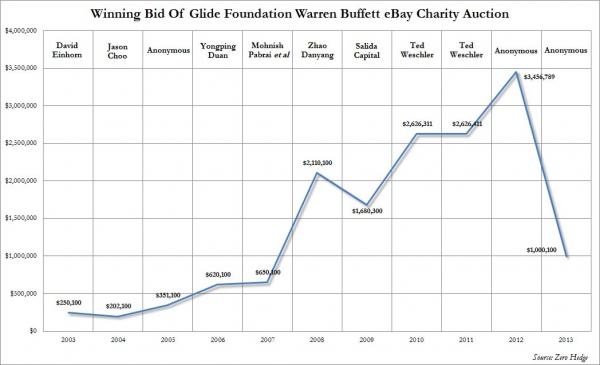
Demand for Warren Buffett, the investor, peaked in 2012 when an anonymous donor bid $3,456,789 for the annual Glide Foundation’s eBay lunch with the Octogenarian of Omaha. Demand for Warren Buffett, 82, the Obama tax and fairness advisor, however, is a mere fraction as the stunned Glide Foundation found out last night when the final bid for the “Power Lunch for 8 with Warren Buffett to Benefit GLIDE Foundation” auction closed at the lowest possible 6 digit increment, or an embarrassing $1,000,100. This was the lowest demand to have lunch with Buffett since 2007.This is a stunning result considering that with every passing year, for obvious reasons, the likelihood of many more such “power lunches” drops exponentially. We hope Buffett-demand is not a proxy leading indicator for the stock market or else a 71% plunge is coming. The San Francisco Business Times reports on the stunned response:

Glide stunned as Warren Buffett lunch raises just $1 million

The last few minutes of bidding for the annual charity lunch with Warren Buffett are normally happy ones for supporters of San Francisco’s Glide Foundation. In recent years, last-minute bidding has regularly pushed the price to record levels. Last year’s lunch for eight almost tripled in the final minute of bidding, closing at $3.46 million. With bidding nearing the $1 million mark by mid-afternoon Friday, expectations ran high that the lunch with the Berkshire Hathaway Chairman and CEO could cross $4 million for the first time. But as the auction closed at just $1,000,100, some attending the invitation-only countdown party at Restaurant Lulu in San Francisco could be heard speculating that a glitch must have occurred. At the party, I asked Alan Marks, eBay’s communications chief, about the possibility of a glitch. He defended the integrity of the auction. Read more of this post

The business lessons behind Disney’s magical experiences

The business lessons behind Disney’s magical experiences

Caitlyn Coverly, Special to Financial Post | 13/06/07 | Last Updated:13/06/06 12:16 PM ET

Premiere Of Disneyland's "Mickey And The Magical Map" New Stage Show

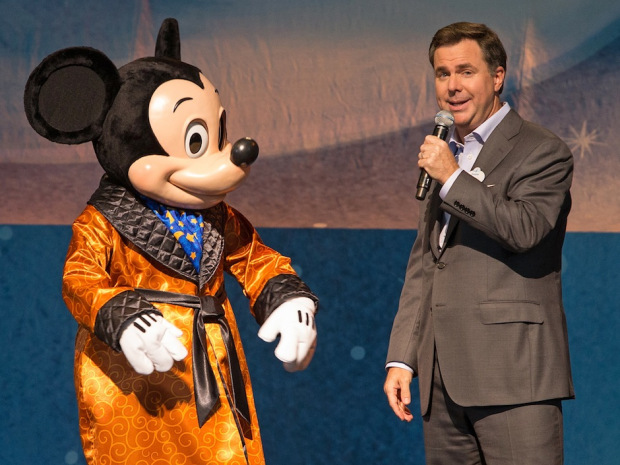
Michael Colglazier, President of Disneyland Resort, speaks prior to the premiere of Disney’s new stage show “Mickey and the Magical Map” at Disneyland on May 23, 2013 in Anaheim, California.

Last week, 250 GTA business professionals participated in “Disney’s Approach to Business Excellence,” an all day workshop offered through the Disney Institute and organized by McMaster University’s DeGroote School of Business in partnership with the Certified General Accountants of Ontario (CGA).

Workshop attendees watched case studies, answered questions, and participated in several group exercises led by Bryan Tabler and Amy Rossi, two facilitators from the Disney Institute and veteran employees of Disney.  The goal of the day was to learn the strategies Disney believes are key to the successful maintenance of The Walt Disney Company. These strategies are regarded as Disney’s five universal assets of a successful business — also known as the Disney Chain of Excellence — made up of leadership excellence, cast excellence, guest satisfaction and financial results/repeat business. Read more of this post

Truly Great Companies Add More Than They Extract

JUNE 7, 2013, 11:52 AM

Truly Great Companies Add More Than They Extract

By TONY SCHWARTZ

Perhaps no business consultant enjoys higher esteem in the corporate world than Jim Collins. Over three decades, he has sold millions of copies of his books describing the characteristics of what he terms “great” companies. It is hard not to admire his diligence. Along with a large team of researchers, Mr. Collins spends years gathering evidence and analyzing companies. The primary measure he uses for greatness is how well a company performs for its shareholders over a given period of time. The problem – as we have all been warned – is that past financial performance is no guarantee of future results.

For “Good to Great,” his most successful book, published in 2001, Mr. Collins selected 11 companies as truly elite performers. They included Circuit City (now bankrupt and defunct); Fannie Mae (taken over by the government in 2008 after huge mortgage losses); Pitney Bowes, whose stock has progressively tanked over the last decade; and Altria, the world’s largest tobacco company, which has actually performed well in the marketplace, but earns its revenues almost exclusively from a product that causes five million deaths a year. In “Great by Choice,” published in 2011, Mr. Collins and a co-author, Morten T. Hansen, call out seven companies for “spectacular” results – outperforming the overall stock market and their industry competitors by at least 10 times over a 15-year period. They also set up comparisons with companies in the same industries that performed markedly less well. The most striking comparison involves Microsoft, which Mr. Collins and Mr. Hansen identify as a great performer, and Apple, which they cite as the comparative laggard. Yes, you read that right. Here’s why: the 15-year period the authors happened to examine was 1987 to 2002.

How could so much research miss the mark by so far? Read more of this post

Look How Much Richer You Would Be If You Bought Company Stock Instead Of Products

Look How Much Richer You Would Be If You Bought Company Stock Instead Of Products

Mandi Woodruff | Jun. 8, 2013, 11:39 AM | 27,001 | 4

Whether it’s the latest iGadget or a hot new car, as consumers, we’re always scrambling for dibs on the “next big thing” in stores. But what if we put that money toward stock in the companies behind our favorite products instead? That’s a question recently explored by the Online Trading Academy. With the benefit of hindsight, their team has taken a look back in time to see what might have happened if we’d ditched the supermarket and invested in the stock market.

In 1990, Apple peddled the Macintosh Classic for $1,500. That much cash in Apple stock would have earned you $98,606 today.

Adjusted stock price in 1990: $6.45

Stock Price on April 5, 2013: $423.20

In 1986, the revolutionary Microsoft Windows 2.0 sold for $100. But if you’d put the money directly into company stock instead, today you’d have $11,480.

Adjusted stock price in 1986: $0.25

Stock price on April 5, 2013: $28.70

In 1985, if you chose to invest $200 in Best Buy Stock, instead of splurging on a Sony Walkman for the same price, you would have $36,343 today.

Adjusted in 1985: $0.14

Stock price on April 5, 2013: $25.45

Forty years ago, you could have dropped $460 on an IBM personal typewriter. But you would have made $38,113 if you’d invested that cash in IBM stock instead.

Adjusted stock price in 1962: $2.52

Stock price on April 5, 2013: $209.41

In 1984, a high-end riding lawn mower from Home Depot would have set you back $2,595. A better idea would have been to put that money in stocks and walk away with $699,199 today.

Adjusted stock price in 1984: $0.26

Stock price on April 5, 2013: $70.06

In 1968, if you stuck with your old fridge in lieu of a $500 GE refrigerator and invested that money in stock instead, you would have $47,763 today.

Adjusted stock price in 1968: $0.24

Stock price on April 5, 2013: $22.93

Walmart charged $15.95 for a toaster in 1972. With that cash in Walmart stock instead, you would have earned $30,403 today.

Adjusted stock price in 1972: $0.04

Stock price on April 5, 2013: $76.39

In 1982, you could have ruled the roads in a $6,572 Ford Mustang. A savvier spender would have put that money into Ford itself, and walked away with $314,433 today.

Adjusted stock price in 1982: $0.26

Stock price on April 5, 2013: $12.44

You couldn’t keep Nike Air Jordan’s on shelves back in the late ’80s. But if you saved that $65 and put it in Nike stock instead, you’d have $9,789 to show for it today.

Adjusted stock price in 1987: $0.39

Stock Price on April 5, 2013: $58.97

If you’d had the forethought to invest your annual coffee money ($520) in Starbucks stock in 1992, you’d have enough to buy a franchise of your own: $46,934.

Adjusted stock price in 1992: $0.64

Stock Price on April 5, 2013: $57.80

In 1970, you could have fed Big Macs to a family of four for $2.20. If only you’d put that money in McDonald’s stock instead, you’d have a cool $1,116 today.

Adjusted stock price in 1970: $0.20

Stock price on April 5, 2013: $101.42
Welcome return of bond volatility

June 7, 2013 5:24 pm

Welcome return of bond volatility

By Michael Mackenzie in New York

Long a benign indicator, the temperature gauge of the US bond market is flashing on the dashboards of investors; volatility is back and it should be welcomed not feared. Thanks to the Federal Reserve staking out a flexible approach to scaling back its $85bn a month bond-buying programme, bond prices have been fluctuating to a degree not seen since the US debt ceiling fracas during the summer of 2011. Trading in currencies, equities and emerging markets has also felt the lash from bigger swings this week, leading up to the release of employment data on Friday. The creation of 175,000 new jobs last month only fans uncertainty as to when the Fed may look to reduce its hefty bond buying later in the year. It means the turmoil we have seen across markets is not going to fade any time soon as investors take a hard look at their bond portfolios. This is particularly so as their benchmark, the Barclays US Aggregate Index, has registered a slide of around 1 per cent, its worst performance at this stage of the year since the savage bear market of 1994. Read more of this post

Inflation figures for services reflect different economic trend than those for goods

Inflation: Beyond goods and people

Jun 5th 2013, 17:11 by R.A. | WASHINGTON

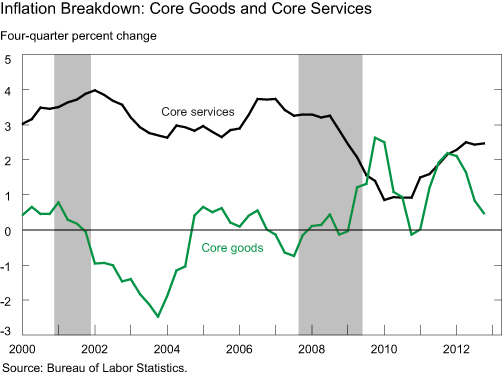
THE datasphere is bursting with inflation indexes (inflation inflation?). The Bureau of Labour Statistics provides consumer and producer prices while the Bureau of Economic Analysis gives us all manner of deflators. There are headline and core series (the latter stripping out especially volatile prices). One can look at price indexes for personal consumption expenditures (PCE), core PCE, “market-based” PCE, and core market-based PCE. There are chained indexes. The Cleveland Fed computes up median and “16% trimmed-mean” CPI. These different indexes provide a check on each other, and are often good at highlighting particular sorts of trends in the data. And new research by economists at the New York Fed suggests another way of chopping up inflation figures that looks especially informative. As it turns out, goods prices and services prices tend to behave very differently, with important implications for macroeconomic policy. A post at the New York Fed’s Liberty Street blog discusses the issue. You can see the divergence in core goods inflation and core services inflation in the chart below:

goodsandservices Read more of this post

China’s foreign ports: The new masters and commanders; China’s growing empire of ports abroad is mainly about trade, not aggression

China’s foreign ports: The new masters and commanders; China’s growing empire of ports abroad is mainly about trade, not aggression

Jun 8th 2013 | COLOMBO |From the print edition

20130608_IRM958_0

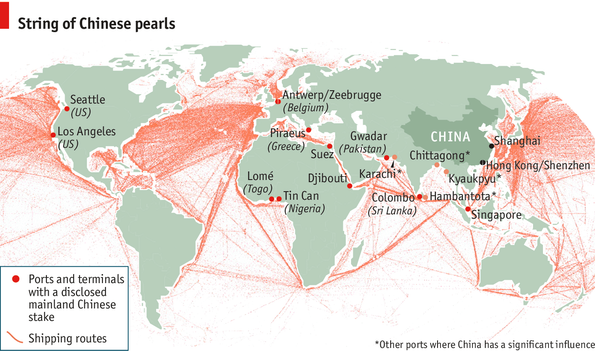
FROM the ground, Colombo’s port does not look like much. Those entering it are greeted by wire fences, walls dating back to colonial times and security posts. For mariners leaving the port after lonely nights on the high seas, the delights of the B52 Night Club and Stallion Pub lie a stumble away. But viewed from high up in one of the growing number of skyscrapers in Sri Lanka’s capital, it is clear that something extraordinary is happening: China is creating a shipping hub just 200 miles from India’s southern tip.

The old port is cramped and stuffed full of containers. To its left, a vast new breakwater curves into the ocean. Alongside it a Chinese ship has just delivered three giant Chinese cranes (see picture) to a new container terminal built by a Chinese company and run by an entity controlled by another Chinese firm. The terminal opens in July and will be complete in April 2014. The old port took centuries to reach its present capacity. China will have almost doubled it in under 30 months. Operated at full capacity, it would make Colombo one of the world’s 20 biggest container ports. Read more of this post

Winners and Losers in the Coming Super-Network War

SATURDAY, JUNE 8, 2013

Winners and Losers in the Coming Super-Network War

By TIERNAN RAY | MORE ARTICLES BY AUTHOR

Ciena, Cisco, Oracle, and F5 Networks could benefit as a battle looms between content and distribution.

The 17% surge in shares of networking-equipment firm Ciena (ticker: CIEN) last Thursday, following better-than-expected fiscal second-quarter earnings, was no doubt driven by some of the animal spirits lately boosting tech stocks. But the surge was not entirely adrenaline-based.

The network—the very “pipes” that carry the data, along with the software directing it, whether on the global Internet or a small corporate network—will play an increasingly pivotal role in commerce and work and play, particularly as a dramatic new age of content and services unfolds. Read more of this post

Cloud Computing and the Changing Role of the CIO

June 7, 2013, 12:44 PM ET

Cloud Computing and the Changing Role of the CIO

Irving Wladawsky-Berger

Last week I wrote about the 2013 MIT Sloan CIO Symposium which I recently attended. The Symposium included a number of talks and panels on the key issues facing CIOs, as every business is essentially becoming a digital business. Big Data and cloud were the most prominent transformative technologies discussed at the Symposium. My remarks last week were focused on Big Data. I now want to turn my attention to cloud computing, and its impact as a key driver of the changing role of the CIO.

These days, few question the importance of cloud to individuals, companies of all sizes and the economy in general. In a just published report by the McKinsey Global Institute, “Disruptive technologies: Advances that will transform life, business, and the global economy,” cloud is listed as one of 12 technologies with significant potential to drive economic impact and disruption by 2025.  The report said: Read more of this post

One Company’s Trash Is Another’s Treasure; Clean Harbors’ growing dominance of the hazardous-waste-disposal business has helped drive 20% annual revenue growth for a decade

SATURDAY, JUNE 8, 2013

One Company’s Trash Is Another’s Treasure

By ALEXANDER EULE | MORE ARTICLES BY AUTHOR

BA-BC133_clean__G_20130608014816

Clean Harbors’ growing dominance of the hazardous-waste-disposal business has helped drive 20% annual revenue growth for a decade. Why the stock could rise 45%.

Clean Harbors has gotten awfully good at fixing other people’s problems. The hazardous-waste manager spent months in the Gulf of Mexico after BP’s Deepwater Horizon rig exploded in April 2010. The company laid booms in the Gulf to contain oil, cleaned beaches and scrubbed ships before they headed back to the Mississippi. Clean Harbors (ticker: CLH) made $220 million for its efforts. It played a similar, though less lucrative role, after Hurricane Sandy flooded refineries near New York and New Jersey. Clean Harbors has a long history with America’s least desirable waste. It helps manufacturers, energy firms and chemical companies dispose of their everyday byproducts, stuff that’s classified as hazardous by federal and state officials. And it has a pretty tight grip on the market; the company handles about 70% of U.S. hazardous waste sent to incinerators and 20% sent to landfills. As long as it’s not radioactive, Clean Harbors can take it. The diverse capabilities sets the company apart even from giants like Waste Management (WM), which doesn’t have the incinerators required for some types of hazardous material. Nor is there much competition on the horizon; U.S. regulators haven’t authorized a new hazardous incinerator or landfill in nearly two decades. Read more of this post

US spends at least $80bn a year on intelligence alone, which is more than the defence budgets of all but a handful of countries.

June 7, 2013 5:53 pm

Data intelligence complex is the real story

By Edward Luce in Washington

More than half a century ago, Dwight D. Eisenhower warned Americans of the dangers posed by the country’s growing “military-industrial complex” – a phrase that entered instantly into everyday language. “The total influence – economic, political, even spiritual – is felt in every city, every state house, every office of the federal government,” the outgoing Republican president said. “We must be alert to the … danger that public policy could itself become the captive of a scientific technological elite.” Ike was chiefly warning about the power of the Pentagon and the big defence companies that had grown up around it. Today his prescience would be applied to America’s vast army of federally-employed data analysts and the hundreds of software companies they employ. The US spends at least $80bn a year on intelligence alone, which is more than the defence budgets of all but a handful of countries. Read more of this post

For Retirees, a Million-Dollar Illusion; The topsy-turvy world of the markets — particularly the ultralow yield of bonds — is upending what many people thought they knew about saving for retirement

June 8, 2013

For Retirees, a Million-Dollar Illusion

By JEFF SOMMER

A MILLION dollars isn’t what it used to be.

In 1953, when “How to Marry a Millionaire” was in movie theaters, $1 million bought the equivalent of $8.7 million today. Now $1 million won’t even buy an average Manhattan apartment or come remotely close to paying the average salary of an N.B.A. basketball player. Still, $1 million is more money than 9 in 10 American families possess. It may no longer be a symbol of boundless wealth, but as a retirement nest egg, $1 million is relatively big. It may seem like a lot to live on. But in many ways, it’s not. Inflation isn’t the only thing that’s whittled down the $1 million. The topsy-turvy world of today’s financial markets — particularly, the still-ultralow interest rates in the bond market — is upending what many people thought they understood about how to pay for life after work. “We’re facing a crisis right now, and it’s going to get worse,” said Alicia Munnell, director of the Center for Retirement Research at Boston College. “Most people haven’t saved nearly enough, not even people who have put away $1 million.” Read more of this post

A model for fighting fraud; SEC developing software “to sift language in financial reports for clues that executives might be misstating results”

Saturday June 8, 2013

A model for fighting fraud

Optimistically Cautious by ERROL OH

WHAT if the regulators can extract information from a listed company’s annual report and feed it into a computer program to find out if there’s probably some financial sleight of hand going on? That sounds like a tremendous step forward for capital market supervision and enforcement. It also seems a bit far-fetched. But maybe it’s not. The Wall Street Journal reported on May 29 that the US Securities and Exchange Commission (SEC) was renewing its focus on accounting fraud and other problems relating to financial disclosures. The newspaper quoted agency officials as saying the SEC was already developing software “to sift language in financial reports for clues that executives might be misstating results”. The program, according to the article, would analyse the annual report section (usually called the management’s discussion and analysis) in which the companies talk in detail about their performance and prospects. Certain word choices, readers are told, may be red flags that warn of earnings manipulation. One SEC official said tests to determine if the analysis would have sniffed out previous accounting frauds “look very promising”. Here’s a couple of paragraphs from the story: “Firms that bend or break accounting rules tend to play a word shell game,’ said Craig Lewis, the SEC’s chief economist and head of the division developing the model. “Such companies try to deflect attention from a core problem by talking a lot more about a benign’ issue than their competitors, while underreporting important risks’.”

Read more of this post

Too much of a good thing: Leaders need to learn to beware of their strengths

Too much of a good thing: Leaders need to learn to beware of their strengths

Jun 8th 2013 |From the print edition

20130608_WBD000_0

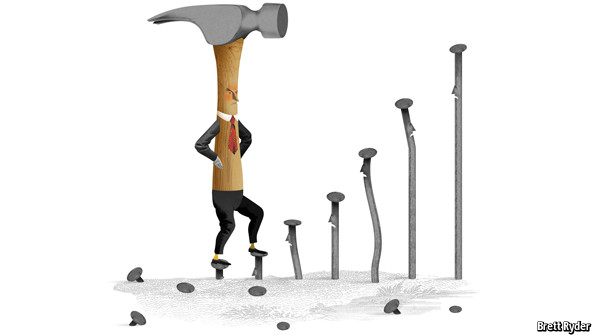
IT IS only natural for leaders to try to make the most of their strengths. The theory of comparative advantage directs people, as well as countries and firms, to focus on what they are good at. Management experts have tended to concur: one of the bestselling business books of recent years is called “Now Discover Your Strengths”, by Marcus Buckingham and Donald Clifton. When business schools (and indeed business columnists) profile bosses, they often assume that more is better. But is this right? Three more recent books express some doubts. In “Fear Your Strengths”, Robert Kaplan and Robert Kaiser argue that “what you are best at could be your biggest problem.” Forcefulness can become bullying; decisiveness can turn into pigheadedness; niceness can develop into indecision. Read more of this post

Deluded bosses: Who’s behind me? The powerful overestimate the support of underlings

Deluded bosses: Who’s behind me? The powerful overestimate the support of underlings

Jun 8th 2013 |From the print edition

HISTORY is littered with powerful people undone by hubris. Julius Caesar should have ignored the cheers of the Roman crowd and paid heed to the soothsayer. The late Steve Jobs overplayed his hand at Apple as a young man and was kicked out of the company he founded. And then there was Jimmy Cayne.

When Mr Cayne walked out of Bear Stearns for the last time, having been eased out as boss of the ailing bank, he claimed there wasn’t a dry eye in the house. Through the tears, he wistfully recalls, heart-broken bankers sent him on his way with a standing ovation. This is not how his staff remember it. So disliked was he that according to “House of Cards”, a book by William Cohan, underlings would ask in meetings: “Is Jimmy staying on? [Because] we’re not coming back for another year of this shit.” Read more of this post

Huge Chinese Interest Rate Spike Has People Freaked Out About A Looming Credit Crisis; China Overnight Rate Rises Most in Two Years as Inflows Slow

Yesterday’s Huge Chinese Interest Rate Spike Has People Freaked Out About A Looming Credit Crisis

Mamta Badkar | Jun. 7, 2013, 11:32 AM | 1,953 | 1

screen shot 2013-06-07 at 11.05.26 am

Chinese interbank rates surged ahead of the three-day Dragon Boat festival next week.

The overnight Shibor, or the Shanghai interbank offered rate, surged to 8.29% on June 7, from 5.98% on June 6. The seven-day Shibor rose to 6.66%, from 5.14%.

This is an interest rate used among banks, and it’s considered a useful proxy for liquidity in the Chinese credit markets. Read more of this post

China’s crackdown on hot inflows lead to cold exports. Get used to it

Saturday, June 8, 2013

China’s crackdown on hot inflows lead to cold exports. Get used to it

Economists and I-bankers have been complaining for months that the China’s export figures have been inflated. But, pulling back the curtain to get a truer picture of exports, they might not like what they see. That’s if today’s trade data release is any indication. Export grew at the slowest pace in a nearly a year in May, rising at shockingly low 1% year-on-year. That’s down from 14.7% growth in April. Slowing growth itself isn’t that surprising. A slowdown had been widely expected, with a consensus economist prediction of only 7.3%, according to Reuters data. Markets were also expecting lackluster trade data as well, contributing to a decline of 3.9% in the Shanghai Composite Index this week leading up to the announcement. Read more of this post

Specter of Another Bond Crash Spooks Asia

Specter of Another Bond Crash Spooks Asia

Kim Choong Soo is seeing ghosts, and that should scare you.

No, the Bank of Korea governor isn’t seeing ghouls or hearing things that go bump in the night. The nightmare preoccupying him involves Alan Greenspan and what traders call the Great Bond Market Massacre of 1994. Kim worries that history is about to repeat itself, potentially devastating Asian growth rates.

Back in the 1990s, when he was Federal Reserve chairman, Greenspan doubled benchmark lending rates over 12 months, causing, according to Fortune magazine, more than $600 billion in losses on U.S. Treasuries. The chaos drove Orange County, California, into bankruptcy; sank Kidder Peabody & Co.; pushed Mexico into crisis; and precipitated Asia’s 1997 meltdown as a surging dollar strained currency pegs. Read more of this post

Asian Debt Hit on Two Sides; Money Managers Pull Back in Face of Weakening Currencies, Rising Bond Yields

June 7, 2013, 6:32 p.m. ET

Asian Debt Hit on Two Sides

Money Managers Pull Back in Face of Weakening Currencies, Rising Bond Yields

By FIONA LAW

HONG KONG—The $2.76 trillion market for Asian local-currency debt is reeling from weakening currencies in the region and rising bond yields around the world.

The HSBC HSBA.LN +1.14% Asian Local Bond Index, which measures the performance of local-currency bonds in some Asian countries but excludes Japan, has fallen 3% from May 9 through Thursday, a selloff that has pushed it into negative territory for the year. Read more of this post

TSMC to feature on Japanese show about industry in Asia; NHK’s new show — Shima Kosaku’s Asia Success Story — focuses on famous Asian business leaders and their innovative strategies that make their businesses succeed and drive the Asian economy

TSMC to feature on Japanese show about industry in Asia

CNA and Staff Reporter

2013-06-08

TSMC NHK

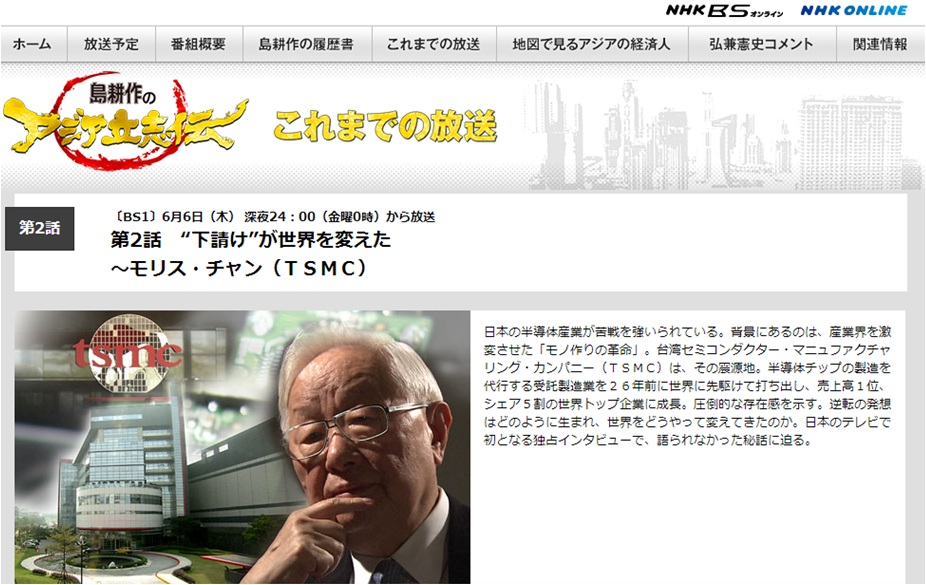
Japan’s NHK network is scheduled to broadcast an animated documentary on Taiwan Semiconductor Manufacturing Co at midnight Thursday, with TSMC’s chairman and CEO Morris Chang portrayed by the fictional character Shima Kosaku.

NHK’s new show — Shima Kosaku’s Asia Success Story — combines documentary footage and anime sequences, and focuses on famous Asian business leaders and their innovative strategies that make their businesses succeed and drive the Asian economy, according the program’s official website.

The TSMC episode, titled OEM that Changed the World — is the second in the series and will depict Chang and his company’s journey to the top of the semiconductor industry. Read more of this post

Why ‘Boring’ Stocks Have an Edge Over ‘Exciting’ Ones

June 7, 2013, 6:18 p.m. ET

BY MARK HULBERT

Why ‘Boring’ Stocks Have an Edge Over ‘Exciting’ Ones

By MARK HULBERT

BF-AF113_HULBER_G_20130607154511

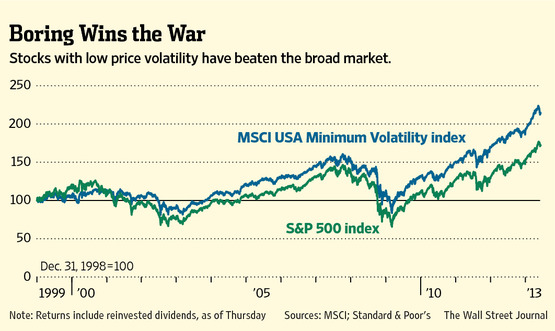
In the stock market, boring is often beautiful. That is because “boring” stocks—those that have exhibited the least historical volatility—on average outperform the most “exciting” issues—those that have been the most volatile. And not by just a small margin, either. By “historical volatility,” we mean the magnitude of a stock’s price swings over a specified period. Just take AppleAAPL +0.76% whose stock has certainly been one of the more volatile in recent years. Its shares have lost 21% over the past 12 months, compared with a 20% gain for those stocks with the least historical volatility, as measured by the MSCI USA Minimum Volatility index. Not all volatile stocks perform as poorly as Apple has over the past year, of course, and not all boring stocks have done well. But the extent to which Apple lags behind the average boring stock over the past 12 months is right in line with historical research conducted by Nardin Baker, who manages global equity at Guggenheim Partners. The firm has $180 billion under management. Read more of this post

The Hot New M.B.A.: Supply-Chain Management; More Schools Are Ramping Up Their Programs, Adding Majors and Concentrations as Employer Demand Grows

Updated June 5, 2013, 7:46 p.m. ET

The Hot New M.B.A.: Supply-Chain Management

More Schools Are Ramping Up Their Programs, Adding Majors and Concentrations as Employer Demand Grows

By MELISSA KORN

Call it a problem of supply and demand.

With global operations becoming more complex, companies in manufacturing, retail and technology—and the consulting firms that service them—are scrambling to hire people with supply-chain expertise. But these experts are hard to come by.

Sensing growing demand, more than a half-dozen universities have recently introduced undergraduate majors, M.B.A. concentrations and even entire degree programs dedicated to procurement, inventory management and global supply-chain strategy. Read more of this post

Humanities Fall From Favor; Far Fewer Harvard Students Express Interest in Field With Weak Job Prospects

June 6, 2013, 12:15 a.m. ET

Humanities Fall From Favor

Far Fewer Harvard Students Express Interest in Field With Weak Job Prospects

By JENNIFER LEVITZ and DOUGLAS BELKIN

NA-BW682_HARVAR_NS_20130605182115

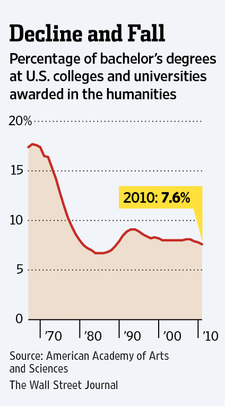
CAMBRIDGE, Mass.—The humanities division at Harvard University, for centuries a standard-bearer of American letters, is attracting fewer undergraduates amid concerns about the degree’s value in a rapidly changing job market.

university report being released Thursday suggests the division aggressively market itself to freshmen and sophomores, create a broader interdisciplinary framework to retain students and build an internship network to establish the value of the degree in the workforce. Read more of this post

Former England cricketer Paul Collingwood lost more than £300,000 of life savings in risky unregulated investments; Many unregulated schemes promise generous upfront tax breaks and the promise of double-digit returns

Former cricketer Paul Collingwood’s investment dreams end in ashes

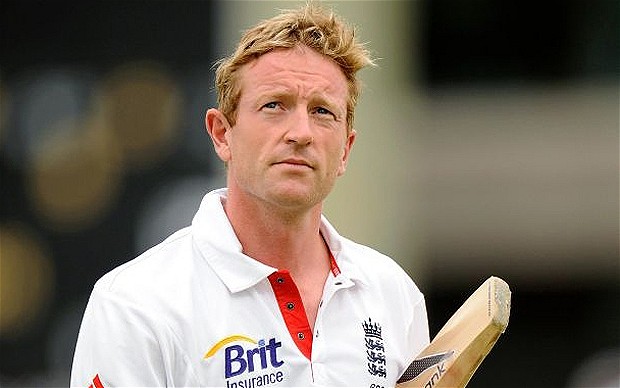
The former England cricketer Paul Collingwood and his wife are suing their financial adviser, claiming that he lost more than £300,000 of their life savings in risky unregulated investments.

paul-collingwood_2265375b

The victims of advisers who sell risky financial schemes include top sports stars Photo: REUTERS

By Emma Simon

7:00AM BST 08 Jun 2013

They have issued a High Court writ against their adviser, Roderick Langham, who worked for Cheshire-based Sigma Wealth Management, which advised a number of other sports stars and has since gone into liquidation.

Mr Collingwood said he had instructed the firm to invest his money for retirement, not gamble it on racy unregulated ventures. Read more of this post

Fiduciary Duty to Cheat? Stock Market Super-Star Jim Chanos Reveals the Perverse New Mindset of Financial Fraudsters

Fiduciary Duty to Cheat? Stock Market Super-Star Jim Chanos Reveals the Perverse New Mindset of Financial Fraudsters

April 1, 2013  |

Editor’s note: This article is the first in a new AlterNet series, “The Age of Fraud.

Hustlers. Cheaters. Crooks. American business has always had them, and sometimes they’ve been punished. But today, those who cheat and put the rest of us at risk are often getting off scot-free. The recent admission of Attorney General Eric Holder [3] that systemically dangerous megabanks may escape prosecution because of their size has opened a new chapter in fraud history. If you know your company won’t be prosecuted, a perverse logic says that you shouldcheat and make as much money for shareholders as you can.

Jim Chanos is one of America’s best-known short-sellers, famed for his early detection [4] of Enron’s fraudulent practices. In deciding which companies to short (short-sellers make their money when the price of a stock or security goes down), Chanos acts as a kind of financial detective, scrutinizing companies for signs of overvaluation and shady practices that fool outsiders into tlhinking that they are prospering when they may be on shaky financial footing. Chanos teaches a class at Yale on the history of financial fraud, instructing students in how to look for signs of cheating and criminal activity. I caught up with Chanos in his New York office to ask what’s driving the current era of rampant fraud, who is to blame, what can be done, and the ways in which fraud costs us financially and socially. Read more of this post