What Warren Buffett would change if he ever edited The Intelligent Investor by Benjamin Graham

The Intelligent Investor — By Warren Buffett

What Warren Buffett would change if he ever edited The Intelligent Investor by Benjamin Graham

CHETAN PARIKH

Chetan Parikh enjoys high recall among value investors in India. Rightly so, as he has contributed the most towards creating awareness about value investing through capitalideasonline. His book, India’s Money Monarchs, co-authored with Utpal Sheth and Navin Agarwal, was the first to chronicle the thought process of prominent Indian investors. Over the years, Parikh has not only built an impressive investing track record, he continues to spread the good word by teaching security analysis at Mumbai’s Jamnalal Bajaj Institute of Management Studies

Benjamin Graham laid the foundation for value investing, which Warren Buffett built on. But along the way, the architectural design underwent some significant changes Read more of this post


Indian promoters can learn a lot from Warren Buffett and Charlie Munger — and finance has very little to do with it

Business Lessons From Buffett

Indian promoters can learn a lot from Warren Buffett and Charlie Munger — and finance has very little to do with it

N MAHALAKSHMI

Barnett Helzberg was at New York’s Plaza Hotel, when he heard a woman holler, “Warren Buffett!” He spun around and yes, it really was. Helzberg did not waste the opportunity — he introduced himself and told Buffett he owned a company that satisfied the “acquisition criteria” laid out by him in the Berkshire Hathaway annual report (Buffett has been listing his acquisition criteria in the annual report for over three decades now). The billionaire investor told him to send across the information. Having sent the details of his company Helzberg Diamonds, he soon found himself in Buffett’s office at Omaha. Buffett looked at him and said, “Well, this will be the fastest deal in history.” When a perplexed Helzberg asked about due diligence, Buffett replied, “I can smell these things Read more of this post
Charles Brandes: “The Market Has Taught Me To Ignore The Market Most Of The Time”

“The Market Has Taught Me To Ignore The Market Most Of The Time”

While volatility can distort prices in the near term, the value of a business is eventually reflected in stock prices over the long term

OUTLOOK BUSINESS

Volatility, they say, is a friend of value investors. But the crisis of 2008 proved to be an exception to the rule. Take the case of Charles Brandes, the 70-year-old founder of Brandes Investment Partners, who saw assets under management wilt from an eye-popping $111 billion at the end of 2007 to around $21 billion in a span of five years. But the turn of events has not shaken the confidence of the dyed-in-the-wool value investor, who believes that so long as human nature doesn’t change, value investing will remain an effective long-term investment strategy. Incidentally, Brandes is among the privileged few to have legendary value investor, Benjamin Graham, as a mentor Read more of this post

“Investing Is About Figuring Out What Somebody Is Doing Right And Paying Less”; The founder of New York-based Gotham Asset Management does have a magic formula for investing

“Investing Is About Figuring Out What Somebody Is Doing Right And Paying Less”

The founder of New York-based Gotham Asset Management does have a magic formula for investing

Joel Greenblatt is no magician, but the founder of New York-based Gotham Asset Management does have a magic formula for investing. In 2005, Greenblatt, who also has been teaching at Columbia Business School for the past 17 years, published The Little Book that Beats the Market, which explains how investors can outperform market averages by following a simple process of investing in good companies at bargain prices. The ‘Magic Formula,’ as Greenblatt termed it, was about seeking out companies with high return on invested capital, and which could be purchased at a low price. The strategy produced back-tested returns of 30.8% per year from 1988 through 2004, more than double the S&P 500’s 12.4% return over the same period. What better proof than eating your own cooking, Greenblatt’s private investment partnership has logged a 40% annualised return since its inception in 1985. Read more of this post

Akio Yamada, who is the CEO of MIRAI Industry, makes the company ‘Paradise of employees’; Yamada’s main philosophy, “Employees are not machines.”

Case study: Akio Yamada, who is the CEO of MIRAI Industry, makes the company ‘Paradise of employees’

June, 2011

Mirai

< Akio Yamada, who is the CEO of MIRAI Industry, makes the company ‘Paradise of employees’ >

Eng. Jinhyung Park

What do you consider when you choose a company for getting a job? The company which gives you no overworks? The company which guarantees retirement age? The company which gives much of money? It is so hard to choose one. But, there’s a company which is fulfilling everything for employees. It is Mirai Industry Corporation. It has been chosen the greatest work place in the survey in Japan. Now, I will introduce this company for the reader who wants to manage a small company or studies business administration. Read more of this post

PE firms in China seek new way out with IPO door shut; short selling and accounting scandals have killed enthusiasm in Chinese stocks listed in the US, prompting many Chinese companies to get out rather than step in

PE firms in China seek new way out with IPO door shut

Xinhua

2013-06-08

China’s private equity firms, sitting on over US$130 billion in assets, are now having a hard time cashing out, as IPOs proposed by Chinese companies have been essentially frozen.

PE firms in China generally cash out by allowing companies to go public. But cash pipelines have been squeezed both at home and abroad.

The China Securities Regulatory Commission has been suspending IPO applications in order to clamp down on fraud and restore confidence in the Shanghai and Shenzhen indexes, two of the world’s worst performers. Meanwhile, short selling and accounting scandals have killed enthusiasm in Chinese stocks listed in the US, prompting many Chinese companies to get out rather than step in. Read more of this post

China’s lack of data on property owners has let the wolves move in on the market

Friday, June 7, 2013

China’s lack of data on property owners has let the wolves move in on the market

By next June, China should know a bit more about who owns what property, how much of it, as well as how much it’s worth.

Because right now, officials on the central level hardly have a clue.

The system that China uses to register real estate ownership is highly fragmented. In some cities, Chinese record a property transaction in a digitized system. In small counties, they might jot the information down on paper before it’s permanently filed away. Drawing connections between localities – essentially figuring out who owns what nationwide – is almost impossible. Read more of this post

Cash-strapped PPTV, China’s first online TV service, at critical juncture; By 2012, PPTV had less than US$30 million left in its account, which made it hard for the company to broadcast new TV dramas from Hong Kong and South Korea

Cash-strapped PPTV at critical juncture

Staff Reporter

2013-06-08

YaoXin-120600_copy1

PPTV, China’s first online TV service, is engaged in negotiations with potential buyers to raise funds for its cash-strapped operations. The service only has enough cash to last until July, according to a report by CNTEN Technology, which cited several sources close to the company’s management.

PPTV is now seeking to raise 100 million yuan (US$16.3 million) in funds through the issue of new bonds in order to deal with its financial woes. Potential buyers are assessing its ability to pay back its growing debt. Read more of this post

Startups Tap Into Mobile-App Explosion; As the mobile business booms, an industry of little-known companies that serve app developers is growing quickly behind the scenes

Updated June 7, 2013, 5:50 p.m. ET

Startups Tap Into Mobile-App Explosion

By JESSICA E. LESSIN

As the mobile business booms, an industry of little-known companies that serve app developers is growing quickly behind the scenes.

Companies that build software for app makers to send messages to users, accept payments, track analytic information, store data and more are drawing interest from customers and investors as developers race to build more features into their applications.

Among them are upstarts like Twilio Inc., a San Francisco-based company that offers notification technology, along with other tools. Customers include the car-service Uber Inc., which uses Twilio to send riders text messages when their rides arrive, and TaskRabbit Inc., which texts people who perform on-demand tasks for the service to see it they are available to jump on new ones. Read more of this post

Credibility Crunch for Tech Companies Over Prism; People’s Locations Could Be Tracked

Updated June 7, 2013, 7:51 p.m. ET

Credibility Crunch for Tech Companies Over Prism

By AMIR EFRATISHIRA OVIDE and EVELYN M. RUSLI

NA-BW717_PRISMT_G_20130607180313

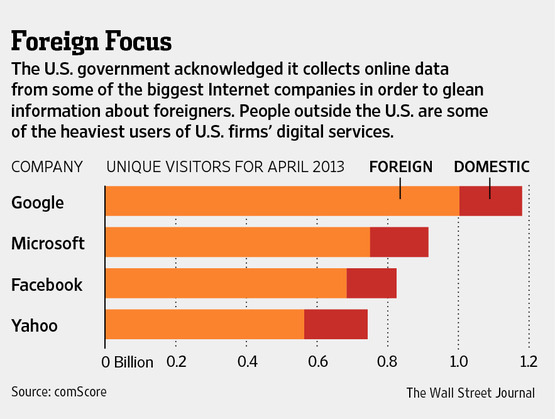
With Silicon Valley’s credibility in protecting consumer privacy on the line, many of the largest Web companies on Friday emphasized they aren’t giving the U.S. government a direct pipe into their networks as part of a secret program to monitor foreign nationals.

But the denials of involvement by Google Inc., GOOG +1.75% Microsoft Corp.MSFT +2.03% and others, which come at the same time the Obama administration confirmed the existence of such a program, raised questions about how data is ending up in the hands of the government.

The issues are especially acute for companies who make their business by collecting and processing customers’ most personal data and secrets. Read more of this post

India’s FreeCharge allows users to top-up their mobile phones for “free”, that is, reimbursed with discount coupons for top Indian food joints and retailers, equivalent to the recharge amount.

The Story of Sequoia-backed FreeCharge and its Success in India

June 7, 2013

by Stephanie Phua

Freecharge.in-Sequoia-funding

FreeCharge was founded on August 2010 by Kunal Shah and Sandeep Tandon. The service allows users to top-up their mobile phones for “free” – basically, every mobile top-up done on FreeCharge is reimbursed with discount coupons for top Indian food joints and retailers, equivalent to the recharge amount. These coupons are delivered to the user. It got $4 million in funding from Sequoia Capital in January 2012. Read more of this post

What Silicon Valley can teach Canadian businesses about ‘lean innovation’

What Silicon Valley can teach Canadian businesses about ‘lean innovation’

Mitchell Osak | 13/06/06 | Last Updated: 13/06/05 3:42 PM ET
It is commonly accepted that launching a new business or product is very challenging — so challenging, in fact, that roughly 75% of new product innovations fail to meet expectations.  Obviously, the chances of success will depend a lot on product and marketing decisions as well as customer interest.  Less attention, however, is paid to the process of commercialization or shepherding a new idea from concept to customer. Having a poor commercialization approach is guaranteed to increase failure rates, waste capital and stress the organization.  One way to improve your odds is to bring inside the “lean” start-up structure and lessons of Silicon Valley.

The typical approach to launching innovations or new businesses is to commercialize it using existing structures, processes and capabilities.  Though an internal focus can be appealing, this method has some major drawbacks.  For example, most firms and people display a bias towards the short-term and proven.  Higher risk innovation initiatives will always compete for resources, focus and capital with existing operations. When the going gets tough, innovation is often the first area to be cut. Moreover, though many companies pay lip service to breakthrough innovation, their culture, structure and management systems are often too rigid and siloed to deliver anything but modest improvements. But there is a better way. Read more of this post

AutoNavi Amap Integrates Taxi and Restaurant Reservations Services

AutoNavi Amap Integrates Taxi and Restaurant Reservations Services

By Tracey Xiang on June 8, 2013

Amp, maps service provided by AutoNavi, just updated its Android app which has integrated a plenty of location-based life services such as taxi hailing and restaurant reservations. Partering with Didi taxi service, Amap users can see taxis nearby on the map and hail one directly by clicking on a button on the top left corner(see image below). As to the restaurant reservations feature, it shows restaurants near to a user and whether group-buying or coupons are available. Reservations can be made within the app. It also added real-time bus arrival information and updated the parking spaces database.

4

YY becomes a TV partner: Another reason the US should be paying attention to China tech

YY becomes a TV partner: Another reason the US should be paying attention to China tech

BY HAMISH MCKENZIE 
ON JUNE 7, 2013

Further to the chronicles of the “yes, the US can learn from China on tech” meme, as well as the “Hey, maybe these Chinese tech IPOs aren’t so shitty after all” revelation, another Internet company from the Middle Kingdom is showing that it has ideas and execution that the West should envy.

Mass social communications platform YY – which is kind of like Google Hangout meets Facebook but on steroids – has announced a partnership with an “American Idol”-like TV show that will see it serve as a broadcasting and interactive platform throughout the duration of the popular program. Read more of this post

It’s Official? Alibaba doing more business than Amazon + eBay (Charts)

It’s Official? Alibaba doing more business than Amazon + eBay (Charts)

Jim Erickson  | Jun 07, 2013 | 03:50 PM

KChartAli_0 KChartDesk KChartDevices kChartTime

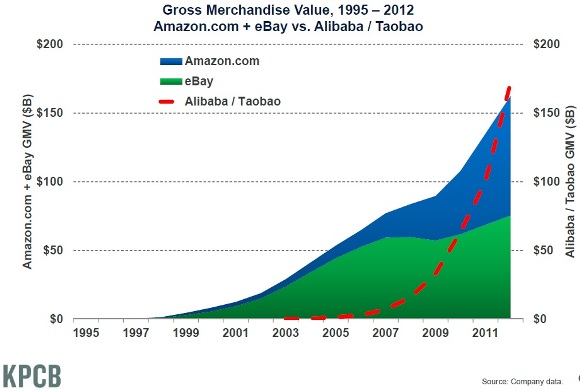
Former U.S. Vice President Al Gore gave a shout-out to Alibaba Group at the 2013 Internet Retailer Conference & Exhibition this week in Chicago, noting that China’s largest e-commerce company generated more GMV (gross merchandise value) than Amazon and eBay combined. The inventor of the Internet may have misspoke himself a tad. Gore’s syntax implied that the comparison was confined to the fourth quarter of 2012. In fact, what was being compared was total GMV for the companies for all of 2012—it was during Q4 that Alibaba’s e-commerce platforms passed the two U.S. giants for the year. Well, he got the gist right. Gore apparently sourced his material from stats offered by well-known tech pundit and KPCBpartner Mary Meeker during a “state of the Internet” talk she gave at the Wall Street Journal’s annual D: All Things Digital conference in California last week. Here’s the chart from her hard copy report, which appeared in a section entitled “Lots to Learn From China – Volume + Innovation.” Read more of this post

Mao’s birthday: Party time; Preparations are under way for big celebrations of Mao’s 120th birthday on December 26th

Mao’s birthday: Party time

Jun 7th 2013, 10:41 by J.M. | BEIJING

CHINA-POLITICS-RED-PUSH

THERE was a time, just a few months ago, when some analysts were speculating that new leaders preparing to take over in China wanted to abandon Mao. If it ever seemed likely then, it is looking far less so now. The new helmsman, Xi Jinping, has been showing no sign of squeamishness about the horrors of that era. Preparations are under way for big celebrations of Mao’s 120th birthday on December 26th. Mr Xi will likely use the occasion to pay fulsome homage.

On June 5th the party chief of Hunan, Xu Shousheng, paid a visit to one of his province’s most-visited attractions: Mao’s rural birthplace in Shaoshan village (theHunan Daily’s report is here, in Chinese). There he laid a wreath before a bronze statue of the late chairman. Mr Xu has good economic reasons for showing obeisance. Last year the province earned nearly $4.6 billion from “red tourism”, as pilgrimages to historic Communist sites are known (a local newspaper, in Chinese,describes hopes to boost this by more than 20% in 2013). But Mr Xu made clear he was not there just to drum up business for Hunan. The central leadership, he said, was attaching “great importance” to the birthday celebrations. The entire nation, he said, was paying “great attention”. Read more of this post

Halting The Great Corrupt Cadre Escape; over 1,100 officials failed to return from abroad over recent years, 714 of them were confirmed as fleeing officials

Halting The Great Cadre Escape

By Chen Yong (陈勇) and Qiao Yafei (乔亚飞)
June 3, 2013
On May 27, the Chinese Communist Party’s internal anti-corruption agency released a notification requiring all staff toreturn any membership cards that they had obtained by June 20. This is the first time in 20 years that the Central Commission for Discipline Inspection (CCDI) has launched an anti-corruption campaign aimed at its own members.

An official from the discipline inspection commission, who was unwilling to reveal his name, told the EO that this internal focus was aimed at ensuring the integrity of the inspection system and also at preventing more officials from fleeing abroad. Read more of this post

Lab-Grown Blood Vessel Used for First Time in the U.S.

Lab-Grown Blood Vessel Used for First Time in the U.S.

A 62-year-old Virginia man with kidney failure received the first genetically engineered blood vessel in the U.S., a vein that may improve his dialysis treatments and pave the way for future tissue transplants.

The operation at Duke University Hospital in Durham, North Carolina, yesterday marked the first time doctors have implanted an “off-the-shelf” tissue graft in the U.S. The vessel, grown with human cells on a mesh tube, has the potential to be widely used since it was cleansed of any lingering cells that may trigger an immune reaction, said the doctors who performed the surgery. Read more of this post

Buffett’s former Iron Mountain and Equinix, two technology companies planning to convert to real estate investment trusts, plunged after saying that the U.S. Internal Revenue Service is scrutinizing their eligibility

Iron Mountain, Equinix Fall as IRS Scrutinizes REIT Plans

Iron Mountain Inc. (IRM) and Equinix Inc. (EQIX), two technology companies planning to convert to real estate investment trusts, plunged after saying that the U.S. Internal Revenue Service is scrutinizing their eligibility.

The IRS is weighing whether to revise the legal definition of real estate for the purposes of converting to a trust, the companies said in separate regulatory filings.

As more businesses from data centers to prisons make the switch to REITs — which are subject to lower taxes and pay higher dividends than other companies — the IRS is considering whether to narrow the types of enterprises that should qualify. Recent examples of REIT applications in the technology industry include Equinix, which operates data centers for companies such as AT&T Inc. and Amazon.com Inc., and Iron Mountain, which rents businesses storage and maintains paper documents as well as electronic files, medical data and e-mail. Read more of this post

Russian retailing: A Magnit for investors; A retailer doing well in a business-unfriendly country by catering to the needs of price-sensitive shoppers in the country’s regions. That makes him not only the rare Russian oligarch whose wealth has nothing to do with natural resources, but also the only one who does not make his home in Moscow or in one of Europe’s fancier cities but in Krasnodar, a regional capital in south-western Russia

Russian retailing: A Magnit for investors; A retailer doing well in a business-unfriendly country

Jun 8th 2013 | KRASNODAR |From the print edition

images (14)

STANDING in front of a bank of display screens in Krasnodar, Alexander Barsukov, an executive at the Russian grocery chain Magnit, can see that a hypermarket in Nizhnekamsk, a town of 230,000 people 1,900km (1,200 miles) away, is running low on “Group A” products—ones such as bread and milk that account for 20% of stock but 80% of sales. Mr Barsukov has the store manager notified to restock the shelves; a “control call” will follow up in 40 minutes. The point is to “catch mistakes fast,” he says.

It is this combination of advanced IT systems and efficient logistics that has propelled Magnit to the top of the Russian food-retail industry, a fast-growing, $300-billion-a-year market that is now Europe’s largest. In April, for the first time in its 15-year history, Magnit bested its competitors by posting $4.3 billion in quarterly sales. Long the underdog, Magnit has become an investors’ favourite: its share price has nearly doubled over the past 12 months. Read more of this post

Shocks and ores: Short-term gyrations in commodity prices may do more damage than long-run trends

Shocks and ores: Short-term gyrations in commodity prices may do more damage than long-run trends

Jun 8th 2013 |From the print edition

20130608_FNC741_0

HUMANITY harbours a lingering fear that Thomas Malthus might just have been right. The dour reverend first warned in 1798 that population growth would lead to soaring resource prices, leaving workers destitute. Two centuries of growth later, the worry that the world’s natural resources are finite remains.

Paul Ehrlich, a biologist of Malthusian disposition, argued in “The Population Bomb”, a 1968 book, that rising populations would inevitably exhaust those resources, sending prices soaring and condemning people to hunger. That pitted him against economists who argued that rising prices should mitigate the squeeze by calling forth more supply. In a famous 1980 wager Julian Simon, an economist, bet Mr Ehrlich that commodity prices would be lower a decade later. He won, as the effects of rising prices in the 1970s showed up in energy conservation and more oil exploration. But when exuberance returned to commodity markets in the 2000s, so did the old arguments. Jeremy Grantham, a money manager, wrote in 2011 that “price pressure and shortages of resources will be a permanent feature of our lives.” Read more of this post

Advertising hedge funds: Bull marketing; Alternative-investment firms are preparing to pitch to the public

Advertising hedge funds: Bull marketing; Alternative-investment firms are preparing to pitch to the public

Jun 8th 2013 |From the print edition

20130608_FND002_0

TOBACCO and alcohol brands face heavy restrictions when it comes to advertising. Hedge funds and other purveyors of alternative investments have suffered similar prohibitions on marketing their products. That ban may soon be lifted in America. (Europe’s pending new regime for alternative investments is stricter, although it has lots of loopholes.) Long consigned to silence, the money men are starting to practise their sales pitches.

Change is expected as part of the JOBS act, a 2012 bill designed to make it easier for smaller American businesses to raise cash. Hedge funds, private-equity firms and others piggybacked on the reforms in the hope of widening the pool of investors they can pitch to. The Securities and Exchange Commission (SEC) is busy writing the rules that would put the bill into practice. That process has been bedevilled by delays but it seems inevitable it will overturn a Depression-era ban on “general solicitation”. Read more of this post

Can You Trust Private-Equity Returns? In the best of times, the true value of a private-equity fund is a mystery. At other times, the value might be manipulated to entice prospective investors

June 7, 2013, 6:26 p.m. ET

Can You Trust Private-Equity Returns?

By JOE LIGHT

BF-AF112_UPSIDE_NS_20130607154503

In the best of times, the true value of a private-equity fund is a mystery. At other times, the value might be manipulated to entice prospective investors, according to new research. Private-equity funds are partnerships that own companies or other assets that aren’t typically traded on a public exchange. Before selling fund holdings, private-equity firms have to rely on recent sales of similar companies and other variables to guess at what the assets are worth. When the sales do happen, some research has found, private-equity-fund performance can be quite good. But in the meantime, it turns out that some firms might be using the ambiguity to make their returns look better than they really are, right before trying to raise capital for a new fund, according to recent research. Read more of this post

What’s Eating Munis? Municipal bonds are beginning to look tempting — but investors who buy munis in haste can unwittingly hand over their first year’s worth of income to their broker

Jun 7, 2013

Intelligent Investor: What’s Eating Munis?

By Jason Zweig

BF-AF125_INVEST_G_20130607173911

Illustration by Christophe Vorlet

Municipal bonds are beginning to look tempting — but investors who buy munis in haste can unwittingly hand over their first year’s worth of income to their broker.

Fortunately, with a few simple steps, you can control that risk and maximize your net return.

Intriguingly, the health of many municipalities is improving even as tax-free bonds offer relatively attractive returns. Yields on the highest-quality, widely traded munis, triple-A-rated, 10-year “general obligation” bonds, have risen by 0.45 percentage point since May 1, according to Daniel Berger, senior market strategist at Municipal Market Data. Read more of this post

Europe’s banking union: Till default do us part; A half-hearted banking union raises more risks than it solves

Europe’s banking union: Till default do us part; A half-hearted banking union raises more risks than it solves

Jun 8th 2013 |From the print edition

20130608_FNC747

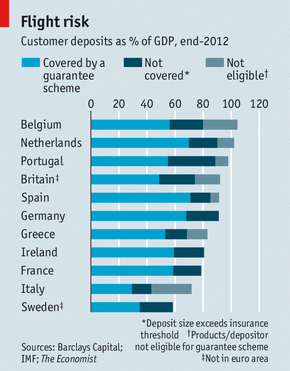
PENNY-PINCHING lovers can always turn to Las Vegas, where wedding-chapel packages start at just a couple of hundred dollars (wedding music included, rose bouquets extra) and annulments are fast and cheap. The architects of the euro zone’s banking union are planning something similarly cut-price. Almost a year ago, as the euro crisis raged, Europe’s leaders boldly pledged a union to break the dangerous link between indebted governments and ailing banking systems, where the troubles of one threatened to pull down the other. Yet the agreement that seems likely to emerge from a summit later this month will be one that does little to weaken this vicious link. If anything it may increase risks to stability instead of reducing them. Almost everyone involved agrees that in theory a banking union ought to have three legs. The first is a single supervisor to write common rules and to enforce them uniformly. Next are the powers to “resolve” failed banks, which is a polite term for deciding who takes a hit; these powers also require a pot of money (or at least a promise to pay) to clean up the mess left by bust lenders and to inject capital into those that can get back on their feet. The third leg is a credible euro-wide guarantee on deposits to reassure savers that a euro in an Italian or Spanish bank is just as safe as one in a German or Dutch bank. National insurance schemes offer scant reassurance to savers when sovereigns are wobbly and insured deposits make up a big chunk of annual GDP (see chart). Read more of this post

A Bond Market Plunge That Baffles the Experts

June 7, 2013

A Bond Market Plunge That Baffles the Experts

By JAMES B. STEWART

Bond Turmoil

As if it wasn’t bad enough for the millions of Americans scraping by on paltry interest payments, now they face another threat: the loss of principal on their bonds and other fixed-income assets.

The month of May, and this first week of June, were terrible for many fixed-income investors who have spent the last few years reaching for higher yields.

If there was an index for fixed income with the status of the Dow Jones industrial average or Standard & Poor’s 500 index for stocks, the carnage in fixed-income markets would have been a big story and we’d all be talking about a bear market in bonds. Read more of this post

Dundee Shows REIT No Haven as Bond Yields Rise

Dundee Shows REIT No Haven as Bond Yields Rise

Dundee Real Estate Investment Trust (D-U) and Calloway REIT (CWT-U) are bearing the brunt of a rout among real estate, utility and telecommunications shares as rising bond yields reduce demand for high-dividend stocks.

Dundee and Calloway are the two worst-performing REITs this year through yesterday among 14 stocks in the Standard & Poor’s/TSX Capped REIT Index. The index has slid 8.5 percent since reaching a record high on April 30, three days before a stronger-than-expected U.S. jobs report sparked a rise in bond yields and speculation the Federal Reserve may begin to slow monetary stimulus. The index dropped seven straight days through June 5, the longest skid in three years. Read more of this post

How America Lost Its Way; It is getting ever harder to do business in the United States, argues Niall Ferguson, and more stimulus won’t help: Our institutions need fixing

June 7, 2013, 7:02 p.m. ET

How America Lost Its Way

It is getting ever harder to do business in the United States, argues Niall Ferguson, and more stimulus won’t help: Our institutions need fixing.

The decline of America’s institutions, and the related rise in red tape that hinders business, may spell the nation’s economic doom. Harvard’s Niall Ferguson talks to WSJ’s Charles Forelle about the theory outlined in his new book “The Great Degeneration.”

By NIALL FERGUSON

Not everyone is an entrepreneur. Still, everyone should try—if only once—to start a business. After all, it is small and medium enterprises that are the key to job creation. There is also something uniquely educational about sitting at the desk where the buck stops, in a dreary office you’ve just rented, working day and night with a handful of employees just to break even.

As an academic, I’m just an amateur capitalist. Still, over the past 15 years I’ve started small ventures in both the U.S. and the U.K. In the process I’ve learned something surprising: It’s much easier to do in the U.K. There seemed to be much more regulation in the U.S., not least the headache of sorting out health insurance for my few employees. And there were certainly more billable hours from lawyers. Read more of this post

Currency-focused hedge funds performed poorly, hurt by volatile dollar

June 7, 2013, 3:35 p.m. ET

Hedge Funds Hurt by Volatile Dollar

By MATTHEW WALTER and CLARE CONNAGHAN

Currency-focused hedge funds performed poorly as the dollar swung back and forth in May and even worse during the greenback’s fall this past week, according to a widely watched barometer of these investors’ returns.

The Parker Global Currency Managers Index, which tracks the performance of 17 funds in which Parker Global Strategies LLC invests, fell 0.58% last month, according to a preliminary figure provided by the company. Read more of this post

Golden Parachutes of $100 Million for Fired CEOs Outlive Outrage

Golden Parachutes of $100 Million for Fired CEOs Outlive Outrage

Corporate governance advocates and shareholder activists have long complained that chief executive officer pay, which has jumped by a third since 2007, is sometimes way out of line with the CEO’s on-the-job performance.

Severance packages for executives fired by their boards are often far bigger than those corner-office salaries. At least a dozen executives of companies in the Standard & Poor’s 500 Stock Index (SPX) stand to receive more than $100 million if they’re dismissed, according to a Bloomberg review of proxy data.

The potential payouts show that golden parachutes live on – – even after the uproar over Jack Welch’s $417 million farewell kiss from General Electric Co. more than a decade ago. At the top of the list compiled by Bloomberg are three executives who each would receive almost a quarter of a billion dollars or more if they were sent packing: McKesson Corp. (MCK) CEO John Hammergren, eligible for $303.4 million; CBS Corp. (CBS) chief Les Moonves, with $251.4 million; and Discovery Communications Inc. (DISCA)’s David Zaslav, with $224.7 million. Read more of this post