China Penalizes (Only) Two Brokerages in Crackdown on IPO Fraud

China Penalizes Two Brokerages in Crackdown on IPO Fraud

China’s securities regulator punished two brokerages for violating the country’s securities rules and banned four bankers from the industry for life as it steps up a crackdown on fraud in initial public offerings.

The China Securities Regulatory Commission plans to fine Minsheng Securities Co. 2 million yuan ($326,024) for failed due diligence in Shanxi Tianneng Technology Co.’s bid to list shares in 2011 and confiscate the 1 million yuan fee it earned from the deal, the agency said on its website today. Nanjing Securities Co. will be given a warning for a similar offense committed when it advised Guangdong Xindadi Biotechnology Co. in 2012, the CSRC said. The agency said both IPOs were pulled after reports of fraud were published by unidentified media. Read more of this post

Shenzhen banks suspend financing amid dodgy trade figures

Shenzhen banks suspend financing amid dodgy trade figures

Staff Reporter

2013-06-01

An unusual amount of speculative capital has flooded into Shenzhen of late, with speculators using false trade to conduct heavy cross-border arbitrages, thus forcing the renminbi to repeatedly hit new highs against the dollar and confounding the true figures of China’s imports and exports. The Shenzhen city government has therefore announced a new policy to suspend trade financing by partial banks, our affiliate Commercial Times reports.

The move has triggered plenty of complaints, however, especially from banks and foreign traders who say suspending financing will cause genuine import/export businesses to find it difficult to secure credit. Read more of this post

Artificial kidneys are getting closer to becoming a clinical reality, thanks to a range of advances

Medical technology: Artificial kidneys are getting closer to becoming a clinical reality, thanks to a range of advances

Jun 1st 2013 |From the print edition

AN ARTIFICIAL kidney these days still means a refrigerator-sized dialysis machine. Such devices mimic the way real kidneys cleanse blood and eject impurities and surplus water as urine. But they are nothing like as efficient, and can cause bleeding, clotting and infection—not to mention inconvenience for patients, who typically need to be hooked up to one three times a week for hours at a time. Still, for 2m people around the world who suffer from chronic kidney failure, dialysis is the best option—unless they qualify for one of the 76,000 or so kidney transplants performed each year. Even those lucky few endure a lifetime on drugs to stop their bodies rejecting the foreign tissue.

A world in which new kidneys are grown using a patient’s own cells remains some way off. In the meantime, human patients are likely to be offered tiny versions of the dialysis machine. None is available yet, but last year America’s Food and Drug Administration (FDA) picked a couple of candidates to participate in a fast-track process called Innovation Pathway 2.0, which aims to bring promising medical gizmos to market more promptly. Read more of this post

A new technique aims to prevent blood loss and save lives by using a rapidly expanding foam

A new technique aims to prevent blood loss and save lives by using a rapidly expanding foam

Jun 1st 2013 |From the print edition

ON OBSERVING that most injured soldiers died before receiving medical attention, Dominique-Jean Larrey, a young surgeon in Napoleon’s army, proposed installing surgical teams near the front lines. Horse-drawn carriages would whisk the wounded from the battlefield to the closest field hospital, dramatically reducing casualties. Today the whisking is done by helicopter or ambulance and the treatment on arrival is incomparably better.

But whereas clever bandages help deal with external injuries, little progress has been made in helping soldiers with innards ravaged by bullets or shrapnel survive the trip to the operating table. Upma Sharma and her colleagues at Arsenal Medical, a start-up based in Massachusetts, hope to change that. They are developing a way to help a field medic stanch blood loss from punctured organs. Read more of this post

Zapping mosquitoes, and corruption: Technology and government: How the clever use of mobile phones is helping to improve government services in Pakistan

Zapping mosquitoes, and corruption: Technology and government: How the clever use of mobile phones is helping to improve government services in Pakistan

Jun 1st 2013 |From the print edition

LIVE in a crowded South Asian city and a host of problems—smog, contagious disease, corruption—may plague you. Each winter, the air grows foul. The monsoon season brings mosquitoes, bloodsuckers capable of carrying nasties such as dengue and malaria. As cities expand and people are packed closer, they are more likely to pass on infections. Overwhelmed municipalities, especially if weakened by corruption, offer a weak response. In Lahore, Pakistan’s second-most populous city, there were 21,292 confirmed dengue patients in 2011, a particularly dire year. At least 350 of them died, victims of associated haemorrhages or shock.

The usual response is to send out fogging lorries to spray a choking mixture of insecticide (such as DDT) and kerosene to kill mosquitoes. Public officials also advise residents to drain every reservoir of water near their homes. Mosquito larvae flourish in puddles, even inside old tyres or old flower pots. But foggers sometimes spread their helpful poison too liberally, where no dengue-infected mosquitoes are present, or too rarely, perhaps neglecting poor neighbourhoods. Municipal workers skip puddle-hunting, or fail to tip chemicals into ponds to kill the larvae. Crooked workers sell their insecticides or refuse to spray without bribes from residents. Read more of this post

Desalination: A useful application may have been found for graphene: improving access to fresh water in the developing world

Desalination: A useful application may have been found for graphene: improving access to fresh water in the developing world

Jun 1st 2013 |From the print edition

ALLOTROPES of carbon—varying forms of the element in which the atoms are stuck together in different patterns—have a mixed record of practical use. Diamonds, famously, are a girl’s best friend. Graphite makes good pencil lead. But buckminsterfullerene, in which the atoms are arranged like the geodesic domes beloved of the eponymous American architect, though hailed as a wonder material, proved largely useless.

Graphene, which looks like atomic-scale chicken-wire, may be in the useful camp. At room temperature, it is the best conductor of heat yet found. It is being developed as a photoreceptor, to convert light into electricity. And now two groups of engineers, one at Lockheed Martin, an American aerospace company, the other at the Massachusetts Institute of Technology (MIT), are trying to use it to desalinate water. That could change the world. Read more of this post

Teaching old microphones new tricks with sensor technology: Microphones are designed to capture sound. But they turn out to be able to capture other sorts of information, too

Microphones as sensors

Teaching old microphones new tricks

Sensor technology: Microphones are designed to capture sound. But they turn out to be able to capture other sorts of information, too

Jun 1st 2013 |From the print edition

20130601_TQD005_0

MICROPHONES exist in many shapes and sizes, and work in many different ways. In the late 19th century, early telephones relied on carbon microphones, pioneered by Thomas Edison; today’s smartphones contain tiny microphones based on micro-electro-mechanical systems, commonly called MEMS. Specialist microphones abound in recording studios; others are used by spies. But whatever the technology, these microphones all do the same thing: they convert sound waves into an electrical signal.

It turns out, however, that with the addition of suitable software, microphones can detect more than mere audio signals. They can act as versatile sensors, capable of tuning into signals from inside the body, assessing the social environment and even tracking people’s posture and gestures. Researchers have reimagined microphones as multi-talented collectors of information. And because they are built into smartphones that can be taken anywhere, and can acquire new abilities simply by downloading an app, they are being put to a range of unusual and beneficial uses. Read more of this post

Concrete, heal thyself! Civil engineering: A building material that can perform running repairs on itself, fixing small cracks and holes, is on the horizon

Concrete, heal thyself! Civil engineering: A building material that can perform running repairs on itself, fixing small cracks and holes, is on the horizon

Jun 1st 2013 |From the print edition

IT IS useful stuff, concrete, but it does have drawbacks. One of the biggest is that it is not as weatherproof as the stone it often substitutes for. Salt and ice routinely turn microscopic fractures in its fabric into gaping holes. These let water soak in. That, in time, can cause the structure to fail. The upshot is that concrete needs constant repair by teams of workmen assigned to fill in the newly formed gaps, which is tedious and expensive. It would be better if the stuff could heal such damage by itself. And that, as he reports in Applied Materials & Interfaces, is exactly what Chan-Moon Chung of Yonsei University in South Korea hopes to get it to do.

Self-healing concrete is not a new idea. In 2009 a team at the Delft University of Technology in the Netherlands showed that it is possible to mix special bacteria, which release crack-sealing chemicals, into concrete before it is poured. These bacteria do, indeed, keep the concrete healthy—but only while they are alive. Experience shows that they last for no more than a year or so. Read more of this post

“Talent exchanges” on the web are starting to transform the world of work

Online labour exchanges

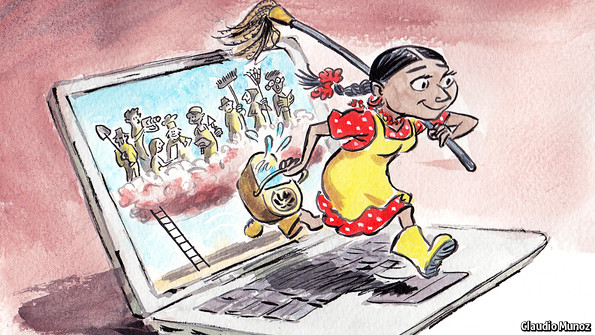
The workforce in the cloud

“Talent exchanges” on the web are starting to transform the world of work

Jun 1st 2013 | REDWOOD CITY, CALIFORNIA |From the print edition

20130601_WBD001

FOR translating a 22-minute video from English into Spanish at short notice, 7Brands Global Content, a professional-translation firm based in New York, quoted “approximately $1,500”. This fee seems in line with the local going rate for the job from a firm which boasts membership of three professional associations and clients such as Chase and Bank of America. Not so long ago, paying the local rate was the only option. Today anyone seeking to get this sort of job done is only a click away from the whole world of professionals competing to do it far cheaper. Read more of this post

For Wearable Computers, Future Looks Blurry

May 30, 2013, 7:29 p.m. ET

For Wearable Computers, Future Looks Blurry

At the D11 Confab, the Silicon Valley Elite Debate Google Glass’s Mainstream Appeal

By EVELYN M. RUSLI

RANCHO PALOS VERDES, Calif.—If you haven’t heard, the future is wearable computing. But how that future—seen through Google GOOG +0.05% Glass specs—will go mainstream is still out of focus.

At the D11: All Things Digital conference here, the tech elite buzzed about the promise of microcomputers that attach onto humans. They opined not just about fitness-tracking bands, which are already becoming ubiquitous, but also about multipurpose mobile gadgets that we can strap onto our wrists, heads or other body parts.

Tim Cook, CEO of Apple Inc., AAPL -0.41% which is reported to be working on a watch-like device, said wearable computers will likely be “another key branch” of the Apple tree. But in reference to competitor Google Inc.’s Glass headgear, Mr. Cook said high-tech eyeglasses would be “difficult” to pull off as a mainstream product. On stage, he wore a Nike+ FuelBand bracelet that tracks physical activity. Read more of this post

Killer cloud: report says Amazon Web Services threatens all IT incumbents

Killer cloud: report says Amazon Web Services threatens all IT incumbents

By Barb Darrow | GigaOM.com, Published: May 31

Amazon Web Services faces growing competition from a dozen or more legacy name-brand IT giants. But instead of taking a hit, it poses a bigger-than-ever threat to the those vendors — all of which are building their own competitive clouds, according to new Morgan Stanley research.

Oh, and the researchers project that AWS will hit $24 billion in revenue by 2022. Amazon doesn’t break out AWS revenue, but most pundits figure it passed the $2 billion-a-year mark about a year ago.

The fact that AWS has a huge lead in cloud over the rest of the world is not news to anyone who’s been watching, but these projections could be a wakeup call to investors who think tech incumbents — companies like IBM, Microsoft, HP, VMware, Red Hat, as well as every telco and hosting provider — can challenge Amazon in cloud computing.

“Applying retail economics to the delivery of technology services well positions Amazon Web Services [to be] a Top 5 vendor within the $152 TAM [total addressable market], ” according to Morgan Stanley analysts Scott Devitt, Keith Weiss and team. Read more of this post

Bumi Says $201 Million Missing After Review of Berau Finances

Bumi Says $201 Million Missing After Review of Berau Finances

Bumi Plc (BUMI), the coal producer at the center of an ownership dispute between its founders, said a review of spending at one of its two Indonesian units found $201 million of outlays with “no clear business purpose.”

In addition to the $152 million determined to be missing from PT Berau Coal Energy’s finances in 2012, $49 million was identified for the 2011, Bumi said in a statement. The Berau Coal review delayed Bumi’s results by more than two months. It today reported a net loss of $2.3 billion for 2012, compared with the year-earlier loss of $337 million after booking charges of $2.2 billion on its Indonesian coal businesses.

Bumi has been at the center of a battle for control between co-founders Nathaniel Rothschild and Indonesia’s Bakrie family since the $3 billion deal that brought them together started to sour in late 2011. Trading in the stock will remain suspended while the company “continues to enhance its internal systems and controls,” it said today.

Bumi took an impairment charge of $815 million on the Berau assets. PT Bumi Resources, in which Bumi Plc holds a 29 percent stake, posted a net loss of $666.2 million for 2012 as lower coal prices hurt sales at Indonesia’s biggest coal producer. Bumi took a non-cash charge of $1.4 billion on the value of its equity stake in Bumi Resources, it said today. Read more of this post

Frustration Mounts as Brazil’s Real Tumbles

Updated May 31, 2013, 3:56 p.m. ET

Frustration Mounts as Brazil’s Real Tumbles

By PAULO WINTERSTEIN

SÃO PAULO—Brazil’s currency tumbled to a four-year low Friday, underscoring investors’ frustration with the world’s sixth-largest economy.

The real dropped as low as 2.1443 reais per dollar, its weakest since May 2009, while stocks slipped to a six-week low. Friday’s selloff capped a week that saw Brazilian markets battered by mounting evidence that a hoped-for economic recovery isn’t materializing, as well as an interest-rate increase that threatens to further reduce growth.

With the economy slowing, inflation pressures rising and the country’s fiscal situation worsening, policy makers are running out of options to steady what was once South America’s rising star. Read more of this post

US bond investors wake up to QE withdrawal

Last updated: May 31, 2013 9:54 pm

US bond investors wake up to QE withdrawal

By Ralph Atkins in London and Michael MacKenzie in New York

What is the difference between 1.6 per cent and 2.2 per cent? Either: not much, or a potentially explosive shift in the way global investors view the world that presages turbulent market conditions ahead.

Yields on US government debt, which move inversely to prices, have surged during May and peaked this week, leaving holders nursing their worst monthly loss since December 2010. Ten-year Treasury yields hit 2.23 per cent on Wednesday, up from 1.61 per cent at the start of May, and were back to 2.20 per cent in volatile Friday trading. Read more of this post

A New Twist in Monetary Policy: Divergence Between Emerging and Developed Markets; Emerging markets are cutting interest rates in response to disinflation and slowing growth while investors speculate on an early exit, or taper, by the Fed

A New Twist in Monetary Policy: Divergence Between Emerging and Developed Markets

31 MAY 2013 – TOM BUERKLE

For the past five years, policymakers in emerging-markets countries have criticized their U.S. counterparts, arguing that the Federal Reserve Board’s zero interest rates and quantitative easing have flooded the world with cheap money, pushed up asset prices and fanned inflationary pressures in their economies. Japan’s recent entry into the QE club merely generated more such complaints.

Behind that chatter, however, a significant shift is taking place. Advanced economies and emerging markets remain out of sync, but with a twist: While investors are increasingly speculating that the Federal Reserve Board will begin exiting or tapering its easy-money policies sooner than expected this year in response to stronger growth, emerging markets have been cutting rates lately in the wake of a slowdown in growth and waning inflation pressures. Many analysts and investors believe this new trend has plenty of room to run. Read more of this post