99% of the plastic we throw in the ocean has mysteriously disappeared

99% of the plastic we throw in the ocean has mysteriously disappeared

By Gwynn Guilford @sinoceros an hour ago

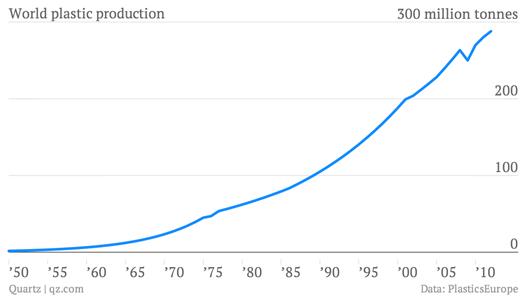
Though plastic was invented in the 1800s, it was really only around 1950 that the human-plastic love affair took off. And boy did it—the nearly 2 million tonnes (2.2 million tons) of plastic produced in 1950 had surged twentyfold in just two decades (by around the time a young Dustin Hoffman was advised to consider a future in plastics in The Graduate) (video).

image001 Read more of this post

“The irony of Sarbanes-Oxley was that it was intended to prevent more Enrons and Worldcoms but it ended up being a gigantic tax on small companies.”

‘The Sarbane-Oxley Act has ironically made the stock market less attractive instead of a safe haven for the average investor.’ 

Gone are the days where companies are going public with cheap valuations. This article from AVC.com rightly states that following the regulatory acts, companies such as Facebook and Twitter would choose to wait for themselves to be worth multi-billions, before engaging in public offerings. Unlike that of the past, where we saw Microsoft, IBM and Apple with cheap valuations, companies such as Dropbox are moving towards private financing, with amounts as large as $10 billion.

Such a trend is definitely not healthy, and would definitely affect the options value investors would have in the market should it continue. Read the original article at http://avc.com/2014/06/the-law-of-unintended-consequences/

What Makes People Generous: Charity, Empathy, And Storytelling

Tom WatsonContributor

ENTREPRENEURS 6/30/2014 @ 3:33PM 618 views

What Makes People Generous: Charity, Empathy, And Storytelling

Two weeks ago, the annual Giving USA report showed that American philanthropycontinues to climb out of the trough of the Great Recession, one of the real lagging indicators of the economy. And while U.S. philanthropy has been roughly static at two percent of GDP for a couple of generations now, overall capacity of donors remains high, even through downturns.

The challenge for causes, fundraisers, nonprofit executives, social entrepreneurs and concerned board members everywhere remains “how?” – how best to tap that steady vein of generosity in this society which, even if fairly flat, remains constant and deep.

A couple of reports that crossed my desk over the past few weeks provide some new insight, and should be of interesting to folks in the philanthropic sector.

One  is called I’m Moral, But I Won’t Help You: The Distinct Roles of Empathy and Justice in Donations, and it focuses on the results of an academic study of 600 people run through four different charitable scenarios. In one, for example, participants were asked to choose “between donating to medical patients described alternately as having a low level of responsibility for their situations and those having a high level of responsibility.” Recipients of donations in the group were described either as unable to pay for medical treatment because of “low-wage jobs with poor benefits due to economic conditions” or unable to pay for treatment because of inability “to hold a steady job due to their drug and alcohol abuse or gambling addiction” – in shorter terms, not their fault and their fault.

Read more at

http://www.forbes.com/sites/tomwatson/2014/06/30/what-makes-people-generous-charity-empathy-and-story-telling/print/


The Right to Write: Who owns a story, the person who lives it or the person who writes it?

By ROXANA ROBINSON

JUNE 28, 2014 2:39 PM 47 Comments

I sat on a panel once with another novelist and a distinguished African-American critic, to discuss Harriet Beecher Stowe’s novel “Uncle Tom’s Cabin.” The critic said, “Of course, as a white woman, Stowe had no right to write the black experience.” The other novelist said lightly, “No, of course not. And I had no right to write about 14th-century Scandinavians. Which I did.”

The exchange made me wonder: who has the right to our stories?

For centuries, African-Americans couldn’t fully participate in the literary conversation, since for many of them literacy was forbidden. Why wouldn’t they resent the fact that their stories were told by whites? But does this mean that, as novelists, we can write stories only of our own race, our own gender, our own subcultural niche?

Stowe used other people’s stories as sources, but what drove her to write was her own outraged response to slavery. She has the right to that response. Isn’t it better that Stowe wrote her book, instead of staying respectfully mute because the stories were not hers to tell? It was the narrative strands about the black experience that gave the book such emotional potency, and made it such a powerful abolitionist force.

Who owns the story, the person who lives it or the person who writes it?

Read more at http://opinionator.blogs.nytimes.com/2014/06/28/the-right-to-write/?ref=opinion

How We Transformed Marketing at Electrolux

How We Transformed Marketing at Electrolux

by MaryKay Kopf and Fred Geyer  |   11:00 AM June 30, 2014

Marketers are racing to create seamless customer experiences that make it easy for consumers to engage at every touchpoint as they navigate the “decision journey” and beyond. Despite this revolution, leading appliance makers have been slow to adapt to the ways people learn about and purchase appliances. Electrolux was no exception – until recently.

Many consumers think of us as a vacuum cleaner company – and indeed our first product, in 1919, was a vacuum. But today we’re a $15 billion global consumer and professional appliance firm that includes Frigidaire, AEG, Molteni, Electrolux, Zanussi, and Eureka among its brands. As we were a product-centric organization, the shopping experience had played a supporting role, with individual elements of the experience managed by different organizational silos. When online emerged it became a new silo, followed by mobile and social. The organization was locked in a structure that made it difficult to connect and integrate all the different ways that a person gathers information, makes a decision and receives support — online and offline. In 2012, Electrolux leadership decided this had to change.

Read more at http://blogs.hbr.org/2014/06/how-we-transformed-marketing-at-electrolux/

Morning Bamboo Insight: 02/07/2014

Daily Bamboo Insight

Macro

1. ECB Must Embrace Role as Zombie Killer; Low Interest Rates Encourage Banks to Paper Over Unrecognized Losses, Says the Bank for International Settlements

http://online.wsj.com/articles/ecb-must-embrace-role-as-zombie-killer-1404204219?mod=Markets_newsreel_2

2. In a recent paper titled “Banks As Secret Keepers,” four economists argue that banks are necessarily opaque institutions, concealing their portfolios and concentrating on hard-to-value assets

http://online.wsj.com/articles/heard-on-the-street-bank-secrets-can-do-investors-a-service-1404142241

3. With Markets at Peaks, Some Say Air Feels Thin; Global Junk-Bond Sales Hit a High in the First Half, but Some Investors Are Wary: ‘This Is a Time for Caution’

http://online.wsj.com/articles/with-debt-yields-low-firms-dash-for-cash-1404158180

http://online.wsj.com/articles/with-markets-at-peaks-some-say-air-feels-thin-1404167926

4. Where in the World is the Kuwait Investment Authority? On the trail of the world’s oldest-and most elusive-sovereign wealth fund.

http://ai-cio.com/print.aspx?id=2147489062

Asia Pacific

1. Steer Clear of China’s Aluminum Crush

http://online.wsj.com/articles/heard-on-the-street-steer-clear-of-chinas-aluminum-crush-1404205417?tesla=y&mg=reno64-wsj&url=http://online.wsj.com/article/SB10001424052702304344504580002491074538712.html

2. India’s Auditor Suggests Canceling Reliance Jio’s Licenses; Government Report Cites Irregularities in How the Company Acquired the Licenses

http://online.wsj.com/articles/india-auditor-suggests-revoking-some-reliance-jio-licenses-1404143573

3. Thailand’s Divided Military; Gen. Prem Tinsulanonda’s arch-royalist faction may control the top posts, but most soldiers support former Prime Minister Thaksin

http://online.wsj.com/articles/thailands-divided-military-1404148174

4. Kathmandu founder Jan Cameron’s retail empire collapses again; Cameron’s private company DSG, which operates more than 140 Crazy Clarks and Sams Warehouse discount variety stores, has gone into receivership

http://www.brw.com.au/p/entrepreneurs/kathmandu_founder_jan_cameron_retail_1kxvqwwnSFwwta84vYXvMO

5. Modi pitches India’s frugal space prowess at rocket launch

http://www.reuters.com/article/2014/06/30/us-india-space-idUSKBN0F51ES20140630?feedType=nl&feedName=usmorningdigest

6. Macau gambling revenue sees first decline in over 4 years

http://www.thestar.com.my/Business/Business-News/2014/07/01/Macau-gambling-revenue-sees-first-decline-in-over-4-years/

7. Australia’s dependence on China commodity appetite increases

http://www.thestar.com.my/Business/Business-News/2014/06/30/Australia-dependence-on-China-commodity-appetite-increases/

8. China general’s ousting tightens Xi’s grip on military; “One of the things that Deng commanded was, ‘We either get the PLA out of business, or you get out of the PLA’,” he said of the order to businessman officers

http://www.channelnewsasia.com/news/asiapacific/china-general-s-ousting/1226340.html#

9. 600,000 Chinese Die Each Year From Working Too Hard

http://www.zerohedge.com/news/2014-06-30/600000-chinese-die-each-year-working-too-hard

10. What Psy’s ‘Hangover’ Doesn’t Say About Korea’s Drinking Culture

http://blogs.wsj.com/korearealtime/2014/07/01/what-psys-hangover-doesnt-say-about-koreas-drinking-culture/

Life

1. World Cup: Jurgen Klinsmann’s Yoda; Menotti’s central belief is that the key to victory isn’t defensive organization or keeping hold of the ball, but trying to score as many goals inside 90 minutes as humanly possible

http://online.wsj.com/articles/world-cup-jurgen-klinsmanns-yoda-1404165139

2. The Evolution of Trust; The evolution to more frugal, deinstitutionalized living that has created the sharing economy may also lead to less involvement of government in everyday life

http://www.nytimes.com/2014/07/01/opinion/david-brooks-the-evolution-of-trust.html?emc=edit_th_20140701&nl=todaysheadlines&nlid=36114517&_r=0

TMT

1. Tencent’s Online Shopping Doesn’t Come Cheap; Company Spends $736 Million for 20% of 58.com

http://online.wsj.com/articles/heard-on-the-street-tencents-online-shopping-doesnt-come-cheap-1404128933

2. When Big Data Isn’t an Option; Companies that only have access to “little data” can still use that information to improve their business

http://www.strategy-business.com/article/00250?gko=6a94d&cid=20140701enews&utm_campaign=20140701enews

3. The Incredible Shrinking Tech Spending Projections

http://bits.blogs.nytimes.com/2014/07/01/the-incredible-shrinking-tech-spending-projections/?ref=technology

4. With Software Eating Hardware, Silicon Valley Enters “Hard” Times

http://techcrunch.com/2014/06/30/with-software-eating-hardware-silicon-valley-enters-hard-times/

Health

1. New Weapon in Fight Against ‘Superbugs’; A soil sample from a national park in eastern Canada has produced a compound that appears to reverse antibiotic resistance in dangerous bacteria

http://online.wsj.com/articles/new-weapon-in-fight-against-superbugs-1404175658?mod=WSJ_hpp_MIDDLENexttoWhatsNewsFifth

Consumer

1. Grocery manufacturers are struggling to adapt to the online world and need to invest in smarter packaging, presentation and supply chains to reap the long term benefits

http://www.reuters.com/article/2014/07/01/us-food-digital-idUSKBN0F636N20140701?feedType=nl&feedName=usmorningdigest

2. “When Esprit went public in 1998 they said ‘we want to buy your business and fold it into Esprit’; “When multinational companies buy small privately-owned entrepreneurial businesses they often lose their soul”

http://www.theage.com.au/small-business/startup/red-earth-ring-any-bells-its-back-20140624-3aq84.html?eid=email:nnn-13omn620-ret_newsl-membereng:nnn-04/11/2013-small_business-dom-business-nnn-age-u&campaign_code=13IBU007&promote_channel=edmail&mbnr=NDEzOTI1Mg

3. Nestlé U.S. Chief Looks for Brands to Fix or Toss; Number of Product Variations Is Slashed, Lean Cuisine Gets a Makeover

http://online.wsj.com/articles/nestle-u-s-chief-looks-for-brands-to-fix-or-toss-1404172061

Investing Process

1. Banks as Secret Keepers

Tri Vi Danag 

Columbia Business School – Finance and Economics

Gary B. Gorton 

Yale School of Management; National Bureau of Economic Research (NBER)

Bengt R. Holmström 

Massachusetts Institute of Technology (MIT) – Department of Economics; National Bureau of Economic Research (NBER); European Corporate Governance Institute (ECGI)

Guillermo L. Ordoñez 

University of Pennsylvania – Department of Economics; National Bureau of Economic Research (NBER)
June 2014
NBER Working Paper No. w20255

Abstract:      
Banks are optimally opaque institutions. They produce debt for use as a transaction medium (bank money), which requires that information about the backing assets – loans – not be revealed, so that bank money does not fluctuate in value, reducing the efficiency of trade. This need for opacity conflicts with the production of information about investment projects, needed for allocative efficiency. Intermediaries exist to hide such information, so banks select portfolios of information-insensitive assets. For the economy as a whole, firms endogenously separate into bank finance and capital market/stock market finance depending on the cost of producing information about their projects.
 

Tide turning against buybacks ahead of the market top

FT reports that there has been a change in corporate buyback behaviors, as companies prefer not to deploy their cash to buy back their stocks. While traditionally, companies that engage in buyback behaviors are often rewarded during post-crisis rally, it has been reported that TrimTabs, the US research group, shows that money spent on buying back stock in each of the last two months has been the lowest since January 2013.

And one possible reason is that companies fear that their own company’s stocks may be overvalued. This comes at a time when there are more new offerings in the market, with notable ones being GoPro’s IPO in recent weeks. This begs the question, how long more would the equity rally continue?

Read more at http://www.ft.com/intl/cms/s/0/da7af7d6-fe16-11e3-acf8-00144feab7de.html#axzz36CcgBUKt

Daily Bamboo Insight: 01/07/2014

Daily Bamboo Insight

Macro 

1. Secrecy of Dark Pools Can Blur Both Ways; what seems to have escaped notice is that a lack of transparency is almost sure to invite abuses

http://dealbook.nytimes.com/2014/06/30/secrecy-of-dark-pools-can-blur-both-ways/?_php=true&_type=blogs&emc=edit_dlbkpm_20140630&nl=business&nlid=36114517&_r=0

2. Hedge funds’ correlation with the equity market has risen back to pre-financial crisis highs, raising fears that the $2.7tn industry could again suffer sharp losses in the event of a market slide

http://www.ft.com/intl/cms/s/0/b5ad4370-fde7-11e3-acf8-00144feab7de.html#axzz36A4WnU9X

3. FASB Turning Back Clock on Global Accounting, IASB Leader Says

http://ww2.cfo.com/gaap-ifrs/2014/06/fasb-turning-back-clock-global-accounting-iasb-leader-says/?utm_campaign=CFOWeekly&utm_source=CFO-email&utm_medium=email&utm_content=CFOWeekly_Friday_2014-6-27&utm_term=the-economy

4. Soros Dabbles in Shareholder Activism

http://dealbook.nytimes.com/2014/06/27/soros-dabbles-in-shareholder-activism/?emc=edit_dlbkam_20140630&nl=business&nlid=36114517


Life

1. Warning, high voltage: scientists solve mysteries of electric fish http://www.reuters.com/article/2014/06/26/us-science-fish-idUSKBN0F12UW20140626

2. Passion for Reality: The Extraordinary Life of the Investing Pioneer Paul Cabot

http://www.amazon.com/gp/product/0231167466?ie=UTF8&camp=1789&creativeASIN=0231167466&linkCode=xm2&tag=moi0e-20

3. Sleep as a Competitive Advantage

http://dealbook.nytimes.com/2014/06/27/sleep-as-a-competitive-advantage/?emc=edit_dlbkam_20140630&nl=business&nlid=36114517


Energy

1. Following long ban, U.S. could dominate global light oil supply

http://www.reuters.com/article/2014/06/30/us-oil-exports-u-s-idUSKBN0F50B320140630?feedType=RSS&feedName=businessNews