Deutsche Bank “horribly undercapitalized”: U.S. regulator

Deutsche Bank “horribly undercapitalized”: U.S. regulator

3:26am IST

By Emily Stephenson and Douwe Miedema

WASHINGTON (Reuters) – A top U.S. banking regulator called Deutsche Bank’s (DBKGn.DE:QuoteProfileResearch) capital levels “horrible” and said it is the worst on a list of global banks based on one measurement of leverage ratios.

“It’s horrible, I mean they’re horribly undercapitalized,” said Federal Deposit Insurance Corp Vice Chairman Thomas Hoenig in an interview. “They have no margin of error.”

Hoenig, who is second-in-command at the regulator, said global capital rules, known as the Basel III accord, allow lenders to appear well-capitalized when they are not. That is because the rules allow the banks to use complicated measurements of how risky their loans are to determine the capital they must hold, he said. Read more of this post

Bill Gross: Which way for bonds? Mapping a path forward

June 2013

Which way for bonds? Mapping a path forward

William H. Gross

Q: Can you explain what is happening in markets now?
Gross: In 1980, the Federal Reserve, led by Paul Volcker, tightened the quantitative noose to tame double-digit inflation, fueling an unprecedented tailwind for bond prices. Thirty years later we find ourselves at the other extreme, as central banks print money in the trillions of dollars to stimulate economic growth, and inflation is abnormally low. While we are not likely to see a repeat of that type of bull market any time soon, we also do not believe we are at the beginning of a bear market for bonds. Rather, what we’re seeing is the continuation – and acceleration, in some respects – of the de-levering process, a key distinction that may be getting lost in some of the noise over the past few weeks. The Fed, the Bank of England, and now the Bank of Japan have all committed to holding their easing stance until growth targets are hit. We don’t see the Fed raising rates in a meaningful way for at least the next few years.
That said, we believe caution is warranted not just for fixed income investors, but for investors in all risk assets. Central banks have reached a critical inflection point in which the negatives of their aggressive policies may be outweighing the positives and in fact hampering growth. Where their monetary repression has succeeded, however, is in forcing investors to take increasing amounts of risk, but for lower yields and more volatile returns.

Q: When do you expect the Fed to begin to take its foot off the QE pedal? Are rising rates a concern?
Gross: The Federal Reserve has cited an unemployment rate of 6.5% as its threshold for pulling back on monetary policy. At the same time, Chairman Bernanke wants to avoid the mistake of premature tightening, as occurred disastrously in the 1930s. While we agree with this reasoning, we are concerned by the growing downside of zero-based money and QE policies – among them a worrisome distortion in asset pricing, the misallocation of capital and ultimately a dis-incentivizing of risk taking by corporations and investors. The Fed shares these concerns as well, which is why some members are considering a reduction or tapering of purchases. From a technical perspective, the Fed may also be forced to taper its purchases to match the shrinking U.S. budget deficit. But there’s a difference between a mild reduction and a decision by the Fed to materially scale back its bond purchase program. The economy has yet to achieve escape velocity, and unemployment is still stubbornly high and structural in nature. So while we may see some tapering, possibly by the end of the year, we do not expect the Fed to remove the trough for some time or for this to signal a dramatic increase in rates. Rates will fluctuate over the shorter term, of course, and it’s our job as active managers to effectively position our clients’ portfolio if that occurs. This is something we have done for our investors for decades.
Q: How are you positioning Total Return to navigate this environment?
Gross: While it’s natural to want to reach for higher returns, an investment strategy’s success depends on carefully weighing potential rewards against the long-term costs, using the insights you’ve gathered on the ground and on a macro level through rigorous analysis. Today, given the economic uncertainty and rich market valuations, we think that the fortitude to wait for more attractive opportunities is a valuable attribute. Our goal for the Total Return strategy is to enhance our dry powder, seek prudent alpha and reduce risk – not dramatically, but to average or slightly below-average levels. Fortunately, PIMCO has a wide array of tools at our disposal to accomplish that. So, among other things, we’re avoiding long durations, reducing credit risk away from economically vulnerable companies and sectors, managing volatility and increasing exposure to countries with higher-quality balance sheets such as the U.S., Brazil, Mexico and Australia. And we are seeking out and taking advantage of opportunities in the market. For example, we believe intermediate Treasuries are currently attractively priced at around 2%.

At the forefront, PIMCO’s first and most important objective is preserving our clients’ capital, as it has been since Total Return was launched more than a quarter-century ago. In a market environment such as the one we’re currently navigating, this risk management priority becomes even more essential. In the meantime, we believe our portfolios are well positioned for future opportunities. If “traditional” bond beta is likely to be subdued, as we are forecasting, there are still ways for a resourceful and experienced investment manager to generate alpha from less traditional sectors.

Q: With bond markets so uncertain, what steps can investors  take to ensure they’re prudently pursuing their financial  goals?
Gross: It’s important for investors to remember the reasons they own bonds in the first place – namely for the potential for the preservation of capital, income and growth, relative steadiness and typically low to negative correlations with equities. These needs – which will only become more urgent as millions of baby boomers head to retirement over the next decade and a half – are long term, regardless of what markets are doing today. So fixed income should always have a place in a portfolio. Still, there are ways to navigate challenging markets without feeling stuck. One is to expand your investment universe by going global. Here at PIMCO we like to say that there is no “bond market,” but rather “a market of bonds.” So, you should prize flexibility in your fixed income manager or core bond strategy.

Finally, be patient. Times are challenging, to be sure, but PIMCO has been successfully investing through more than four decades of market and economic cycles, which gives us some perspective, as well as the confidence that we’re going to be around to fight for the next 40 years. We certainly hope our clients take some comfort in that.
Bill Gross: Wounded Heart; Low yields, low carry, future low expected returns have increasingly negative effects on the real economy. Perhaps the beating heart is pumping anemic, even destructively leukemic blood through the system

June 2013

​Wounded Heart

William H. Gross

Joseph Schumpeter, the originator of the phrase “creative destruction,” authored a less well-known corollary at some point in the 1930s. “Profit,” he wrote, “is temporary by nature: It will vanish in the subsequent process of competition and adaptation.” And so it has, certainly at the micro level for which his remark was obviously intended. Once proud, seemingly indestructible capitalistic giants have seen their profits fall short of “everlasting” and exhibited a far more ephemeral character. Kodak, Sears, Barnes & Noble, AOL and countless others have been “competed” to near oblivion by advancing technology, more focused management, or evolving business models that had better ideas more “adaptable” to a new age.  Read more of this post

BOND FUND CARNAGE: Investors Stage An Exodus From Emerging Markets As Equities Suffer Collateral Damage

BOND FUND CARNAGE: Investors Stage An Exodus From Emerging Markets As Equities Suffer Collateral Damage

MATTHEW BOESLER JUN. 14, 2013, 10:31 AM 1,684 2

screen shot 2013-06-14 at 10.27.08 amscreen shot 2013-06-14 at 10.25.14 am

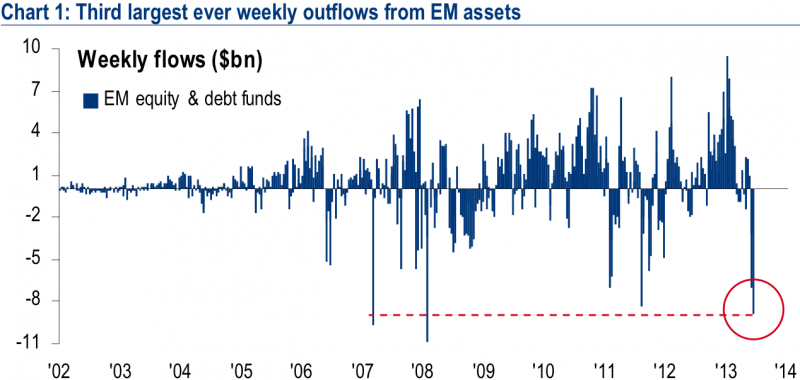
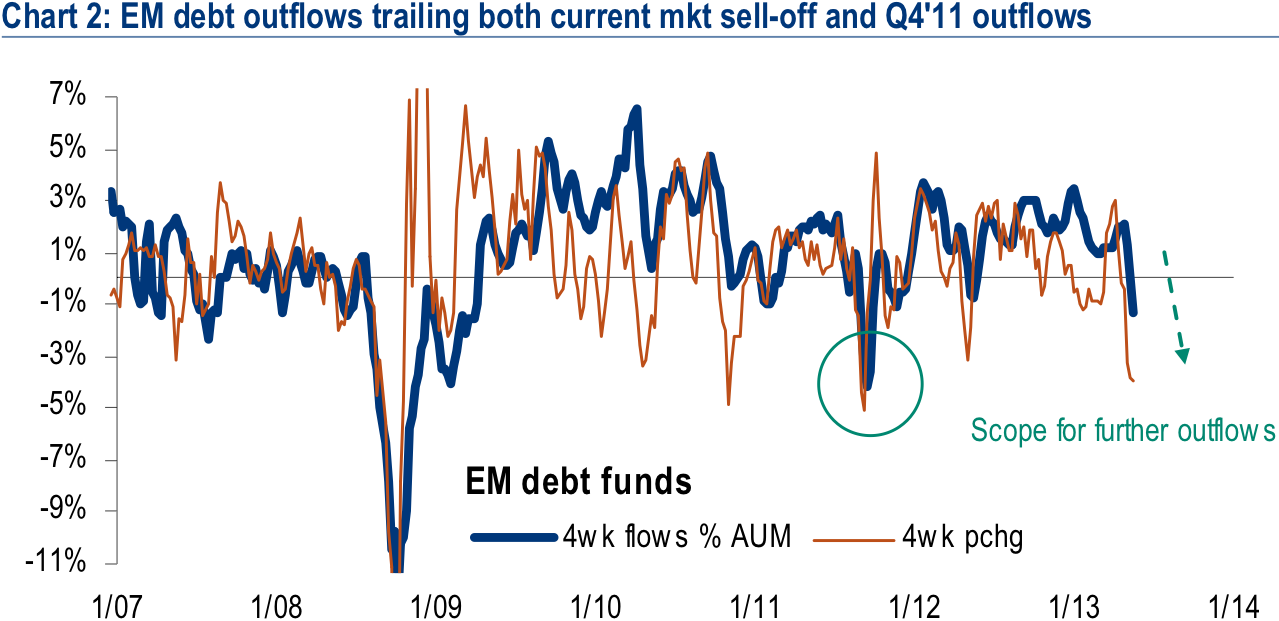
It was another insane week for asset managers. After huge redemptions from bond funds last week – during which investors pulled the most money in a single week from Treasury funds ever – the onslaught of outflows continues. In the week ended June 12, bond funds as a whole saw $14.5 billion in redemptions, the second-largest weekly outflow from the asset class ever – for the second straight week in a row. BofA Merrill Lynch Chief Investment Strategist Michael Hartnett calls it “bond fund carnage,” writing in a note to clients that a “record $27 billion in 2 weeks shows complete washout in fixed income.” Hartnett also flags an “exodus from [emerging markets] assets” – emerging market debt and equity funds saw $9 billion in redemptions, the third largest weekly outflow on record – and calls the $9 billion of redemptions across global equity funds this week “collateral damage … on big ‘risk-off’ trade.”

Read more of this post

The Mortgage Refinancing Boom Is Evaporating Before Our Eyes

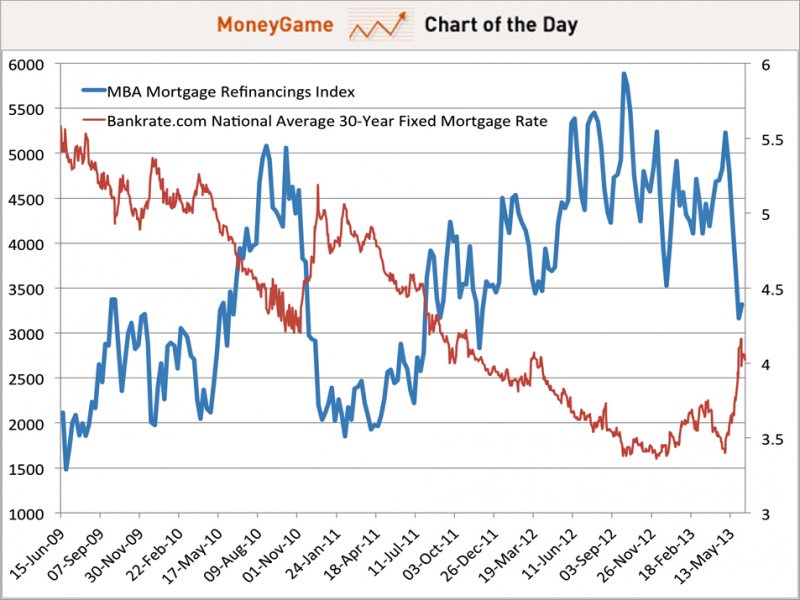
CHART OF THE DAY: The Mortgage Refinancing Boom Is Evaporating Before Our Eyes

MAMTA BADKAR AND MATTHEW BOESLER JUN. 14, 2013, 1:29 PM 2,548 2

cotd-9

Mortgage rates have been climbing for five straight weeks, and the latest data from the Mortgage Banker’s Association shows that the average 30-year fixed rate is now at 4.15%, up from 3.59% in the first week of May.

Meanwhile, the MBA’s refinancings index is down 36% from its peak at the beginning of May.

The rise in mortgage rates has been driven by concerns about when the Federal Reserve will begin to slow its $85-billion-a-month bond purchase program, which is designed to keep interest rates low. Those fears have sparked a sell-off in the Treasury market, which has caused yields on fixed income instruments of all shapes and sizes – including mortgages – to rise. Read more of this post

In Japan, Aversion to Mergers Runs Deep

June 14, 2013, 11:48 a.m. ET

In Japan, Aversion to Mergers Runs Deep

By ATSUKO FUKASE and MAYUMI NEGISHI

BF-AF162_JBLOAT_G_20130614173905

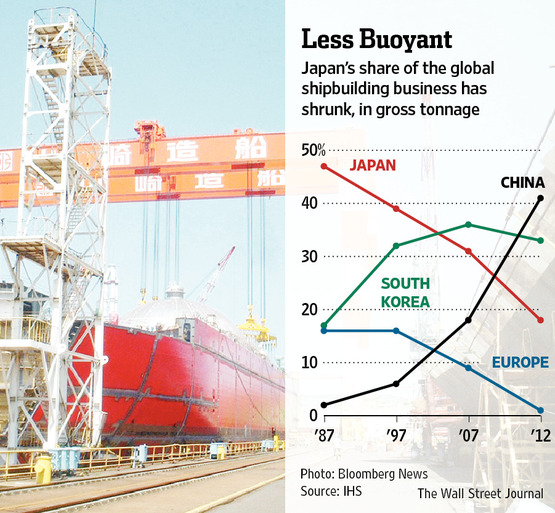
TOKYO—The Japanese government’s new “growth strategy” includes measures designed to encourage consolidation in manufacturing sectors notoriously overcrowded with inefficient companies averse to merging or combining overlapping production lines. A sign of the difficulties that lie ahead in promoting that reform came in the form of a 35-minute boardroom fight this week at Kawasaki Heavy Industries Ltd.,7012.TO +4.25% Japan’s second-largest heavy machinery maker. The battle ended with the ouster of the company’s president in order quash his plans to merge with rival Mitsui Engineering & Shipbuilding Co.7003.TO -5.52% Read more of this post

Stanley Druckenmiller On China’s Future And Investing In The New Normal

Stanley Druckenmiller On China’s Future And Investing In The New Normal

Tyler Durden on 06/14/2013 19:38 -0400

From Goldman Sachs

Stan Druckenmiller is Chairman and Chief Executive Officer of Duquesne Family Office. He founded Duquesne Capital Management in 1981, which he ran until he closed the firm in 2010. Previously, he was a Managing Director at Soros Fund Management, where he served as Lead Portfolio Manager of the Quantum Fund and Chief Investment Officer of Soros

Interview with Stan Druckenmiller

Hugo Scott-Gall: What are the risks of investing in China that are not well understood in your view? Read more of this post

Paulson Gold Fund Falls 13% In May, Down 54% In ’13

Paulson Gold Fund Falls 13% In May, Down 54% In ’13

Jun 11 2013 | 12:19pm ET

Earlier this month, Paulson & Co. said it would restrict the distribution of its Gold Fund’s performance—and for good reason. The $360 million fund—Paulson’s smallest—fell a further 13% in May. The fund, which manages primarily firm founder John Paulson’s own fortune, is down 54% this year. Despite the huge losses, which follow a 25% decline last year, New York-based Paulson urged investors to stick with the gold fund, noting that valuations offer “significant upside.” It added that it would not close the fund, which it has renamed the PFR Gold Funds, using the initials of Paulson and his gold specialists, Victor Flores and John Reade. Paulson has been a gold bug for years, arguing that inflation will soar when the Federal Reserve begins to cut back on its quantitative easing program. But the precious metal last month entered bear-market territory for the first time in a dozen years as the Fed’s bond-buying continues unabated. Paulson, which allows investors to buy gold-denominated shares of all of its funds, said earlier this month that it would stop reporting the gold funds’ results to all investors, complaining that their struggles were overshadowing strong returns by its other, larger products.

The race to destroy your data; Companies like Silent Circle, which promises to secure or get rid of consumers’ private information, have seen a surge in the wake of government spying reports

The race to destroy your data

June 14, 2013: 10:24 AM ET

silent-circle-test

Companies like Silent Circle, which promises to secure or get rid of consumers’ private information, have seen a surge in the wake of government spying reports.

FORTUNE — Silent Circle, an app that allows users to place encrypted phone calls, makes money on paranoia. Paranoia like, say, the fear that the government might build a massive surveillance operation in cooperation with major tech companies and then keep it secret from the public for years.

So naturally, after news broke that the government really was gathering large amounts of data on Americans’ phone calls and e-mails, Silent Circle found itself in a sweet spot. The company says reports of the National Security Agency’s data-gathering activities drove a huge increase in sales — up 480% in the last seven days. Read more of this post

From Silicon Wadi to Silicon Valley: How Waze found its way to Google; Nitzan Hirsch-Falk, the lawyer who headed map startup’s legal team, recounts each twist and turn that led to most exciting exit seen in Israel in recent years

From Silicon Wadi to Silicon Valley: How Waze found its way to Google

Nitzan Hirsch-Falk, the lawyer who headed map startup’s legal team, recounts each twist and turn that led to most exciting exit seen in Israel in recent years.

By Amir Teig and Inbal Orpaz | Jun.14, 2013 | 3:38 AM

Last Friday, after eight intensive days negotiating with Google, attorney Nitzan Hirsch-Falk left Google headquarters in California and went to the San Francisco International Airport. Just as he was about to board a return flight to Israel, Waze CEO Noam Bardin send him a text message asking him to come back.

“Afterward I realized they were just stressed,” says Hirsch-Falk, describing what happened on the day of the most exciting exit seen in Israel in recent years. “They basically needed me to hold their hand. We worked until 6 A.M. Saturday morning and closed the deal.”

By Tuesday evening the money was in Waze’s Israeli bank account. The man who has been with Waze for five years, from infancy to its phenomenal, $1.15 billion exit, can now relax. Together with Bardin, it was Hirsch-Falk who zipped in and out of the conference rooms of all the global technology giants. Read more of this post

How the NSA Could Get So Smart So Fast; Modern Computing Is Helping Companies and Governments Accurately Parse Vast Amounts of Data in a Matter of Minutes

Updated June 12, 2013, 7:51 p.m. ET

How the NSA Could Get So Smart So Fast

Modern Computing Is Helping Companies and Governments Accurately Parse Vast Amounts of Data in a Matter of Minutes

Five years ago it would have been unimaginable for a government agency such as the National Security Agency to efficiently parse millions of phone, text and online conversations for keywords that could have warned of an impending terrorist attack. Today, it’s much easier. Michael Hickins joins the News Hub.

By MICHAEL HICKINS

Five years ago it would have been unimaginable for a government agency such as the National Security Agency to efficiently parse millions of phone, text and online conversations for keywords that could have warned of an impending terrorist attack. Today, a set of new technologies make it relatively affordable and manageable for it do so. These technologies can store vastly different types of data in a single database, and can be processed rapidly using inexpensive hardware, without an analyst having to formulate a hypothesis. “They’ve substantially reduced the cost and greatly increased the [government’s] ability to analyze this type of data,” says Tom Davenport, an expert on analytics and a visiting professor at Harvard Business School. The technology needed to outfit data centers to perform these tasks has become “orders of magnitude” less expensive than in the past, he said. Read more of this post

How Location Data Is Being Collected And Transforming The Mobile Industry

INFOGRAPHIC: How Location Data Is Being Collected And Transforming The Mobile Industry

JOSH LUGER JUN. 14, 2013, 2:30 PM 1,214

slide1-8-1

With over 770 million GPS-enabled smartphones, location data has begun to permeate the entire mobile space. The possibilities for location-based services on mobile go beyond consumer-facing apps like FourSquare and Shopkick. It’s powering advertisements, and many other services — from weather to travel apps. In a recent report from BI Intelligence on location-based data, we analyze the opportunities emerging from this new local-mobile paradigm. We specifically examine how location-enabled mobile ads have generated excitement, look at how location-based feature have boosted engagement for apps, and demystify some of the underlying technologies and privacy issues. A pure GPS approach and the “lat-long” tags it generates is considered the standard for location data. But there are at least four other methods, sometimes used in combination, for pinpointing locationRead more of this post

Big data meets the Bard: A ‘literary lab’ that believes reading with computers is the future

June 14, 2013 6:29 pm

Big data meets the Bard

By John Sunyer

A ‘literary lab’ that believes reading with computers is the future

Here’s some advice for bibliophiles with teetering piles of books and not enough hours in the day: don’t read them. Instead, feed the books into a computer program and make graphs, maps and charts: it is the best way to get to grips with the vastness of literature. That, at least, is the recommendation of Franco Moretti, a 63-year-old professor of English at Stanford University and unofficial leader of a band of academics bringing a science-fiction thrill to the science of fiction. For centuries, the basic task of literary scholarship has been close reading of texts. But for digitally savvy academics such as Moretti, literary study doesn’t always require scholars actually to read books. This new approach to literature depends on computers to crunch “big data”, or stores of massive amounts of information, to produce new insights. Read more of this post

Obama’s Lost AAA Brings Falling Yields-to-Deficits on Downgrade

Obama’s Lost AAA Brings Falling Yields-to-Deficits on Downgrade

Ever since Standard & Poor’s stripped the U.S. of its AAA credit rating almost two years ago, the unemployment rate has fallen, household wealth has reached a record and the budget deficit is shrinking. More downgrades may be coming, anyway.

While S&P boosted its outlook for the U.S.’s AA+ grade earlier this week to “stable” from “negative,” Moody’s Investors Service said it’s awaiting lawmakers’ budget decisions this year as it weighs reducing America’s Aaa. Fitch Ratings, which has a “negative” outlook on the U.S., said in February that the debt trajectory isn’t consistent with a AAA borrower. Read more of this post

U.S. plastics from gas threaten European petchem industry

U.S. plastics from gas threaten European petchem industry

6:43am EDT

By Ludwig Burger

FRANKFURT (Reuters) – The oil-dependent European petrochemicals industry could be in for a body blow as U.S. rivals seek to get a wider range of raw materials out of cheap shale gas to make more plastics, coatings and adhesives.

U.S. players including Dow Chemical (DOW.N: Quote,ProfileResearchStock Buzz) and Enterprise Products Partners (EPD.N: QuoteProfileResearchStock Buzz) are building facilities to convert gas into propylene, a key building block for advanced materials that has so far required the oil distillate naphtha as feedstock.

This could further squeeze margins and endanger jobs at European plants that convert naphtha into precursor chemicals ethylene and propylene, the backbone of the more than 130 billion euro ($167 billion) petrochemical industry in Europe. Read more of this post

Singapore most expensive Asian city for visitors

Singapore most expensive Asian city for visitors

English.news.cn   2013-06-14

SINGAPORE, June 14 (Xinhua) — A latest survey shows Singapore is the most expensive Asian city to spend a night, local daily Straits Times reported on Friday. An evening for two costs 495.79 Singapore dollars (396.63 U.S. dollars) in the city state, making it the world’s 14th most expensive city for visitors, according to the survey by travel website TripAdvisor. The survey, known as TripIndex Cities, was based on an overnight stay for two people that would include a return taxi trip, a night’s stay at a four-star hotel, a two-course dinner and cocktails. Some 49 cities were included in the list. Tokyo took the 15th spot globally, with an overnight stay costing travellers 495.64 Singapore dollars (396.51 U.S. dollars). Singapore was the 10th most expensive city worldwide, but remained the priciest Asian city this year. Oslo in Norway came out tops for the most expensive city, costing 717.41 Singapore dollars (573.93 U.S. dollars).

Value is Now Generated Pre-IPO; for companies going public before 2000, almost 75 percent of their eventual market value was realized in the public market, post-IPO; Who would have imagined that Splunk, which started out just analyzing log files, could be worth over $4 billion?

The Right Now Economy: The Next Wave of Startup Success

Mark Siegel6/12/13Follow @msiegel11

[Editor’s Note: Mark Siegel, managing director at Menlo Ventures, was the keynote speaker at IBF’sVenture Capital Investing Conference today in San Francisco. The post below summarizes his talk, in which he argued that the convergence of mobility, cloud infrastructure, social and big data—what he calls the Right Now Economy—sets the stage for $500 billion in venture returns over the next decade.]

Every technology cycle is driven by a huge disruptive new trend in innovation, such as the PC, the Internet/telecom boom, or the rise of social networking. We’re in the midst of the latest cycle, and it’s particularly compelling because it marks the convergence of four important trends: mobile, social, cloud infrastructure and Big Data.

These technological mega-trends have converged to create the real-time marketplaces of the Right Now Economy, which are already disrupting trillions of dollars in aggregate market value and have produced an incredibly fertile area for entrepreneurs to grow ideas into well-funded companies with the potential to take on established stalwarts. Read more of this post

China braces for capital flight and debt stress as Fed tightens; There have been signs of serious stress in China’s interbank lending markets, with short-term SHIBOR rates spiking violently. Bank Everbright missed an interbank payment last week in a technical default

China braces for capital flight and debt stress as Fed tightens

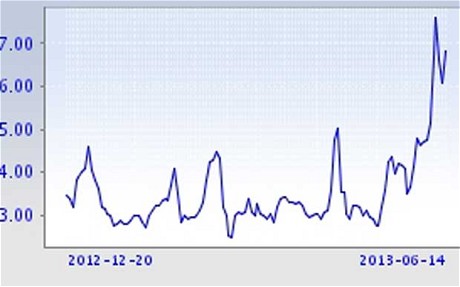
China appears increasingly worried that monetary tightening by the US Federal Reserve could trigger capital flight from the People’s Republic and set off a Chinese corporate debt crisis.

There have been signs of serious stress in China’s interbank lending markets, with short-term SHIBOR rates spiking violently. Photo: Alamy

By Ambrose Evans-Pritchard

1:50PM BST 14 Jun 2013

shiboroneweek_cut_2590358c

A front-page editorial on Friday in China Securities Journal – an arm of the regulatory authorities – warned that capital inflows have slowed sharply and may have begun to reverse as investors grow wary of emerging markets. “China will face large-scale capital outflows if there is an exit from quantitative easing and the dollar strengthens.” it wrote. The journal said foreign exodus from Chinese equity funds were the highest since early 2008 in the week up to June 5, and the withdrawal Hong Kong funds were the most in a decade.

Read more of this post

China estimates fake trade invoicing at S$94 billion in Jan-April

China estimates fake trade invoicing at S$94 billion in Jan-April

SHANGHAI – Fake invoicing inflated China’s official import and export totals by US$75 billion (S$94 billion) in the first four months of this year, local media reported on Friday, citing an internal review by China’s commerce ministry.

BY –

1 HOUR 5 MIN AGO

SHANGHAI – Fake invoicing inflated China’s official import and export totals by US$75 billion (S$94 billion) in the first four months of this year, local media reported on Friday, citing an internal review by China’s commerce ministry.

An alternate estimate found that actual year-on-year export growth for January to April was only about 7 per cent, while import growth was about 6 per cent, the 21st Century Business Herald reported, citing an unidentified source and an internal commerce ministry document.

The second estimate was based on excluding data from the port of Shenzhen, where much of the fraud is suspected to have occurred. Read more of this post

India is Asia’s weakest link in QE-driven rout

India is Asia’s weakest link in QE-driven rout

Thu, Jun 13 2013

By Vidya Ranganathan

SINGAPORE (Reuters) – India is emerging Asia’s canary in the ‘hot money’ mine.

As financial markets sell off on concerns over rising U.S. rates, what happens in India, an economy with slowing growth and a heavy dependence on foreign money, could well determine if this is merely a short-term rout or a full-blown crisis.

India’s rupee currency has weakened the most among emerging markets after the South African rand since May as investors flee assets most vulnerable to the end of super-loose U.S. monetary policy. Read more of this post

MD&A Disclosure and the Firm’s Ability to Continue as a Going Concern

MD&A Disclosure and the Firm’s Ability to Continue as a Going Concern

William J. Mayew Duke University – Fuqua School of Business

Mani Sethuraman Duke University – Fuqua School of Business

Mohan Venkatachalam Duke University – Fuqua School of Business

March 22, 2013

Abstract: 
This paper explores the role of textual disclosures in the MD&A section of a firm’s SEC 10K filing to predict a firm’s ability to continue as a going concern. Using a sample of firms that filed for bankruptcy over the period 1995-2011 and a matched set of control firms we find that both management’s opinion about going concern stated in the MD&A and the linguistic tone of the MD&A together provide significant explanatory power in predicting whether a firm will cease as a going concern. Moreover, the predictive ability of MD&A disclosure is incremental to financial ratios, auditor going concern opinion, and market based variables. The striking feature of our findings is that the information in MD&A disclosures is more useful in predicting bankruptcy relative to financial ratios three years prior to bankruptcy. This suggests that MD&A disclosures are more timely than financial ratios and hence, a leading indicator of going concern problems. Our findings have important implications for current standard setter deliberations on whether to mandate qualitative disclosures about management’s assessment of the firm’s ability to continue as a going concern.

Distracted Directors: Does Board Busyness Hurt Shareholder Value?

Distracted Directors: Does Board Busyness Hurt Shareholder Value?

Antonio Falato Federal Reserve Board

Dalida Kadyrzhanova University of Maryland

Ugur Lel Virginia Polytechnic Institute & State University – Department of Finance, Insurance, and Business Law

May 31, 2013

Abstract: 
This paper examines the impact of independent director busyness on firm value in a setting that addresses a key challenge that the board of directors is an endogenously determined institution. We use the deaths of directors and CEOs as a natural experiment to generate exogenous variation in the time and resources available to independent directors at interlocked firms. The sudden loss of such key co-employees is an ‘attention shock’ because it increases the board committee workload for some independent directors at the interlocked firm – the ‘treatment group,’ but not others – the ‘control group.’ In a hand-collected sample of 2,551 (592) firms that share a non-deceased independent director with 633 (189) firms subject to director (CEO) deaths, difference-in-difference estimates reveal that investors react negatively to these attention shocks. There is a significant negative stock market reaction of -0.79% (-0.95%) for director-interlocked firms in the treatment group, but no reaction for those in the control group. The treatment effect is significantly magnified by interlocking directors’ busyness (e.g., board size and number of outside directorships), the importance of their roles in the firm (e.g., type of committee membership), and their degree of actual independence (e.g., entrenchment). Overall, these results provide direct evidence that director attention shocks are interpreted as negative events for firms and that independent directors’ busyness entails costs for shareholders.

Are Investors Guided by the News Disclosed by Companies or by Journalists?

Are Investors Guided by the News Disclosed by Companies or by Journalists?

Zilu Shang ICMA Centre, Henley Business School

Chris Brooks University of Reading – ICMA Centre

Rachel McCloy University of Plymouth – School of Psychology

June 1, 2013

Abstract: 
Most previous studies demonstrating the influential role of the textual information released by the media on stock market performance have concentrated on earnings-related disclosures. By contrast, this paper focuses on disposal announcements, so that the impacts of listed companies’ announcements and journalists’ stories can be compared concerning the same events. Consistent with previous findings, negative words, rather than those expressing other types of sentiment, statistically significantly affect adjusted returns and detrended trading volumes. However, extending previous studies, the results of this paper indicate that shareholders’ decisions are mainly guided by the negative sentiment in listed companies’ announcements rather than that in journalists’ stories. Furthermore, this effect is restricted to the announcement day. The average market reaction – measured by adjusted returns – is inversely related only when the announcements are ignored by the media, but the dispersion of market reaction – measured by detrended trading volume – is positively affected only when announcements are followed up by journalists.

Materiality Guidance of the Major Auditing Firms

Materiality Guidance of the Major Auditing Firms

Aasmund Eilifsen Norwegian School of Economics (NHH) – Department of Accounting, Auditing, and Law

William F. Messier Jr.University of Nevada, Las Vegas – Department of Accounting; Norwegian School of Economics (NHH) – Department of Accounting, Auditing and Law

June 5, 2013

Abstract: 
This paper examines the materiality guidance for eight of the largest U.S. auditing firms. Knowledge of how materiality guidance is integrated into a firm’s methodology is important for accounting and auditing researchers. Our results show a high level of consistency across the firms in terms of the quantitative benchmarks (e.g., income before taxes, total assets or revenues, and total equity) used to determine overall materiality, the related percentages applied to those benchmarks, the percentages applied to overall materiality for determining tolerable misstatement, and what constitutes a clearly trivial misstatement. We also find that the firms’ guidance for evaluating detected misstatements including qualitative factors and firm guidance for group audits is consistent across firms. However, there are differences in how the firms consider the possibility of undetected misstatements when evaluating detected misstatements. The results offer insights into implementation of standards that provides valuable information for future materiality research as well informing future archival and behavioral research.

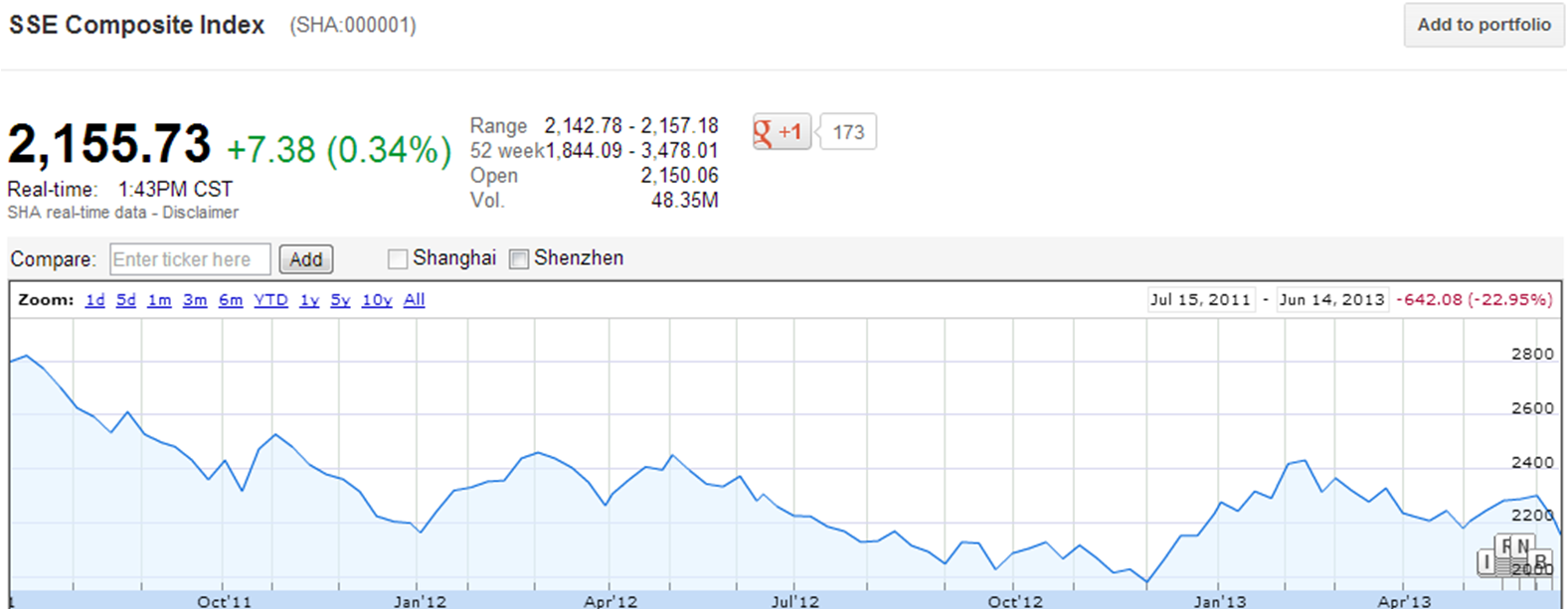
China Debt Sale Fails for First Time in 23 Months on Cash Crunch; The ministry’s last failed auction was in July 2011 and Shanghai index was down 23% subsequently

China Debt Sale Fails for First Time in 23 Months on Cash Crunch

SSE

China’s Finance Ministry failed to sell all of the debt offered at an auction for the first time in 23 months owing to a cash squeeze, according to two traders at finance companies that participate in the sales.

The ministry sold 9.53 billion yuan ($1.55 billion) of 273-day bills, less than the 15 billion yuan target, they said. Agricultural Development Bank of China Co. raised 11.51 billion yuan in a sale of six-month bills last week, less than its 20 billion yuan goal. The seven-day repurchase rate, which measures interbank funding availability, has more than doubled in the past month as banks hoard cash to meet quarter-end capital requirements and capital inflows ease.

“The cash crunch is curbing demand for bonds,” said Chen Ying, a fixed-income analyst at Sealand Securities Co. in Shenzhen. “The crunch may persist if the central bank doesn’t come out to inject more capital into the financial system. If it lasts longer, it may affect issuance of both government and corporate bonds.” Read more of this post

Stock Rout Threatens $10 Billion Asia IPOs as Suntory Nears

Stock Rout Threatens $10 Billion Asia IPOs as Suntory Nears

Slumping stock markets are threatening to disrupt as much as $10 billion of initial public offerings across Asia, as companies from Suntory Holdings Ltd. to Macau Legend Development Ltd. (1680) prepare listings.

Companies are gauging demand or taking orders for as much as $2.5 billion of IPOs in Southeast Asia and $2.3 billion of deals in Hong Kong, according to data compiled by Bloomberg. Suntory is seeking to raise as much as $4.7 billion this month in Japan’s largest first-time share sale since September.

With Asia’s benchmark stock index wiping out the year’s gains, some companies marketing IPOs may be forced to accept lower valuations or delay listings. Hopewell Hong Kong Properties Ltd. scrapped a $780 million offering in the city yesterday while China Harmony Auto Holding Ltd. plunged 16 percent (3836) in the worst Hong Kong debut since February 2012. Read more of this post

Korean Tiger Moms Scrimp for Tutors in Blow to Consumer Spending

Korean Tiger Moms Scrimp for Tutors in Blow to Consumer Spending

Housewife Ahn Jee Eun began looking for a job to supplement her husband’s income after the cost of sending her twin three-year-old daughters to pre-school pushed the family’s bank account into the red.

“My husband and I are spending about half of our income on education,” said Ahn, 34, who pays more than 1.7 million won ($1,500) a month on private tuition fees. “I’ve been cutting down on grocery shopping to make sure my kids socialize in good places and learn stuff they’re supposed to learn.”

Education expenses have helped push the nation’s household debt toward record levels, sapping households’ ability to spend money on other goods — private consumption fell the most last quarter since the 2009 global recession. President Park Geun Hye this week set up a task force to scale back excess high-school testing in a nation where four out of five elementary school pupils get additional private tuition. Read more of this post

Yen Slump Failing to Stem Japan’s Exodus of Factories Overseas

Yen Slump Failing to Stem Japan’s Exodus of Factories Overseas

Japanese Prime Minister Shinzo Abe promises that Abenomics will revive the nation’s industrial might. For Takumi Tanaka at auto-parts maker Uchida Co., times are worse than after the 2011 earthquake.

Tanaka, managing director of a company founded in 1955, whose 94 employees supply Honda Motor Co. (7267) with parts molds, is contending with higher costs after an 18 percent drop in the yen in the past nine months pushed up the price of imported energy and metals. At the same time, he’s under pressure from clients to build factories near their overseas plants.

“We see very little benefit” from Abenomics, Tanaka said in an interview in Miyagi Prefecture, where two of the company’s three factories are located, close to the center of the earthquake that caused Japan’s worst nuclear disaster. “Even today, we are being asked to build plants in Vietnam, Thailand and Indonesia. There is little relief that manufacturing can stay in Japan.” Read more of this post

Who wants to the last person carrying the broken record and be blamed by investors? “There is now anecdotal evidence that long-term investors have started selling.” Investors lose bet on EM local currency debt

June 13, 2013 5:10 pm

Investors lose bet on EM local currency debt

By Pan Kwan Yuk

Investors in emerging market local currency bonds are among the biggest losers from the recent sell-off in emerging market assets. The average EM local currency fund has lost 7.8 per cent since the beginning of May, according to data from Lipper. This compares with a loss of 6.1 per cent on average for EM hard currency funds and 6.7 per cent for EM equity funds. The sharp reversal in performance comes as investors have substantially increased their bets on the locally denominated EM debt this year. As the chase for yield intensified, investors have piled into the asset class – drawn by the higher yields offered by the bonds and the prospect of an added sweetener in the form of foreign exchange gains. Investors have funnelled $20.4bn into EM local debt in the year to date, compared with just $2.5bn for hard currency bonds, according to data from EPFR. The flows into EM local debt this year have already surpassed the $16.7bn the asset class attracted for the whole of 2012. But the twin attractions of local currency debt – higher bond yields and foreign exchange appreciation – have also made it more vulnerable to the recent rise in US Treasury yields. Yields on JPMorgan’s GBI-EM index, which tracks local currency debt, have risen 82 basis points, or 15.34 per cent, since May 22, when the US Federal Reserve hinted that it may start winding down its $85bn-a-month bond buying programme. Meanwhile EM currencies have suffered a sharp correction. The South African rand, Brazilian real, Philippine peso, Indian rupee, and Mexican peso are among the world’s 10 worst performing currencies since May 22 – with losses ranging from 4.3 per cent to 3.2 per cent against the dollar. Sara Zervos, head of the global debt team at Oppenheimer Funds, attributes the sharp sell-off in recent weeks to crossover money from hedge funds pulling out. “Interest rate swaps yields have been going up higher and faster than [EM local currency] bond yields,” she said. “Real money accounts tend to hold bonds. Fast money tends to hold swaps. So my sense is that the sell-off has been initiated by leveraged buyers unwinding their positions rather than real money dumping bonds.” Others think it is only a matter of time before real-money investors pull back. “In retrospect, it is quite clear that positioning in local bond markets has been excessive,” said Benoît Anne, head of EM strategy at Société Générale, in a note to clients last week. “There is now anecdotal evidence that long-term investors have started selling. That may suggest that more pain is on the way. I see little reason to be bullish on EM fixed income against this backdrop.”

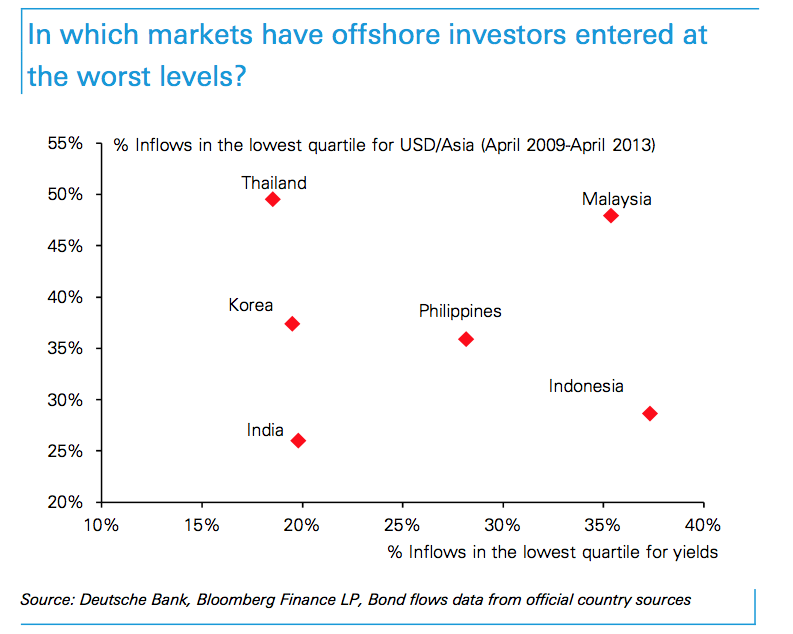
“Size of the exit”: Emerging markets are often easy to get into, but if history is any guide, when the elevator starts to go down and everyone is trying to get out, some people are going to get stuck

Still got your money in emerging markets? Here’s what to worry about—and where

By Matt Phillips @MatthewPhillips June 13, 2013

screen-shot-2013-06-12-at-2-24-23-pmscreen-shot-2013-06-12-at-3-18-32-pm

Global riptides of investment cash are a well-established threat for developing economies. On its way in, a surge in foreign investment pushes up prices of stocks, bonds and other assets. It drives down borrowing costs. It supercharges growth. But if the wave suddenly starts to recede, countries can face nasty combinations of currency collapse, banking crises and government default. This script has repeatedly played out. There was Mexico’s “tequila crisis” in 1994. The Asian crisis in 1997. The Russian devaluation of 1998. Which brings us to the current sharp selloff in a range of emerging markets. Among the countries that have been darlings of global investors in recent years, which ones are the most vulnerable to a reversal of fortunes? Here are a few ways to think about the risks. Read more of this post