Apple $17 billion bonds lose 9% in six weeks. Will Apple’s $17bn debt sale in April turn out to be the “AOL buys Time Warner”moment of the three-decade bond market bull run?

June 11, 2013 9:53 am

Apple bonds lose 9% in six weeks

By Stephen Foley and Michael Mackenzie in New York

Investors are nursing losses of up to 9 per cent on Apple’s record-breaking $17bn bond offering, less than six weeks after the securities landed in their portfolios.

The technology giant tapped the white-hot bond market for the largest debt fundraising to date on April 30, but a sharp turn in interest rates has caused a sell-off in corporate bonds and wiped hundreds of millions of dollars off the value of the offering.

Apple sold $3bn of bonds maturing in 2043, locking in a low interest rate of 3.9 per cent for the next 30 years, but the market price of these bonds had fallen to 90.36 per cent of face value in late trading on Monday, according to Trace data. Read more of this post

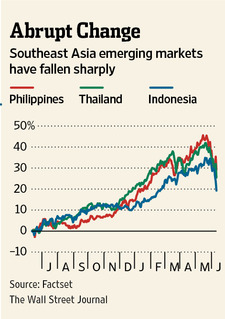
An exodus from emerging markets threatens to hurt the financing and growth prospects of developing economies that have come to rely on large inflows of foreign capital in the wake of the global financial crisis

Updated June 11, 2013, 6:05 p.m. ET

Money Flows Out of Emerging Markets

By ALEX FRANGOS and DANIEL INMAN in Hong Kong and PATRICK MCGROARTY in Johannesburg

AM-AY936_EMFLOW_NS_20130611134503AI-CB513_EMFLOW_G_20130611133904

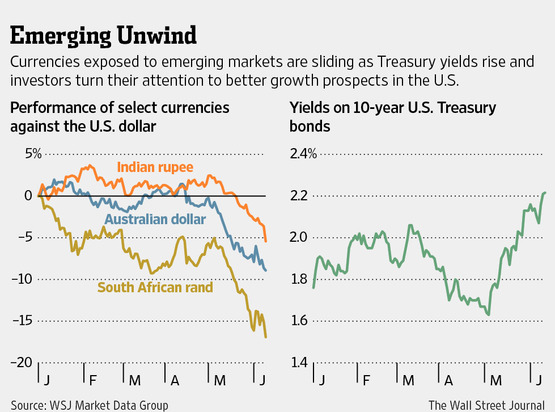
Money streamed out of emerging markets, destabilizing currencies, sinking stocks and creating headaches for policy makers already worried about faltering growth.

In the latest signs of turmoil, highflying stock markets fell in Asia, while currencies in India, Thailand and Indonesia reeled in the face of a surging U.S. dollar.

Some emerging-market currencies rebounded in New York trading hours but others remained weaker on the day. The volatile trading reflected the difficulties investors face in trying to predict when developed-world banks might start to withdraw stimulus and how such moves would ripple across global markets. Read more of this post

Across China, local governments are pushing ambitious spending projects that add to concerns about wasteful capital investment and rising debts

June 11, 2013, 1:30 p.m. ET

Across China, the Itch to Spend Is Strong

WO-AO132_CINVES_NS_20130611181513

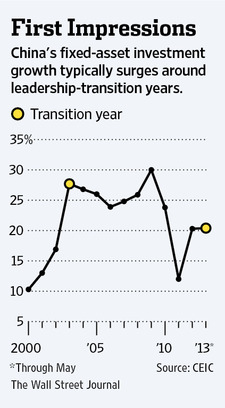
BEIJING—As leaders in Beijing remain cautious about stimulating China’s economy out of a slowdown, local governments are taking no chances, pushing ambitious spending projects that add to concerns about wasteful capital investment and rising debts.

It isn’t clear how many of these undertakings—which include everything from highways to subways—will end up with funding. But the push illustrates Beijing’s challenge as it attempts to rebalance the world’s No. 2 economy to make it less dependent on such massive investment plans.

A total of 16 provinces and two municipalities representing more than 60% of China’s gross domestic product have issued statements since the start of the second quarter proclaiming the importance of investment projects in driving growth and urging lower levels of government to use all means to accelerate plans in the months ahead. Read more of this post

UPS is expanding its health-care shipping services in China, as it pursues a larger foothold in a lucrative market with limited access to foreign delivery companies; The largest distributors in the U.S. control approximately 90% of the health-care logistics market

June 11, 2013, 12:36 p.m. ET

UPS Bulks Up in China

Delivery Firm Seeks Deals to Broaden Health-Care Shipping Efforts

By LAURIE BURKITT

SHANGHAI—United Parcel Service Inc. UPS -0.81% is expanding its health-care shipping services in China, as it pursues a larger foothold in a lucrative market with limited access to foreign delivery companies.

Atlanta-based UPS is seeking acquisitions to broaden its health-care supply chain in China, enabling it to transport medical devices and pharmaceuticals in China to companies such as drug maker Merck & Co., said Jim Barber, the president of UPS International. The company operates a facility in Shanghai as well as a new 237,000-square-foot storage and distribution center in the coastal city of Hangzhou, China. Read more of this post

Chinese local governments are padding their balance sheets with billions in fake assets

Chinese local governments are padding their balance sheets with billions in fake assets

By Gwynn Guilford @sinoceros 10 hours ago

Even China’s most prominent cities and provinces are increasingly relying on high-risk and murky forms of borrowing. That’s according to a new report from China’s National Audit Office on the finances of 36 provincial and municipal governments(link in Chinese). The report covered the governments of cities including Shanghai, Chongqing and Tianjin, and the provincial governments of Guangdong, Jiangsu and others. Here’s a roundup of the most notable numbers:

Local government debt hasn’t gone up much recently… or so it might seem. At the end of 2012, those 36 local governments had racked up $628 billion in debt, a 12.9% increase on what they’d amassed by the end of 2010. That’s not exactly shocking. But there are hints that the debt of some local governments may be threatening to spiral out of control: 12 of them saw their debts rise 20% or more. Plus, as China Real Time estimates, the report probably only covers 25-30% of total local government debt.

A sizable part of some local governments’ debt is dubious “shadow lending.” Nearly 16% of the total debt accrued by 13 local governments since 2010—$36 billion—came from trust loans and other sketchy financing, which channels lending off bank balance sheets. That could be higher—the report said financing through these channels is easy to conceal. It also noted that these are especially risky since rates tend to be much higher than those of banks—up to 17.5% annually.  Read more of this post

The price of love: Dowry map of China goes viral

The price of love: Dowry map of China goes viral

Staff Reporter

2013-06-08

1306041726102436--ss2-180501_copy1

The map shows the different amounts of dowry money expected in different parts of the country. (Internet photo)

In traditional Chinese culture, a man must first provide a dowry to his wife’s family before getting married. The practice has persisted into the present day, and a map showing the average amount required in different parts of China has gone viral online, with many internet users saying that they cannot afford a wife, reports the Henan-based news website Dahe.

The Dowry Map of China divides the country into five zones in terms of the amount expected by a bride’s family — 1 million yuan (US$163,000), 500,000 yuan (US$80,750), 100,000 yuan (US$16,300), and 10,000 yuan (US$1,600), and zero yuan. Read more of this post

Tamil Nadu: Can eccentric politics continue to deliver prosperity? Why are so many Tamil politicians ex-film stars?

Tamil Nadu

A successful show begins to pall

Can eccentric politics continue to deliver prosperity?

Jun 8th 2013 | CHENNAI |From the print edition

20130608_ASC740

IMAGINE a place run by film stars—vain, power-hungry, paranoid, adored. Imagine they had been in charge not for the duration of a reality television series but for decades in a territory containing 72m people and one of the world’s largest cities. It would be a disaster zone, wouldn’t it? Think again, and welcome to Tamil Nadu, one of India’s great success stories—and a state run by actors. It is the ultimate celebrity experiment.

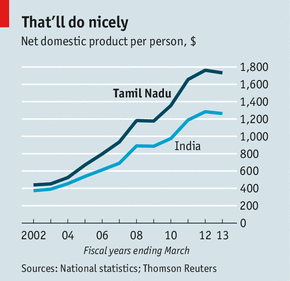
Tycoons and foreign bosses are infatuated by Gujarat, a hard-charging western state where the trains run on time. Policy wonks admire Bihar, an eastern badland that is getting its act together. But India’s most consistent economic performer is in its deep south (see chart). Tamil Nadu has the third-biggest GDP of any state and has grown faster and richer than most.

It is as industrialised as Gujarat—Hyundai, Ford and Renault, among others, churn out a third of all cars made in India there, while the state’s looms dominate the national textile industry. It is also as socially progressive as famously lefty states like Kerala. Compared with the Indian average, more people can read, fewer babies die, and fewer folk are poor in Tamil Nadu. Read more of this post

After two years of relentless buying overseas, Japanese companies are taking a breather in mergers and acquisitions

Jun 11, 2013

Japanese M&A Takes a Step Back

By Isabella Steger

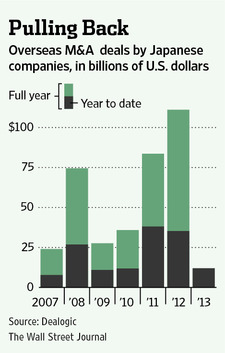
After two years of relentless buying overseas, Japanese companies are taking a breather in mergers and acquisitions.

AM-AY924_AMONEY_NS_20130611113004

Japanese outbound M&A has dropped 67% this year from a year earlier, according to data provider Dealogic, with just $11.9 billion in announced deal volume, the lowest level since 2009. In the same period in 2012, $35.3 billion in deals had been announced.

Deal sizes have also become noticeably smaller this year. In the same period last year, the biggest deal was the $5 billion acquisition by advertising giant Dentsu Inc. 4324.TO -2.38% of U.K.-based Aegis PLC, followed by a string of multibillion-dollar deals. Only two transactions announced this year by Japanese companies were valued at more than $1 billion—the biggest being the $2.6 billion acquisition by Orix Corp. 8591.TO -4.34% for Dutch asset manager Robeco Group ROBA.AE -1.02% from Rabobank in February. Read more of this post

Nintendo Chief Defends Console Strategy; Company Sticks to Games for Its Hardware, Resisting Lure of Mobile Devices

Updated June 11, 2013, 5:45 p.m. ET

Nintendo Chief Defends Console Strategy

Company Sticks to Games for Its Hardware, Resisting Lure of Mobile Devices

By DAISUKE WAKABAYASHI

MK-CD942_NINTEN_G_20130611190753

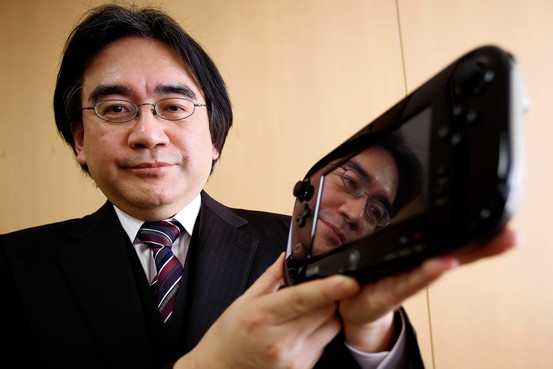
Nintendo President Satoru Iwata, shown with a Wii U controller, says the company will stick with a strategy of making games for its own hardware.

LOS ANGELES—Game apps for smartphones and tablet computers are selling at a rapid pace, much faster than the market for console games. But Satoru Iwata isn’t succumbing to their allure.

The president of Nintendo Co.7974.OK -1.47% is determined to stick to its three-decades-old strategy of making games only for its own hardware, despite pressures to exploit its popular software more widely.

In an interview, Mr. Iwata said the short-term benefits of going after the mobile-apps market wouldn’t be worth the potential harm to the company’s strategy of combining hardware and software in ways that make Nintendo’s offerings unique. Read more of this post

Fast Retailing, operator of the casual clothing chain Uniqlo, has become the unlikely symbol of volatility in Japanese stocks

June 11, 2013, 2:23 p.m. ET

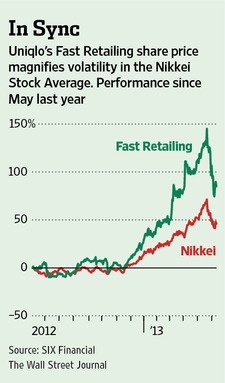
Fast Retailing: The Stock That Wags the Nikkei

By MAYUMI NEGISHI And BRADFORD FRISCHKORN

AM-AY929_UNIQLO_NS_20130611122703

TOKYO—Fast Retailing Co., 9983.TO -1.44% operator of the casual clothing chain Uniqlo, has become the unlikely symbol of volatility in Japanese stocks, pulling with it the Nikkei Stock Average in its incandescent rise and sudden drop.

Shares in Fast Retailing, headed by Japan’s richest billionaire, Tadashi Yanai, more than doubled in 2013 to an all-time high of ¥44,400 before shedding 33% as Japanese equities markets underwent a severe correction stretching from late May to early June. Shares closed Tuesday at ¥31,250, down about 30%, and off 2.5% for the day, compared with a 1.45% loss for the overall Nikkei.

Neither the rise nor fall had much to do with the business performance of the maker of T-shirts and thermal underwear. The key was Fast Retailing’s 9.4% weighting on the Nikkei average—the highest of all 225 stocks in the index and more than the combined weighting of Japan’s four biggest companies by market capitalization. Read more of this post

S Korean women struggle in workforce; Only about 10 per cent of all managerial positions are held by women, and the gender pay gap is 39 per cent, making it the highest in the OECD

June 11, 2013 9:20 am

S Korean women struggle in workforce

By Song Jung-a

Mrs Kim has been thinking about quitting her job at a Seoul brokerage for a while, as she finds it hard to juggle her career and two pre-school children.

Like many South Korean office workers, Mrs Kim leaves home before 7am and returns after 7pm. While long work days are common in Korea – which has the longest working hours in the OECD – they are tough for mothers with young children.

“Sometimes days pass by without even saying ‘hi’ to my children when I get too busy,” says the 38-year-old. “Then I become more sceptical about continuing my work.”

She is not alone. Korean women have to overcome many obstacles at work after marriage and child birth. On top of the long hours, the lack of childcare and the male-dominated business culture force many to leave the workforce. Read more of this post

Uber Cab App Threatens Death of Taxi Dinosaurs

Uber Cab App Threatens Death of Taxi Dinosaurs

People can run into two problems when they need to find a taxi. The first is that they don’t know whether a taxi will be available. The second is that they don’t know when a taxi will be available.

Uber Technologies Inc., a San Francisco-based company, was set up to solve both problems. You can download its application, and it will find out where you are and come pick you up. It will also tell you when it is coming.

In fact, the app comes with a screen that shows exactly where the vehicle is, so you can watch as it makes its way toward you. Once a credit card is in the system, the customer doesn’t have to pay with cash or decide on a tip; everything is automatic. Read more of this post

CIA Chooses: Amazon or IBM? $600 million contract to set up a cloud-computing system shows the growing importance of intelligence-agency business for technology companies

Updated June 11, 2013, 9:47 p.m. ET

CIA Chooses: Amazon or IBM?

By SPENCER E. ANTE

MK-CD938_IBMCIA_G_20130611183613

The battle between International Business Machines Corp. IBM -0.51% andAmazon.com Inc. AMZN -2.24% over a $600 million contract to set up a cloud-computing system for the Central Intelligence Agency shows the growing importance of intelligence-agency business for technology companies.

The competition comes amid extraordinary disclosures of secret government-surveillance programs and shows that even in the rarified world of intelligence agencies, companies selling Internet-based cloud-computing services—like Amazon—are challenging the position of traditional technology vendors.

Companies like IBM have long supplied the U.S. military and intelligence services with computers, software and the know-how to operate them. Now, new contenders like Amazon are getting into the act, drawn by a fresh source of revenue as business spending on technology remains sluggish and by the imprimatur of providing services to clients that have the highest security standards. Read more of this post

An astounding 54% of online display ads weren’t seen by anyone

June 11, 2013, 10:51 a.m. ET

Web Display Ads Often Not Visible

By SUZANNE VRANICA

MK-CD933A_MISSI_G_20130611181506

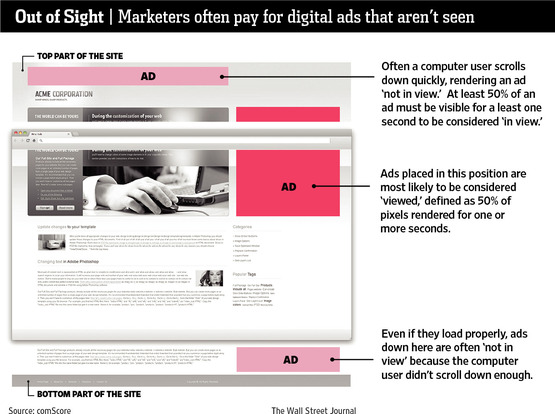
The old adage in advertising—that half the money is wasted but no one knows which half—turns out to be as true for the digital world as it ever was for traditional media.

An astounding 54% of online display ads shown in “thousands” of campaigns measured by comScore Inc.SCOR -0.22% between May of 2012 and February of this year weren’t seen by anyone, according to a study completed last month.

Don’t confuse “weren’t seen” with “ignored.” These ads simply weren’t seen, the result of technical glitches, user habits and fraud.

The finding implies that billions of marketing dollars are being poured down a digital drain. Last year, $14 billion was spent on online display advertising, estimates eMarketer, 40% of all online ad spending. Read more of this post

VF Corp, whose portfolio of clothing brands includes North Face, Wrangler, Timberland, laid out an ambitious new five-year target that would be the envy of almost anyone in the apparel industry

June 11, 2013, 5:43 p.m. ET

VF Lays Out Ambitious Growth Plan

By ANDRIA CHENG

VF Corp., VFC +0.57% whose portfolio of clothing brands includes North Face, Wrangler, Timberland and others, on Tuesday laid out an ambitious new five-year target that would be the envy of almost anyone in the apparel industry. The Greensboro, N.C., company, projects that sales will increase almost 60% to $17.3 billion over the next five years. The company already has a track record for strong growth: Last year sales hit $10.9 billion, up 42% over the five-year period from 2008, when sales totaled $7.64 billion. Given its strategy of buying labels to spur growth, acquisitions will continue to play a role as it aims for a five-year compounded annual sales target of 10%, with 8% “organic” growth and 2% growth anticipated from acquisitions. Read more of this post

Ferrari repositions for a one-horse race in ultra-luxury stakes; By creating a cult of exclusivity for their most expensive products, consumers will often shop for items lower down its retail chain in order to buy into brand exclusivity

June 11, 2013 4:32 pm

Ferrari repositions for a one-horse race in ultra-luxury stakes

By Rachel Sanderson in Maranello

At its headquarters amid the cherry orchards and Lambrusco vineyards of Emilia Romagna, Ferrari has built a reputation as haven of prosperity in recession-wrackedItaly. This year, while much of Italian business splutters, Ferrari is adding 250 jobs and handing out bonuses of at least €8,500 to its workers. But Luca di Montezemolo, 65, aristocratic chairman of the flame-red sports car maker, wants to pull even further away from the crowd. After a record €350m in trading profits in 2012 and on the cusp of the launch of its $1.3m LaFerrari, Ferrari plans to ensure its future success not by increasing output but by cutting back production this year by 400 cars to around 6,900 vehicles. Sitting at his red-leather topped desk at Ferrari HQ in Maranello, Mr Montezemolo sweeps back his signature floppy hair as he argues that after a record year for the business it is the ideal time to switch gear on strategy. “I’m talking about fewer cars but this does not mean fewer revenues or profits,” he says. “We want to increase the exclusivity of Ferrari. We want to maintain the value of the used car market. We want to develop the rest of the business like licensing and products.” Read more of this post

Hedge funds battered in quant arms race; Trend-following strategies sputter in volatile markets

June 11, 2013 5:53 pm

Hedge funds battered in quant arms race

By Sam Jones, Hedge Fund Correspondent

At the end of this month, a team of Cantabrigian hedge fund quants will attempt to wipe out rivals from Switzerland – in a computer game. Cantab Capital (assets under management: $6bn) will fight Zug’s Amplitude Capital in Battlefield 3. The gaming shoot out, part of an online league, is the smaller scale and lesser known version of two wars being fought between the biggest names in the quant hedge fund world. The other is more high stakes. A “quant” arms race, involving tens of billions of dollars, is on for big managers to find new markets and new models in which, and with which, to make money and outshine their rivals. Quant hedge funds have always been motivated to stay ahead of their peers, but in the past few years the struggle has intensified for good reason. So-called “trend-following” strategies – which have historically been at the core of what firms such as Man, Winton Capital, Cantab or BlueCrest Capital do – have sputtered since 2010, wrongfooted by range-bound, volatile prices in the futures contracts they trade linked to bonds and equities. Trend following does as it says: funds’ computers look for consistent moves in futures instruments and then follow them, up or down, until the trend reverses. Read more of this post

Australia’s covered bond boom is waning less than two years after the market started as yield-hungry buyers more than double purchases of RMBS

Australian Covered Bond Boom Wanes as RMBS Sales Double

Australia’s covered bond boom is waning less than two years after the market started as yield-hungry buyers more than double purchases of residential mortgage-backed securities.

Issuance of the debt, backed by the borrower and mortgages that stay on its balance sheet, fell 64 percent to $9.9 billion this year, data compiled by Bloomberg show. The decline in Australian offerings outpaced a 41 percent slump from banks worldwide, according to the data.

Renewed appetite for RMBS, as the market recovers after being decimated by the 2008 U.S. subprime collapse, has seen sales surge while banks reserve covered-bond allowances for when market conditions worsen. Commonwealth Bank of Australia (CBA)’s 2017 covered securities offered just 33 basis points more than swaps last month, compared with a 47 basis-point premium on shorter-dated unsecured notes sold by Westpac Banking Corp., Bloomberg-compiled data show. Global financial debt pays a 141 basis-point spread, Bank of America Merrill Lynch data show. Read more of this post

Swedish Credit Drives Frenzy in Dragon Tattoo Quarter

Swedish Credit Drives Frenzy in Dragon Tattoo Quarter

One of Stockholm’s most popular attractions is a guided tour of the Soedermalm district streets featured in Stieg Larsson’s bestselling book “The Girl With The Dragon Tattoo.” Buying a home in the former working-class neighborhood is far less accessible.

A one-bedroom, 55-square meter (592-square feet) apartment in Hoegalidsgatan, in the neighborhood where Larsson’s troubled heroine Lisbeth Salander grew up, sold last month for 3.75 million kronor ($569,000), 17 percent above the listing price, after a bidding war involving nine parties.

That level of demand is typical in the Swedish capital, where a shortage of construction, a population boom and mortgage rates below 3 percent have pushed prices in central Stockholm up 35 percent since early 2009. Borrowing for home purchases has in turn fueled record household debt across the country. That’s sparking concern among policymakers over potential damage to the economy and preventing the central bank from cutting rates, even as Sweden’s exporters say action must be taken to weaken the currency to protect thousands of jobs. Read more of this post

Nestle’s Nespresso to Face New Mondelez Copycat Capsule

Nestle’s Nespresso to Face New Mondelez Copycat Capsule

Mondelez International Inc., (MDLZ) the world’s second-biggest coffee maker, will start selling Nespresso-compatible capsules across Europe this fall, posing the sternest competitive challenge yet to the Nestle SA (NESN) brand. Mondelez, based in Deerfield, Illinois, will sell the knock-off capsules under its Jacobs and Carte Noire brands in Germany, France, Austria and Switzerland in the second half of 2013, Roland Weening, vice president of strategy, marketing and innovation, said in an interview in London yesterday. The move brings a deep-pocketed entrant to the fastest-growing part of the $80 billion global coffee market at a time when Nespresso’s growth has slowed. Nestle, of Vevey, Switzerland, has filed patent-infringement lawsuits against some rivals that introduced capsules compatible with Nespresso machines, yet to date has not been able to stem the flow of copycat capsules from producers including D.E Master Blenders 1753. (DE) That comes as Nestle has said sales growth this year may be at the low end of its long-term target. Read more of this post

The Rise and Fall of Economic History at MIT

The Rise and Fall of Economic History at MIT

Peter Temin Massachusetts Institute of Technology (MIT) – Department of Economics; National Bureau of Economic Research (NBER)

June 5, 2013
MIT Department of Economics Working Paper No. 13-11

Abstract: 
This paper recalls the unity of economics and economics at MIT before the Second World War, and their divergence thereafter. Economic history at MIT reached its peak in the 1970s with three teachers of the subject to graduates and undergraduates alike. It declined until economic history vanished both from the faculty and the graduate program around 2010. The cost of this decline to current education and scholarship is suggested at the end of the narrative. This paper was written for a conference on the history of the MIT economics department held at Duke University in early 2013.

Expectation Gap and Corporate Fraud: Is Public Opinion Reconcilable with Auditors’ Duties? Expectation gap is unlikely to disappear given that auditor is unable or unwilling to assess the subjective components of fraudulent behavior

Expectation Gap and Corporate Fraud: Is Public Opinion Reconcilable with Auditors’ Duties?

Jeffrey R. Cohen Boston College – Department of Accounting

Yuan Ding China Europe International Business School (CEIBS)

Cédric Lesage HEC School of Management, Paris

Hervé Stolowy HEC Paris – Accounting and Management Control Department

January 15, 2013
CAAA Annual Conference 2013 

Abstract:      
The objective of this paper is to answer the key question of whether auditors’ view of their fraud detection duties is reconcilable with the public’s view. We perform a content analysis of press articles covering 37 U.S. corporate fraud cases discovered during the period 1992-2005. We compare the auditors’ duties (as described by the auditing standards) with the public opinion represented by these press articles. Consistent with Porter (1993), we identify three types of divergence between public expectations and auditing standards: deficient performance (that we label “Type 1”), deficient standards (“Type 2”) and unreasonable expectations (“Type 3”). The Type 1 gap can be reduced by strengthening auditors’ willingness and ability to apply existing auditing standards on fraud detection. The Type 2 gap can be narrowed by improving the existing auditing standards. The Type 3 gap, however, concerns highly subjective criteria beyond the auditors’ usual sphere of control. The results of our analysis confirm that the expectation gap is unlikely to disappear given that the rational auditor is unable or unwilling to assess the subjective components of fraudulent behavior, and that value judgments, as demonstrated in the media, retain their popularity.

Dropbox Founder Drew Houston’s MIT Commencement Address: ‘I stopped trying to make my life perfect, and instead tried to make it interesting.’

Drew Houston’s Commencement address

20130607150520-0

Drew Houston ’05 displays his Brass Rat during his Commencement Address.
‘I stopped trying to make my life perfect, and instead tried to make it interesting.’

June 7, 2013

Below is the prepared text of the Commencement address by Drew Houston ’05, the CEO of Dropbox, for MIT’s 147th Commencement held June 7, 2013.

Thank you Chairman Reed, and congratulations to all of you in the class of 2013.
I’m so happy to be back at MIT, and it’s an honor to be here with you today. I still wear my Brass Rat, and turning this ring around on graduation day is still one of the proudest moments of my life.
There are a lot of reasons why this is a special day, but the reason I’m so excited for all of you is that today is the first day of your life where you no longer need to check boxes.
For your first couple decades, success in life has meant jumping through one hoop after another: get these test scores, get into this college. Take these classes, get this degree. Get into this prestigious institution so you can get into the next prestigious institution. All of that ends today.
The hard thing about planning your life is you have no idea where you’re going, but you want to get there as soon as possible. Maybe you’ll start a company, or cure cancer, or write the great American novel. Or who knows? Maybe things will go horribly wrong. I had no idea.
Being up here in robes and speaking to all of you today wasn’t exactly part of my plan seven years ago. In fact, I’ve never really had a grand plan — and what I realize now is that it’s probably impossible to have one after graduation, if ever.
I’ve thought a lot about what’s different about the life you’re beginning today. I’ve thought about what I would do if I had to start all over again. What got you here was basically being smart and working hard. But nobody tells you that after today, the recipe for success changes. So what I want to do is give you a little cheat sheet, the one I would have loved to have had on my graduation day.
If you were to look at my cheat sheet, there wouldn’t be a lot on it. There would be a tennis ball, a circle, and the number 30,000. I know this doesn’t make any sense right now, but bear with me.
I started my first company in a Chili’s when I was 21. My cofounder, Andrew Crick, and I had never done this before. We were wondering if you needed to wear a suit to City Hall, or if you needed to make a company seal for stamping important documents. It turns out you can just go online and fill out a form and be done in about two minutes. It was a little anti-climactic, but we were in business. Over onion strings we decided that our company was going to make a new kind of online course for the SAT. Most kids back then were still using these old-school 800-page books, and the other online prep courses weren’t very good. We called it Accolade, an SAT vocab word meaning an award of distinction. Well, actually, we called it “The Accolade Group, LLC” which we thought sounded a lot more impressive.
I stopped at Staples on the way home to pick up some card stock. Clearly, the most important order of business was to Photoshop a logo and print out some business cards that said “Founder” on them. The next order of business was to hand them out at conferences, and tell girls “why yes, I do have a company.” It was awesome.
But the best part was learning all kinds of new things. I lived in my fraternity house every summer, and up on the fifth floor there’s a ladder that goes up to the roof. I had this green nylon folding chair that I’d drag up there along with armfuls of business books I bought off Amazon and I’d spend every weekend reading about marketing, sales, management and all these other things I knew nothing about. I wasn’t planning to get my MBA on the roof of Phi Delta Theta, but that’s what happened.
A couple years later, things started going downhill. I felt like I had to paddle harder and harder to make progress, and at some point I just snapped and couldn’t deal with any more math questions about parallel lines or the train leaving Memphis at 3:45. I figured something was wrong with me. I felt guilty for being so unproductive. Starting a company had been my dream, and, well, maybe I didn’t have what it takes after all.
So I took a little break. Of course, if you’re in course 6, sometimes “taking a break” means writing a poker bot. For those of you who don’t know what a poker bot is, what happens when you play poker online is first, you sit for hours and click buttons, and then you lose all your money. A poker bot means you can have your computer lose all your money for you.
But it was a fascinating challenge. I was possessed. I would think about it in the shower. I would think about it in the middle of the night. It was like a switch went on — suddenly I was a machine.
In the middle of all this, my mom and dad wanted all of us to come up to New Hampshire to spend a family weekend together. But I really wanted to keep working on my poker bot. So I pull up in my Accord and open the trunk, and next I’m dragging all my computer stuff and all these wires into our little cottage. The dining room table wasn’t big enough so I started moving all the pots and pans off the stove to make room for all my monitors. This time it was my mom who thought something was wrong with me. She was convinced I was going to jail.
I was going to say work on what you love, but that’s not really it. It’s so easy to convince yourself that you love what you’re doing — who wants to admit that they don’t? When I think about it, the happiest and most successful people I know don’t just love what they do, they’re obsessed with solving an important problem, something that matters to them. They remind me of a dog chasing a tennis ball: their eyes go a little crazy, the leash snaps and they go bounding off, plowing through whatever gets in the way. I have some other friends who also work hard and get paid well in their jobs, but they complain as if they were shackled to a desk.
The problem is a lot of people don’t find their tennis ball right away. Don’t get me wrong — I love a good standardized test as much as the next guy, but being king of SAT prep wasn’t going to be mine. What scares me is that both the poker bot and Dropbox started out as distractions. That little voice in my head was telling me where to go, and the whole time I was telling it to shut up so I could get back to work. Sometimes that little voice knows best.
It took me a while to get it, but the hardest-working people don’t work hard because they’re disciplined. They work hard because working on an exciting problem is fun. So after today, it’s not about pushing yourself; it’s about finding your tennis ball, the thing that pulls you. It might take a while, but until you find it, keep listening for that little voice.
Let’s go back to the summer after my graduation, the summer you’re about to have. One of my fraternity brothers, Adam Smith, and his friend Matt Brezina were starting a company and we decided it would be fun for all of us to work together out of one apartment.
It was the perfect summer — well, almost perfect. The air conditioner was broken so we were all coding in our boxers. Adam and Matt were working around the clock, but as time went on they kept getting pulled away by potential investors who would share their secrets and take them on helicopter rides. I was a little jealous — I had been working on my company for a couple years and Adam had only been at it for a couple months. Where were my helicopter rides?
Things only got worse. August rolled around and Adam gave me the bad news: they were moving out. Not only was my supply of Hot Pockets cut off, but they were off to Silicon Valley, where the real action was happening, and I wasn’t.
Every now and then I’d give Adam a call and hear how things were going. Things were always pretty good. “We met with Vinod this afternoon,” he would tell me. Vinod Khosla is the billionaire investor and cofounder of Sun Microsystems. Then Adam dropped the bomb. “He’s going to give us five million dollars.”
I was thrilled for him, but it was a shock for me. Here was my faithful beer pong partner and my little brother in the fraternity, two years younger than me. I was out of excuses. He was off to the Super Bowl and I wasn’t even getting drafted. He had no idea at the time, but Adam had given me just the kick I needed. It was time for a change.
They say that you’re the average of the 5 people you spend the most time with. Think about that for a minute: who would be in your circle of 5? I have some good news: MIT is one of the best places in the world to start building that circle. If I hadn’t come here, I wouldn’t have met Adam, I wouldn’t have met my amazing cofounder, Arash, and there would be no Dropbox.
One thing I’ve learned is surrounding yourself with inspiring people is now just as important as being talented or working hard. Can you imagine if Michael Jordan hadn’t been in the NBA, if his circle of 5 had been a bunch of guys in Italy? Your circle pushes you to be better, just as Adam pushed me.
And now your circle will grow to include your coworkers and everyone around you. Where you live matters: there’s only one MIT. And there’s only one Hollywood and only one Silicon Valley. This isn’t a coincidence: for whatever you’re doing, there’s usually only one place where the top people go. You should go there. Don’t settle for anywhere else. Meeting my heroes and learning from them gave me a huge advantage. Your heroes are part of your circle too — follow them. If the real action is happening somewhere else, move.
The last trap you might fall into after school is “getting ready.” Don’t get me wrong: learning is your top priority, but now the fastest way to learn is by doing. If you have a dream, you can spend a lifetime studying and planning and getting ready for it. What you should be doing is getting started.
Honestly, I don’t think I’ve ever been “ready.” I remember the day our first investors said yes and asked us where to send the money. For a 24 year old, this is Christmas — and opening your present is hitting refresh over and over on bankofamerica.com and watching your company’s checking account go from 60 dollars to 1.2 million dollars. At first I was ecstatic — that number has two commas in it! I took a screenshot — but then I was sick to my stomach. Someday these guys are going to want this back. What the hell have I gotten myself into?
You already know this feeling: at MIT we call it “drinking from the firehose.” It’s about as fun as it sounds, and all of us have the internal bleeding to prove it. But we’ve also learned it’s good for you. Today, one valve shuts off. Now you need to go out and find another firehose.
Dropbox has been mine. As you might expect, building this company has been the most exciting, interesting and fulfilling experience of my life. What I haven’t really shared is that it’s also been the most humiliating, frustrating and painful experience too, and I can’t even count the number of things that have gone wrong.
Fortunately, it doesn’t matter. No one has a 5.0 in real life. In fact, when you finish school, the whole notion of a GPA just goes away. When you’re in school, every little mistake is a permanent crack in your windshield. But in the real world, if you’re not swerving around and hitting the guard rails every now and then, you’re not going fast enough. Your biggest risk isn’t failing, it’s getting too comfortable.
Bill Gates’s first company made software for traffic lights. Steve Jobs’s first company made plastic whistles that let you make free phone calls. Both failed, but it’s hard to imagine they were too upset about it. That’s my favorite thing that changes today. You no longer carry around a number indicating the sum of all your mistakes. From now on, failure doesn’t matter: you only have to be right once.
I used to worry about all kinds of things, but I can remember the moment when I calmed down. I had just moved to San Francisco, and one night I couldn’t sleep so I was on my laptop. I read something online that said “There are 30,000 days in your life.” At first I didn’t think much of it, but on a whim I tabbed over to the calculator. I type in 24 times 365 and — oh my God, I’m almost 9,000 days down. What the hell have I been doing?
(By the way: you guys are 8,000 days down.)
So that’s how 30,000 ended up on the cheat sheet. That night, I realized there are no warmups, no practice rounds, no reset buttons. Every day we’re writing a few more words of a story. And when you die, it’s not like “here lies Drew, he came in 174th place.” So from then on, I stopped trying to make my life perfect, and instead tried to make it interesting. I wanted my story to be an adventure — and that’s made all the difference.
My grandmother is here today, and next week we’ll be celebrating her 95th birthday. We talk more on the phone now that I’ve moved out to California. But one thing that’s stuck with me is she always ends our phone calls with one word: “Excelsior,” which means “ever upward.”
And today on your commencement, your first day of life in the real world, that’s what I wish for you. Instead of trying to make your life perfect, give yourself the freedom to make it an adventure, and go ever upward. Thank you.
Chobani Yogurt’s Hamdi Ulukaya, the new World Entrepreneur of the Year, likened entrepreneurship to a quest, “like crossing the ocean or climbing Mount Everest: When you put yourself through this journey, you find out who you really are.”

New ‘World Entrepreneur’ has a beef with Canada

Rick Spence | 13/06/08 | Last Updated: 13/06/10 11:33 AM ET

0610chobani2

Hamdi Ulukaya, founder and CEO of New York State yogurt producer Chobani Inc., was named World Entrepreneur of the Year 2013.

MONTE CARLO — The newly selected World Entrepreneur of the Year has a problem. And it’s Canada.

At a posh Monaco banquet hall on June 8 overlooking the Mediterranean Sea, Hamdi Ulukaya, founder and CEO of New York State yogurt producer Chobani Inc., was named World Entrepreneur of the Year 2013. The world event, founded by Ernst & Young, brought together the winners of 47 national Entrepreneur of the Year programs in a global playoff adjudicated by a panel of seven experienced business owners representing six continents.

The judges believed that Ulukaya’s story represents the best rags-to-riches aspects of global entrepreneurship. Born to a dairy-farming family in east Turkey, Ulukaya moved to upstate New York in 1994, to learn English and attend business school. He never finished his studies, but he started a business producing feta cheese. Read more of this post

Leadership: Art of delegation provides key to success; Such enlightenment, however, is usually only gained by a founder through a painful learning process

June 11, 2013 12:13 am

Leadership: Art of delegation provides key to success

By Jonathan Moules

Entrepreneurship is often presented as the achievement of individuals, defying the odds and proving that their idea or way of doing business was superior to what went before. But there is a problem with this image of entrepreneurial champions, because the world’s most successful companies have never been built on the achievements of just one person. It is a misunderstanding partly perpetuated by the media, profiling individual founders as if they alone created their companies’ successes. Some of these people no doubt believe their own PR, but the most successful are usually those with enough humility to admit their need to step back from running everything to let others take charge and grow their operations. The celebrated British entrepreneur, Sir Richard Branson, may be among the world’s best self-publicists, but he also readily admits that his most valuable skill is an ability to find good people to run the individual businesses within his Virgin empire. Such enlightenment, however, is usually only gained by a founder through a painful learning process. Read more of this post

Europe’s Top 25 Businesses and Leaders 2013

EUROPE’S TOP 25 BUSINESSES AND LEADERS 2013

ARTICLE | 10 JUNE, 2013 10:09 AM

The winners of the Families in Business Awards, in association with Societe Generale Private Banking, are soon to be announced, so take a look at the achievements of CampdenFB’s shortlisted candidates. The award ceremony will take place tomorrow, 11 June, at the Cercle National des Armées, in Paris.

Brembo Group
• FAMILY: Bombassei
• SECTOR: Automotive
• COUNTRY: Italy

Since Brembo was founded in Bergamo in 1961 by Emilio Bombassei and Italo Breda – along with current group president Alberto Bombassei, then aged 20 – it has supplied brakes to Aston Martin, Bugatti, Daimler, Ferrari, General Motors, Lamborghini and Porsche, and its products are sold in 70 countries. It has supplied brakes to Formula One cars since 1975. Celebrating its 50th anniversary in 2011 seems to have given the 58% family-owned northern Italian manufacturer a boost: net profits in 2012 were 81% higher than the previous year at €77.8 million, on sales of €1.4 billion. It now has more than 6,000 employees in 15 different countries. Read more of this post

Transferring the core values of the family is one of the key challenges facing a family-owned business in ensuring its long-run viability

Values transfer keep family firms afloat

Kwanchai Rungfapaisarn 
The Nation June 11, 2013 1:00 am

B Grimm head outlines fundamentals to sustainability

Transferring the core values of the family is one of the key challenges facing a family-owned business in ensuring its long-run viability.
Harald Link, chairman of B Grimm and a member of the third generation of the founding family, said yesterday that the core values of his family applied by or transferred from generation to generation are the desire to contribute, caring for ordinary people and compassion in daily life. 
“This means that we make a strong effort to be caring, reliable and responsible towards all people we deal with in our daily lives, be happy for other people’s successes and invest our time and money in social development projects that further education, culture, the environment, sports, religion and care for those in need,” he said. Read more of this post

Forget Revolution. More Like Renovation. At many U.S. manufacturing plants, the winds of change have barely caused a ripple

Updated June 10, 2013, 12:18 p.m. ET

Forget Revolution. More Like Renovation.

At many U.S. manufacturing plants, the winds of change have barely caused a ripple

By JAMES R. HAGERTY

IV-AA412B_STEAM_G_20130610120910

CLEVELAND—As part of reparations exacted after World War II, U.S. authorities confiscated a metal-forging press made in Germany during the 1930s. The 62-foot-tall machine was taken apart, shipped across the Atlantic and reassembled at a plant operated here by Alcoa Inc. AA +0.36% More than 60 years later, Alcoa is still using that press to squeeze hot aluminum alloys into dies for aircraft wheels and brakes. Computerized controls have been added and many parts updated, but the basic iron structure and other original parts remain. “It was very well-designed by the Germans,” says Eric Roegner, a senior Alcoa executive whose duties include overseeing the plant Alcoa’s cavernous Cleveland Works forging plant is a reminder that manufacturers often choose to make do with equipment that is decades old, instead of rushing to buy the latest technology. They find it can make more economic sense to renovate old machinery than risk investing in something entirely new—especially in a slow-growing market like the U.S. “In manufacturing, people won’t spend money unless there’s a guaranteed return on investment,” says Craig Resnick, a vice president at ARC Advisory Group, a Dedham, Mass., consulting firm that specializes in industrial automation. Often, he says, it is difficult to know precisely how much will be gained by installing new equipment. And there is a nagging worry: What if the new stuff doesn’t work? Read more of this post

A Revolution in the Making; Digital technology is transforming manufacturing, making it leaner and smarter—and raising the prospect of an American industrial revival

Updated June 10, 2013, 1:15 p.m. ET

A Revolution in the Making

Digital technology is transforming manufacturing, making it leaner and smarter—and raising the prospect of an American industrial revival

By JOHN KOTEN

IV-AA437A_IVCOV_D_20130610121205

On a dark and stormy night two weeks ago in Schenectady, N.Y., Ken Hislop was relaxing at home when his cellphone suddenly began buzzing in his pocket. It was an urgent text message—from the General Electric Co. GE -0.34% factory where he works.

Soon, a second message arrived. And then another, and another. The texts were being sent by tiny sensors embedded inside a series of machines, some of which look like enormous upside-down cement mixers. A violent thunderstorm passing through the area had caused something to go wrong.

“I knew right away we’d lost power at the plant,” says Mr. Hislop, a manufacturing engineer. He quickly switched on his iPad and accessed animated schematic maps that signaled everything happening at the $170 million facility, which makes massive batteries for things like cellphone towers and power plants. Though the outage had been momentary, much of the equipment at the factory had to, in effect, reboot, and any blip could mean costly lost production time. Read more of this post

How 3-D Printing Works; The process turns conventional manufacturing on its head, producing objects from the bottom up

Updated June 7, 2013, 7:02 p.m. ET

How 3-D Printing Works

The process turns conventional manufacturing on its head, producing objects from the bottom up

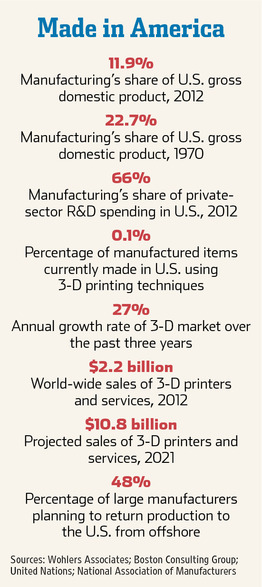
People have traditionally made things—from doorknobs to scalpels to engine cylinders—in one of two ways. They start with a solid block or sheet of metal, wood or other material and cut, stamp, drill or shave it to create a desired shape. Or they use a mold made of metal or sand, pour liquefied plastic or metal into it and let it cool to create a metal casting or molded plastic part. Now for something completely different. Three-dimensional printing and other forms of what is known as additive manufacturing use neither machining nor molds. They build an object from the bottom up by piling razor-thin layers of material on top of each other until a three-dimensional shape emerges. The computer-guided technologies enables individuals to create objects, particularly prototypes, without a shop full of metal presses, cutting lathes or plastic injection molds. There are a variety of processes for 3-D printing. Some of the most widely used rely on a printer that makes objects from powdered material. A 3-D printer bears little resemblance to a document printer in an office. It has two major parts: a “build box” that contains a smooth, thin bed of finely ground material such as pulverized stainless steel or powdered plastic; and a printing head. Depending on the type of printer, the head contains either a heat source, such as a laser or an electron beam, that melts the powdered material or jets that spray binder over the powder in a precise pattern. The binder functions as a glue for the material as an object is built. The world-wide market for 3-D printing, which includes materials, machines and service, totaled $2.2 billion last year, up 29% from 2011, according to industry estimates. But the process has some limitations. For high-volume jobs, 3-D printing can’t yet match the speed and efficiency of traditional fabrication methods and machinery. Not all materials are suitable for powder-based additive manufacturing, and not all objects, particularly those made of metal, are able to stand up to high-stress use. For manufacturers of 3-D equipment, the future of their nascent industry depends on broadening the appeal of their equipment by expanding its uses and versatility.

IV-AA436_3DPRIN_G_20130607153616