Why China lacks the romantic advantage; In the race to be the world’s dominant economy, Americans have at least one clear advantage over the Chinese. We are much better at branding; 94 per cent of Americans cannot name even a single brand from the world’s second-largest economy

Why China lacks the romantic advantage

In the race to be the world’s dominant economy, Americans have at least one clear advantage over the Chinese. We are much better at branding.

6 HOURS 20 MIN AGO

In the race to be the world’s dominant economy, Americans have at least one clear advantage over the Chinese. We are much better at branding. United States companies have these eccentric failed novelists and personally difficult visionary founders who are fantastic at creating brands that consumers around the world flock to and will pay extra for. Chinese companies are terrible at this. Every few years, Chinese officials say they are going to start an initiative to create compelling brands, and the results are always disappointing. According to a recent survey by HD Trade services, 94 per cent of Americans cannot name even a single brand from the world’s second-largest economy. Whatever else they excel at, the Chinese have not been able to produce a style of capitalism that is culturally important, globally attractive and spiritually magnetic. Read more of this post
China’s sense of superiority and injustice is a potent mix

China’s sense of superiority and injustice is a potent mix

David Pilling – FT4 hours ago

On December 16 1773, a group of American patriots boarded three British vessels and destroyed the tea they were carrying by chucking hundreds of chests into Boston harbour. The rebellion that came to be known as the Boston Tea Party was a milestone in the American Revolution, which triumphed a few years later when the US threw off its colonial yoke.

The Canton opium party (never so named) of 1839 ended rather less triumphantly. Lin Zexu, an imperial commissioner, had written to Queen Victoria asking her why the British were so bent on selling “poison” to the Chinese. When he received no reply, he ordered 20,000 crates of opium to be set alight and sluiced into the sea. Britain reacted furiously, sending in warships, and China was forced to sign the ignominious Treaty of Nanking, in which it indemnified London, opened up five “treaty ports” and ceded Hong Kong island. Lin was sent into exile.

While America’s act of defiance gave birth to a great nation – and two centuries of optimism – China’s rebellion ushered in a period of imperial collapse, Japanese invasion and extended impoverishment. Read more of this post

Consumers don’t care about most brands; Brand owners have never been less sure of ad spending returns; P&G and Mondelez recently squeeze ad agencies by delaying payments for 75 days and 120 days respectively

June 5, 2013 4:18 pm

Inside Business: Consumers don’t care about most brands

By Andrew Edgecliffe-Johnson

Brand owners have never been less sure of ad spending returns

Marketing can sound woefully fluffy. The language of “emotional engagement”, “consumer passion-points” and “key influencers” the industry has become so fond of is a tough sell to senior executives under pressure to deliver hard returns from their investment in advertising.

Little wonder that executives at Procter & Gamble and Mondelez International have felt able to recently squeeze ad agencies by delaying payments for 75 days and 120 days respectively. Read more of this post

Foie Gras Now Served in Coach Class as Airlines Spice Up Profit

Foie Gras Now Served in Coach Class as Airlines Spice Up Profit

The days of bland economy-class food are numbered, with Europe’s full-service carriers dishing up gourmet menus reminiscent of the golden age of air travel as they look for ways to squeeze more revenue out of passengers.

Air France (AF) is tempting economy-class customers with paid-for meal upgrades featuring foie gras terrine, and Austrian Airlines has Wiener schnitzel and sushi among its 15-euro ($19.60) in-flight nourishments. They’re part of a growing trend of carriers charging for auxiliary services, including lounge access or individual aircraft seat choice. Read more of this post

Real-Linked Bond’s 13% Wipeout Hits Foreigners: Brazil Credit

Real-Linked Bond’s 13% Wipeout Hits Foreigners: Brazil Credit

Foreign investors are dumping Brazilian real-denominated bonds sold overseas after the currency posted the second-biggest plunge in emerging markets.

Yields on the country’s real-linked debt due in 2028 have jumped 1.12 percentage points in the past month, touching a record 8.73 percent on June 3. The bonds lost 13.4 percent in dollars in the period, the worst among local-currency government notes issued abroad after Peruvian debt. That exceeds the 12.3 percent loss in real-denominated bonds issued locally, which foreigners had shunned because of taxes. The government pared back those taxes late yesterday, eliminating a levy on foreign investment on fixed-income assets that was implemented to slow the real’s rally in 2009.

Investors are fleeing Brazil’s $6.4 billion market for overseas real bonds after the real sank 6.5 percent in May, the most among developing nations after South Africa’s rand and part of a global selloff sparked by concern the Federal Reserve could trim its bond buying. While central bank President Alexandre Tombini intervened for the first time in two months to shore up the real after it fell to a four-year low on May 31, he said this week the slide will have a limited effect on inflation, fueling speculation he’s comfortable with the currency’s level. Read more of this post

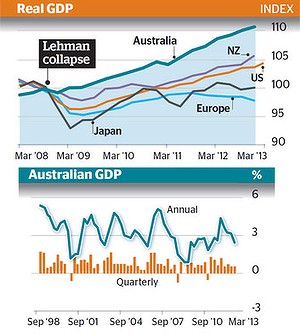
Western Australia, the engine room of Australia’s growth in recent years, is now in recession.

WA in recession as growth slows to a trickle

June 6, 2013 Glenda Kwek

GDPln-300x0

WA’s State Final Demand, an indicator of growth that excludes exports, fell a seasonally adjusted 3.9 per cent in the March quarter.

Western Australia, the engine room of Australia’s growth in recent years, is now in recession.

Growth in the mining state remained contracted for the second consecutive quarter as the national economy expanded 0.6 per cent in the first quarter of 2013, reflecting the peaking of resources investment, but a shortfall in the expansion of other sectors, analysts said. Read more of this post

Taurus Shuts Gold Fund on Redemptions After Price Tumbles; product once held as much as A$250 million ($240 million)

Taurus Shuts Gold Fund on Redemptions After Price Tumbles

Taurus Funds Management Pty Ltd. shut its precious metals fund because of investor redemptions after gold slumped, according to an executive, who said that the product once held as much as A$250 million ($240 million).

Assets in Taurus Precious Metals peaked last year before the closure in May, Gordon Galt, a principal at the Sydney-based fund manager, said in an interview today, declining to comment on the level last month. As of February, the fund had invested mostly in physical gold, according to a report to investors for that month, which was confirmed by Galt.

Taurus Funds’ decision reflects a shift by some investors away from bullion and into other assets as signs that the global economy was recovering drove gold into a bear market while equities rallied. Withdrawals from gold-backed exchange-traded products reached a record pace this year, and Nouriel Roubini has forecast that gold may fall toward $1,000 an ounce by 2015. Read more of this post

Man Group, the world’s second largest hedge fund, tumbled as much as 15 per cent in London after steep losses for the company’s flagship $16.4bn “black box” fund; Almost all of the losses are attributable to long positions in global bond markets

Last updated: June 5, 2013 3:06 pm

Man Group shares tumble after steep losses by flagship AHL fund

By Sam Jones, Hedge Fund Correspondent

Shares in Man Group, the world’s second largest hedge fund, tumbled as much as 15 per cent in London after steep losses for the company’s flagship fund.

Man’s $16.4bn “black box” fund AHL, which uses complex computer models to spot and ride trends in hundreds of markets around the world, lost more than 10 per cent of its value in May and is down more than 12 per cent from a peak earlier this year.

Almost all of the losses are attributable to long positions in global bond markets, which have been hit hard in the past two weeks on investors’ anticipation of an end to the US Federal Reserve’s quantitative easing measures. Read more of this post

Some of the world’s biggest quant hedge funds have suffered steep losses in the past two weeks following the sell-off in global bond markets.

Last updated: June 5, 2013 3:10 pm

Quant hedge funds hit by US bonds sell-off

By Sam Jones

Some of the world’s biggest quant hedge funds have suffered steep losses in the past two weeks following the sell-off in globalbond markets.

So-called “CTAs”, which use computer models to automatically spot and ride market trends, were caught out as investors anticipated an end to the Federal Reserve’s measures to stimulate the US economy, triggering a global rout in fixed income investments.

Bond yields have risen sharply from some of their lowest levels in decades in the past fortnight, leaving funds with large holdings badly hit. Many quant funds have been major buyers of bonds over the past few years as their algorithms have followed yields lower. Read more of this post

US dividend play at risk of overrunning

June 5, 2013 9:30 am

US dividend play at risk of overrunning

By Michael Mackenzie in New York

Some investment trends are like a long-running Broadway or West End show. No matter how stale the storyline, an infusion of new cast members can attract renewed interest from audiences.

When it comes to buying stocks, owning high dividend paying companies has been the trend to follow for some years. But, with the US equity bull market in its fifth year and the S&P 500 occupying record territory, the preference for owning stocks that pay hefty dividends is under assault.

High yielding stocks in the utilities and telecoms sectors have fallen sharply over the past month, thanks to the sharp jump in bond yields that has reduced the attractiveness of such companies. The pressure on these traditional high dividend paying sectors is the first sign that their high valuations have finally became too lofty for investors seeking income. Read more of this post

Fed ‘tapering’ fears push up US mortgage rates

Last updated: June 4, 2013 11:59 pm

Fed ‘tapering’ fears push up US mortgage rates

By Stephen Foley and Michael Mackenzie in New York

The average rate on a US mortgage has soared above 4 per cent for the first time in more than a year, reflecting recent turmoil in the bond market and threatening to undermine the Federal Reserve’s efforts to stoke the US recovery.

The rise has outstripped even the sharp jump in rates on US Treasury debt, whichtook many traders by surprise in May.

Economists said the upswing in homeowner borrowing costs is one of the first significant impacts of concern in the financial markets that the Fed will taper its purchases of Treasuries and mortgage-backed securities, measures which have been holding mortgage rates at historic lows. Read more of this post

What Enron and the IRS Have in Common; Ethical meltdowns are rarely the work of a few rogue workers. They take their cues from toxic leadership

June 5, 2013, 7:10 p.m. ET

What Enron and the IRS Have in Common

Ethical meltdowns are rarely the work of a few rogue workers. They take their cues from toxic leadership.

By STEVEN LAW

Any good CEO will tell you that ethical meltdowns like the IRS political-targeting scandal are rarely the work of a few rogue employees. Such messes are the result of a toxic culture that has been allowed to fester.

When I was chief of staff at the Labor Department, we investigated the ethical and financial disintegration of Enron in connection with the collapse of its pension funds in 2001. What we found was a small circle of certifiably bad actors who acted without regard for the law or for anyone else. Surrounding this inner circle was a culture that gave these employees tacit permission to run roughshod over others and break the law. Read more of this post

Stock Jitters Spread to REIT IPOs as Colony American Deal Delayed

Jun 5, 2013

Stock Jitters Spread to REIT IPOs as Colony American Deal Delayed

By Matthew Jarzemsky

The jitters hitting the stock market in recent weeks are spreading to what had been a red hot market for high-yielding initial public offerings.

Late Tuesday evening, executives at Colony American Homes Inc. and its bankers decided to delay the real-estate investment trust’s IPO, which had been expected to raise some $245 million. The last minute decision to put off the IPO was due to adverse market conditions, according to a person familiar with the deal. Read more of this post

‘Dark Pools’ Face Scrutiny; Regulators Ask for Details on Stock Trading in Murkiest Parts of the Market

June 5, 2013, 9:55 p.m. ET

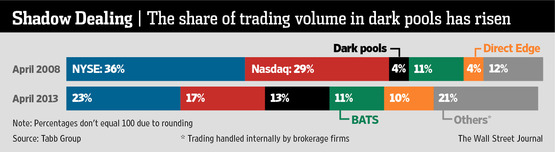
‘Dark Pools’ Face Scrutiny

Regulators Ask for Details on Stock Trading in Murkiest Parts of the Market

By SCOTT PATTERSON

MI-BW409_DARKPO_G_20130605182106

WASHINGTON—Regulators are ramping up scrutiny of an opaque corner of the market where stocks change hands in the dark.

The Financial Industry Regulatory Authority, Wall Street’s self-regulatory body, last month sent 15 examination letters to operators of “dark pools”—lightly regulated, off-exchange trading venues that have been a rising concern for regulators and some investors as more activity shifts away from exchanges.

Finra is seeking details about how the increasingly popular venues operate, what they disclose to clients and whether they adequately police trades. It could bring enforcement action against dark-pool operators or issue recommendations for tighter oversight, depending on the answers it receives and additional examinations, said John Malitzis, executive vice president of market regulation at Finra. The letters are a follow-up to an initial round of questions the regulator circulated last fall. Read more of this post

The Richest Families In The World Are Staging A Quiet Rebellion Against Hedge Funds

The Richest Families In The World Are Staging A Quiet Rebellion Against Hedge Funds

Linette Lopez | Jun. 5, 2013, 10:54 AM | 9,873 | 13

It’s no secret that since 2008, most hedge funds have lagged the S&P 500. Because of that, now the world’s richest families are starting to wonder if hedge funds are really worth their incredibly expensive price tag.

And they’re starting to ask hedge fund managers some tough questions about it.

Yesterday, Bloomberg hosted a conference called “The Hedge Funds Summit” for (you guessed it) hedge funds and the people that invest in them. Many of the attendees were from Family Offices — investment houses where the fortunes of the world’s wealthy are put to work. Read more of this post

Should We Trust Economists? They’re fractious, frequently wrong, and have lost much of the public’s faith. But their insights are still valuable — as long as you don’t expect them to predict the future

Should We Trust Economists?

They’re fractious, frequently wrong, and have lost much of the public’s faith. But their insights are still valuable — as long as you don’t expect them to predict the future.

NOAH SMITHJUN 4 2013, 9:59 AM ET

Imagine you are the Royal Physician in England some time during the 14th century. The prince is sick, and you’ve been summoned to help. You call in two experts for advice. The first says: “Use leeches to suck out the evil humors.” The second says “No, you must bleed him to get the evil humors out.” They start to argue, insulting each other in nasty epistles. “Leech guy is secretly working for the French!” alleges Bleeding Guy. “Bleeding Guy just wants the prince to die because the prince wanted higher taxes on the nobles!” Leech Guy fires back. Read more of this post

What to Do When the Invisible Hand Stops Working

What to Do When the Invisible Hand Stops Working

Economists rave about the power of the market to deploy productive resources better than any central planner possibly could. A mysterious process, which Adam Smith called the “invisible hand,” guides countless individuals with conflicting aims to somehow coordinate into a remarkably effective economic organization. Usually.

But as the British economist John Maynard Keynes famously argued, markets can also fall into dysfunction. A crisis can set off a downward spiral: Spending declines, companies fail, people lose jobs, spending declines further. Much of the wonderful coordination disappears, as if the invisible hand were injured.

None of this is controversial. But if you ask how best to cure an afflicted economy, you get vicious and sometimes hysterical argument, typically polarized along political lines. Should markets be left alone, because the invisible hand is self-healing and intervention can only make matters worse? Or does an economy, like a real living thing, sometimes need direct medical (or governmental) intervention? Read more of this post

Alcoa Junk Downgrade Is Rare Trauma for Dow Stocks; Alcoa is the second junk-rated Dow Jones Industrial Average company in at least three decades. It took four years for the first to be ejected

Alcoa Junk Downgrade Is Rare Trauma for Dow Stocks: Commodities

Alcoa Inc. (AA)’s speculative-grade credit ranking at Moody’s Investors Service makes it only the second junk-rated Dow Jones Industrial Average company in at least three decades. It took four years for the first to be ejected. The New York-based aluminum producer was lowered last week by Moody’s, following General Motors Corp. as the only Dow member below investment grade since at least 1980, according to Howard Silverblatt, an analyst at S&P Dow Jones Indices. While the guidelines don’t mention debt ratings, Dow companies become vulnerable when their finances deteriorate, says Richard Moroney, editor of Dow Theory Forecasts newsletter.

Alcoa shares have declined 67 percent in the past decade through yesterday, leaving the company with the lowest share price and market value in the Dow, as surging aluminum production in China led to a supply glut. While S&P Dow Jones says inclusion in the average is not governed by quantitative rules, the index provider prefers “sustained growth.” Alcoa’s revenue has declined for four straight quarters and 2012 net income was less than a tenth what it was five years earlier. Read more of this post

A growing number of institutional investors are turning away from external asset managers and other intermediaries and are instead looking to one another for assistance. Through collaboration, these investors hope to lever a new set of network economics

Platforms and Vehicles for Institutional Co-Investing

Jagdeep Singh Bachher Alberta Investment Management Corp.

Ashby H. B. Monk Stanford University – Global Projects Center

May 28, 2013
Rotman International Journal of Pension Management, Vol. 6, No. 1, 2013

Abstract: 
A growing number of institutional investors are turning away from external asset managers and other intermediaries and are instead looking to one another for assistance. Through collaboration, these investors hope to lever a new set of network economies. Can they actually co-invest successfully to take advantage of these network effects? Differing return objectives and investment philosophies, as well as the basic challenge of geography, all complicate matters. Through a specific case study of a successful co-investment platform, and drawing on additional information collected from more than 20 on-site case studies of public pension funds and sovereign wealth funds around the world, this article offers insights into how institutional investors can structure platforms and vehicles that will align interests and facilitate co-investment.

Benjamin Graham’s Net Nets: Seventy-Five Years Old and Outperforming

Benjamin Graham’s “Foolproof Method of Systematic Investment”

January 15, 2013 by Tobias Carlisle

Last week I wrote about the performance of one of Benjamin Graham’s simple quantitative strategies over the 37 years he since he described it (Examining Benjamin Graham’s Record: Skill Or Luck?). In the original article Graham proposed two broad approaches, the second of which we examine in Quantitative Value: A Practitioner’s Guide to Automating Intelligent Investment and Eliminating Behavioral Errors. The first approach Graham detailed in the original 1934 edition of Security Analysis (my favorite edition)—“net current asset value”: My first, more limited, technique confines itself to the purchase of common stocks at less than their working-capital value, or net-current asset value, giving no weight to the plant and other fixed assets, and deducting all liabilities in full from the current assets. We used this approach extensively in managing investment funds, and over a 30-odd year period we must have earned an average of some 20 per cent per year from this source. For a while, however, after the mid-1950’s, this brand of buying opportunity became very scarce because of the pervasive bull market. But it has returned in quantity since the 1973–74 decline. In January 1976 we counted over 300 such issues in the Standard & Poor’s Stock Guide—about 10 per cent of the total. I consider it a foolproof method of systematic investment—once again, not on the basis of individual results but in terms of the expectable group outcome. In 2010 I examined the performance of Graham’s net current asset value strategy with Sunil Mohanty and Jeffrey Oxman of the University of St. Thomas. While Graham found this strategy was “almost unfailingly dependable and satisfactory,” it was “severely limited in its application” because the stocks were too small and infrequently available. This is still the case today. There are several other problems with both of Graham’s strategies. In Quantitative Value: A Practitioner’s Guide to Automating Intelligent Investment and Eliminating Behavioral Errors Wes and I discuss in detail industry and academic research into a variety of improved fundamental value investing methods, and simple quantitative value investment strategies. Weindependently backtest each method, and strategy, and combine the best into a sample quantitative value investment model.

Independent Directors in Companies in the Backdrop of Corporate Failures

Independent Directors in Companies in the Backdrop of Corporate Failures

Bindu Samuel Ronald Symbiosis Law School, Pune

May 18, 2013

Abstract:      
The article considers the role of independent directors in the governance of companies. It puts forth the role of independent directors in the good governance of companies and looks at the issues that question the independence of the independent directors.

The Way to Produce a Person; You would be more likely to cultivate a deep soul if you put yourself in the middle of the things that engaged you most seriously

June 3, 2013

The Way to Produce a Person

By DAVID BROOKS

Dylan Matthews had a fascinating piece about a young man named Jason Trigg in The Washington Post on Sunday. Trigg is a 25-year-old computer science graduate of the Massachusetts Institute of Technology who has hit upon what he thinks is the way he can do maximum good for the world. He goes to work each day at a high-frequency trading hedge fund. But, instead of spending his ample salary, he lives the life of a graduate student and gives a large chunk of his money away. Read more of this post

Amazing scenery of China’s Huangshan Mountain, UNESCO cultural and natural heritage

Amazing scenery of Huangshan Mountain

China.org.cn)  14:32, June 03, 2013

Huangshan Mountain, listed as a UNESCO cultural and natural heritage and World Geopark, boasts of spectacular landscapes thick with vegetation and lofty peaks. The 154-square-kilometer sight-seeing area possesses four unique scenes: peculiarly shaped granite rocks, waterfalls, pine trees and views of the clouds from above. The Flying over Rock, the Stone Monkey Gazing over the Sea of Clouds, the Brush pen-liked Rock and many other renowned scenic spots attract streams of visitors to the marvelous mountain every day. (China.org.cn)

F201306031451352499622354F201306031451336304180672F201306031451303144631598F201306031451272810615987F201306031451021773320622

How to attract long-term investors: An interview with M&G’s Aled Smith

How to attract long-term investors: An interview with M&G’s Aled Smith

The award-winning fund manager discusses what he looks for in a company when he’s making investment decisions.

June 2013 | byMarc Goedhart and Tim Koller

Executives overburdened by the demands of their companies’ short-term investors may yearn for a more supportive crowd that might be less skittish about volatility. Such investors would base their decisions on a deeper understanding of a company’s strategy, performance, and potential to create long-term value—and would not pressure a company for short-term gains at the expense of greater long-term growth.1 Attracting such investors can prove something of a challenge. Certainly, executives are often highly coached when they talk about their strategy and objectives, and have extensive information about potential investors and their style and approach to investing. Too often, though, those messaging cues come from sell-side analysts, who may have a shorter-term agenda. So says Aled Smith, who manages the Global Leaders Fund and the American Fund at M&G Investments, based in London.2 Smith recently joined Marc Goedhart and Tim Koller in McKinsey’s London office for this wide-ranging interview on what he looks for in potential investments for his portfolios. Read more of this post

Loews’ James Tisch Says Hedge Funds Envy Him Amid Withdrawal Concerns; Tisch, 60, and his family have built Loews into a $17.7 billion business

Tisch Says Hedge Funds Envy Him Amid Withdrawal Concerns

James Tisch, who invests in hedge funds to boost returns at Loews Corp. (L), said he avoids managers with the largest pools of money and sleeps better at night knowing he doesn’t face the same prospect of client withdrawals.

“We are very wary of managers that have $10 billion, $15 billion, $20 billion, because you have to wonder, how can they generate outsize returns with so much money,” Tisch, Loews’s chief executive officer, said today at the Bloomberg Hedge Funds Summit in New York. “We are constantly looking and probing and trying to find the new guys on the street, the people that aren’t loaded to the gills.”

Tisch, 60, and his family have built Loews into a $17.7 billion business by investing in hotels, energy companies and insurer CNA Financial Corp. (CNA) Most of Loews’s investment portfolio is held by CNA, which gets to oversee money for years in some cases before paying claims and can raise cash by selling more policies. Managers of the largest funds are “really insecure,” because clients can demand their money back, he said. “They’re phenomenally jealous of me, believe it or not,” Tisch told Bloomberg Television’s Stephanie Ruhle at the event. “They say to me, Jim, you’ve got permanent capital. Your money can’t leave. But all these other guys if they have a bad quarter, a bad year, boom! Look at SAC Capital.” Read more of this post

Parents pray for students at Confucian temple before Gaokao, China’s SAT

Parents pray for students at Confucian temple before Gaokao

People’s Daily Online)  13:19, June 05, 2013

Every year before Gaokao, loads of students accompanied by their parents come and pray at Confucian temple.

F201306051317101237232119 (1)F201306051317103378120021

Chinese Officials stamps on man’s head and another reeked of alcohol while carrying out a campaign against street vendors and traders

Officials suspended for stamping on man’s head

2013-06-04 23:31:56 GMT2013-06-05 07:31:56(Beijing Time)  Shanghai Daily

Police in Yan’an City are investigating reports that an urban management official trampled on the head of a bicycle dealer and another reeked of alcohol while carrying out a campaign against illegal street vendors and traders. Officials at the scene and their supervisors, eight in total, have been suspended, according to the Yan’an urban management bureau. Last Friday, seven people got off a minivan which had “urban management law enforcement” painted on it, and carried away several bicycles lined up in front of a store in the city in northwestern Shaanxi Province. That led to a brawl during which the owner of the bicycle shop, a person surnamed Liu, was stamped on the head by an official, witnesses said. Video posted online showed a man in yellow, said to be Liu, and several uniformed men locked in a war of words as Liu held back the bicycles. The quarrel escalated into a free-for-all. Two officials kicked and beat Liu who fell to the ground. One official can be seen jumping on his head and shoulder. At the end of the clip Liu walks away, bleeding profusely. A police car can also be seen passing by in the video without stopping. The local district police refused to give any details as a probe was underway. The bicycle store owner was twice warned by law enforcement officials not to put the bicycles outside the store. Officials again found the bicycles parked outside last Friday, said Duan Yuting, deputy head of the local urban management supervising detachment. Officials seized the bicycles, said Duan. He had no comment over the “stamping” issue.

U158P5029T2D596342F26DT20130605073156U158P5029T2D596342F28DT20130605073156

Panera Bread chief Ron Shaich on staying recharged and why the company opened pay-what-you-can cafes

June 4, 2013, 8:02 p.m. ET

A New Test for Panera’s Pay-What-You-Can

By ANNIE GASPARRO

MK-CD738_Panera_G_20130604225543

Panera Bread Co. chief Ron Shaich on staying recharged and why the company opened pay-what-you-can cafes.

The fast-casual dining segment is getting crowded. While chains like Panera BreadCo. PNRA -0.64% and Chipotle Mexican Grill Inc. CMG -0.12% continue to log rapid expansion, even fast-food operators like Wendy’s are going upscale, adding items like flatbread sandwiches and remodeling their interiors.

Bakery-cafe chain Panera Bread, based in a St. Louis suburb, rang up a 28% increase in profit for fiscal 2012, outpacing the sector as a whole, but the company’s customer-traffic growth slowed in the first quarter. Read more of this post

Starbucks regularly launches products before they’re perfect. Why does such a risky approach to innovation work so well?

RISKY INNOVATION: WILL STARBUCK’S LEAP OF FAITH PAY OFF?

THE WORLD’S LARGEST COFFEEHOUSE CHAIN REGULARLY LAUNCHES PRODUCTS BEFORE THEY’RE PERFECT. WHY DOES SUCH A RISKY APPROACH TO INNOVATION WORK SO WELL?

BY: AUSTIN CARR

In late March, as Starbucks was preparing to introduce its first offer on Groupon, the daily-deal service, the coffee chain’s chief digital officer, Adam Brotman, realized he had no clue whether the gambit would pay off. The discount wasn’t for anything crazy like bungee jumps or skydiving lessons–it was for 50% off a $10 Starbucks Card eGift–but to Brotman, the deal was just as risky because of how the company would be offering it. His team had to integrate Starbucks’s eGift platform with Groupon’s system for the one-off promotion, and it was about to go live to the world. “They’d never done deals at the scale we were offering, and we had never put our [eGift] platform through that type of pressure test,” Brotman says. “But we didn’t have the luxury to say anything other than, ‘We think we got this right, so let’s see what happens.’ There are times when we just completely don’t know how things are going to work.” Read more of this post

Strategies for playing at war: World of Tanks revenues have soared from €18m in 2011 to €218m last year

June 4, 2013 4:42 pm

Strategies for playing at war

By Jan Cienski

World-of-Tanks-11

Tanks for the memories: Victor Kislyi turned to the history on his Minsk doorstep for inspiration

To the dismay of wives and mothers the world over, huge numbers of men and boys adore powerful vehicles and big guns. If you put the two together, you have tanks. This insight has help­ed Victor Kislyi build one of the world’s fastest-growing computer game developers.

Mr Kislyi’s Belarus-based Wargaming.net is the creator of World of Tanks , the online game in which players get to drive a second world war-era tank and engage in team battles on an accurately depicted terrain or in city streets, using detailed and realistic maps. Read more of this post